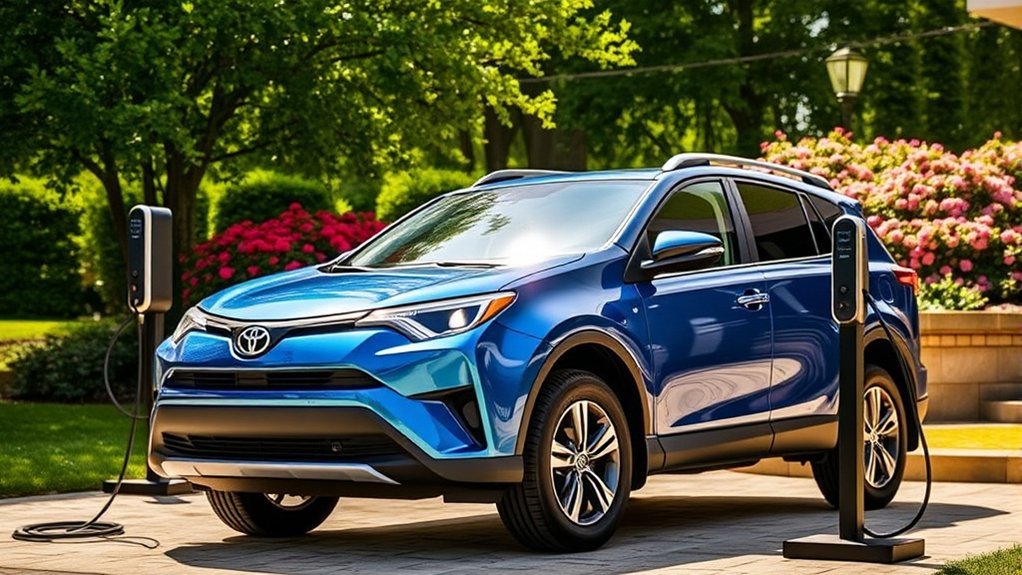
The names sound similar, but the charging routine is completely different. A standard Toyota RAV4 Hybrid manages its battery while you drive, while the RAV4 Plug-in Hybrid gives you the option to recharge from an outlet. The details below use current U.S. 2026 specifications, so older model years may differ.
Quick Answer
You do not plug in a standard Toyota RAV4 Hybrid. It has no external charging port, and its gasoline engine plus regenerative braking keep the traction battery charged. You can plug in the RAV4 Plug-in Hybrid for longer electric driving, but the plug-in model can still continue in hybrid mode when its usable EV charge is depleted.
Key Takeaways
- A standard RAV4 Hybrid cannot be connected to an external charger because it has no charging inlet.
- The RAV4 Plug-in Hybrid can be charged at home or at compatible public stations to maximize electric-only driving.
- For 2026, Toyota lists up to 54 miles of EPA-estimated electric range on the Plug-in Hybrid SE and 324 net combined horsepower.
- The better choice depends on your daily mileage, charging access, local energy costs, trim, and towing needs.
Note: RAV4 specifications changed substantially for the 2026 model year. Figures for 2025 and earlier vehicles, including 219 or 302 horsepower and a 42-mile plug-in range, should not be presented as current 2026 specifications.
What Is a Hybrid and Plug-In Hybrid?
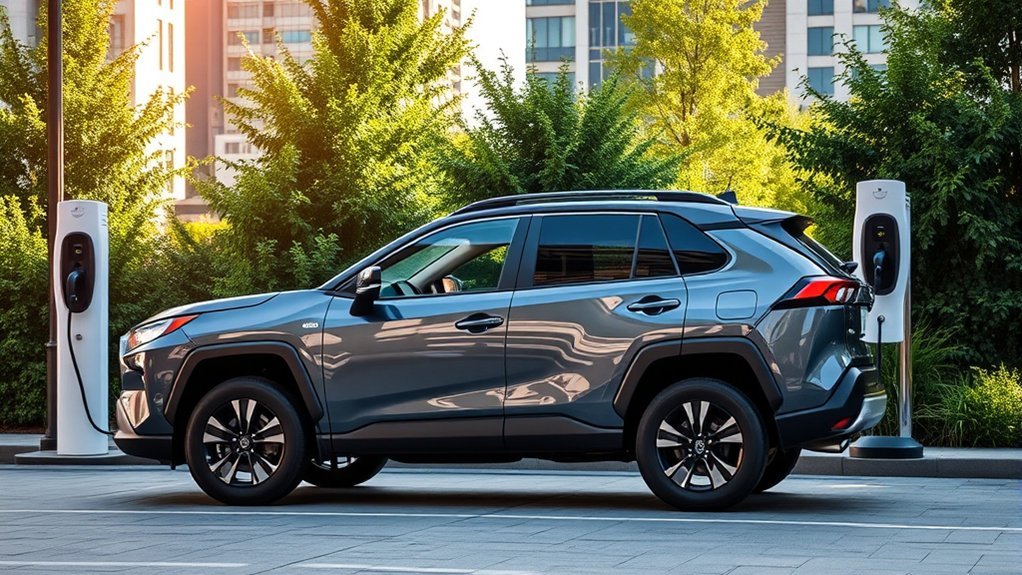
A hybrid electric vehicle, or HEV, combines a gasoline engine with one or more electric motors. The standard RAV4 Hybrid automatically decides when to use the engine, electric power, or both. Regenerative braking captures some energy during slowing and stores it in the traction battery.
A plug-in hybrid electric vehicle, or PHEV, uses the same basic idea but adds a larger battery and a charging inlet. You can recharge it from compatible Level 1, Level 2, or supported public charging equipment, depending on the trim. That larger battery allows much longer electric-focused driving before the vehicle relies more heavily on its gasoline engine.
The key distinction is simple: the standard RAV4 Hybrid is self-charging during normal operation, while the RAV4 Plug-in Hybrid adds external charging. A depleted plug-in battery does not leave you stranded. The vehicle can continue operating as a gasoline-electric hybrid as long as it has fuel.
A regular RAV4 Hybrid never needs an outlet. A RAV4 Plug-in Hybrid does not require a charge to keep driving, but regular charging is what unlocks its main efficiency benefit.
Key Features of the RAV4 Hybrid Model
The 2026 RAV4 starts a new generation and uses a 2.5-liter four-cylinder hybrid system across the lineup. Current U.S. specifications vary by drivetrain and grade, so one set of numbers does not describe every model.
- Power: 226 net combined horsepower with front-wheel drive or 236 net combined horsepower with all-wheel drive.
- Fuel economy: Up to an EPA-estimated 47 MPG city and 40 MPG highway on eligible configurations.
- Cargo space: Toyota lists up to 37.8 cubic feet behind the rear seats.
- Towing: Ratings range from 1,750 pounds to 3,500 pounds, depending on drivetrain and grade.
- Safety technology: The 2026 lineup includes Toyota Safety Sense 4.0, although individual driver-assistance features and subscriptions can vary by trim.
These features make the standard Hybrid attractive when you want strong fuel economy without changing how you refuel. You simply add gasoline and drive; the hybrid system handles the traction battery automatically.
Should You Plug In Your RAV4 Hybrid?
No. You cannot plug in a standard Toyota RAV4 Hybrid because it does not have an external charging inlet. Do not try to connect an adapter or improvised cable. The vehicle recharges its traction battery through regenerative braking and energy produced by the gasoline-electric system.
If your RAV4 has a factory charging door and charging inlet, you own a RAV4 Plug-in Hybrid rather than the standard Hybrid. That model is designed for external charging.
Plug-In Benefits Overview
The 2026 RAV4 Plug-in Hybrid offers several advantages when you charge it regularly:
- Longer electric driving: Toyota lists an EPA-estimated electric range of up to 54 miles on the 2026 SE.
- More power: The current plug-in system produces 324 net combined horsepower and Toyota lists a 5.4-second 0-to-60-mph time.
- Lower gasoline use on short trips: A commute that fits within the available EV range may use little or no gasoline under suitable conditions.
- Gasoline backup: Longer trips do not depend on finding a charger because the vehicle can continue in hybrid mode.
Charging Frequency Considerations
A standard RAV4 Hybrid has no charging schedule. For the Plug-in Hybrid, charging after daily use usually provides the greatest electric-driving benefit, but you do not have to charge after every trip.
Charging hardware varies across the 2026 Plug-in Hybrid lineup. Toyota’s launch information states that SE and GR SPORT use a 7-kW onboard charger with a J1772 inlet for Level 1 and Level 2 charging. XSE and Woodland use an 11-kW onboard charger with a CCS1 inlet and support DC fast charging. Toyota estimated roughly four hours from 10% to 80% on Level 2 for SE and GR SPORT, and about 30 minutes from 10% to 80% with compatible DC fast charging for XSE and Woodland under ideal conditions.
Actual charging time changes with battery temperature, starting charge, charger output, weather, and power sharing at the station. Level 1 charging from a household outlet is slower but may still work for overnight replenishment when daily mileage is modest.
What Happens If You Do Not Charge the RAV4 Plug-In Hybrid?
The vehicle still runs. After the usable external charge is depleted, the system operates more like a conventional hybrid by blending the gasoline engine with electric assistance and regenerative braking. You lose much of the plug-in model’s electric-range advantage, but you do not lose normal transportation.
That distinction matters when comparing value. Buying a Plug-in Hybrid without reliable charging access may leave you paying for a larger battery and more complex charging hardware that you seldom use.
Warning: Charge only with compatible equipment and a suitable outlet or charging station. Do not use damaged cables, connectors, or inlets, and stop charging if you notice unusual heat, smoke, noise, or odor. Follow the charging instructions and safety limits in the owner’s manual for your exact model and trim.
Key Advantages of Owning a Toyota RAV4 Plug-In Hybrid
The Plug-in Hybrid makes the most sense when you can charge regularly and value electric commuting, stronger acceleration, or its available towing capability. Its benefits are real, but they depend more on your routine than the standard Hybrid’s benefits do.
Enhanced Power and Performance
The 2026 RAV4 Plug-in Hybrid produces 324 net combined horsepower, compared with 226 horsepower for the Hybrid FWD and 236 horsepower for the Hybrid AWD. Toyota also lists a 5.4-second 0-to-60-mph time for the plug-in model.
All 2026 Plug-in Hybrid grades use all-wheel drive. The electric motors can provide quick response from a stop, while the gasoline engine supports sustained power and long-distance travel.
Increased Electric Driving Range
The 2026 Plug-in Hybrid SE carries an EPA-estimated all-electric range rating of up to 54 miles. Other trims have different wheel, tire, equipment, and efficiency ratings, so use the window sticker for the exact vehicle you are considering.
Electric range is not guaranteed. Cold weather, high speeds, steep grades, hard acceleration, cabin heating or cooling, tire pressure, and battery condition can reduce the distance. The gasoline engine may also start during EV driving when the system needs more power, heat, or battery protection.
Towing Capacity Benefits and Limits
The 2026 RAV4 Plug-in Hybrid can tow up to 3,500 pounds on SE, XSE, and Woodland grades when properly equipped. That is higher than the 1,750-pound rating on some Hybrid configurations, but select 2026 Hybrid AWD grades can also reach 3,500 pounds.
Towing capacity is not the only limit. Passenger weight, cargo, tongue weight, hitch equipment, trailer brakes, tires, and local regulations all affect what you can tow safely. Always use the rating for the exact vehicle shown on its certification labels and in its owner’s manual.
Fuel Economy: RAV4 Hybrid vs. Plug-In Hybrid

The standard Hybrid and Plug-in Hybrid use different efficiency measurements. A standard Hybrid is primarily compared by MPG. A PHEV receives an MPG rating for gasoline operation and an MPGe rating that expresses electricity use in gasoline-energy-equivalent terms.
| 2026 Comparison | RAV4 Hybrid | RAV4 Plug-in Hybrid |
|---|---|---|
| External charging | No charging inlet | Level 1 and Level 2; DC fast charging on XSE and Woodland |
| Net combined horsepower | 226 FWD or 236 AWD | 324 |
| Efficiency highlight | Up to 47 city/40 highway MPG | SE: 40 MPG and 101 MPGe combined; other trims vary |
| EPA-estimated electric range | No separately rated long-distance EV range | Up to 54 miles on SE |
| Towing | 1,750 or up to 3,500 pounds by grade and drivetrain | Up to 3,500 pounds on SE, XSE, and Woodland |
MPGe is not gasoline MPG. It compares the energy used from electricity with the energy contained in a gallon of gasoline, so claims such as “468.3 MPG” should not be used as a normal fuel-economy figure.
Your real cost depends on both fuels. The Plug-in Hybrid can be cheaper to operate on short trips when electricity is affordable and you charge regularly. The standard Hybrid may be the more predictable choice when charging is unavailable or most of your driving is long-distance highway travel.
Towing Capacity: Which RAV4 Model Can Handle More?
For 2026, towing capacity is trim-specific rather than a simple Hybrid-versus-PHEV contest.
- RAV4 Hybrid: Front-wheel-drive models and the LE AWD are rated at 1,750 pounds. Select AWD grades, including XLE Premium, Woodland, SE, XSE, and Limited, can tow up to 3,500 pounds when properly equipped.
- RAV4 Plug-in Hybrid: Toyota lists up to 3,500 pounds for SE, XSE, and Woodland.
- Before towing: Confirm the exact rating, hitch requirements, tongue-weight limit, payload, trailer-brake rules, and break-in guidance in the manual.
Warning: Never select a trailer by the headline towing number alone. Occupants, cargo, accessories, and tongue weight can reduce the remaining payload and may make a lighter trailer necessary.
Is the RAV4 Plug-In Hybrid Worth the Cost?
The Plug-in Hybrid can justify its higher purchase cost when you use its battery often. It is less compelling when you cannot charge or when nearly every trip exceeds its electric range.
Ask these questions before choosing:
- Can you charge at home or work? Reliable charging matters more than occasional access to a public station.
- How far do you drive each day? A daily route within the available EV range gives the battery more opportunity to replace gasoline.
- What do electricity and gasoline cost locally? Compare energy cost per 100 miles rather than relying only on MPG or MPGe.
- Do you value the extra performance? The 324-horsepower plug-in system is a meaningful upgrade even when fuel savings are not the only goal.
- Which towing rating do you need? Both powertrains now offer 3,500-pound ratings on select 2026 configurations.
- How long will you keep the vehicle? A longer ownership period gives operating savings more time to offset the initial difference.
Pro Tip: Use the exact window-sticker electricity consumption and gasoline consumption. Multiply kilowatt-hours per 100 miles by your electricity rate, then compare that result with gallons per 100 miles multiplied by your gasoline price.
If you want the simplest ownership experience, the standard Hybrid is usually easier to justify. If you can charge most days and your routine fits the electric range, the Plug-in Hybrid can sharply reduce gasoline use while adding stronger performance.
How Do Owners Experience the RAV4 Hybrid and Plug-In Hybrid?
The ownership experience differs mainly in routine and variability rather than basic drivability.
- Standard Hybrid: You refuel with gasoline and drive normally. The vehicle handles battery charging automatically, so efficiency does not depend on remembering to plug in.
- Plug-in Hybrid: You get the greatest benefit by connecting it regularly. When the usable EV charge runs down, it continues as a hybrid instead of stopping.
- Range changes: Weather, speed, hills, climate control, tire pressure, and driving style can move real electric range above or below the estimate.
- Engine operation: The gasoline engine may start even with battery charge remaining when the system needs heat, stronger acceleration, or battery protection.
- Charging speed: Station output, temperature, and the vehicle’s onboard charger determine actual charging time.
Avoid treating isolated owner-reported MPG numbers as directly comparable. A PHEV driver who charges daily and records gasoline only can produce an unusually high personal MPG figure, but that number leaves out electricity use. For a fair comparison, track both gasoline and kilowatt-hours.
Frequently Asked Questions
Can you drive a RAV4 Hybrid without ever charging it?
Yes. The standard RAV4 Hybrid is designed to operate without external charging. Its engine, electric motors, and regenerative braking manage the traction battery while you drive.
Can you plug a standard RAV4 Hybrid into an outlet?
No. It has no external charging inlet. Only the RAV4 Plug-in Hybrid is designed to connect to charging equipment.
What happens if you never charge the RAV4 Plug-In Hybrid?
It can continue operating as a gasoline-electric hybrid after its usable EV charge is depleted. However, you will miss much of the fuel-saving benefit that comes from regular external charging.
Do you need to charge the RAV4 Plug-In Hybrid every day?
No, but charging after regular use helps maximize electric driving. The best frequency depends on your daily mileage, available charging time, and energy costs.
How long does the RAV4 hybrid battery last?
Toyota does not give one fixed replacement age because battery life depends on use, climate, condition, and other factors. For U.S. Toyota hybrid and plug-in hybrid vehicles from model year 2020 onward, the hybrid battery limited warranty is 10 years or 150,000 miles, whichever comes first. A warranty period is not a guaranteed service-life limit.
Is maintenance different for the RAV4 Hybrid and Plug-In Hybrid?
Both have gasoline engines and require routine items such as oil, filters, fluids, tires, and inspections. The Plug-in Hybrid also has charging equipment and model-specific checks. Follow the maintenance guide for the exact model year instead of assuming one version always costs more or needs more service.
What type of fuel does the RAV4 Hybrid use?
U.S. RAV4 Hybrid models use unleaded gasoline. Check the fuel-door label and owner’s manual for the required octane and fuel standards for your exact model year and market.
Can the standard RAV4 Hybrid run on electric power only?
It can move on electric power for short periods under suitable speed, battery, temperature, and power-demand conditions. It does not have the separately rated long electric range of the Plug-in Hybrid.
Conclusion
You do not need to plug in a standard Toyota RAV4 Hybrid, and you cannot connect it to an external charger. It manages the traction battery automatically while you drive. The RAV4 Plug-in Hybrid adds external charging for longer electric driving, yet it can still continue in hybrid mode when the usable EV charge runs down.
Choose the standard Hybrid for simplicity and consistent efficiency without a charging routine. Choose the Plug-in Hybrid when you can charge regularly, your daily trips fit its electric range, and you value its extra power or trim-specific towing capability.
Sources
- Toyota: 2026 RAV4 — current Hybrid fuel-economy, cargo, towing, safety, and lineup information.
- Toyota: 2026 RAV4 Plug-in Hybrid — current horsepower, range, acceleration, efficiency, and towing information.
- Toyota USA Newsroom: 2026 RAV4 launch details — drivetrain, trim, charging-hardware, charging-time, and towing details.
- Toyota: Hybrid Battery Warranty — hybrid battery warranty coverage.
- U.S. EPA: Electric and Plug-in Hybrid Vehicles — MPGe, PHEV operating modes, and range-variation guidance.
- Toyota Owners: Manuals and Warranties — model-specific charging, fuel, towing, maintenance, and safety instructions.
