
Toyota RAV4 Hybrid MPG depends on the model year, trim, drivetrain, weather, speed, and trip length. Most 2025 RAV4 Hybrid trims are EPA-rated at 41 city, 38 highway, and 39 combined MPG, while the 2025 Woodland is rated lower at 38 city, 35 highway, and 37 combined MPG. For 2026, the most efficient FWD configurations reach 47 city, 40 highway, and 43 combined MPG; AWD versions are rated lower.
Last updated: September 11, 2026
Quick Answer
Yes. The RAV4 Hybrid is a fuel-efficient compact SUV. Most 2025 hybrid trims are EPA-rated at 41 city, 38 highway, and 39 combined MPG; the Woodland is 38/35/37. For 2026, the most efficient FWD configurations reach 47 city, 40 highway, and 43 combined MPG, while AWD versions range lower by configuration.
Key Takeaways
- The familiar 41/38/39 MPG rating applies to most 2025 RAV4 Hybrid trims; the 2025 Woodland is rated at 38/35/37 MPG.
- The 2026 U.S. RAV4 lineup is fully electrified, with hybrid and plug-in hybrid powertrains instead of a gas-only model.
- Cold weather, short trips, high speeds, roof cargo, tire pressure, and aggressive driving can reduce your actual MPG.
- Owner-submitted results can be useful, but a small sample or one exceptional tank should not be treated as a typical average.
- Calculate savings with your annual mileage, local fuel price, and the official rating for the exact trim you are comparing.
How Does RAV4 Hybrid MPG Compare With the 2025 Gas RAV4?
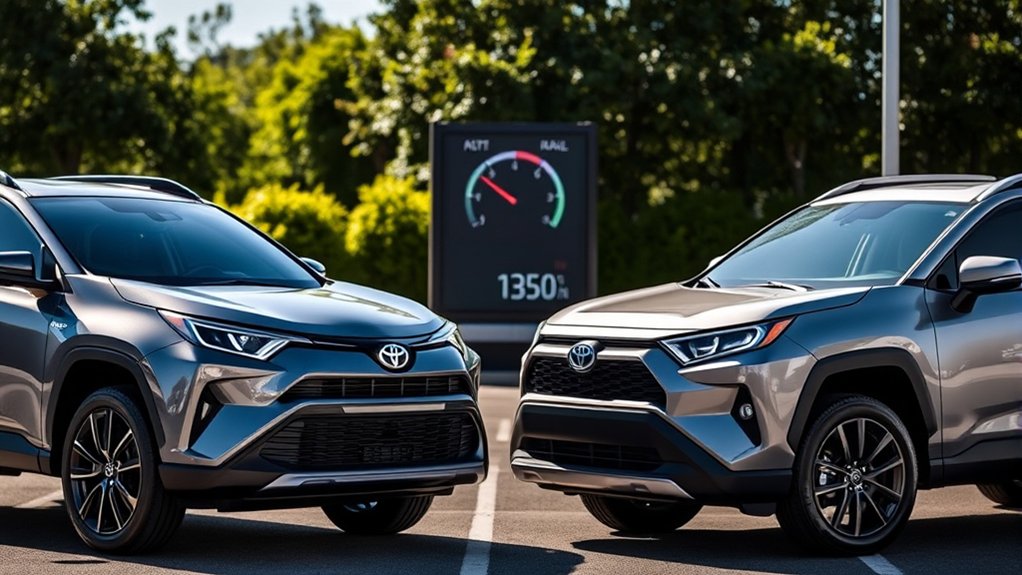
The RAV4 Hybrid combines a gasoline engine, electric motors, regenerative braking, and an electronically controlled continuously variable transmission. This system can use electric assistance during acceleration and recover energy while you slow down. For a deeper mechanical explanation, see how the RAV4 Hybrid engine and electric motors work.
The comparison changes depending on which model year you are shopping for. The 2025 RAV4 was available with either a gas-only or hybrid powertrain. For 2026, Toyota moved the U.S. lineup to hybrid and plug-in hybrid powertrains only.
Note: A gas-versus-hybrid comparison remains useful for 2025 and older RAV4 models. It is not a direct new-vehicle comparison for the 2026 U.S. lineup because Toyota no longer offers a gas-only 2026 RAV4.
| Model | Official Fuel Economy | Power and Drivetrain |
|---|---|---|
| 2025 RAV4 Hybrid, most trims | 41 city/38 highway/39 combined MPG | 219 net combined horsepower; AWD standard |
| 2025 RAV4 Hybrid Woodland | 38 city/35 highway/37 combined MPG | 219 net combined horsepower; AWD standard; all-terrain-focused trim |
| 2025 RAV4 gas LE FWD | 27 city/35 highway/30 combined MPG | Gas-only powertrain; FWD in this comparison |
| 2026 RAV4 Hybrid, most-efficient FWD configuration | 47 city/40 highway/43 combined MPG | 226 net combined horsepower; FWD |
| 2026 RAV4 Hybrid AWD | 41–42 combined MPG for non-Woodland AWD configurations; Woodland is 38 combined MPG | 236 net combined horsepower; exact rating varies by grade |
The 2026 model adds FWD on selected grades, while AWD remains available depending on the configuration. Toyota lists up to 37.8 cubic feet of cargo space behind the rear seats, so the efficiency gain does not require giving up the RAV4’s compact-SUV practicality.
Performance is another advantage. Electric-motor torque supports smooth initial acceleration, and the hybrid transaxle varies the power split without the fixed gear changes of a traditional automatic transmission. Exact acceleration results vary by model year, grade, test conditions, and testing organization.
What Is the Real-World Toyota RAV4 Hybrid MPG?
Real-world RAV4 Hybrid MPG can be above or below the official rating. EPA estimates come from standardized tests that help you compare vehicles, but they cannot predict every driver’s result.
FuelEconomy.gov currently displays a 41.2 MPG owner average for the 2025 RAV4 Hybrid AWD, with submitted results ranging from 35 to 55 MPG. However, that figure is based on only four vehicles, and the site warns that owner-submitted data cannot be independently verified.
Independent tests show why one “real-world MPG” number cannot describe every RAV4 Hybrid. Different model years, trims, routes, speeds, and test methods produce different results:
| Source and Test | Vehicle / Conditions | Observed Result |
|---|---|---|
| FuelEconomy.gov owner submissions | 2025 RAV4 Hybrid AWD; four submitted vehicles | 41.2 MPG average; 35–55 MPG range |
| Cars.com comparison drive | 2025 RAV4 Hybrid; roughly 250-mile comparison route | Nearly 38 MPG |
| Edmunds long-term test | 2026 XLE Premium FWD; 3,092 miles | 38.7 MPG versus a 43-MPG combined EPA rating |
| Car and Driver highway test | 2026 Limited AWD; 75-mph highway test | 36 MPG |
| Consumer Reports road test | 2026 RAV4 Hybrid AWD | 40 MPG overall |
These results are benchmarks, not directly comparable experiments. Use the EPA rating for your exact trim as the baseline, then judge your own vehicle across several tanks under similar conditions.
A single tank above 50 MPG is possible under favorable conditions, but it should not be treated as a normal long-term average. A downhill route, slow traffic, mild weather, a warm engine, and the dashboard’s calculation method can all influence one trip or tank.
Your long-term result will depend on:
- Your exact model year, trim, and drivetrain
- The length and frequency of your trips
- Average speed and traffic conditions
- Temperature and HVAC use
- Tire pressure and tire type
- Passenger, cargo, and roof-rack load
- Acceleration and braking habits
- Vehicle condition and engine break-in
How Do Seasonal Changes Impact RAV4 Hybrid Fuel Economy?
Seasonal changes can noticeably affect RAV4 Hybrid fuel economy. Winter usually produces the largest decline because the engine, battery, tires, fluids, and cabin-heating system must operate in colder conditions.
FuelEconomy.gov reports that hybrid fuel economy can decline by roughly 20% to 40% during cold-weather city driving, with larger losses possible on short trips.
Cold Weather Effects
Cold weather can lower MPG for several reasons. The engine takes longer to reach an efficient operating temperature, while cold oil and drivetrain fluids create more friction. The gasoline engine may also run more often to provide cabin heat.
Cold temperatures can reduce tire pressure and increase rolling resistance. Battery performance and regenerative-braking effectiveness may also decline until the vehicle warms up.
Short trips suffer the most because the engine may spend much of the journey warming up. FuelEconomy.gov estimates that hybrid city fuel economy can fall 20% to 40% in cold conditions and 25% to 45% on short trips.
Summer Fuel Efficiency
Mild and warm weather often helps a RAV4 Hybrid return closer to its official rating because the engine and battery reach efficient operating temperatures faster. Tire pressure also tends to be less affected by cold-weather contraction.
Extreme heat does not guarantee better MPG. Heavy air-conditioning use, high-speed driving, hot pavement, and battery cooling can increase energy consumption. The best results usually come from moderate temperatures, smooth driving, and trips long enough for the powertrain to warm fully.
Seasonal Driving Techniques
- Check cold tire pressure when the seasons change.
- Use the pressure shown on the driver-door placard, not a generic target.
- Combine short errands so the engine completes fewer cold starts.
- Drive away gently instead of idling for a long warm-up.
- Use heating, defrosting, and air conditioning as needed for safety and comfort, but avoid unnecessary maximum settings.
- Remove unused roof racks or cargo boxes that increase aerodynamic drag.
Tips to Maximize Fuel Efficiency in the RAV4 Hybrid

You do not need to drive unusually slowly or avoid normal climate-control use to improve your RAV4 Hybrid’s MPG. Consistent habits make a larger difference than short-term tricks.
- Accelerate smoothly. Use moderate throttle and leave enough space to avoid repeated surges and hard braking.
- Brake early and progressively. Gentle or moderate braking allows the regenerative system to recover more energy before the friction brakes take over.
- Control highway speed. Aerodynamic drag rises with speed, so sustained high-speed travel commonly lowers MPG.
- Use Eco mode appropriately. Eco mode can soften throttle and climate-control responses, but it cannot offset speeding, heavy loads, or cold weather.
- Keep tires correctly inflated. Check them cold and follow the specification on the driver-door placard.
- Remove unnecessary weight and exterior cargo. A roof box creates far more aerodynamic drag than luggage carried inside the vehicle.
- Follow the maintenance schedule. Use the specified motor oil and address warning lights or engine faults promptly.
- Track several tanks. One short trip or favorable tank does not show your true average.
Warning: Do not inflate every RAV4 tire to 36 PSI or use the maximum pressure printed on the tire sidewall. Check the driver-door placard and measure pressure when the tires are cold. Incorrect inflation can affect handling, braking, tire wear, and fuel use.
Pro Tip: Watch the hybrid-system display to learn when heavy acceleration or late braking forces the gasoline engine and friction brakes to do more work. Use it as feedback rather than trying to keep the vehicle in electric mode at all costs.
Common Owner Experiences With RAV4 MPG
RAV4 Hybrid owners can report very different numbers without either driver necessarily having a problem. A driver making moderate-speed urban trips in mild weather may meet or exceed the city rating. Another driver making short winter journeys may remain well below it.
Common patterns include:
- Stop-and-go city driving: The hybrid system can recover braking energy and switch the engine off when conditions allow.
- Short winter trips: Warm-up and cabin-heating demands can sharply reduce MPG.
- High-speed highway travel: The gasoline engine works more continuously, and aerodynamic drag increases.
- Hilly routes: Downhill regeneration may recover some energy, but it cannot recover everything used during the climb.
- Heavy loads or roof cargo: Added weight and drag increase the energy needed to move the vehicle.
Owner reports are most useful when they identify the model year, trim, drivetrain, temperature, average speed, trip length, and calculation method. A bare MPG number without that context has limited value.
How Does the RAV4 Hybrid Perform in Real Life?
In real life, the RAV4 Hybrid performs best when trips are long enough for the engine to warm up and the driver uses smooth acceleration and predictable braking. The official rating is a comparison tool, not a guaranteed minimum.
| Driving Situation | Likely MPG Effect | Main Reason |
|---|---|---|
| Mild-weather mixed driving | Often close to the official combined rating | Balanced speed, warm engine, and regenerative braking |
| Moderate-speed urban driving | May approach or exceed the city estimate | Frequent electric assistance and energy recovery |
| Short cold-weather trips | Often below the official rating | Engine warm-up, cabin heat, and colder battery and tires |
| High-speed highway driving | Often below the highway estimate | Increased aerodynamic drag and continuous engine use |
| Heavy cargo or rooftop storage | Lower MPG | Additional weight and wind resistance |
Why Is RAV4 Hybrid City MPG Often Higher Than Highway MPG?
A hybrid can perform especially well in city traffic because its electric motors assist the gasoline engine at low speeds. The engine can also shut off while the vehicle is stopped or moving under suitable conditions.
When you brake gently, the electric motors act as generators and send part of the vehicle’s motion energy back to the hybrid battery. A conventional gas vehicle normally loses most of that energy as heat through its brakes.
During steady highway travel, opportunities for regenerative braking are limited. The gasoline engine operates more continuously, and increasing aerodynamic drag requires more energy as speed rises. That is why the 2025 RAV4 Hybrid’s city rating is higher than its highway rating.
Cost Benefits of the RAV4 Hybrid

The RAV4 Hybrid can reduce fuel expenses, but your savings depend on annual mileage, fuel price, driving conditions, and the vehicle used for comparison.
Toyota’s October 10, 2024 launch announcement listed a starting MSRP of $28,850 for the 2025 gas LE FWD and $31,900 for the 2025 Hybrid LE, creating a $3,050 launch-price difference. Those are historical launch MSRPs before destination, options, taxes, and dealer pricing—not current dealer prices and not a 2026 gas-versus-hybrid price gap.
You can estimate annual fuel cost with this formula:
Annual fuel cost = annual miles ÷ MPG × fuel price per gallon
| Illustrative 2025 Comparison | RAV4 Hybrid | Gas RAV4 |
|---|---|---|
| Combined rating used | 39 MPG | 30 MPG |
| Annual miles | 12,000 | 12,000 |
| Fuel price used | $3.50 per gallon | $3.50 per gallon |
| Estimated annual fuel cost | About $1,077 | About $1,400 |
In that example, the hybrid saves about $323 per year and would need roughly 9.4 years of similar driving to recover a $3,050 purchase difference through fuel alone. Higher annual mileage or fuel prices shorten the payback period. Lower mileage lengthens it.
This illustration excludes financing costs, insurance, taxes, incentives, resale value, dealer pricing, maintenance differences, and changes in fuel prices.
Is the Price Premium for the RAV4 Hybrid Worth It?
For a 2025 or older RAV4, the hybrid premium may be worthwhile if you drive many miles, spend substantial time in urban traffic, or plan to keep the vehicle long enough to benefit from lower fuel use.
For 2026 shoppers, the decision is different because every new U.S. RAV4 uses either a hybrid or plug-in hybrid powertrain. Instead of comparing a new gas RAV4 with a new hybrid RAV4, you will usually compare:
- One RAV4 Hybrid trim with another
- FWD with AWD
- The standard hybrid with the RAV4 Plug-in Hybrid
- A new 2026 hybrid with a used 2025 or older gas RAV4
- The RAV4 Hybrid with another compact SUV
Long-Term Fuel Savings
Fuel savings matter most when you drive enough miles for small per-mile differences to accumulate. Calculate costs using your expected annual mileage, local fuel price, and the combined rating for the exact vehicles under consideration.
Do not assume the hybrid automatically pays for every price difference. A higher trim may include comfort, appearance, or technology upgrades unrelated to fuel economy. Compare equivalent equipment whenever possible.
Enhanced Driving Experience
The RAV4 Hybrid’s electric motors provide immediate assistance from low speeds, while the hybrid transaxle manages engine and motor power without traditional fixed-gear shifts. This can create smooth acceleration in everyday traffic.
The 2025 model produces 219 net combined horsepower. The redesigned 2026 model increases output to 226 horsepower with FWD and 236 horsepower with AWD. The 2026 model also lets selected buyers choose FWD for efficiency or AWD for additional traction.
Neither drivetrain replaces safe driving or suitable tires in snow, ice, or severe weather. AWD can help the vehicle accelerate on slippery surfaces, but it does not shorten braking distances.
How to Calculate Your RAV4 Hybrid MPG Accurately
The dashboard display is convenient, but a hand calculation across several fill-ups gives you a better long-term measurement.
- Fill the tank and reset a trip meter.
- Drive normally until your next fill-up.
- Record the trip-meter mileage and the gallons needed to refill the tank.
- Divide miles driven by gallons added.
- Repeat the process for at least three to five tanks.
- Add all miles and divide by all gallons for a multi-tank average.
For example, if you drive 430 miles and add 10.5 gallons, your calculated result is about 41 MPG.
Pro Tip: Use the same filling method each time and stop at the pump’s first automatic shutoff. Differences in pump angle, parking position, and added fuel after shutoff can distort one-tank calculations.
Related Guides
Frequently Asked Questions
How does driving style affect RAV4 fuel economy?
Rapid acceleration, hard braking, speeding, and repeated speed changes can lower MPG. Smooth acceleration and early, moderate braking help the hybrid system operate efficiently and recover more energy through regenerative braking.
What maintenance tips help improve fuel efficiency?
Follow Toyota’s maintenance schedule, use the specified motor oil, keep tires at the door-placard pressure, and have warning lights or engine faults diagnosed promptly. Do not rely on fuel additives unless Toyota specifically approves them for your vehicle and purpose.
Are there specific tire recommendations for better MPG?
Use a tire size, load rating, and speed rating approved for your RAV4. Low-rolling-resistance tires may help efficiency, but wet braking, snow traction, ride quality, noise, durability, and load capacity also matter. Keep every tire at the cold pressure shown on the driver-door placard.
How does the RAV4’s weight impact its fuel economy?
Extra weight requires more energy during acceleration and climbing. The effect may be modest for a light load, but it becomes more noticeable with several passengers, heavy cargo, a trailer, or frequent stop-and-go driving.
Can cargo and passengers reduce fuel efficiency significantly?
Yes. Added weight can reduce MPG, while rooftop cargo may have an even larger highway effect because it increases aerodynamic drag. Remove unused roof racks and boxes when practical, and stay within Toyota’s payload and towing limits.
Why is my RAV4 Hybrid getting lower MPG than the EPA rating?
Common causes include short trips, cold weather, high highway speeds, heavy HVAC use, low tire pressure, roof cargo, engine break-in, and aggressive driving. Compare several full tanks before deciding that the vehicle has an efficiency problem.
Does Eco mode always improve RAV4 Hybrid MPG?
No. Eco mode can moderate throttle and climate-control responses, which may make efficient driving easier. Your speed, trip length, temperature, traffic, cargo, and driving habits still have a greater effect on the final result.
What MPG does the 2026 Toyota RAV4 Hybrid get?
The most efficient 2026 RAV4 Hybrid FWD configurations are rated at 47 city, 40 highway, and 43 combined MPG. AWD versions are lower by configuration: non-Woodland AWD grades are rated at 41 to 42 combined MPG, while the Woodland is rated at 38 combined MPG.
Does AWD reduce RAV4 Hybrid MPG?
For the 2026 RAV4 Hybrid, the highest-rated FWD configuration reaches 43 combined MPG, while AWD versions are rated lower. For 2025, every RAV4 Hybrid used AWD; most trims were rated at 39 combined MPG and the Woodland at 37 combined MPG.
Conclusion
The Toyota RAV4 Hybrid offers strong fuel economy, but you need the correct model-year, trim, and drivetrain information to set realistic expectations. Most 2025 Hybrid trims are rated at 41 city, 38 highway, and 39 combined MPG, while the 2025 Woodland is rated at 38/35/37. The most efficient 2026 FWD configurations reach 47 city, 40 highway, and 43 combined MPG.
Your actual result may be higher or lower because of temperature, trip length, speed, tire pressure, traffic, cargo, and driving style. Use several hand-calculated tanks rather than one dashboard reading, and compare fuel costs with your own annual mileage and local fuel price.
For 2025 and older models, the hybrid can provide meaningful savings over a comparable gas RAV4. For 2026, the decision is mainly between trims, drivetrains, the standard hybrid, the plug-in hybrid, and competing SUVs.
Sources
- Toyota: 2026 RAV4 overview — current fuel-economy, trim, and cargo highlights.
- Toyota USA Newsroom: 2026 RAV4 launch information — powertrains, horsepower, drivetrains, and fully electrified lineup.
- Toyota USA Newsroom: 2025 RAV4 specifications — gas and hybrid ratings, output, drivetrains, and launch MSRPs.
- Toyota: 2025 RAV4 Hybrid trims — current archived city/highway estimates, including the Woodland.
- FuelEconomy.gov: 2025 Toyota RAV4 Hybrid AWD — official EPA rating and owner-submitted MPG data.
- FuelEconomy.gov: Fuel Economy in Cold Weather — winter losses, causes, and cold-weather driving guidance.
- FuelEconomy.gov: Keeping Your Vehicle in Shape — tire pressure, motor oil, and maintenance guidance.
- Edmunds: 2026 RAV4 Hybrid long-term test — observed MPG and test-vehicle details.
- Car and Driver: 2026 RAV4 fuel economy and testing — EPA ratings and 75-mph highway result.
- Consumer Reports: 2026 RAV4 Hybrid road test — overall real-world fuel economy.
- Cars.com: 2025 RAV4 Hybrid comparison drive — observed fuel economy on a 250-mile route.

