
The Toyota RAV4 can tow a small trailer, but there is no single tow prep package, equipment list, or capacity that applies to every model. The correct setup depends on the model year, trim, powertrain, drivetrain, hitch rating, payload, and trailer. Check the owner’s manual for your exact vehicle before buying or installing towing equipment.
Quick Answer
The RAV4 does not have one universal tow prep package across all years and trims. Some versions are engineered for higher towing limits, while a receiver and wiring may be standard, optional, dealer-installed, or aftermarket. Always use the lowest rating among the vehicle, hitch, ball mount, ball, and trailer components.
Key Takeaways
- A hitch receiver does not increase the RAV4’s factory towing capacity.
- Capacity varies by model year, trim, drivetrain, and powertrain; “up to 3,500 pounds” is not a rating for every RAV4.
- For the 2026 U.S. lineup, Toyota lists 1,750 pounds for the LE AWD and 3,500 pounds for certain AWD grades, including the XLE Premium, SE, and Woodland.
- Payload, tongue weight, trailer brakes, wiring, tires, and the ratings of every hitch component also limit what you can tow safely.
What Does “Tow Prep Package” Mean on a Toyota RAV4?

“Tow prep package” is often used loosely to describe factory engineering or equipment that supports towing. Depending on the RAV4’s year and configuration, that may involve cooling, electrical, suspension, drivetrain, software, or structural differences. It does not necessarily mean the vehicle already has a receiver, trailer-light connector, ball mount, or brake controller.
Toyota’s naming and equipment have changed between generations. For that reason, do not rely on a generic online list of alternator sizes, coolers, or batteries. Use the towing section of the Toyota owner’s manual for the exact model year, then confirm the installed equipment on the vehicle.
Note: A bike-rack “activity mount” is not automatically a trailer-towing receiver. For example, Toyota described the 2025 RAV4 Hybrid Woodland Edition’s 1¼-inch activity mount as being ready for a bike rack, while the redesigned 2026 Woodland is listed with a 2-inch rear tow hitch receiver and wiring harness.
RAV4 Towing Capacity: Why Model Year and Trim Matter
The maximum trailer weight printed in an advertisement is only a starting point. Your exact limit can be lower because of passengers, cargo, accessories, tongue weight, hitch-component ratings, or restrictions in the owner’s manual.
The redesigned 2026 U.S.-market RAV4 shows how much ratings can vary within one model year:
| 2026 example | Toyota-listed towing capacity | Important detail |
|---|---|---|
| LE AWD | 1,750 lb | The rating shown by Toyota is for AWD. |
| XLE Premium AWD | 3,500 lb | FWD and AWD availability does not mean both have the same rating. |
| SE AWD | 3,500 lb | Toyota specifies the 3,500-pound figure for AWD. |
| Woodland HEV or PHEV | 3,500 lb | Standard AWD, 2-inch receiver, and wiring harness. |
These are current examples, not a substitute for your vehicle’s manual. Earlier RAV4s use different trim names, powertrains, and ratings. The safest rule is to identify the vehicle by model year, trim, drivetrain, and powertrain before choosing a trailer.
Warning: Never assume your RAV4 can tow 3,500 pounds because another trim can. Adding a heavy-duty receiver, transmission cooler, or other accessory does not raise Toyota’s published rating for your vehicle.
The safe limit is the lowest applicable rating—not the largest number printed on any one component.
What Changed for the 2025 and 2026 RAV4?
Trim names and drivetrains are not consistent from one year to the next. Toyota’s 2025 U.S. gas lineup included LE, XLE, XLE Premium, and Limited grades; the Adventure and TRD Off-Road grades were no longer listed. All 2025 RAV4 Hybrid grades used electronic AWD.
For 2026, Toyota redesigned the RAV4 and moved the U.S. lineup to hybrid and plug-in hybrid powertrains. Front-wheel drive returned on selected hybrid grades, so the old statement that every RAV4 Hybrid is AWD is no longer current. The 2026 Woodland is a notable towing-focused configuration because Toyota lists standard AWD, a 3,500-pound capacity, a 2-inch receiver, and a wiring harness.
Front-Wheel Drive vs. All-Wheel Drive for Towing
AWD can improve traction when pulling away on wet pavement, loose surfaces, or a slippery boat ramp. It does not automatically create a higher tow rating. Toyota assigns capacities to specific configurations, and two RAV4s with similar engines may have different limits because of their cooling, chassis, brakes, software, or other engineering.
- FWD: Often lighter and efficient, but the exact towing permission and limit must come from the manual.
- AWD: May offer better low-speed traction and may carry a higher rating on selected grades, but AWD alone is not proof of that rating.
- Payload: Passengers, luggage, aftermarket accessories, and trailer tongue weight all count against the vehicle’s available payload.
RAV4 Hybrid and Plug-in Hybrid Towing

Hybrid and plug-in hybrid RAV4s can tow when Toyota approves towing for the specific configuration. Their electric motors may provide useful low-speed torque, but the hybrid badge does not establish the limit. The rating still depends on the model year, grade, drivetrain, and market.
Owners of older models should be especially careful with advice written for the redesigned 2026 RAV4. The 2025 RAV4 Hybrid lineup was AWD-only in the United States, while selected 2026 hybrid grades are available with FWD or AWD. Check the manual and the certification labels on the vehicle rather than transferring a rating from a different year.
Which RAV4 Trims Are Better for Towing?
The best RAV4 for towing is the configuration whose published capacity exceeds the trailer’s fully loaded weight while still leaving adequate payload for people, cargo, and tongue weight. For the current 2026 U.S. lineup, Toyota lists 3,500-pound AWD configurations such as XLE Premium, SE, and Woodland. The Woodland also includes a factory 2-inch receiver and wiring harness.
That does not make every 3,500-pound trailer a good match. Travel trailers can have substantial frontal area and tongue weight, and their real loaded weight may be much higher than the advertised dry weight. A lighter, lower-profile trailer usually gives a compact SUV more operating margin.
What Equipment Do You Need to Tow?
A complete setup may require more than a receiver. Match every part to the vehicle, trailer, and required load:
- Receiver hitch: A vehicle-specific receiver with a rating at least as high as the planned load.
- Ball mount and hitch ball: Correct shank size, ball diameter, rise or drop, and weight rating.
- Trailer wiring: A vehicle-compatible connector that powers the required stop, turn, tail, and marker lights.
- Safety chains: Rated chains attached to proper points and crossed beneath the coupler where required.
- Trailer brakes and controller: Required when specified by the trailer maker, Toyota, or applicable law. Rules differ by state.
- Mirrors and visibility: The driver must have a legal, unobstructed view around the trailer.
- Correct tires and pressures: Check the tow vehicle and trailer tires cold, including the spare.
How to Check Your Exact Towing Limit
- Identify the RAV4 exactly. Record the model year, trim, engine or powertrain, and FWD or AWD configuration.
- Read the towing section of the owner’s manual. Note the maximum trailer weight, tongue-weight guidance, prohibited configurations, break-in restrictions, and any required equipment.
- Check the driver-door labels. Confirm GVWR, GAWR, tire limits, and the stated combined weight of occupants and cargo.
- Find the trailer’s loaded weight. Include batteries, propane, water, tools, food, and gear—not only the brochure’s dry weight.
- Calculate payload use. Add occupants, cargo, accessories, and actual tongue weight. Keep the total within the vehicle’s payload and axle ratings.
- Check every towing component. The receiver, ball mount, ball, pin, coupler, chains, and wiring must suit the load.
- Use the lowest number. The lowest vehicle, axle, tire, hitch, or trailer-component rating governs.
Pro Tip: Weigh the loaded tow vehicle and trailer at a certified public scale before a long trip. A scale ticket can reveal payload or axle overload that is not obvious from the trailer’s advertised weight.
How to Install a Tow Hitch on Your RAV4
Receiver installation is model- and product-specific. Some bolt-on jobs are relatively direct, while others require lowering the exhaust, removing underbody panels, trimming a fascia panel, routing protected wiring, or programming an electronic module. Follow the hitch manufacturer’s instructions and Toyota’s service information rather than using a universal time estimate.
At a Glance
| Time Required | Varies by model and hitch; allow several hours when receiver and wiring work are both needed. |
| Difficulty | Moderate to advanced; exhaust, fascia, underbody panels, or wiring may be involved. |
| Tools Needed | Model-specific instructions, socket set, calibrated torque wrench, trim tools, safe lifting equipment as required, and a wiring tester. |
| Cost | Varies by receiver, wiring kit, brake-controller needs, and professional labor. |
Required Tools and Materials
Use the list supplied with the exact hitch. A typical installation may call for a socket set, extensions, a calibrated torque wrench, trim-removal tools, a support strap for the exhaust, rust penetrant, eye protection, wheel chocks, and approved ramps or jack stands. You may also need a vehicle-specific wiring harness and circuit tester.
Step-by-Step Installation Overview
- Confirm fit and ratings. Match the receiver and wiring kit to the RAV4’s exact year, trim, drivetrain, and powertrain.
- Prepare the vehicle safely. Park on a level surface, apply the parking brake, chock the wheels, and follow the product instructions for lifting or electrical disconnection.
- Remove or lower only the listed parts. This may include an exhaust hanger, splash shield, appearance panel, or bumper trim.
- Position the receiver. Use a helper or suitable support. Start all hardware by hand before tightening.
- Torque the hardware. Follow the hitch maker’s sequence and exact torque values. Do not guess or reuse damaged fasteners.
- Install protected wiring. Use the vehicle-specific route and module, keep wiring away from heat and sharp edges, and seal openings as directed.
- Reassemble and test. Check clearance, test every trailer-light function, inspect the coupler and safety-chain attachment points, and recheck fastener torque at the interval specified by the hitch manufacturer.
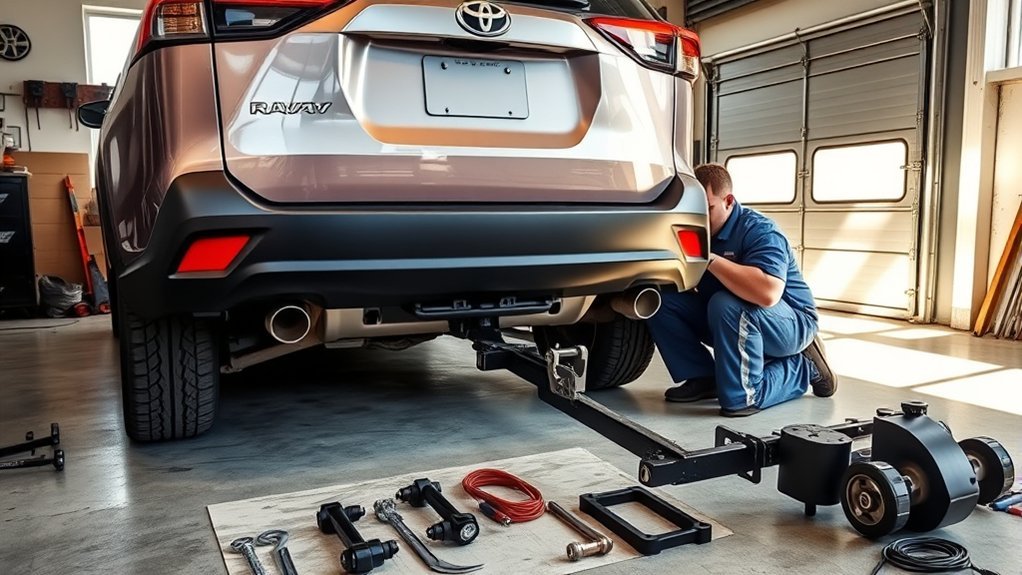
Warning: Never work beneath a vehicle supported only by a jack. Use the lifting points and support equipment specified for the vehicle, or have a qualified shop install the hitch and wiring.
Factory vs. Aftermarket Hitches for a RAV4
| Factor | Toyota or dealer-supplied setup | Aftermarket setup |
|---|---|---|
| Fit | Designed or selected for the stated Toyota application. | Can fit well when the part number exactly matches the vehicle. |
| Appearance and clearance | May integrate more closely with factory trim. | Receiver height and visible cross-tube design vary by brand. |
| Wiring | May use a Toyota accessory harness or a factory-installed system. | Use a powered, vehicle-specific harness when the instructions call for one. |
| Capacity | Does not exceed the vehicle’s published limit. | A higher hitch rating still does not raise the vehicle’s published limit. |
| Installation | Dealer installation can simplify parts selection and documentation. | Quality depends on the product, installer, wiring, and torque procedure. |
Towing Safety Checklist
Complete a walk-around before every trip. Government towing guidance recommends checking the ball-mount pin, coupler, safety chains, and electrical connector before departure. Also verify the following:
- The loaded trailer and actual tongue weight are within every applicable rating.
- The coupler matches the hitch-ball size and is fully latched and pinned.
- Safety chains are correctly attached and have enough slack for turns without dragging.
- Brake, turn, tail, license-plate, and marker lights work.
- The breakaway system and trailer brakes work when required.
- Tow-vehicle and trailer tires are undamaged and inflated to the specified cold pressures.
- Cargo is secured and distributed according to the trailer manufacturer’s instructions.
- The trailer sits level enough for stable handling, and nothing contacts the road or vehicle during turns.
Brake, lighting, breakaway, mirror, speed, and licensing rules vary by jurisdiction. Check the laws for every state or province on your route.
Warranty Implications of an Aftermarket Hitch
An aftermarket hitch does not automatically void the entire vehicle warranty. Under U.S. federal warranty principles, a warrantor generally cannot require a specific branded part or service merely to preserve coverage. However, coverage may be denied for a defect or damage caused by an aftermarket part, improper installation, overloading, or misuse.
Keep the hitch instructions, receipts, torque records, and photographs of the installation. When the vehicle is still under warranty, ask a Toyota dealer to document any model-specific concerns before installation.
Where to Find Support for Your RAV4 Towing Needs
- Toyota owner’s manual: The controlling source for your vehicle’s towing limits, required equipment, warnings, and operating procedures.
- Toyota dealer or qualified repair facility: Useful for confirming parts compatibility, wiring integration, and warranty questions.
- Hitch manufacturer: Use the exact installation sheet, torque specifications, and fit notes for the receiver part number.
- Professional trailer shop: Appropriate when trailer brakes, a controller, custom wiring, weight distribution, or setup measurements are involved.
- Public scale: The best way to confirm actual loaded axle, vehicle, and trailer weights.
Frequently Asked Questions
Can I tow with a RAV4 that lacks a tow prep package?
Possibly, but only when Toyota permits towing for that exact configuration and you install all required equipment. A receiver alone is not proof that the vehicle is approved for the trailer’s weight. Check the owner’s manual first.
What is the maximum weight my RAV4 can tow?
It depends on the model year, trim, powertrain, drivetrain, and market. Some current 2026 AWD grades are rated at 3,500 pounds, while the 2026 LE AWD is listed at 1,750 pounds. Your owner’s manual and vehicle configuration determine the applicable figure.
Does towing affect fuel efficiency?
Yes. Added weight and aerodynamic drag make the powertrain work harder, so gasoline use usually rises and electric driving range may fall. Speed, hills, wind, trailer shape, tire pressure, and load all affect the result.
Will an aftermarket hitch void my RAV4 warranty?
Not automatically. A warrantor may deny coverage for damage caused by the aftermarket part, installation, overloading, or misuse, but the mere presence of an aftermarket hitch does not void the entire warranty.
Can a RAV4 tow a camper or travel trailer?
A properly equipped RAV4 can tow a camper whose fully loaded weight, tongue weight, frontal area, and braking requirements fit the limits for that exact vehicle. Use loaded—not dry—weight, and leave margin for passengers, cargo, hills, heat, and wind.
Does adding a hitch increase the RAV4’s towing capacity?
No. A receiver gives you an attachment point, but it does not change Toyota’s vehicle rating. Even when the hitch is rated for more weight, the RAV4’s published limit remains controlling.
Do I need trailer brakes or a brake controller?
Use trailer brakes and a compatible controller when required by Toyota, the trailer manufacturer, or the laws where you drive. Legal weight thresholds vary, so check each jurisdiction on your route instead of relying on one national number.
Conclusion
A Toyota RAV4 can be a practical tow vehicle for a properly matched small trailer, but the answer is configuration-specific. Confirm the exact factory rating, calculate payload and tongue weight, use correctly rated equipment, and inspect the connection before every trip. For 2026, Toyota offers several AWD grades rated at 3,500 pounds, but other RAV4s have lower limits—so the owner’s manual always wins.
Sources
- Toyota USA Newsroom: 2026 RAV4 launch information — current U.S. powertrains, grades, towing capacities, and Woodland receiver equipment.
- Toyota USA Newsroom: 2025 RAV4 overview — 2025 grade lineup, hybrid AWD configuration, and Woodland activity-mount description.
- Toyota Manuals and Warranties — model-specific owner’s manuals and warranty information.
- Federal Trade Commission: Federal Warranty Law — aftermarket parts, tie-in sales provisions, and damage-caused exclusions.
- California DMV: Towing Your Trailer Safely — pre-trip inspection, weight limits, safety chains, lights, brakes, and trailer handling.
