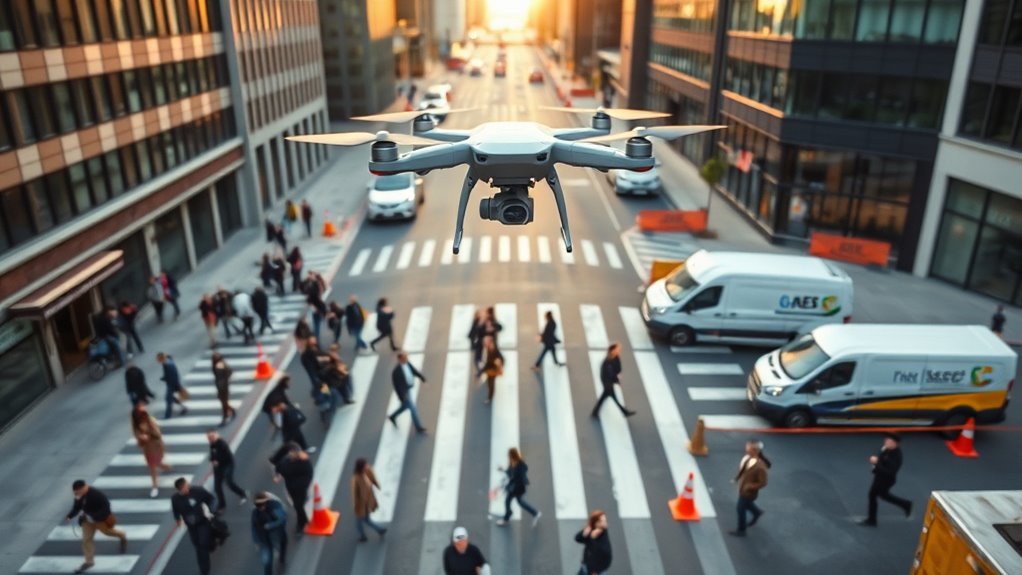
The FAA limits drone flights over people and moving vehicles through a tiered system tied to aircraft weight, design, and operational risk. Category 1 permits the lightest drones with minimal exposure hazards, while Categories 2 and 3 add stricter safeguards, notifications, and performance limits. Category 4 applies to certified aircraft under approved procedures. The rules appear straightforward until operational details begin to shift the compliance burden.
What Are FAA Over-People Rules?
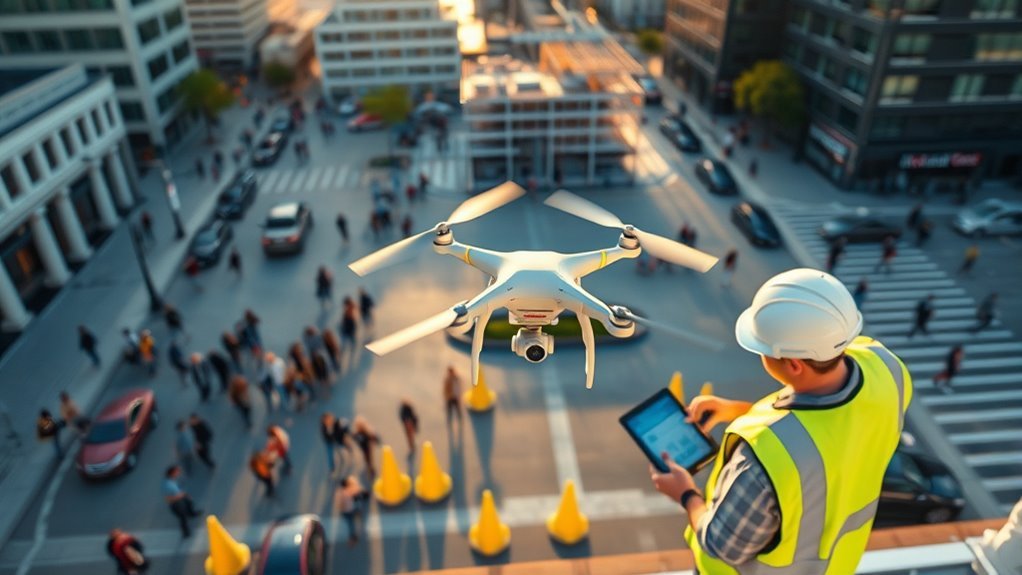
FAA over-people rules classify drone operations by the aircraft’s weight, kinetic energy, and certification status, with Category 1 limited to drones under 0.55 pounds with no exposed rotating parts. Category 2 and Category 3 are defined by increasing injury thresholds, and Category 4 is reserved for type-certified aircraft.
The FAA framework governs operations over people by permitting only specified Drone categories when risk to persons and property is controlled. Category 1 and Category 2 operations may proceed when the aircraft meets the relevant limits, and sustained flight in those classes requires Remote ID compliance.
A remote pilot certificate remains a baseline credential for lawful commercial conduct. Category 4 aircraft must hold an airworthiness certificate and satisfy maintenance standards before over-people use.
The FAA also expects rigorous safety assessments, with attention to kinetic energy transfer, contingency planning, and operational discipline. In practical terms, the rules define a narrow channel for liberation through compliant flight rather than unrestricted access.
Why FAA Restricts Drone Flights Over People
Drone flights over people are restricted to reduce undue hazard, ensuring that a loss of control, system failure, or pilot error does not create unacceptable risk to persons or property below.
The FAA restricts these operations because drone flights over people can generate undue hazards from kinetic energy transfer during impact, particularly in crowded environments and open-air assemblies. Regulatory limits prioritize injury mitigation, requiring Remote ID compliance and adherence to 14 CFR 107.39 before routine overflight is permitted.
The FAA limits flights over people to reduce impact hazards and prioritize injury mitigation in crowded environments.
Sustained flight above occupied areas is consequently constrained, while only narrowly controlled transits may satisfy safety objectives. The framework supports liberation by preserving public access to airspace without surrendering personal security.
When operators seek waivers, they must document hazard assessments, failure modes, and mitigation measures that reduce exposure to harm. This structure allows limited access, but only where the residual risk is shown to remain acceptable under FAA standards for unmanned aircraft operations.
Category 1 Over People Requirements
Category 1 eligibility is limited to drones weighing 0.55 pounds or less and containing no exposed rotating parts, which reduces the likelihood of injury to persons below.
Under FAA rules, these aircraft may operate over people without additional documentation, but they may not hover or sustain flight over open-air assemblies.
All operations must remain free of undue hazard to people or property, and Remote ID compliance is required for sustained flight over people.
Category 1 Eligibility
Eligibility for Category 1 operations over people is limited to the smallest and least hazardous unmanned aircraft systems, specifically those weighing 0.55 pounds (250 grams) or less.
Under Category 1, a small unmanned aircraft must satisfy the weight limit and meet operational restrictions designed to preserve public liberty without imposing unnecessary burden. Exposed rotating parts are not permitted, and safety features must reduce injury potential during normal operation.
No compliance declaration is required, streamlining lawful use. However, a Remote ID requirement applies when sustained flight over open-air assemblies is conducted, supporting accountability while maintaining access.
These provisions establish a narrowly tailored pathway for routine over-people operations, provided the aircraft remains within the regulatory threshold and remains configured to minimize risk to persons below.
Flight Limits Over People
Even the smallest Category 1 aircraft may be flown over individual persons when the operation remains within FAA safety limits and does not create an undue hazard to people or property.
Category 1 drones, as small unmanned aircraft of 0.55 pounds or less and without exposed rotating parts, may conduct flight over people without extra documentation. These operations remain lawful only when the pilot maintains direct control and avoids sustained flight over open-air assemblies, including hovering or circling above crowds.
Brief transiting may be exempt from Remote ID compliance; however, sustained flight triggers the applicable Remote ID rules.
Each flight must satisfy all FAA safety standards, preserving orderly access to airspace while protecting people from unnecessary risk and ensuring responsible operations.
Category 2 Over People Requirements
To operate over people under Category 2, a drone must meet specific safety limits, including a maximum weight of 0.55 pounds and an impact energy threshold of no more than 11 foot-pounds of kinetic energy.
Under FAA regulations, category 2 aircraft may fly over people only within tightly controlled conditions, typically at restricted-access sites where operators provide notice before overhead operations. The drone must comply with Remote ID requirements, supporting identification and accountability during flight.
Sustained flight over open-air assemblies is not permitted; only brief transits may occur when authorized and when the operation remains within applicable limits. The airframe must present no exposed rotating parts, reducing injury risk if contact occurs.
These rules are designed to preserve public safety while allowing measured operational access. In practice, category 2 standards create a narrow pathway to fly over people without surrendering technical rigor or regulatory discipline.
Category 3 Over People Restrictions
Category 3 operations permit drones to fly over people under defined FAA limits, but they remain barred from sustained flight over open-air assemblies and require prior notice to individuals on site before operations begin.
In category 3, operations over people are authorized only when the unmanned aircraft satisfies FAA regulations governing operational parameters and demonstrates adequate safety features. The kinetic energy transfer may not exceed 25 foot-pounds, a threshold intended to reduce injury potential.
Operators must conduct a documented risk assessment and apply safety protocols proportionate to the mission profile. Remote ID compliance is required for sustained flight, supporting accountability and traceability in liberated airspace use.
These restrictions preserve access while imposing disciplined limits on exposure to ground risk. Category 3 consequently represents a controlled regime: permitted flight above persons, prohibited sustained passage over open-air assemblies, and mandatory adherence to flight planning, notification, and operational safeguards.
Category 4 Type-Certified Drone Operations
When a drone holds a Special Airworthiness Certificate, FAA Category 4 operations permit flight over people under defined airworthiness and safety conditions. Under category 4, the aircraft must satisfy FAA regulations, demonstrate compliance through maintenance records, and meet stringent safety standards before any operations over people proceed.
- Special airworthiness certificate verification confirms eligibility for unmanned flights.
- Risk assessments support controlled operations over open-air assemblies.
- Remote pilots must notify persons on site before launch.
These requirements establish a regulatory pathway that preserves public access while limiting exposure to hazard. Unlike lower categories, category 4 may authorize open-air assemblies without a waiver, provided the platform remains airworthy and operating procedures stay within approved limits.
Remote pilots carry responsibility for awareness, coordination, and adherence to safety protocols throughout each mission. The framework is technical, but its effect is practical: disciplined compliance enables liberated unmanned flights without sacrificing predictability, accountability, or public protection.
FAA Rules for Flying Over Moving Vehicles
FAA regulations permit certain unmanned aircraft operations over moving vehicles only within defined categories and under controlled conditions, typically in closed or restricted-access sites where proper notice has been given to persons present.
Under the FAA rules, a remote pilot in command may authorize a small unmanned aircraft only when the operation avoids undue hazard and follows documented safety protocols.
Sustained flight over moving vehicles is generally prohibited; however, Category 4 UAS may conduct such operations when the approved Flight Manual does not impose a limitation.
All occupants in the moving vehicles must receive notice and be governed by the site’s safety procedures.
Compliance documentation is central to the regulatory structure, confirming eligibility, operating limits, and the lawful basis for operations over moving vehicles.
The framework is designed to reduce administrative friction while preserving strict control, allowing freedom of flight only where risk is bounded, notice is clear, and the aircraft’s performance and procedures remain within approved limits.
Night Rules for Over-People Flights
Night operations add another layer of compliance to flights over people, as the FAA permits such operations only when the aircraft, pilot, and operating environment satisfy the applicable rule set.
Since April 21, 2021, remote pilots may conduct a flight over people at night only after completing the updated knowledge test covering nighttime procedures and risk management under FAA regulations.
- lighted anti-collision lighting must remain visible for at least three statute miles
- flash rate must be sufficient to avoid collisions and preserve visibility in low-light conditions
- certificates and identification must be carried during the operation
For sustained flight, the aircraft must maintain compliance with all operational limits, including Remote ID requirements that support accountability and situational awareness.
In practice, the night standard does not relax the core duty of remote pilots: to preserve control, maintain visibility, and execute each flight over people with disciplined precision.
How Remote ID Affects Over-People Flights
Remote ID provides continuous identification and location data, forming the baseline for compliant operations over people.
For over-people flights, particularly in Categories 1 and 2, Remote ID capability is a mandatory condition of lawful sustained operation and supports the legal meaning of “over” as any body part directly beneath the aircraft.
Flight logs and Remote ID records serve as evidence of compliance, aiding enforcement and demonstrating adherence to applicable safety requirements.
Remote ID Basics
For over-people operations, Remote ID serves as a core compliance layer by requiring eligible drones in Categories 1 and 2 to broadcast identification and location information during sustained flight.
This Remote Identification framework enables the FAA to verify a small unmanned aircraft’s remote status, improving safety and traceability in operations over people. Under the rule, “over” means any part of a person directly beneath the flight path. Category 1 aircraft must remain under 250 grams and contain no exposed rotating parts.
- Real-time identification supports lawful remote flight oversight.
- Compliance preserves access to Categories 1-4 privileges.
- Noncompliance can restrict operations over people and open-air assemblies.
Within this regulatory structure, sustained flight data helps authorities confirm legitimacy and maintain disciplined airspace use.
OOP Compliance Needs
OOP compliance requirements narrow the focus from identification basics to the conditions under which Remote ID must be active during over-people operations.
Under FAA rules, Remote ID compliance is mandatory for sustained flight above persons in Category 1 drones and Category 2 operations, because location and identification data must remain broadcast throughout the mission.
For Category 1 drones, the rule supports safety measures by pairing low mass with traceable operation. In Category 2 operations, it reduces exposure by enabling authorities to monitor aircraft movement during over-people flights.
Brief transit over people is treated differently from sustained flight, so operational classifications matter.
Category 3 and 4 operators should align risk assessments with compliance standards and additional safety measures to satisfy FAA rules.
Flight Logging Evidence
Flight logs should document Remote ID status throughout any over-people mission, because FAA compliance turns identification data into operational evidence. For small unmanned aircraft, flight logging must show sustained flight intervals, signal continuity, and any gaps affecting operations over people.
In categories 1-4, the record should support risk assessments and prove that the aircraft remained identifiable under FAA regulations.
- Timestamped Remote ID activation and loss events
- Category designation, route, and people-beneath exposure
- Notes on open-air assemblies, waivers, and corrective action
The FAA treats “over” as any part of a person directly beneath the aircraft, so precise logs matter. Such documentation strengthens compliance, supports authorities’ situational awareness, and preserves lawful freedom to operate.
Violations often begin where evidence is absent.
Which Drone Category Fits Your Mission?
Which drone category applies depends on the aircraft’s weight, design, and injury potential, as well as the operational setting.
Among drone categories, Category 1 is limited to aircraft under 0.55 pounds with no exposed rotating parts, permitting operations over people without extra documentation.
Category 2 covers aircraft capable of no more than 11 foot-pounds of kinetic energy, but FAA compliance requires documentation before operations over people.
Category 3 reaches 25 foot-pounds of kinetic energy and must remain over closed sites or proceed only after prior notification to persons on site.
Category 4 is reserved for aircraft holding Special Airworthiness Certificates and is evaluated case by case.
All four categories remain bound by safety protocols. Sustained flight over open-air assemblies is prohibited unless Remote ID compliance and other operational standards are satisfied.
Mission planning consequently demands classification before launch, because category choice determines lawful access, operational freedom, and the minimum controls needed to protect public space.
Frequently Asked Questions
What Are Category 4 Drone Operations?
Category 4 drone operations are certified UAS flights over people, using aircraft with a Special Airworthiness Certificate and strict operational guidelines.
They prioritize drone safety through risk assessment, flight planning, pilot certification, airspace regulations, insurance requirements, and incident reporting.
This drone technology is subject to manufacturer limits in the Flight Manual, enhancing public perception by permitting controlled aerial presence while maintaining safety and regulatory compliance under a disciplined framework.
Can a Category 2 Drone Fly Over People?
Yes, a Category 2 drone can fly over people, but only under strict operational guidelines.
Drone safety depends on Remote ID compliance, a documented risk assessment, and equipment standards that limit injury potential.
Pilot training, insurance requirements, and emergency procedures support regulatory compliance and reduce accident liability.
Public perception improves when operators notify bystanders and demonstrate disciplined control, preserving space for responsible flight while preventing sustained overflight of open-air assemblies.
Are You Allowed to Fly a Drone Over a Crowd of People?
Generally, no; drone operation over a crowd is restricted unless legal regulations specifically authorize it.
Drone safety depends on rigorous risk assessment, crowd control, operator training, insurance requirements, and emergency protocols.
At public events, drone technology must avoid privacy concerns and undue hazard to persons or property.
Only narrowly approved operations may proceed, preserving practical freedom while respecting safety and compliance.
Sustained flight over open-air assemblies remains prohibited.
Can I Fly a Drone From a Moving Vehicle?
Only under limited conditions can a drone be flown from a moving vehicle.
Drone safety depends on vehicle restrictions, flight regulations, and operational limits. The pilot’s responsibilities include verifying equipment requirements, completing a risk assessment, checking state laws, and reviewing insurance considerations.
Occupants should be informed, and emergency procedures prepared. A Part 107 certificate and compliant aircraft are required.
Operational freedom remains bounded by FAA rules and any Flight Manual limitations.
Conclusion
FAA over-people and over-moving-vehicle operations are a tiered compliance system designed to balance access and risk. Category 1 offers the lightest regulatory burden for sub-0.55-pound drones, while Categories 2 and 3 impose increasing safeguards, and Category 4 requires certified-aircraft-level controls. Night operations, Remote ID, and operational context further shape eligibility. Taken together, the framework functions like a four-step safety ladder, enabling lawful flight only when the operator matches the category to the mission and hazard profile.