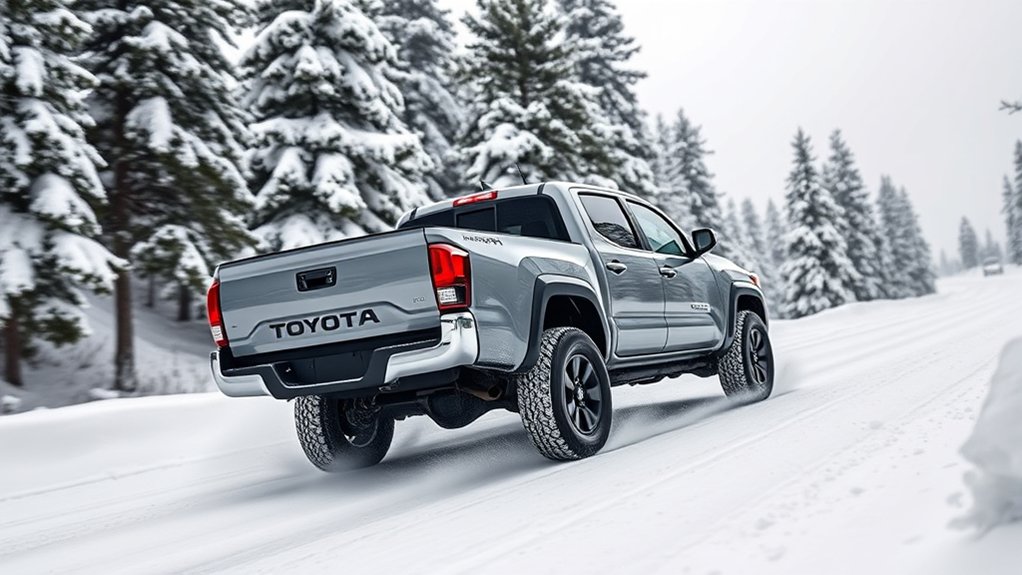
Driving a Toyota Tacoma in snow safely depends more on tire grip, speed, and smooth control than on four-wheel drive alone. On a part-time 4WD Tacoma, use 4H only on snow, ice, loose surfaces, or other conditions that allow some tire slip; use 2H on clear, high-traction pavement. Full-time 4WD Tacomas use different settings and can remain in their normal unlocked high-range mode on dry pavement. In every version, 4WD can improve forward traction, but braking and cornering are still limited primarily by the tires and road surface.
Last updated: September 19, 2026. Current-generation Tacoma 4WD guidance and federal winter-driving safety guidance were reviewed for this update.
Quick Answer
Drive a Toyota Tacoma in snow by fitting four suitable winter tires, using the correct drivetrain setting, keeping stability systems active during normal driving, and making every steering, throttle, and braking input smooth. On part-time 4WD models, 4H is for slippery surfaces that allow tire slip and 4L is for very slow deep-snow or high-resistance situations. Full-time 4WD models use different normal, locked-center, and low-range settings, so follow the labels and procedure in your exact owner’s manual.
Key Takeaways
- On part-time 4WD Tacomas, use 4H on snow-covered, icy, or loose roads when the owner’s manual permits it; return to 2H on sustained dry, high-traction pavement.
- Full-time 4WD Tacoma models use different settings, including an unlocked normal high-range mode that can be used on dry pavement.
- Four-wheel drive helps acceleration, but the tires and road surface still limit braking and cornering.
- Keep traction and stability control enabled during normal driving. Consider temporary deactivation only when the truck is stuck and the manual permits it.
- Check cold tire pressure against the driver-door label. Do not intentionally lower road-going pressure for snow.
- Drive slowly, use smooth inputs, increase following distance substantially, and postpone unnecessary travel when roads are dangerous.
At a Glance
| Pre-Trip Check | Allow enough time to fully clear snow and ice and inspect tires, lights, wipers, and fluids; the time varies with conditions |
| Difficulty | Basic preparation is straightforward, but severe ice, poor visibility, and deep snow may make postponing the trip the safer option |
| Tools Needed | Tire-pressure gauge, snow brush, ice scraper, flashlight, shovel, and winter emergency kit |
| Cost | Varies with tire, traction-device, and emergency-supply needs; no special purchase is required if the Tacoma is already properly equipped |
Warning: Tacoma 4WD controls, permitted shift speeds, low-range procedures, and drivetrain designs vary by model year and trim. Use the instructions in your exact Toyota owner’s manual. Postpone nonessential travel when roads are closed, visibility is poor, or ice makes control uncertain.
Understanding Your Tacoma’s 4WD System for Snow Driving
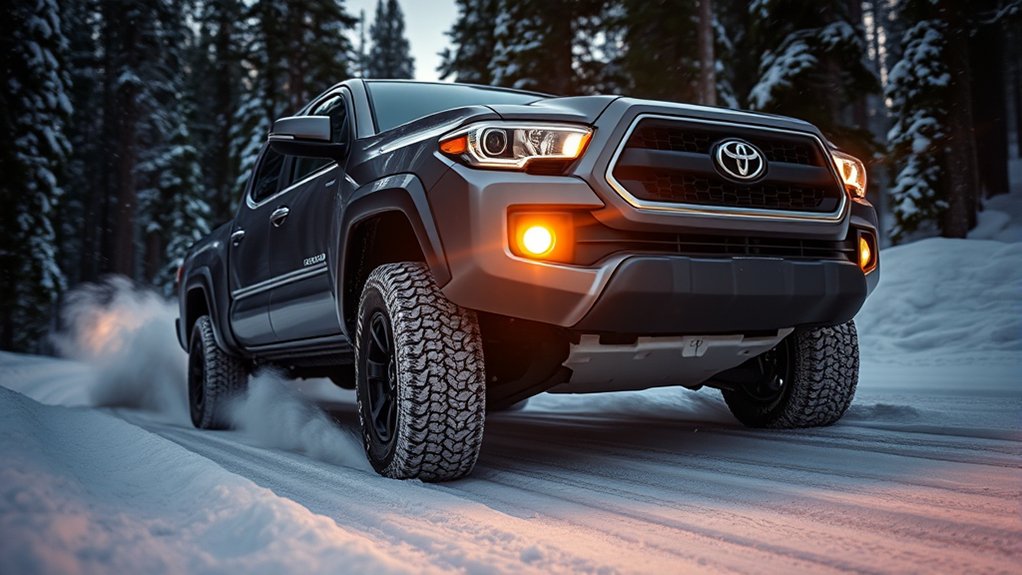
Your Tacoma’s drivetrain can send torque to additional wheels to improve forward traction, but the controls are not identical across generations and trims. Many Tacomas use part-time 4WD with 2H, 4H, and 4L. Current full-time 4WD models use an unlocked normal high-range setting plus locked-center high and low ranges. Always identify the labels on your own selector before applying instructions intended for another Tacoma.
| Road or Situation | Part-Time 4WD Tacoma | Full-Time 4WD Tacoma |
|---|---|---|
| Clear, dry, high-traction pavement | 2H | Normal unlocked high range, labeled H4F on applicable current models |
| Snow, ice, or another surface that permits tire slip | 4H when the manual permits it | Normal full-time mode remains available; locked-center H4L is intended for slippery surfaces when additional locked-center traction is appropriate |
| Deep snow, steep low-speed terrain, or hard pulling | 4L | Locked low range, labeled L4L on applicable current models |
| Patchy snow mixed with long dry sections | Avoid keeping a locked part-time mode engaged on sustained high-traction pavement | Use the normal unlocked full-time high-range setting unless the manual calls for another mode |
Toyota’s terminology and procedures vary by year, so treat the table as a mode-selection guide rather than a substitute for the manual. Practice identifying the selector, indicators, and normal drive mode while the truck is parked instead of learning the controls during a storm.
When to Use 2WD or the Normal Road Mode
On a part-time 4WD Tacoma, use 2H on clear, dry, high-traction pavement. A locked part-time system can bind or resist turning because the front and rear axles need to rotate at different average speeds during a turn.
A full-time 4WD Tacoma is different. Applicable current models use an unlocked high-range setting for normal driving, including dry hard-surfaced roads. Do not apply the part-time instruction to a full-time system without checking your selector and manual.
When to Use 4WD High
On a part-time 4WD Tacoma, use 4H when the road is covered by snow, ice, loose gravel, or another surface that allows tire slip and your manual permits the mode. Select it before the truck becomes stuck, preferably while traveling straight and without heavy throttle.
On applicable 2024 part-time 4WD models, Toyota specifies reducing speed below 62 mph (100 km/h) before shifting between 2H and 4H. Older Tacoma generations can have different procedures or limits, so verify the exact rule in your model-year manual rather than treating 62 mph as universal.
4H can reduce rear-wheel spin and improve forward traction. It does not increase the tire-road friction available for every stop or corner, so it is not permission to use dry-road speeds in winter conditions.
When to Use 4WD Low
Low range is not selected according to a fixed snow depth. It is intended for very slow travel when the truck needs high torque and controlled movement, such as deep unplowed snow, a difficult recovery, or a steep low-speed surface. Excessive throttle in low range can spin the tires and dig the truck deeper.
Engagement normally requires a specific sequence involving vehicle speed, transmission position, and the brake or clutch. Follow your manual exactly and confirm that the dashboard indicator shows complete engagement before applying substantial power.
Note: A flashing 4WD indicator may mean the requested mode has not fully engaged. Do not assume the shift is complete. Reduce load on the drivetrain and follow the troubleshooting steps in your manual.
What if Your Tacoma Is 2WD?
A 2WD Tacoma cannot use 4H or 4L, so tire grip and speed management become even more important. Fit four suitable winter tires where regular snow or ice is expected, keep stability and traction systems active during normal driving, accelerate progressively, and leave extra stopping distance. A lightly loaded pickup can spin its rear tires easily, but adding unsecured or excessive weight is not a substitute for proper tires or careful driving.
How to Drive a Toyota Tacoma in Snow Safely
Winter control comes from preserving the limited traction available at the tires. Look far ahead, reduce speed before reaching a hazard, and avoid combining large steering, braking, and throttle inputs. Heavy braking while turning, sharp steering under throttle, or sudden acceleration can exceed the available grip.
Tire Selection Matters
Four-wheel drive cannot compensate for unsuitable tires. For frequent snow and ice, choose four tires in the correct size and load rating that are designed for winter use. The three-peak mountain snowflake symbol indicates that a tire meets specified severe-snow traction requirements.
Transport Canada notes that conventional all-season and summer tires begin losing elasticity below about 7°C (45°F), while winter tires remain more flexible at lower temperatures. It also recommends four winter tires and advises against using tires close to 4 mm (5/32 inch) of tread on snow-covered roads.
| Traction Option | Best Use | Important Caution |
|---|---|---|
| Dedicated winter tires | Regular driving in sustained cold, snow, and ice | Install a compatible set of four and confirm the truck’s size and load requirements |
| 3PMSF-rated all-terrain or all-weather tires | Mixed road use with occasional or moderate snow | The symbol verifies qualifying snow traction, not identical ice braking or cornering performance among all products |
| Studded winter tires | Persistent hard-packed snow or ice where permitted | Dates and legality vary by jurisdiction |
| Chains or approved traction devices | Posted chain-control areas or short periods of severe conditions | Confirm clearance, installation position, speed limit, and compatibility in the manual |
Choose a winter tire by current fitment and measurable requirements rather than an old product list. Confirm the correct size, load rating, severe-snow marking, tread condition, and compatibility with any traction device you plan to carry.
Control Techniques Explained
- Accelerate gently: Apply light, progressive throttle. If the tires spin, ease off instead of pressing harder.
- Brake early: Begin slowing before a curve, intersection, downhill section, or traffic queue.
- Steer smoothly: Make small corrections and avoid snapping the steering wheel.
- Separate inputs: Finish most braking before turning, then accelerate after the truck begins to straighten.
- Increase following distance: Leave substantially more room than you would on dry pavement and increase it further for ice, hills, poor visibility, or heavy traffic.
Tacomas equipped with an antilock braking system are designed to prevent wheel lock during hard braking. During an emergency stop, press the brake pedal firmly and continuously while steering toward a clear path. Pedal vibration or noise can occur while ABS is operating. Do not pump the pedal on an ABS-equipped Tacoma.
Pro Tip: Before winter, review the ABS, stability-control, and 4WD indicator descriptions in your manual. Recognizing normal warning lights and pedal feedback helps you respond correctly when a system activates.
What to Do if the Tacoma Starts Sliding
Ease off the accelerator and look toward the open path where you want the truck to travel. Steer smoothly in that direction without making a sudden opposite correction. Avoid abrupt braking. If braking is necessary and the truck has ABS, apply firm, continuous pressure while continuing to steer.
As the tires regain grip, unwind the steering smoothly. A rapid correction after traction returns can send the truck in the opposite direction.
Tires and Weight Distribution for Better Traction
A pickup has less unloaded weight over its rear axle than many passenger vehicles, so a rear-wheel-drive Tacoma can spin its rear tires easily on a slippery surface. Suitable tires remain the first priority. Extra cargo can change the truck’s balance, but it must not substitute for winter tires, careful driving, or 4WD when available.
How to Check Tacoma Winter Tire Fit and Condition
Check more than the brand name. All four tires should have compatible construction, size, load index, speed rating, and tread characteristics. Mixing only two winter tires with ordinary all-season tires can make one axle lose grip before the other. For snow-covered roads, Transport Canada also advises against tires that are worn close to 4 mm (5/32 inch) tread depth.
| Check | What to Confirm |
|---|---|
| Size | Matches the door label, manual, or an approved alternate size |
| Load rating | Supports the Tacoma, passengers, cargo, accessories, and towing load |
| Winter marking | Three-peak mountain snowflake symbol for qualifying severe-snow traction |
| Tread condition | Enough tread for winter use; snow performance falls well before a badly worn tire becomes visibly bald |
| Set consistency | Four compatible tires with similar tread depth and wear |
| Chain clearance | Enough clearance for only the device type and wheel position approved by Toyota |
Adding Weight for Traction
Extra bed weight may change rear-tire traction on a lightly loaded two-wheel-drive pickup, but Toyota does not specify one universal snow-ballast amount for every Tacoma. Do not rely on an arbitrary pound figure.
If you choose to carry ballast or other heavy cargo, treat it as cargo: secure it against movement and stay within the truck’s payload, gross vehicle weight, and axle ratings. Loose sandbags, blocks, or containers can shift during steering or braking and become dangerous in a crash.
Sand or non-clumping kitty litter can also serve as an emergency traction aid if the truck becomes stuck. Carry it in a sealed, secured container rather than leaving loose material in the bed.
Tire Pressure Management Tips
Cold weather reduces tire pressure, so check all tires when they are cold, preferably before driving or after the truck has been parked for several hours. Inflate them to the cold pressure shown on the driver-door Tire and Loading Information label or in the owner’s manual.
- Do not use the maximum pressure printed on the tire sidewall as the Tacoma’s normal setting.
- Do not intentionally lower road-going pressure to create a larger contact patch.
- Check the spare tire as well as the four road tires.
- Inspect for cuts, bulges, cracks, punctures, and uneven wear.
- Remember that the tire-pressure warning light may not activate until a tire is already significantly underinflated.
NHTSA recommends checking tire pressure at least monthly and before long trips. Winter grip can become inadequate before tread reaches the legal minimum replacement threshold, so tire condition should be judged for the conditions you actually drive in rather than by the minimum tread limit alone.
How to Stay Safe While Driving in Snow
Check the weather, road closures, and traffic reports before leaving. If officials advise against travel or the route is untreated, delaying the trip is safer than relying on the truck’s ground clearance or 4WD system.
Prepare the Tacoma Before Moving
- Clear snow and ice from every window, mirror, exterior light, roof, hood, and tailgate.
- Clear cameras, parking sensors, and driver-assistance sensor areas without damaging them.
- Confirm that the headlights, brake lights, turn signals, and hazard lights work.
- Fill the washer reservoir with winter-rated fluid and inspect the wiper blades.
- Check the battery, coolant, defroster, heater, brakes, and tire condition.
- Remove snow from the exhaust outlet before starting or idling the truck.
Adjust Your Driving
Use low-beam headlights when visibility is poor. Reduce speed before bridges, shaded areas, curves, ramps, and hills because traction can change quickly in these locations. Avoid crowding or traveling directly beside a snowplow, and pass only when it is clearly legal and safe.
Approach hills with steady, modest momentum. Avoid a sudden throttle increase partway up the grade. Before descending, reduce speed and choose an appropriate gear without making abrupt shifts. Four-wheel drive may help the Tacoma climb, but it does not remove the need for a slow, controlled descent.
NHTSA estimates that 101,390 police-reported crashes occurred while snow or sleet conditions were present in 2023. Slower speeds and greater following distance give you more time to respond.
Use Traction and Stability Control Correctly
Leave traction and stability control enabled during normal winter driving. These systems can reduce engine power or brake individual wheels when they detect wheelspin or a developing skid. Their intervention may feel like hesitation, but switching them off can remove an important safety aid.
A temporary reduction or deactivation may help only when the Tacoma is stuck and controlled wheelspin is needed to move through loose snow. Use that option only when the owner’s manual allows it, apply light throttle, and turn the system back on as soon as the truck is moving normally.
What Common Mistakes Should You Avoid When Driving Your Tacoma in Snow?
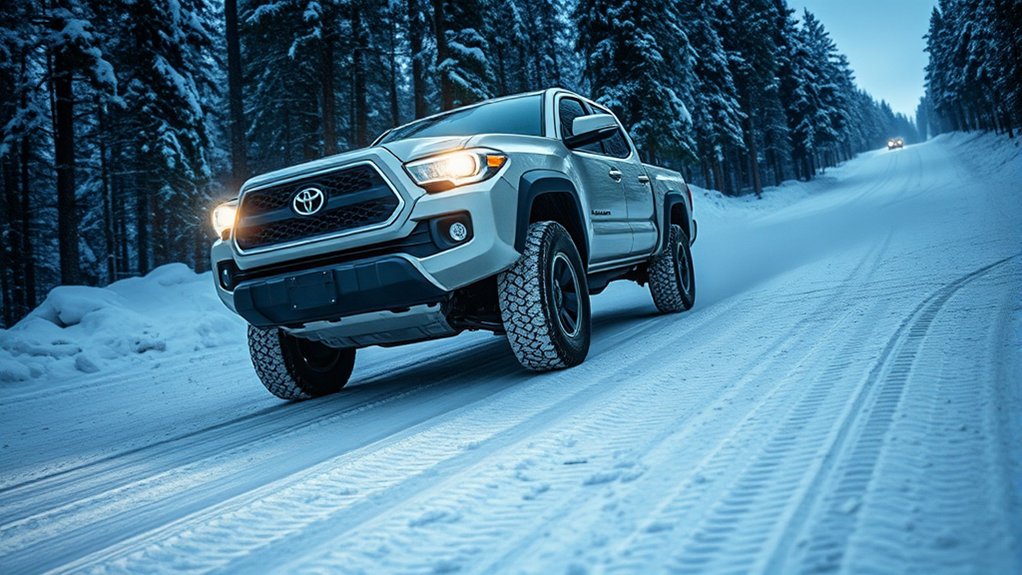
A Tacoma can feel secure when 4WD prevents wheelspin, which may encourage excessive speed. Avoid treating forward traction as proof that the truck can stop or turn normally.
- Do not wait for the wheels to spin before preparing: Select the permitted winter mode before entering a clearly slippery section.
- Do not use locked part-time 4WD on sustained dry pavement: Return to the normal road mode when the surface provides consistent traction. Full-time systems use different rules.
- Do not pump ABS brakes: Apply firm, continuous pressure during an emergency stop in an ABS-equipped Tacoma.
- Do not lower tire pressure for public-road snow driving: Use the specified cold pressure.
- Do not make sudden inputs: Abrupt throttle, steering, or braking can break traction.
- Do not depend only on traction control: Electronic systems cannot overcome excessive speed or unsuitable tires.
- Do not stop in an exposed traffic lane: Reach a safe parking area whenever possible.
- Do not spin the tires continuously when stuck: This can dig holes, overheat components, and polish snow into slick ice.
If Your Tacoma Gets Stuck
- Stop applying heavy throttle and switch on the hazard lights if traffic may approach.
- Clear snow from around the tires, under the axles, and beneath the front or rear of the truck.
- Straighten the front wheels to reduce rolling resistance.
- Place sand, kitty litter, or an approved traction aid in the direction of travel.
- Select the appropriate drive mode according to the owner’s manual.
- Apply light, steady throttle instead of rapidly spinning the tires.
- If the manual permits it, temporarily reduce traction-control intervention and reactivate the system once free.
- Call professional recovery assistance if you cannot identify a manufacturer-approved recovery point or the truck is near traffic, a slope, deep water, or another hazard.
Warning: Do not stand directly in front of or behind spinning tires, and do not crawl beneath a vehicle supported only by snow, loose ground, or a jack.
Preparing Your Tacoma for Winter Weather Challenges
Prepare before the first storm rather than after the truck loses traction. Begin with tires, brakes, lights, battery condition, coolant protection, wipers, washer fluid, and the correct operation of the heater and defroster.
Using Chains or Other Traction Devices
Carry chains or approved traction devices when your route or local regulations may require them. Buying a device that matches the tire size does not automatically guarantee Tacoma clearance. Check Toyota’s instructions for the approved device type, installation axle, maximum speed, and body or suspension clearance.
Practice installation in dry weather. Stop and retighten the devices according to their instructions, and remove them when they are no longer required. Driving too fast or using chains on exposed pavement can damage the tires, wheels, suspension, and body.
Pack a Winter Emergency Kit
NHTSA winter-driving guidance recommends carrying supplies for routine winter problems and unexpected delays. A practical Tacoma kit includes:
- Snow brush, ice scraper, and compact shovel
- Sand or kitty litter for temporary traction
- Flashlight, spare batteries, and reflective warning devices
- Jumper cables or a suitable jump pack
- Warm clothing, gloves, boots, and blankets
- Water, nonperishable food, and necessary medicine
- First-aid kit
- Phone charger and backup power bank
- Current road map in case navigation or cellular service fails
- Chains or approved traction devices when appropriate
If You Become Stranded
Stay with the Tacoma unless remaining there presents an immediate danger. Make the vehicle visible with hazard lights and bright markers. Keep the exhaust outlet clear of snow to reduce the risk of carbon monoxide entering the cabin.
Run the engine only intermittently as needed for warmth, monitor fuel, and avoid running it for long periods with the windows closed. Contact emergency services or roadside assistance and share your location, route, passengers, and vehicle description.
Related Guides
Frequently Asked Questions
Should I turn off traction control in 4WD in snow?
Usually, no. Keep traction and stability control enabled during normal snow driving. Temporary deactivation may help when the truck is stuck and needs limited wheelspin, but only use that option when your Tacoma’s owner’s manual permits it. Reactivate the system as soon as you regain normal movement.
Should I use 4H or 4L in snow?
Use 4H on a part-time 4WD Tacoma for normal travel on snow-covered or icy surfaces when the manual permits it. Reserve 4L for very slow conditions that require high torque and control, such as deep snow, steep terrain, or recovery. Full-time 4WD models use different H4F, H4L, and L4L settings, so follow the labels and instructions for your exact Tacoma.
Is a Tacoma 4×4 good in snow?
A 4WD Tacoma can provide strong forward traction when it has suitable tires and the correct mode is selected. Its height or drivetrain does not guarantee short stops or secure cornering. Winter tires, lower speed, smooth control, and adequate following distance remain essential.
Can I switch a Tacoma into 4H while moving?
Many Tacoma part-time 4WD systems allow 2H-to-4H selection while moving within a specified speed range. For applicable 2024 part-time 4WD models, Toyota specifies less than 62 mph (100 km/h). Older generations differ, so use the model-year owner’s manual and never shift into 4H while the wheels are actively spinning.
Can I drive a Tacoma in 4WD High on dry pavement?
Do not use a locked part-time 4WD mode on clear, dry pavement unless the owner’s manual specifically permits it. High-traction surfaces can create driveline binding during turns. Full-time 4WD Tacoma models have a normal unlocked high-range mode designed for regular pavement, so identify your drivetrain before applying the part-time rule.
Does 4WD help a Tacoma stop faster in snow?
Do not rely on 4WD to shorten a snow or ice stop. Four-wheel drive mainly improves the ability to apply engine torque for forward traction. Braking remains limited by tire grip, road conditions, vehicle speed, and the braking system, so slow down and leave substantially more stopping room.
Should I pump the brakes if my Tacoma slides on snow?
Not on an ABS-equipped Tacoma. Press the brake pedal firmly and continuously while steering toward a safe path. Pumping may be appropriate only for a vehicle without ABS when its wheels begin to lock. Check the manual if you drive an older Tacoma and are unsure of its braking equipment.
Sources
- Toyota Manuals and Warranties — model-year-specific 4WD controls, indicators, tire information, and operating procedures
- NHTSA Winter Weather Driving Tips — ABS technique, cold tire pressure, trip planning, winter preparation, crash data, and emergency supplies
- NHTSA TireWise — tire size, cold inflation pressure, tread inspection, maintenance, and winter-tire guidance
- Transport Canada: Using Winter Tires — three-peak mountain snowflake marking, four-tire installation, tread condition, temperature, and winter-pressure guidance
- National Weather Service Winter Preparation — winter planning, vehicle readiness, and emergency preparation
Conclusion
Your Tacoma’s drivetrain can improve forward traction in snow, but the correct setting depends on the system. Part-time 4WD models normally use 2H on dry pavement, 4H on surfaces that allow tire slip, and 4L for slow high-resistance conditions. Full-time 4WD models have a normal unlocked high-range setting and separate locked-center modes. Use the labels and procedures in the manual for your exact model year.
Regardless of drivetrain, suitable tires, correct cold pressure, lower speed, smooth inputs, and extra stopping distance matter more than simply selecting 4WD. Prepare the truck before each winter trip, carry emergency supplies, and delay travel when ice, visibility, road closures, or conditions exceed what you and the vehicle can safely manage.

