
If your Toyota Tacoma won’t start, first determine whether the engine does not crank, cranks slowly, or cranks normally without starting. That single observation separates most battery, cable, starter-circuit, and interlock problems from fuel, ignition, immobilizer, sensor, and engine-management faults. Start with the symptom, then test the simplest cause before replacing parts.
Last updated: September 19, 2026
Quick Answer
If your Toyota Tacoma won’t start, first identify whether the engine does not crank, cranks slowly, or cranks normally but will not fire. No-crank problems usually involve the 12-volt battery, cables, starter circuit, gear or clutch interlock, or smart key. A crank-no-start points more toward fuel, ignition, engine-management, or immobilizer faults.
Vehicle scope: This guide uses a symptom-first process that applies broadly across Tacoma generations. Exact fuse names, relay locations, Smart Key steps, starter wiring, fuel-pressure specifications, and hybrid procedures vary by model year, engine, transmission, and market. Use the Toyota manual or repair information for your exact truck before applying a model-specific test value.
Key Takeaways
- Rapid clicking usually calls for battery and cable testing before starter replacement.
- A battery reading near 12.6 volts suggests a full resting charge, but it does not prove the battery can handle starter load.
- If the engine cranks normally, focus on fuel delivery, ignition, sensor signals, immobilizer operation, and stored trouble codes.
- Automatic, manual, push-button, and hybrid Tacoma models have different starting interlocks and procedures.
- Stop testing if you find a damaged battery, fuel leak, smoke, hot wiring, or a hybrid high-voltage warning.
At a Glance
| Time Required | About 10 to 30 minutes for basic checks; advanced testing takes longer. |
| Difficulty | Beginner for visual and battery checks; intermediate or professional for circuit, fuel-pressure, and hybrid diagnosis. |
| Tools Needed | Safety glasses, gloves, digital multimeter, battery tester or jump pack, flashlight, and an OBD-II scanner. |
| Cost | Basic inspection may cost nothing. Testing and repair costs depend on the failed battery, cable, switch, starter, sensor, fuel component, or control circuit. |
Warning: Do not jump-start a battery that is cracked, leaking, swollen, severely corroded, or possibly frozen. Stop immediately if you smell strong raw fuel, see a leak, notice smoke or melting insulation, or find hot battery cables. Work outdoors and keep sparks, flames, jewelry, and tools away from battery terminals. On a hybrid Tacoma, never touch orange high-voltage cables or components.
Why Won’t My Toyota Tacoma Start?

A Tacoma can fail to start for several reasons, but you should not diagnose the truck from one sound alone. Start by watching the dashboard, listening to the cranking speed, and noting whether the engine rotates.
| What You Notice | Most Likely Areas to Check First | Best Next Check |
|---|---|---|
| No lights, no sound, and no crank | Battery charge, battery terminals, main ground, main fuse, and battery-cable connection | Measure battery voltage, inspect terminal tightness, and check main power connections. |
| Rapid clicking | Low battery voltage, loose or corroded terminals, poor ground, or excessive voltage drop | Load-test the battery and inspect voltage drop before condemning the starter. |
| One solid click | Starter solenoid, starter motor, battery under load, cable resistance, or a mechanical engine problem | Confirm battery strength, starter power and ground, and whether the engine can rotate normally. |
| Normal lights but no click | Park/neutral switch, clutch switch, brake-pedal input, smart key, immobilizer, fuse, relay, or starter-control wiring | Try the correct interlock procedure, watch security messages, then test the starter command circuit. |
| Slow or uneven cranking | Weak battery, poor cable connection, failing starter, thick oil in extreme cold, or mechanical resistance | Test battery performance under load and check cable voltage drop. |
| Normal cranking but no start | Fuel pressure, ignition, crank or cam sensor signals, immobilizer, engine-management power, or stored fault codes | Scan for codes and cranking RPM, then prove fuel pressure, spark, and injector command. |
| Starts and then stalls | Immobilizer recognition, fuel delivery, charging-system operation, wiring, air metering, or another engine-control fault | Record warning lights and codes, then test charging voltage or hybrid READY status and engine-control inputs. |
The fastest no-start diagnosis begins with one question: Does the engine crank?
How to Diagnose and Fix Your Tacoma’s Starting Issues
1. Identify the Exact Starting Symptom
Turn off the lights, climate system, audio equipment, and accessories. Apply the parking brake. Watch the dashboard while you attempt one brief start.
Do not crank continuously. If the engine does not start within several seconds, release the key or button and pause before trying again. Repeated long attempts can overheat the starter, drain the battery, and flood some gasoline engines.
2. Check the Starting Interlocks
On an automatic Tacoma, confirm the shifter is fully in Park. Try starting in Neutral while holding the brake pedal. If it starts only in Neutral, the shifter adjustment or park/neutral circuit may require service.
On a manual-transmission Tacoma, press the clutch pedal fully to the floor. Make sure a floor mat or other object is not limiting pedal travel. A faulty clutch-start switch can prevent the starter from receiving a command.
For push-button models, press the brake pedal firmly. If the brake lights do not illuminate, a brake-switch or related circuit fault may prevent starting.
3. Watch the Warning and Security Indicators
Look for a key-not-detected message, flashing security indicator, check-engine light, charging-system warning, or hybrid-system warning. A security light that behaves abnormally can point toward key recognition or immobilizer trouble.
Do not disconnect the battery simply to “reset lock mode.” Battery disconnection does not repair a damaged key, immobilizer antenna, brake switch, starter circuit, or control-module fault.
4. Scan for Trouble Codes
If the dashboard powers up, connect an OBD-II scanner before disconnecting the battery. Stored codes can identify lost crankshaft signals, camshaft sensor faults, low system voltage, immobilizer problems, communication failures, or other engine-control issues.
Pro Tip: Record every code and freeze-frame value before clearing anything. A code identifies the circuit or condition the computer detected, not automatically the part that must be replaced.
Is the Battery or a Bad Connection Causing the No-Start?
Inspect the Battery Before Testing It
Wear eye protection and gloves. Check the battery case for swelling, cracks, leakage, or signs that it may be frozen. Do not charge or jump-start a visibly damaged battery.
Inspect both terminals, the negative cable where it connects to the body or engine, and the positive cable leading toward the starter and fuse box. Corrosion, a loose clamp, or a damaged ground can allow lights to work while preventing the starter from receiving enough current.
Measure Resting Voltage Correctly
Set a digital multimeter to DC volts. With the truck off, place the red probe on the positive terminal and the black probe on the negative terminal.
- About 12.6 volts: A conventional 12-volt lead-acid battery is near a full resting charge under moderate conditions; AGM batteries may rest slightly higher.
- About 12.4 volts: The battery has a useful charge but may not be full.
- Below about 12.0 volts: The battery is substantially discharged, although the reading alone does not prove the battery is defective.
These are general 12-volt lead-acid guidelines, not a Tacoma-specific battery specification. Haynes notes that a rested, fully charged automotive battery is generally around 12.6 volts, while also emphasizing that resting voltage alone does not prove the battery can handle starter load.
For a useful resting reading, let the battery sit with the truck off and accessories inactive. A recent drive or charge can leave a temporary surface charge.
A battery can display normal resting voltage and still collapse under starter load. If the truck cranks slowly, clicks, or loses dashboard power during the attempt, have the battery load-tested or conductance-tested before replacing other components.
Check Voltage During Cranking
Have a helper attempt to start the truck while you monitor the meter from a safe position. A sharp voltage collapse suggests a discharged or weak battery, excessive cable resistance, a high-current starter problem, or another heavy load.
Exact acceptable cranking voltage depends on temperature, battery type, test method, and model. Use the specifications for your Tacoma rather than relying on one universal cutoff.
Clean and Secure the Connections
If the terminals are dirty, disconnect and clean them only after reviewing the correct procedure for your model. Disconnect the negative terminal first and reconnect it last. Tighten the clamps securely without overtightening or damaging the posts.
If corrosion returns quickly, the battery leaks, or the cable insulation is swollen or damaged, replace the affected component instead of repeatedly cleaning it.
If testing confirms that the 12-volt battery itself needs replacement, see how to replace a Toyota Tacoma battery before disconnecting it.
Jump-Start the Tacoma Safely
Follow the jump-start sequence in the Toyota owner’s manual for your exact model year. Connection points and hybrid procedures can differ.
Use a compatible 12-volt jump pack or donor vehicle. Confirm polarity before making a connection, keep the vehicles from touching, and place the final ground connection at the manufacturer-approved point away from the battery when instructed by the manual.
If It Starts With a Jump, What Does That Mean?
If the Tacoma starts after a jump, do not assume the battery was the only problem. Test the battery and charging system. A loose connection, parasitic drain, charging fault, or worn battery can cause the same event.
Note: Charging voltage varies with temperature, battery condition, electrical demand, control strategy, and powertrain. Hybrid Tacomas use a high-voltage system and DC-to-DC conversion rather than a conventional starter-and-alternator arrangement in every operating condition.
Can the Smart Key or Immobilizer Stop a Tacoma From Starting?
If the truck has normal electrical power but does not crank, test a spare key if one is available. Move other keys, electronic devices, and large metal objects away from the start button and key area.
A weak key-fob battery can interfere with wireless detection. Many Toyota smart-key systems include a backup recognition procedure for a depleted fob, but the steps vary. Use the manual for your Tacoma’s year and equipment rather than guessing.
If the security indicator continues flashing, the dashboard reports that the key is not detected, or neither registered key works, the immobilizer, key transponder, antenna, wiring, or control system may require professional diagnosis.
Steering lock and shift lock are separate issues. Moving the steering wheel gently while operating the key may release mechanical steering pressure on applicable models. Do not force the key or steering wheel.
For model-specific Smart Key use, see Toyota Tacoma push-button start explained. If the fob battery is weak, see how to replace a Tacoma key-fob battery.
Could a Fuel Problem Keep the Tacoma From Starting?
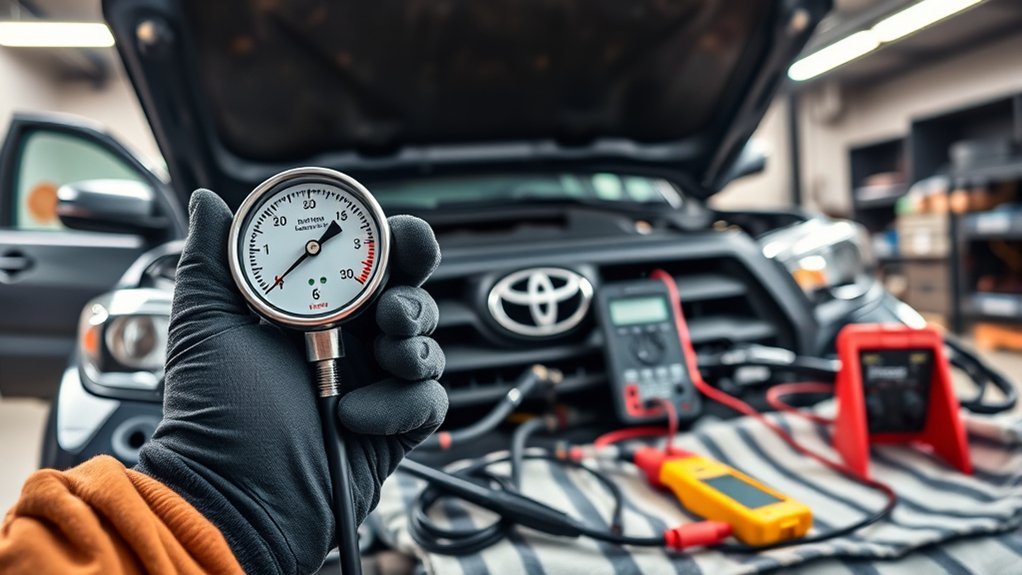
Move to fuel-system diagnosis only if the engine cranks at a normal speed but does not start, or if test results point toward fuel delivery.
Confirm the Fuel Level
Check the gauge, but do not rely on it completely if the truck is parked on a steep slope or the sender has behaved incorrectly. Add a small amount of the correct fuel when an empty tank is reasonably possible.
Listen for the Pump, but Do Not Treat Sound as Proof
You may hear a brief hum when the ignition is switched on or during a starting attempt. The sound is only a clue. A pump can run without producing enough pressure, and some control strategies do not operate the pump in the same way during every key cycle.
No sound can result from the pump, fuse, relay, wiring, ground, control command, or test conditions. Check the fuse and relay locations in the model-year manual before removing or swapping components.
Check Codes and Fuel Pressure
An OBD-II scan may reveal fuel-pressure, injector-circuit, crankshaft-signal, or communication faults. Professional testing can confirm fuel pressure, pressure retention, pump power and ground, injector command, and fuel quality.
Do not rely on fuel-system cleaner to correct a no-start. Cleaner cannot repair a failed pump, blown fuse, damaged injector circuit, missing control signal, contaminated fuel, or severe mechanical blockage.
Warning: Stop cranking if you smell strong raw fuel or see wet fuel around the engine, tank, or lines. Keep ignition sources away and arrange professional inspection or towing.
What Should You Check If the Tacoma Does Not Crank?
The starter circuit deserves attention when the engine does not rotate, especially after the battery and cable connections pass testing.
Interpret the Sound Carefully
- Rapid clicks: Recheck battery charge, terminal contact, grounds, and voltage drop.
- One heavy click: Test battery voltage under load, starter power, starter ground, solenoid command, and engine rotation.
- No click: Check the key or start-button command, brake or clutch input, park/neutral switch, immobilizer, starter fuse, relay, and control wiring.
- Grinding: Stop immediately. Continued attempts can damage the starter drive or flywheel teeth.
Inspect the Starter Connections
Do not work near the starter until the truck is safely secured and the battery is disconnected according to the correct service procedure. The starter’s main power cable can carry very high current.
A technician can perform voltage-drop tests on the positive and ground sides of the circuit while the starter is commanded. This identifies resistance in cables, terminals, grounds, relays, or connections that may look normal during a visual inspection.
Test the Command Circuit
If battery power reaches the starter but the starter receives no control signal, the problem may be upstream. Possible causes include the starter relay, ignition switch or start button, park/neutral switch, clutch switch, brake input, immobilizer, wiring, or an engine-control command.
Avoid tapping the starter with a hammer. Impact can damage the housing, internal magnets, wiring, or nearby parts and does not provide a complete diagnosis.
Replace the starter only after testing confirms that it receives proper power, ground, and control but cannot crank the engine correctly.
What to Check When the Engine Cranks but Won’t Start
If the engine rotates at a normal speed, the battery and starter have completed their main job. The next checks involve fuel, ignition, sensor information, immobilizer authorization, engine compression, and control-module power.
Scan Before Replacing Parts
Read stored, pending, and permanent trouble codes. Codes involving the crankshaft-position sensor, camshaft-position sensor, ignition coils, fuel pressure, throttle control, immobilizer, or network communication can narrow the test plan.
A missing engine-speed signal on live scan data during cranking can be an important clue, but wiring and signal testing should confirm the cause before a sensor is replaced.
Check Ignition and Engine-Management Power
A blown engine-control or ignition fuse can cause normal cranking without spark or injector operation. Use the fuse diagram for the exact model year and replace a fuse only with the specified rating.
If a replacement fuse blows again, stop replacing it. A short circuit or failed component must be located first.
Consider Recent Work or an Impact
If the no-start began after battery service, engine work, accessory installation, off-road use, or a collision, inspect the areas that were disturbed. A loose ground, disconnected sensor, pinched harness, damaged fuse, or improperly installed accessory can interrupt the starting system.
Why Won’t a Hybrid Tacoma Enter READY Mode?
Toyota’s 2026 Tacoma lineup includes an available i-FORCE MAX hybrid powertrain. On a hybrid, the key question is whether the truck enters READY mode. The gasoline engine may not start immediately even when the hybrid system is ready to drive.
A discharged 12-volt auxiliary battery can prevent the control systems from booting and stop READY mode. Safe 12-volt terminal checks may still apply, but jump-start points and procedures must come from the model-year manual.
Do not touch, test, disconnect, or probe orange high-voltage cables, the traction battery, inverter, electric motor, or high-voltage connectors. If the hybrid-system warning appears, the truck was flooded or crashed, or high-voltage components may be damaged, arrange professional service.
For a plain-language overview of the current hybrid hardware, see Toyota Tacoma i-FORCE MAX hybrid system explained.
When Should You Stop Troubleshooting and Call for Help?
Arrange roadside assistance, towing, or professional diagnosis when:
- The battery is cracked, swollen, leaking, frozen, or repeatedly overheats.
- You see smoke, sparks, melted insulation, or glowing connections.
- You smell strong raw fuel or find a visible fuel leak.
- The engine grinds, locks, or stops rotating suddenly.
- A replacement fuse blows again.
- The security system rejects all registered keys.
- The starter receives proper power and command but will not crank.
- The engine cranks normally but fuel pressure, spark, or sensor testing requires specialized equipment.
- A hybrid warning appears or an orange high-voltage component may be damaged.
For recurring or unexplained problems, check your VIN through the Toyota Safety Recall and Service Campaign lookup and the NHTSA recall database.
How Can You Prevent Another Tacoma No-Start?
- Have the battery load-tested when cranking slows or after repeated jump-starts.
- Keep battery terminals and engine grounds clean, tight, and dry.
- Replace a weak key-fob battery before recognition becomes intermittent.
- Turn off added lights, inverters, chargers, and accessories before parking.
- Investigate repeated battery discharge instead of assuming the battery is defective.
- Test the charging system after a jump-start or battery replacement.
- Use properly fused wiring for aftermarket accessories.
- Review open recalls and campaigns by VIN.
Related Toyota Tacoma Guides
- Toyota Tacoma Push-Button Start Explained
- How to Replace a Toyota Tacoma Battery
- How to Replace a Toyota Tacoma Key-Fob Battery
- How to Replace a Toyota Tacoma Alternator (conventional gas models)
- Toyota Tacoma i-FORCE MAX Hybrid System Explained
Frequently Asked Questions
What would cause a Toyota Tacoma not to start?
Common causes include a discharged battery, loose or corroded cables, a failed starter circuit, a park/neutral or clutch interlock problem, smart-key or immobilizer trouble, a blown fuse, low fuel pressure, missing ignition, failed sensor signals, or an engine-control fault. The correct path depends on whether the engine cranks.
Why does my Toyota Tacoma have power but not start?
Dashboard power requires far less current than the starter. The truck may still have a weak battery, poor terminal connection, damaged ground, starter fault, relay problem, interlock failure, or immobilizer issue. Test the battery under load and note whether you hear rapid clicks, one click, or no click.
Why is my Tacoma clicking but not starting?
Rapid clicking usually means the starter solenoid is repeatedly engaging and dropping out because voltage is too low or a connection has excessive resistance. One solid click may point toward the starter, solenoid, cable circuit, battery under load, or a mechanical problem. Test before replacing the starter.
Why does my Tacoma crank but not start?
Normal cranking with no start shifts attention toward fuel pressure, ignition, crankshaft or camshaft sensor signals, immobilizer authorization, engine-control power, wiring, and mechanical compression. Scan for trouble codes before replacing fuel or ignition parts.
How do I get a Toyota out of lock mode?
First identify whether you mean steering lock, shift lock, smart-key detection, or the immobilizer. Confirm the transmission position, use a registered spare key, replace the fob battery, and follow the depleted-key procedure in the model-year manual. Disconnecting the battery is not a universal lock-mode repair.
Can a bad key-fob battery stop a Tacoma from starting?
It can interfere with wireless smart-key detection on equipped models. Try a registered spare key and use the emergency recognition procedure listed in the owner’s manual. If neither key works or the security indicator behaves abnormally, professional immobilizer diagnosis may be needed.
Why will my hybrid Tacoma not enter READY mode?
Possible causes include a discharged 12-volt auxiliary battery, an unrecognized key, an interlock input, a control-system fault, or a hybrid-system warning. Follow the model-year manual for safe 12-volt checks and do not touch orange high-voltage components.
Conclusion
If your Toyota Tacoma won’t start, avoid guessing from one click, warning light, or voltage reading. First decide whether the engine cranks, then check the battery and connections, starting interlocks, smart key, fuses, and stored codes in a logical order.
Basic observations can solve a loose-terminal, discharged-battery, shifter, clutch, or key-detection problem. Fuel-pressure, starter-circuit, immobilizer, engine-management, and hybrid faults often require proper test equipment and model-specific service information. Stop when you find damaged electrical parts, raw fuel, smoke, or a high-voltage warning.
Sources
- Toyota Manuals and Warranties — model-specific starting, smart-key, fuse, battery, and jump-start procedures.
- Toyota Tacoma Official Model Page — current gas and i-FORCE MAX hybrid powertrain information.
- Toyota Technical Information System — factory repair, electrical, diagnostic, and service information.
- Toyota Safety Recall and Service Campaign Lookup — VIN-based Toyota campaign information.
- National Highway Traffic Safety Administration Recall Lookup — federal VIN-based safety recall records.
- Haynes Battery Testing Guide — general 12-volt resting-voltage and load-test context.
