Your Toyota Tundra can stay dependable for many years, but no mileage number is guaranteed. The best way to protect its engine is to follow the maintenance guide for your exact model year, shorten applicable intervals during severe use, and respond quickly to leaks, overheating, warning lights, or unusual sounds.
Last updated: July 12, 2026
Quick Answer
To extend your Toyota Tundra’s engine life, use the exact oil and service schedule for its model year, check the oil monthly, prevent overheating, maintain the cooling and driveline systems, use the door-placard tire pressure, reduce severe towing stress, check recalls by VIN, and repair warning signs promptly.
Key Takeaways
- Use the maintenance guide for your exact year, engine, drivetrain, hybrid status, and market.
- Follow both mileage and time limits, whichever comes first.
- Dust, repeated short winter trips, towing, heavy loading, road salt, and off-road use can require extra service.
- Never use a generic tire-pressure number. Use the cold specification on the driver-door placard.
- Maintenance records, recall repairs, and early diagnosis protect reliability and resale value.
At a Glance
| Time Required | About 10–20 minutes for monthly owner checks; scheduled services take longer. |
| Difficulty | Easy for visual checks; moderate to advanced for fluid and mechanical service. |
| Tools Needed | Owner’s manual, maintenance guide, accurate tire gauge, flashlight, gloves, clean cloth, and service records. |
| Cost | Monthly checks usually cost nothing. Parts and labor vary by model, location, and required service. |
Understanding the Lifespan of Your Toyota Tundra

No single mileage figure defines how long a Toyota Tundra engine will last. Engine generation, previous maintenance, towing frequency, climate, corrosion, idle time, driving habits, repair quality, and overheating history all affect the result.
Claims that every Tundra should last 150,000 to 250,000 miles, or that most will exceed 300,000 miles, are too broad. A carefully maintained truck may travel far beyond those figures, while a neglected or overheated engine may fail much earlier.
Toyota has documented an exceptional case involving Victor Sheppard’s 2007 Tundra, which passed one million miles. Toyota later examined the truck to learn from its durability. That example shows what is possible under unusual operating and maintenance circumstances, but it is not a promised lifespan for other Tundras.
Toyota documented a 2007 Tundra that exceeded one million miles, but individual engine life still depends on use, condition, maintenance history, and repairs.
Start With the Correct Tundra Maintenance Guide
Before choosing an interval, identify your truck’s model year, engine, drivetrain, and whether it uses the i-FORCE MAX hybrid system. Then download the matching guide from Toyota’s manuals and warranties page.
Toyota’s current U.S. 2026 Tundra guide schedules maintenance visits every 5,000 miles or six months, whichever comes first. That does not mean every item is replaced at every visit. Each service point combines inspections, rotations, adjustments, or replacements based on mileage and operating conditions.
Note: A 2026 interval should not automatically be applied to a 2007, 2014, or 2021 Tundra. Older engines, transmissions, coolants, spark plugs, and oil specifications may use different schedules.
Normal Service vs. Special Operating Conditions
Toyota lists extra maintenance for trucks used mainly under demanding conditions. Depending on model year, these can include:
- Regular driving on dirt or dusty roads
- Repeated trips shorter than five miles in below-freezing weather
- Frequent towing, heavy loading, or use of a roof-mounted carrier
- Driving on roads treated with salt
- Off-road travel through deep sand, mud, or water
Occasional exposure may not trigger every severe-service item. Review the footnotes in your specific maintenance chart instead of choosing a shorter interval without context.
Step-by-Step Maintenance Practices for Your Tundra
A long-lasting Tundra depends on repeated small checks rather than one major service. Build your routine around the factory schedule and record the date, mileage, work performed, fluid specification, and parts used.
Routine Oil Changes
Engine oil lubricates bearings, piston rings, timing components, camshafts, turbocharger parts where equipped, and other moving surfaces. Use the oil viscosity, quantity, and performance standard listed for your exact engine.
For the U.S. 2026 Tundra, Toyota permits oil and filter replacement at up to 10,000 miles or 12 months under qualifying normal operation. Toyota shortens the interval to 5,000 miles or six months when the truck is driven mainly on dirt or dusty roads or takes repeated trips shorter than five miles in temperatures below 32°F or 0°C.
- Check the engine-oil level about once a month and before long trips.
- Park on level ground and follow the manual’s required checking procedure.
- Use the specified oil grade and viscosity rather than choosing oil by brand alone.
- Replace the oil filter whenever the maintenance guide requires an oil change.
- Inspect for leaks around the drain plug, filter, oil pan, valve covers, turbo oil lines, and underbody.
- Do not overfill the crankcase. Excess oil can also cause operating problems.
Pro Tip: Keep the oil-change receipt and note the exact oil specification and mileage. A complete record helps with troubleshooting, warranty questions, and resale.
Tire Rotation Schedule
Tire rotation does not directly lubricate the engine, but it supports stable handling, even tread wear, and predictable load transfer. Uneven or underinflated tires can also increase rolling resistance and make the powertrain work harder.
The current U.S. 2026 Tundra maintenance chart lists tire rotation at each 5,000-mile service point. Your year, tire type, wheel setup, and tire manufacturer may require a different pattern, so use the applicable guide.
Inspect tread, sidewalls, wheel damage, and uneven wear during every rotation. Persistent inside-edge, outside-edge, cupping, or feathered wear may indicate an alignment, balance, suspension, or pressure problem.
Why Do Regular Oil Changes Matter for Your Engine?
Oil gradually collects combustion byproducts, moisture, fuel dilution, and wear particles. Heat and time also weaken its protective properties. Delaying service beyond the applicable limit can increase deposits, friction, oil consumption, bearing wear, and turbocharger stress.
- Fresh oil maintains a protective film between moving parts.
- The oil filter captures particles before they circulate through sensitive components.
- Correct viscosity supports cold-start flow and high-temperature protection.
- Routine level checks can reveal consumption or leaks before the engine runs dangerously low.
- Documented oil service supports diagnosis and demonstrates responsible ownership.
Warning: Stop the engine as soon as it is safe if the oil-pressure warning appears, the engine develops loud knocking, or the oil level is critically low. Continued operation can turn a repairable problem into severe engine damage.
Fluid Maintenance Tips for Your Toyota Tundra
Fluid maintenance should follow the chart for your exact Tundra. Avoid applying one replacement interval to every generation or assuming that a fluid is “lifetime” without checking Toyota’s inspection and severe-use requirements.
Engine, Intercooler, and Inverter Coolant
Check coolant only when the engine is cool and follow the reservoir markings in the owner’s manual. Low coolant, repeated coolant loss, contamination, damaged hoses, blocked cooling fins, or a weak pressure cap can contribute to overheating.
As one current example, Toyota’s U.S. 2026 Tundra guide calls for the initial engine or intercooler coolant replacement, where applicable, at 100,000 miles or 120 months. It then specifies replacement every 50,000 miles or 60 months. Other model years may differ.
Hybrid models also have inverter-related cooling requirements. The current hybrid guide lists a separate initial inverter or intercooler coolant replacement at 150,000 miles or 180 months, followed by 50,000-mile or 60-month intervals where applicable.
Transmission, Differential, and Transfer-Case Fluids
Inspect sealed transmissions, differentials, and transfer cases for leakage at the intervals listed in the guide. Fluid type, checking procedure, and fill temperature can be highly specific, so these services are often best handled by a qualified technician.
The U.S. 2026 guide includes automatic-transmission-fluid replacement at 60,000-mile intervals when the truck is used primarily for towing, a car-top carrier, or heavy loading. Normal-use inspection and replacement requirements differ, and older Tundras may use another schedule.
Four-wheel-drive trucks also require attention to front and rear differential oil, transfer-case oil, drive-shaft boots, propeller-shaft fasteners, and related seals. Water crossings, road salt, towing, and dusty off-road operation can add inspection or replacement requirements.
Brake and Power-Steering Fluid
Inspect brake-fluid level and condition according to the maintenance guide. Replace it when required by the applicable manual, a repair procedure, contamination, moisture testing, or a qualified technician’s condition assessment. Do not assume that every Tundra uses one universal flush interval.
Check power-steering fluid only if your truck is equipped with a serviceable hydraulic system. Some Tundras use steering systems without a conventional fluid reservoir.
Prevent Overheating Before It Damages the Engine
Overheating can damage cylinder heads, gaskets, bearings, turbocharger components, seals, and engine oil. Inspect the radiator, condenser, intercooler, coolant reservoirs, hose connections, and visible fins for leaks, corrosion, impact damage, leaves, mud, and insect buildup.
- Investigate repeated coolant loss instead of repeatedly topping off the reservoir.
- Confirm that the radiator and intercooler areas remain clear after off-road driving.
- Replace cracked, swollen, leaking, or oil-softened hoses.
- Have abnormal fan operation, temperature fluctuations, coolant odors, or steam diagnosed promptly.
- Use coolant that meets Toyota’s exact chemistry and compatibility requirements.
Warning: Do not remove a radiator or pressurized coolant cap while the engine is hot. If the temperature warning appears or steam is visible, stop safely and follow the overheating procedure in the owner’s manual.
Maintain Filters, Spark Plugs, Belts, Hoses, and the Battery
An engine needs clean air, reliable ignition, stable voltage, and intact cooling and vacuum connections. Inspect these items at their scheduled intervals and earlier when symptoms appear.
- Engine air filter: Replace it at the model-specific interval and inspect it more often in dust. A damaged or poorly sealed filter can allow abrasive dirt into the intake.
- Spark plugs: Use the same type and specification Toyota requires. Incorrect heat range, gap, or installation torque can cause misfires or thread damage.
- Drive belts: Inspect for cracking, glazing, missing ribs, contamination, noise, and tension problems.
- Hoses and connections: Check for leaks, swelling, hardened rubber, abrasion, loose clamps, and corrosion.
- Battery and charging system: Clean corrosion safely, secure the battery, and test weak-start or low-voltage symptoms before they cause repeated starting problems.
Hybrid Tundra Cooling-Intake Care
If you own an i-FORCE MAX Tundra, keep the hybrid battery cooling intake and filter unobstructed. The U.S. 2026 hybrid guide calls for a visual dirt or dust check every 5,000 miles and cleaning every 20,000 miles.
Do not cover the intake with cargo, seat covers, pet hair, clothing, or debris. Follow the owner’s manual cleaning procedure rather than forcing compressed air or liquid into the system.
Effective Tire Maintenance for Safety and Longevity

Tire care supports safe braking, predictable handling, even driveline loading, and efficient operation. Check all tires, including the spare if equipped, when they are cold.
- Inflate each tire to the cold-pressure specification on the driver-door placard or in the exact owner’s manual.
- Never assume that 50 psi, the tire sidewall maximum, or another truck’s setting is correct for your Tundra.
- Inspect tread and pressure at least monthly and before towing or long trips.
- Replace tires at the applicable legal or safety limit. NHTSA identifies 2/32 inch as the minimum safe tread threshold in the United States.
- Look for cuts, bulges, cracking, punctures, exposed cords, vibration, and irregular wear.
- Correct alignment, suspension, balance, or pressure problems that cause repeated uneven wear.
Wet and winter traction can decline before tread reaches the minimum limit. Consider climate, tire age, damage, and performance rather than relying on tread depth alone.
How Does Your Driving Style Affect Your Engine’s Lifespan?
Your driving habits affect engine temperature, oil stress, turbocharger load, transmission heat, and fuel dilution. Smooth acceleration and planned braking generally place less strain on the powertrain than repeated full-throttle acceleration and abrupt stops.
- Drive gently until the engine reaches normal operating temperature.
- Avoid high engine load immediately after a cold start.
- Do not race the engine while parked to “warm it up.”
- Avoid unnecessary extended idling.
- Use the correct gear, drive mode, and towing settings for the task.
- Investigate new vibration, hesitation, smoke, misfires, or fuel-economy changes.
- Never exceed the truck’s payload, axle, tire, hitch, or trailer ratings.
Steady highway driving can be easier on many components than repeated short trips because the engine reaches full operating temperature. Short winter trips may leave moisture and fuel in the oil, which is why Toyota treats repeated sub-five-mile cold trips as a special operating condition in its current guide.
Adjust Maintenance for Towing, Heavy Loads, and Off-Road Use
Towing and heavy loading increase heat and stress in the engine, cooling system, transmission, differential, brakes, tires, and wheel bearings. Use the owner’s manual to confirm the truck’s exact ratings and required equipment before towing.
- Check engine oil, coolant, tires, hitch hardware, lights, and brake operation before a trip.
- Use the correct trailer tongue weight and avoid exceeding axle or payload limits.
- Follow severe-use fluid intervals where the maintenance guide requires them.
- Watch engine and transmission temperatures during long climbs or hot-weather towing.
- After deep mud, water, or sand, inspect brakes, air intake, driveline boots, underbody, radiator areas, and fluid leaks.
- Clean road salt and packed debris from the underbody before corrosion spreads.
Toyota’s current guide lists daily inspections after off-road travel through deep sand, mud, or water. These include checks of the air filter, brakes, differential, drive-shaft boots, transmission, steering components, and transfer case where applicable.
When to Seek Professional Maintenance Help
Routine owner checks can uncover problems, but some symptoms require diagnostic equipment, a lift, pressure testing, scan data, or model-specific procedures.
Arrange professional diagnosis when you notice:
- An oil-pressure, temperature, charging, hybrid-system, or check-engine warning
- Engine knocking, persistent ticking, rattling, or sudden valvetrain noise
- Blue, white, or heavy black exhaust smoke
- Repeated coolant or oil loss
- Rough running, misfires, stalling, hesitation, or difficult starting
- Transmission slipping, delayed engagement, harsh shifts, or fluid leakage
- Burning smells, steam, or rapidly rising temperature
- Reduced power while towing or climbing
- Metal particles in drained fluid or an oil filter
The maintenance-required reminder generally signals scheduled service rather than a specific mechanical failure. Warning lights, overheating, oil-pressure alerts, and severe noises require a different level of urgency.
Check Your Tundra for Open Recalls and Service Campaigns
A perfect oil-change history cannot prevent every manufacturing defect. Enter your VIN or eligible license-plate information in Toyota’s recall and service-campaign lookup and complete applicable remedies promptly.
Recall coverage depends on the VIN rather than a broad model-year assumption. Recheck periodically, especially after buying a used Tundra or changing your contact information.
Note: Recall repairs are separate from routine maintenance. Do not pay an independent shop to guess at a recall remedy before confirming your VIN and speaking with an authorized Toyota dealer.
Choose Correct Parts and Fluids
Toyota recommends Toyota Genuine Parts, but the brand name alone does not determine whether a part is suitable. The replacement must have the correct fit, material, capacity, calibration, filtration performance, and specification for your truck.
Toyota’s current warranty guide states that coverage is not dependent on using one particular replacement-parts brand. However, Toyota does not cover damage caused by unsuitable parts or improper installation. Keep receipts and product specifications for aftermarket parts and fluids.
Boosting Resale Value and Performance
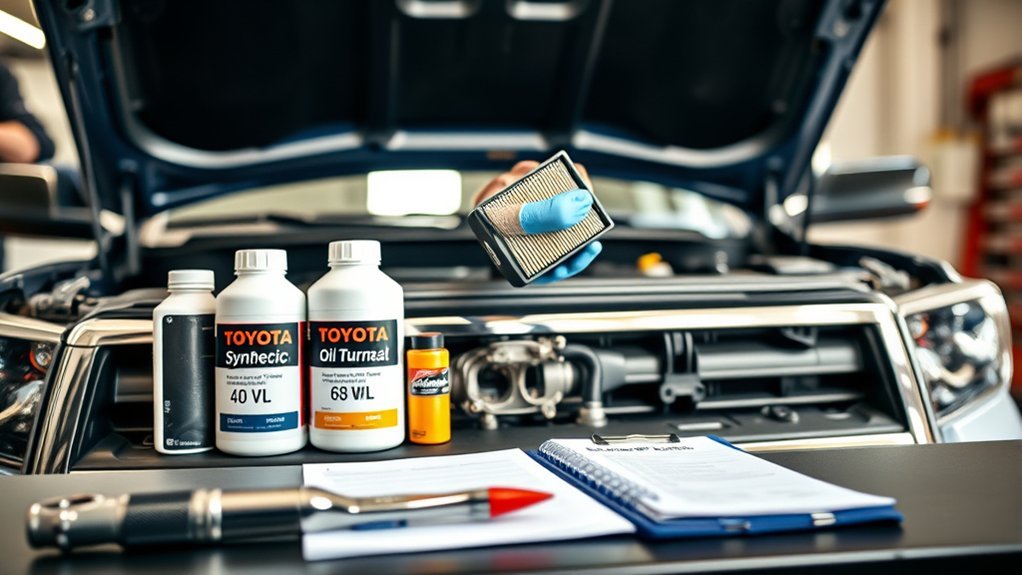
Consistent maintenance can preserve drivability, reduce preventable breakdowns, and make a used Tundra easier to evaluate. Buyers often value organized records more than unsupported claims about how carefully a truck was maintained.
Keep a folder or digital record containing:
- Oil and filter receipts
- Fluid specifications and service dates
- Tire rotations, alignments, and replacements
- Cooling-system, brake, transmission, and differential work
- Spark-plug, belt, hose, and air-filter replacements
- Recall and service-campaign completion records
- Diagnostic reports and major repair invoices
Air-filter replacement should follow the applicable schedule rather than a universal 15,000-to-30,000-mile rule. The current U.S. 2026 guide lists engine-air-filter replacement at 30,000-mile intervals under normal service and more frequent inspections during dusty-road use.
Related Guides
Frequently Asked Questions
How many miles will a Tundra engine last?
Toyota does not publish a guaranteed or average engine lifespan. Some Tundras have reached very high mileage, including one documented million-mile truck, but your result depends on the engine generation, workload, climate, overheating history, corrosion, repairs, and maintenance record.
Should you change Tundra oil every 5,000 or 10,000 miles?
Use the maintenance guide for your exact model year and operating conditions. The current U.S. 2026 guide allows up to 10,000 miles or 12 months under qualifying normal service but requires 5,000 miles or six months for certain dusty-road and repeated cold, short-trip use. Older Tundras may use another interval.
How can you increase your Tundra engine’s lifespan?
Check the oil monthly, use the specified fluids, prevent overheating, maintain filters and ignition parts, service the driveline for your usage, keep tires correctly inflated, avoid overloading, correct warning signs promptly, complete recalls, and maintain detailed service records.
What is the 30-60-90 rule for cars?
The 30-60-90 rule is informal shorthand for reviewing major services at 30,000-mile increments. It is not a universal Toyota standard. Your Tundra’s factory maintenance chart, including its mileage, time, and severe-use footnotes, should control the actual work.
What makes a Toyota engine last so long?
Design and manufacturing quality matter, but maintenance and use remain critical. Correct oil, stable cooling, clean intake air, proper ignition, suitable fluids, careful warm-up, sensible loading, and early repairs all influence how long an individual engine remains serviceable.
What tire pressure should a Toyota Tundra use?
Use the cold tire-pressure specification on the driver-door placard or in the exact owner’s manual. Do not use a generic 50 psi recommendation or the maximum pressure printed on the tire sidewall.
Does towing change Tundra maintenance intervals?
It can. Frequent towing and heavy loading may trigger extra transmission, differential, transfer-case, chassis, and driveline service. Review the special-operating-condition footnotes in the guide for your exact truck.
Conclusion
You can give your Toyota Tundra the best chance of a long engine life by following its exact maintenance guide instead of relying on generic mileage rules. Check the oil, prevent overheating, maintain the cooling and driveline systems, adjust service for towing or harsh use, use the correct tire pressure, complete recalls, and investigate warning signs early.
No routine can guarantee a certain mileage, but consistent service and complete records reduce preventable wear, support dependable operation, and protect your truck’s resale value.
Sources
- Toyota 2026 Tundra Warranty & Maintenance Guide — scheduled maintenance, oil intervals, fluids, severe use, filters, spark plugs, and inspections.
- Toyota 2026 Tundra Hybrid Warranty & Maintenance Guide — hybrid battery cooling-filter and inverter-coolant maintenance.
- Toyota Manuals and Warranties — model-year-specific owner’s manuals and maintenance guides.
- Toyota USA Newsroom: Million-Mile Tundra — documented Victor Sheppard high-mileage example.
- NHTSA TireWise — tire pressure, inspection, and tread-safety guidance.
- Toyota Recall and Service Campaign Lookup — VIN-based recall and campaign status.