
Just like a well-executed flight plan, getting local drone clients takes focus, timing, and a clear strategy. You are not only selling aerial photos, mapping, inspections, or video. You are solving real business problems for local companies that need better visuals, safer site data, faster reporting, or stronger marketing assets. The best place to start is by choosing the right industries, building a simple outreach system, and following up with useful content that proves your value.
Quick Answer
To get local drone clients, focus on industries that already need aerial data or visuals, such as real estate, construction, agriculture, roofing, surveying, and local government. Then use personalized outreach, proof-based follow-ups, networking, and a simple lead funnel to turn prospects into booked projects.
Key Takeaways
- Start with local industries that already understand the value of aerial imagery, inspections, mapping, or progress documentation.
- Personalize every outreach message around the client’s business, location, pain point, and likely return on investment.
- Use a simple funnel: awareness, engagement, consultation, proposal, booking, and follow-up.
- Networking works best when you focus on useful relationships, not quick sales pitches.
- Track response rates, booked calls, proposal wins, and repeat clients so you can improve your outreach over time.
At a Glance
| Time Required | 1 to 3 weeks to build your list, write outreach, send messages, follow up, and start booking calls |
| Difficulty | Moderate, because success depends on niche selection, proof, consistent follow-up, and clear offers |
| Tools Needed | Prospect list, email or DM templates, portfolio samples, CRM or spreadsheet, follow-up calendar, and a simple proposal template |
| Cost | Low if you use manual outreach, higher if you add paid ads, CRM software, portfolio hosting, or printed local marketing materials |
Identifying Target Local Industries for Drone Services
When looking to attract local drone clients, you need to identify industries that already benefit from aerial services. Focus first on real estate, agriculture, construction, surveying, roofing, insurance, events, tourism, and local government work. These sectors often use drones for aerial imagery, inspections, land assessments, site progress updates, marketing videos, and safer visual documentation.
Commercial drone work continues to grow because businesses want faster visuals, safer inspections, and better data without sending people into risky or hard-to-reach areas. Instead of pitching “drone services” in a general way, connect your offer to a business result. A real estate agent wants listings to stand out. A builder wants jobsite progress documented. A farmer may need crop monitoring support. A roofing company may need safer inspection images.
In real estate, drone photos and videos can help agents show lot size, neighborhood context, waterfront access, acreage, rooflines, and large properties more clearly than ground-level photos alone. For local agents, your offer might be a listing media package that includes aerial photos, short video clips, and a quick turnaround time.
In agriculture, drone services can support crop scouting, field overview images, irrigation checks, plant health monitoring, and seasonal reporting. The best prospects are usually farms, agronomists, co-ops, and agricultural consultants that already use data to make field decisions.
Construction and surveying clients often care about documentation, accuracy, safety, and repeatable reporting. You can position drone work as a way to capture progress photos, site overviews, stockpile visuals, drainage concerns, access roads, and before-and-after project records.
Do not overlook local governments either. Municipal departments may use drones for infrastructure inspections, emergency planning, public works documentation, drainage reviews, and urban planning support. These opportunities may take longer to close, but they can open the door to public sector contracts and repeat work.
Note: Paid drone work may require specific licenses, insurance, permissions, or airspace approvals depending on your country, state, and project type. Confirm the rules that apply before you sell or perform commercial drone services.
Choosing a Profitable Local Drone Niche
Before you send outreach messages, narrow your offer. Many new operators make the mistake of saying they can do everything: photos, videos, mapping, inspections, weddings, events, agriculture, and construction. That sounds flexible, but it can also feel vague to a buyer.
A stronger approach is to choose one or two local niches first. You can expand later after you have proof, testimonials, and repeatable packages. Start by comparing three things: demand, budget, and ease of access.
- Demand: Are local businesses already using aerial visuals, inspections, mapping, or project documentation?
- Budget: Can the client justify paying for drone services because the work helps them sell, save time, reduce risk, or document assets?
- Access: Can you reach decision-makers through email, social media, phone, local events, or referrals?
- Repeat potential: Will the client need one project, or can they hire you monthly, seasonally, or for every listing or jobsite?
For example, real estate can be easier to enter because agents are visible online and need fresh listing content often. Construction may take more trust-building, but it can produce repeat monthly work. Agriculture may require more technical knowledge, yet it can offer seasonal recurring opportunities.
Crafting Personalized Outreach Scripts

Having identified key local industries for your drone services, the next step is crafting personalized outreach scripts that resonate with potential clients. Start by researching each prospect’s business, recent projects, listings, service area, and visible marketing gaps. Then pinpoint specific pain points your drone services can solve. This makes your message relevant, direct, and easier to answer.
Use a conversational tone in your scripts to build rapport and make potential clients feel comfortable. Avoid sounding like a mass email. Mention something specific, such as a recent listing, a project they completed, a local development, a property type they sell, or a service they promote.
Incorporate success stories, sample images, or short case studies that show your expertise. Even if you are new, you can build sample projects by photographing permitted locations, creating mock listing videos, or documenting a non-client site with permission. The goal is to show what your work can help them achieve.
Building rapport through a conversational tone and sharing success stories will showcase your expertise and value.
Do not forget to include a clear call to action. Ask for one simple next step, such as scheduling a 10-minute call, reviewing a sample gallery, or letting you quote their next project. A message with no clear next step often gets ignored, even if the prospect likes the idea.
Tailor your outreach by referencing local events, neighborhood growth, seasonal demand, new developments, or community initiatives that align with your services. This shows you understand the local market and are not sending the same message to every business.
Simple Local Drone Outreach Script
Use this structure when you contact a local business for the first time:
- Personal opener: Mention the business, project, listing, location, or service you noticed.
- Pain point: Explain the problem your drone service can help solve.
- Value: State the outcome, such as better marketing, safer inspection, faster documentation, or clearer reporting.
- Proof: Include a short portfolio link, sample image, or relevant example.
- Call to action: Ask for a quick call, quote request, or permission to send examples.
Here is a simple example for real estate agents:
Hi [Name], I saw your recent listings in [Area]. A few of those properties would really benefit from aerial photos that show lot size, access, and neighborhood layout. I help local agents create clean drone visuals for listings, social posts, and short property videos. Would you like me to send over a few examples for your next listing?
For construction companies, shift the focus from marketing to documentation:
Hi [Name], I noticed your team works on projects around [Area]. I help local builders capture aerial progress photos and site overview images so owners, managers, and subcontractors can see what changed without needing extra site walks. Would a monthly progress photo package be useful for one of your active jobs?
Building a Client Acquisition Funnel
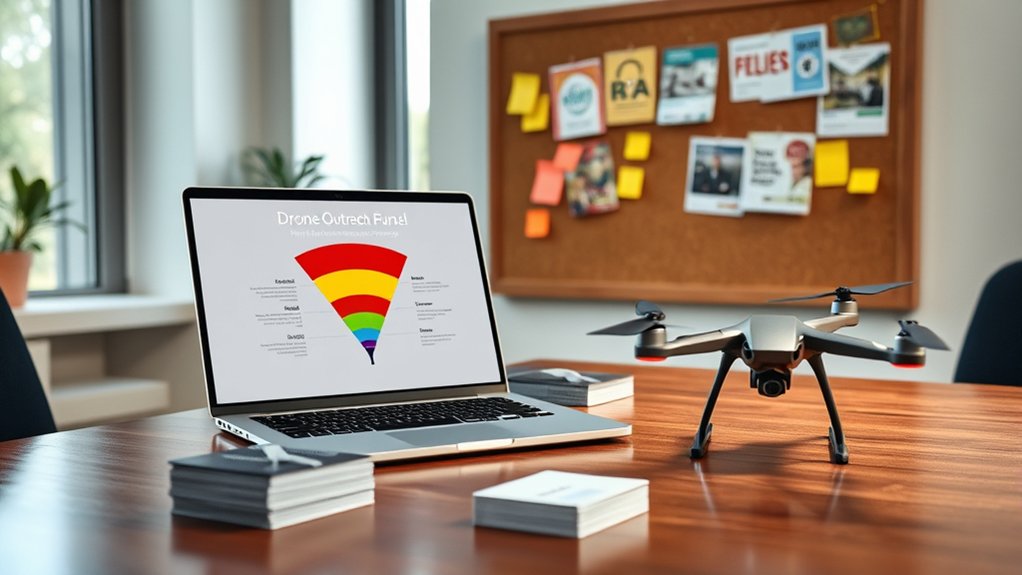
To build an effective client acquisition funnel, you need to clearly define your target audience first. A funnel gives your outreach structure, so you are not randomly messaging businesses and hoping someone replies.
Once you know who you are speaking to, craft engaging outreach messages that match their specific needs. A roofing company, real estate agent, farm owner, and construction manager all care about different outcomes, so each one needs a different angle.
Finally, optimize your conversion strategies so you are not just attracting leads. You also need to move them toward calls, quotes, booked projects, repeat work, and referrals.
Define Target Audience Clearly
Defining your target audience clearly is critical for building a successful client acquisition funnel. Start by identifying specific industries or niches that need drone services, like real estate, agriculture, construction, roofing, surveying, insurance, tourism, or local events.
Understand the demographics, pain points, buying triggers, and preferences of your ideal clients. This helps you tailor your messaging effectively. For example, a real estate agent may care about faster listing media, while a contractor may care about safer site documentation and progress reports.
Using tools like buyer personas can help you visualize your audience and create outreach that feels more relevant. Your persona should include the client type, job title, likely budget, main pain point, common objection, and best contact channel.
Segmenting your audience based on geographic location, business size, and service needs ensures your outreach efforts are focused and relevant. A small local agent may need a simple photo package, while a larger commercial developer may need recurring aerial progress documentation.
Finally, regularly analyze and update your target audience based on market trends, client feedback, and your actual win rate. This ongoing refinement will improve your funnel and help you spend more time with prospects who can actually buy.
Craft Engaging Outreach Messages
How can you grab the attention of potential clients with your outreach messages? Start by personalizing your messages to highlight specific pain points they face. This increases the chances of engagement because the prospect can quickly see why your message matters.
Use a clear call to action, guiding them on what steps to take next. Visuals can make a huge impact, so include drone imagery, a short reel, a small gallery, or a before-and-after example to showcase your abilities effectively.
Additionally, do not forget to craft follow-up messages that deliver extra value, like case studies, project ideas, seasonal tips, or industry insights. Follow-up should not feel like pressure. It should remind the prospect that you understand their business and can help.
- Personalize messages to address specific needs
- Include a clear call to action
- Use engaging visuals, such as drone images or short video clips
- Provide valuable follow-ups to nurture leads
- Keep each message short enough to read quickly
- Lead with business value instead of drone features
Optimize Conversion Strategies Effectively
Building a successful client acquisition funnel is essential for converting leads into loyal customers. Start by analyzing your current marketing efforts to find areas for improvement. Focus on personalized DMs and emails that address specific client pain points, while crafting compelling offers that highlight the benefits of your drone services.
| Stage | Focus on |
|---|---|
| Awareness | Tailored messaging |
| Engagement | Compelling offers |
| Conversion | Streamlined sales process |
Prepare customized pitch decks for meetings to address unique challenges and anticipate questions. Your pitch does not need to be long. It should show the client what you do, why it helps, what similar work looks like, what is included, and how the next step works.
Regularly analyze your funnel and make sure clear calls to action guide leads toward making a decision. This strategy transforms potential clients into committed customers because it removes confusion and makes your service easier to buy.
Build a Simple Drone Service Offer
Your outreach will work better when your offer is easy to understand. Instead of asking prospects to imagine what they need, package your services around outcomes.
- Real estate listing package: Aerial photos, short vertical clips, and exterior property video.
- Construction progress package: Monthly aerial site photos, overview video, and organized delivery folders.
- Roof inspection support: High-resolution roof images, visible damage documentation, and labeled photo sets.
- Agriculture overview package: Field imagery, seasonal progress visuals, and basic scouting support.
- Event aerial media package: Establishing shots, venue overview clips, and promotional recap footage where permitted.
Pro Tip: Sell a clear business outcome first, then explain the drone work. Clients buy better listings, safer inspections, faster documentation, and stronger marketing before they buy flight time.
Utilizing Networking Opportunities for Client Acquisition

Networking opportunities can be a game changer for drone service providers looking to attract local clients. By connecting with potential customers face-to-face, you can build relationships that lead to contracts, referrals, and repeat work.
Networking is crucial for drone service providers to forge relationships and secure local contracts and referrals.
Here is how to maximize these opportunities:
- Attend industry-specific events like trade shows, workshops, real estate meetups, construction association meetings, and local business expos.
- Join networking meetups to engage directly with decision-makers who need your services.
- Establish genuine relationships through consistent engagement in local businesses and community events.
- Collaborate with professionals in complementary fields, such as real estate, construction, roofing, insurance, tourism, and land management.
- Offer a short educational presentation on how drone visuals help businesses save time, market better, or document assets.
The key is to avoid leading with a hard pitch. Ask business owners what they struggle to show, inspect, or document. Their answers will reveal the best way to position your service.
You can also partner with related service providers. For example, a real estate photographer may need drone support. A video production company may need aerial shots. A roofing contractor may need reliable image capture. A surveyor may need support on visual documentation, depending on the project scope and local requirements.
Using Local SEO and Online Proof
Local outreach works better when prospects can quickly verify that you are real. Before you contact businesses, make sure your online presence supports your pitch. You do not need a complex website, but you do need proof.
Create a simple portfolio page with your best aerial images, short clips, service area, industries served, and a clear contact form. Add project examples that match your target niche. If you want real estate clients, show property visuals. If you want construction clients, show site progress examples.
You should also strengthen your local search presence. A Google Business Profile, consistent business name, local service pages, and a few client reviews can help prospects trust you before they reply. When someone searches your name after receiving your message, they should quickly understand what you do and where you work.
- Use a clear service area on your website and profiles.
- Add portfolio examples for each niche you want to target.
- Collect testimonials after successful projects.
- Use simple calls to action like “Request a quote” or “Book a drone shoot.”
- Keep your contact information consistent across platforms.
Following up With Value-Driven Content
Following up with value-driven content is essential for keeping your services top-of-mind. Many prospects will not respond to the first message, even when they are interested. They may be busy, unsure, or not ready for a drone project yet.
By sharing personalized emails, valuable resources, and tailored insights, you can strengthen client relationships and showcase your expertise. This approach keeps the conversation useful instead of pushy.
This strategy not only fosters engagement but also positions you as a go-to resource in the drone industry. When the client finally needs aerial photos, mapping support, progress documentation, or inspection images, your name is easier to remember.
Email Follow-Up Strategies
When you reach out to potential clients, incorporating value-driven content into your follow-up emails is essential for maintaining their interest and showcasing your expertise.
Here are some strategies to enhance your email follow-up:
- Share relevant case studies that highlight your success in similar projects.
- Use personalized email templates that address the specific needs of each client.
- Follow up within 3 to 7 days after your initial contact to keep the momentum going.
- Include a clear call to action, prompting recipients to schedule a call or request a demo of your drone services.
- Send a visual example that relates to their industry, not a random portfolio link.
- Keep the tone helpful and respectful if they do not respond.
A simple follow-up might say:
Hi [Name], I wanted to follow up with a quick example of how aerial photos can help show property layout and surrounding features more clearly. If you have a listing, project, or site coming up, I would be happy to send a simple quote.
Value-Added Resource Sharing
To effectively capture the attention of potential drone clients, sharing value-added resources can make all the difference in your follow-up strategy. Informative eBooks and case studies tailored to their industry needs can address specific pain points and showcase your expertise. Incorporating testimonials and success stories reinforces credibility and highlights the tangible benefits of your services. Here is a simple table to visualize your follow-up content:
| Resource Type | Purpose | Example |
|---|---|---|
| eBook | Educate on industry trends | “Drone Applications in Agriculture” |
| Case Study | Showcase success | “How We Increased Efficiency” |
| Testimonial | Build trust | “Client X’s Experience” |
| Infographic | Visualize data | “Drone Benefits at a Glance” |
| Blog Post | Provide tips | “5 Ways Drones Improve Safety” |
Engaging with personalized content fosters stronger relationships and boosts client acquisition. Keep each resource specific to the industry. A construction manager may want progress documentation examples, while a real estate agent may want listing media examples.
Personalized Content Delivery
While many businesses overlook the power of personalized content delivery, it can be a game-changer in engaging potential drone clients. By addressing specific pain points with tailored messages, you can greatly boost your chances of conversion.
Follow up with value-driven content that showcases your expertise and keeps you top-of-mind.
- Share relevant case studies that highlight successful drone projects.
- Offer informative eBooks on drone applications and industry trends.
- Use eye-catching visual content like drone footage or infographics.
- Implement automated email sequences that deliver ongoing value.
- Send seasonal reminders, such as spring property shoots or monthly jobsite documentation.
Regularly analyze your outreach efforts to refine your strategy based on client feedback. This approach not only nurtures leads but also builds lasting relationships, making your services more appealing when the client is ready to buy.
Handling Common Client Objections
Even strong prospects may hesitate before hiring a drone service provider. They may worry about price, safety, quality, turnaround time, permissions, or whether drone footage will actually help their business. Prepare clear answers before these objections appear.
- “We do not need drone photos.” Show how aerial visuals reveal property layout, site progress, roof condition, access points, or scale in a way ground photos cannot.
- “It is too expensive.” Tie the cost to the result, such as better listings, safer inspections, less travel, clearer documentation, or stronger marketing assets.
- “We already have a photographer.” Offer to support their existing photographer with aerial-only add-ons.
- “We are not ready yet.” Ask when their next listing, inspection, event, or project milestone is scheduled, then follow up closer to that date.
- “Is it legal to fly here?” Explain that you review site conditions, airspace, permissions, and operating requirements before accepting a project.
Warning: Never promise that you can fly at every location before checking site safety, airspace restrictions, weather, privacy concerns, and any required permissions. A professional answer builds more trust than an instant yes.
Measuring and Optimizing Your Outreach Strategy
Successful outreach is not just about sending messages. It is about measuring and optimizing your efforts to ensure maximum engagement with potential clients.
Start by regularly analyzing your outreach metrics, like open rates, reply rates, booked calls, quote requests, proposal acceptance, average project value, and repeat bookings. This data helps you identify which industries, messages, and offers truly resonate.
A/B testing different scripts and messaging styles allows you to fine-tune your approach, driving higher engagement and conversion rates. For example, you can test a real estate message that focuses on better listing presentation against one that focuses on faster sale preparation.
Implement CRM tools to track interactions and follow-ups. A simple spreadsheet can work at first, as long as you record the business name, contact person, industry, date contacted, message used, response status, next follow-up date, and outcome.
Do not shy away from gathering feedback from prospects and clients. Their insights are valuable for refining your outreach techniques, improving your offer, and addressing common concerns.
Continuous optimization is key. Adjust your tactics based on performance data to stay aligned with shifting market demands and client preferences.
Important Metrics to Track
Track the numbers that help you make better decisions. Vanity metrics, such as total messages sent, matter less than the actions that lead to revenue.
| Metric | Why It Matters |
|---|---|
| Reply Rate | Shows whether your message gets attention |
| Booked Call Rate | Shows whether prospects are interested enough to talk |
| Proposal Win Rate | Shows whether your pricing, proof, and offer are strong |
| Average Project Value | Shows whether you are targeting profitable clients |
| Repeat Client Rate | Shows whether your service creates ongoing value |
If your reply rate is low, improve your targeting and opener. If calls do not turn into proposals, improve discovery questions and proof. If proposals do not close, clarify deliverables, timeline, pricing, and expected outcome.
Related Guides
Frequently Asked Questions
How do you get clients for a drone business?
To get clients for your drone business, choose a profitable local niche, build a small portfolio, personalize outreach messages, and use social media to show your work. Attend local events, follow up with useful examples, and create simple service packages that make it easy for prospects to say yes.
How much should you charge for drone services?
Drone service pricing depends on your market, license requirements, insurance, project complexity, deliverables, travel, editing time, and client value. Basic local work may be priced hourly or per project, while inspections, mapping, construction documentation, and commercial video packages often need custom quotes.
Who is the target audience for drone services?
The target audience for drone services includes real estate agents, construction companies, farms, roofing contractors, surveyors, insurance professionals, event planners, tourism businesses, marketing agencies, and local governments. The best target depends on your skills, equipment, local demand, and ability to deliver useful results.
Which software is commonly used for planning autonomous drone missions?
Common software for planning autonomous drone missions includes DroneDeploy, Pix4D, DJI flight planning tools, Litchi, and other mapping or mission-planning platforms. The right choice depends on your drone model, mapping needs, data deliverables, local rules, and whether the project requires simple flight paths or advanced mapping workflows.
What is the fastest way to get your first local drone client?
The fastest way to get your first local drone client is to pick one niche, create a small sample portfolio, contact nearby businesses with personalized messages, and offer a clear starter package. Real estate agents, roofers, event venues, and small contractors are often easier to approach than large organizations.
How often should you follow up with drone service prospects?
A practical follow-up schedule is 3 to 7 days after the first message, then again one or two weeks later with a useful example or idea. After that, you can follow up monthly or seasonally if the prospect is still relevant. Keep every follow-up helpful, short, and specific.
Conclusion
In the world of local drone services, your outreach efforts are like a well-tuned engine, driving potential clients toward you. By identifying the right industries, crafting tailored scripts, building a solid acquisition funnel, and following up with useful content, you can turn cold prospects into real conversations and paid projects.
Start small, focus on one clear niche, and make your value easy to understand. Show prospects how your drone services help them market properties, document jobsites, inspect assets, capture events, or make better decisions. Then measure your results, improve your message, and keep building relationships. With consistent effort, your outreach strategy can soar higher, just like the drones you operate.

