Toyota RAV4 FWD is a good choice for paved commuting, highway travel, rain, and light snow when the vehicle has appropriate, well-maintained tires. Choose AWD instead if you routinely face deep snow, steep slippery starts, mud, loose terrain, or roads that are often unplowed. The exact capability also depends on the model year because 2019–2025 U.S. gas FWD models and the redesigned 2026 hybrid FWD use different powertrains.
Last updated: September 11, 2026
Quick Answer
RAV4 FWD is best for paved roads, daily commuting, rain, and mild winters with suitable tires. AWD is more useful for frequent deep snow, steep slippery hills, mud, and loose surfaces because it can add rear-wheel propulsion. Neither drivetrain can overcome worn or inappropriate tires, and AWD does not remove the need to slow down or allow extra stopping distance.
Key Takeaways
- FWD is usually sufficient for paved urban and highway driving in moderate weather.
- The 2026 RAV4 uses an electrified lineup; LE, SE, and XLE Premium hybrids are available with FWD or AWD.
- AWD’s main low-grip advantage is additional propulsion when starting, accelerating, or climbing.
- Tire type, tread, inflation, and temperature have a major effect on braking, steering, and acceleration.
- Drivers who regularly encounter deep snow, steep icy roads, mud, or unmaintained trails are better served by a factory AWD configuration.
Evidence note: This guide is based on Toyota specifications plus NHTSA and U.S. Tire Manufacturers Association safety guidance. It does not claim independent instrumented snow, braking, or off-road testing.
RAV4 FWD or AWD? Quick Decision Table
| Your Typical Driving | Better Fit | Why |
|---|---|---|
| Paved commuting and highway travel | FWD | Normal pavement rarely requires rear-wheel propulsion, and FWD usually provides the highest fuel-economy rating within a comparable RAV4 configuration. |
| Frequent rain on maintained roads | Either | AWD can help with acceleration traction, but tire tread, speed, water depth, and inflation remain critical for hydroplaning, braking, and steering. |
| Occasional light snow on plowed roads | FWD can be sufficient | Suitable all-weather or winter tires can provide the grip needed for many maintained winter routes. |
| Deep snow, unplowed roads, or steep slippery starts | AWD | Rear-wheel propulsion gives the vehicle more opportunities to maintain momentum when the front tires have limited grip. |
| Mud, loose gravel, trailheads, or rough access roads | AWD | Additional driven wheels can improve low-speed propulsion, although tires, clearance, and terrain still set the limit. |
| Maximum 2026 RAV4 hybrid fuel economy | FWD | Toyota lists the 2026 FWD hybrid configuration at 47/40/43 mpg city/highway/combined. |
Know Your RAV4 Model Year First
The term “RAV4 FWD” can describe two different powertrain layouts in recent U.S. models:
- 2019–2025 gas FWD models: The 2.5-liter gasoline engine and automatic transmission send propulsion to the front axle. Toyota lists the 2025 LE FWD gas model at 203 horsepower and 27 mpg city, 35 mpg highway, and 30 mpg combined.
- 2026 hybrid FWD models: Toyota changed the U.S. RAV4 to an electrified lineup. The FWD hybrid uses its gasoline engine, hybrid transaxle, and front motor-generators to propel the front wheels. Toyota lists 226 net combined horsepower and 47/40/43 mpg city/highway/combined for the FWD configuration.
For 2026, LE, SE, and XLE Premium hybrids are available with FWD or AWD. Woodland, XSE, and Limited hybrids use AWD, and every 2026 RAV4 Plug-in Hybrid grade is AWD. On the 2026 hybrid, AWD uses a dedicated rear electric motor rather than the same mechanical rear-drive arrangement found on older gas AWD models. For a deeper explanation of those systems, see how Toyota RAV4 AWD works.
Because equipment can vary by market and production date, confirm the drivetrain on the window sticker, vehicle specifications, or VIN documentation before purchasing.
Note: Specifications in this guide refer to U.S.-market vehicles. Always verify the exact year, grade, drivetrain, tire placard, and owner’s manual for your RAV4.
When Is RAV4 FWD Enough?
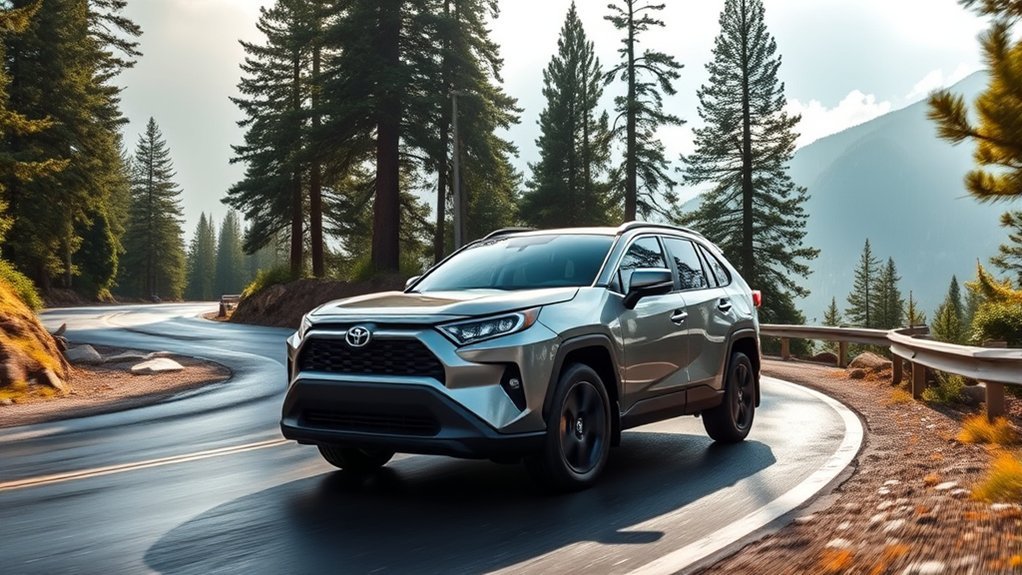
RAV4 FWD is a strong fit when most of your driving takes place on paved, maintained roads. The front tires handle steering and propulsion while also carrying a large share of the braking load, so tire condition has a direct effect on how predictable the vehicle feels.
FWD is generally suitable for:
- Urban and suburban commuting
- Dry highways and maintained rural roads
- Regular rain when the tires have adequate tread
- Mild winters with occasional light or compacted snow
- Graded gravel roads driven at a cautious speed
- Drivers prioritizing fuel economy over maximum low-grip propulsion
AWD becomes more valuable when you regularly start on steep snow-covered roads, drive before roads are plowed, cross muddy or loose terrain, or travel to remote areas where losing momentum could leave the vehicle stuck.
Pro Tip: Base the decision on the most difficult conditions you routinely face, not the easiest part of your commute. A flat, plowed route may suit FWD even in a cold climate, while a steep unplowed driveway can make AWD worthwhile.
Is a RAV4 FWD Good in Snow?
Yes, a RAV4 FWD can work well in light snow and on plowed winter roads when it has suitable tires and the driver reduces speed. Its main limitation appears when the front tires must both steer and pull the vehicle through deep snow or up a slippery grade. In those conditions, AWD can add rear-wheel propulsion and make it easier to start or maintain momentum.
Tires still matter more than the drivetrain label for braking and cornering. NHTSA states that winter tires are more effective than all-season tires in deep snow, while USTMA explains that handling, cornering, and braking depend on traction at both the front and rear tires. AWD therefore does not make an icy stop short or eliminate the need for winter tires, smooth inputs, and extra following distance.
If your normal winter route is flat and promptly plowed, FWD with proper seasonal tires may be entirely adequate. If you regularly face steep grades, deep accumulation, unplowed roads, or situations where becoming stuck creates a serious access problem, AWD is the more capable configuration.
How Does RAV4 FWD Handle Traction and Stability?
In a front-wheel-drive RAV4, propulsion is delivered through the front axle. The engine and major drive components are also positioned toward the front of the vehicle, placing useful static weight over the driven tires. This can help the vehicle start moving on wet pavement or light snow when the tires have suitable grip.
The RAV4 also uses electronic safety systems such as Traction Control (TRAC) and Vehicle Stability Control (VSC). Toyota lists both systems as part of the RAV4’s Star Safety System. Depending on the situation, these systems can reduce excessive wheel slip, adjust power, or apply selective braking to help the driver maintain traction and directional stability.
These systems are aids, not substitutes for traction. They cannot make a worn all-season tire grip like an appropriate winter tire, shorten every icy-road stop, or prevent a vehicle from becoming high-centered in deep snow.
The drivetrain determines which wheels receive propulsion, but the tires determine how effectively that available force reaches the road for acceleration, steering, and braking.
RAV4 FWD vs. AWD: What Changes in Rain, Snow, and Gravel?
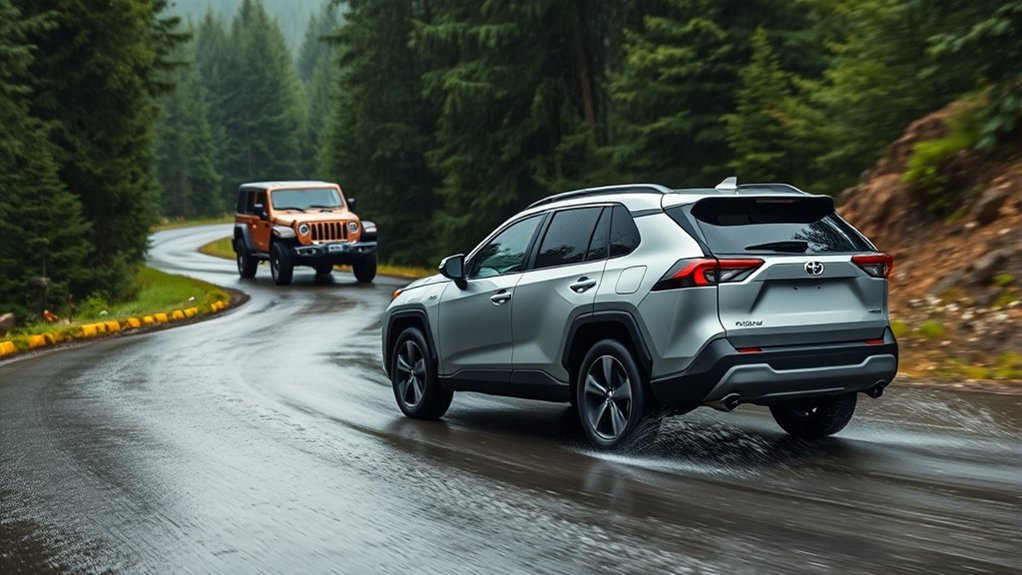
FWD and AWD solve different problems. FWD propels the vehicle through the front axle. AWD can add rear-wheel propulsion when the system determines that extra traction is useful. On the 2026 hybrid, that rear propulsion comes from a dedicated electric motor.
| Condition | RAV4 FWD | RAV4 AWD |
|---|---|---|
| Dry pavement | Usually provides all the traction required for normal driving. | Extra rear-wheel propulsion is usually less important when the road already provides ample grip. |
| Wet roads | Works well with adequate tread, proper inflation, reduced speed, and smooth inputs. | Can reduce front-wheel slip during acceleration, but cannot prevent hydroplaning. |
| Light or compacted snow | Often adequate with suitable all-weather or winter tires. | Provides easier starts and better propulsion when several tires still have grip. |
| Deep snow | More likely to lose momentum or spin the front tires. | Better able to maintain propulsion, although ground clearance remains a limit. |
| Steep slippery starts | May struggle as acceleration shifts some load rearward and reduces the traction available to the driven front tires. | Rear-wheel propulsion can make starting and climbing easier. |
| Mud or loose gravel | Best limited to mild, firm, and relatively level surfaces. | Usually provides better low-speed propulsion and more opportunities to maintain momentum. |
| Braking and cornering | Primarily limited by tire grip, speed, load, and road conditions. | Still limited by tire grip, speed, load, and road conditions; AWD does not remove stopping-distance limits. |
| Fuel economy | Usually receives the highest manufacturer or EPA estimate within a comparable powertrain and trim family. | The mileage difference varies by trim, tires, gearing, weight, and powertrain. |
Warning: AWD can help a RAV4 move forward on a slippery surface, but it does not cancel the need for suitable tires, reduced speed, gentle steering, and a much longer following distance.
RAV4 FWD vs. AWD: Which Should You Choose?
The better system is the one that matches your route, climate, terrain, and consequences of losing traction. Do not choose solely from a broad label such as “snowy state” or “warm state.” Elevation, road maintenance, driveway slope, travel schedule, and tire strategy matter more.
Driving Conditions Consideration
FWD is likely sufficient when:
- Most travel is on paved, regularly maintained roads.
- Snowfall is light, infrequent, or normally cleared before you drive.
- Your home and common destinations do not require steep slippery climbs.
- You are willing to use suitable seasonal tires when conditions require them.
- You do not routinely travel on muddy, deeply rutted, or unmaintained roads.
AWD is the better choice when:
- You must drive before snowplows clear the roads.
- Your route includes steep grades, mountain passes, or an inclined driveway.
- You frequently visit trailheads, campsites, farms, or job sites on loose surfaces.
- You travel with heavy loads in poor weather.
- Becoming stuck would create a significant safety or access problem.
Performance vs. Fuel Economy
Toyota lists the 2026 RAV4 Hybrid at 226 net combined horsepower with FWD and 236 net combined horsepower with AWD. The FWD configuration is also the efficiency leader at 47/40/43 mpg city/highway/combined, while AWD mileage varies by grade and equipment.
The fuel difference should not be considered in isolation. AWD may justify its additional cost and complexity for a driver who frequently needs extra low-grip propulsion. Conversely, AWD provides less practical benefit when a vehicle spends nearly all its time on dry, level, maintained pavement.
Purchase price, insurance, tire selection, wheel size, replacement parts, and model availability can also affect total ownership cost. Compare the exact trims rather than assuming that the only difference between two vehicles is the drivetrain.
Which Tires Work Best on a RAV4 FWD?

Tires are an essential part of RAV4 traction, handling, braking, ride quality, and fuel economy. Drivetrain choice cannot compensate for tires that are worn, underinflated, damaged, or unsuited to the temperature and road surface.
Choosing the Right Tire Type
- All-season tires: A practical choice for moderate climates and varied paved-road use. Their snow capability varies widely by model.
- Severe-snow-rated all-weather tires: Designed for year-round use while meeting a defined severe-snow traction standard. Look for the three-peak mountain snowflake symbol.
- Dedicated winter tires: The strongest choice for recurring snow, ice, and sustained cold. NHTSA states that winter tires are more effective than all-season tires in deep snow.
- Summer tires: Intended for warm-weather performance and not designed for snow, ice, or below-freezing operation.
Warning: Do not install winter tires only on the front axle of a FWD RAV4. USTMA specifically warns against fitting winter/snow tires only to the front axle. Use a compatible set of four so front and rear grip remain balanced during braking and cornering.
Tire Size, Rating, and Pressure
Do not choose a RAV4 tire solely from a generic online size list. Use the tire-information label on the driver-side door frame and confirm the following:
- Required tire size
- Load index and load-carrying capacity
- Speed rating
- Wheel diameter and width compatibility
- Cold inflation pressure
- Any model-specific restrictions in the owner’s manual
The pressure molded into the tire sidewall is a maximum tire specification, not the normal vehicle inflation target. NHTSA recommends checking tires cold and using the vehicle manufacturer’s placard pressure.
Inspect the tread and sidewalls at least monthly and before long trips. Look for cuts, bulges, punctures, cracking, uneven wear, or embedded objects. NHTSA identifies 2/32 inch as the minimum tread depth, but winter performance can become inadequate before a tire reaches that minimum.
If you need help with the vehicle’s pressure display or warning system, see the guide to RAV4 tire-pressure and TPMS displays.
Pro Tip: Recheck cold tire pressure after a major temperature drop. Colder air lowers inflation pressure, and an underinflated tire can respond poorly, wear unevenly, and overheat.
What Are the Limitations of the FWD System?
A RAV4 FWD has only two driven wheels. That design is efficient and sufficient for ordinary roads, but it creates predictable limitations when front-tire grip is scarce.
- Steep slippery starts: Acceleration shifts some vehicle load rearward, which can reduce the grip available to the driven front tires.
- Deep snow: The front tires may spin before the vehicle gains enough momentum, and accumulated snow can contact the underbody.
- Mud and loose surfaces: Without rear-wheel propulsion, the vehicle has fewer opportunities to move when one or both front tires are on a low-grip patch.
- Rough off-road terrain: FWD is not intended to replace a dedicated four-wheel-drive system. Ground clearance, tire construction, approach angles, underbody protection, and recovery access also matter. See the separate Toyota RAV4 ground-clearance guide for model- and trim-specific clearance information.
- Heavy loads and towing: Added weight changes braking, steering, tire loading, and hill performance. Towing limits differ by year, drivetrain, and grade.
- Performance driving: Asking the front tires to steer and deliver substantial propulsion at the same time can increase understeer when the available grip is exceeded.
TRAC and VSC can reduce excessive slip and help maintain directional stability, but they cannot add rear-wheel propulsion to an FWD model or create tire grip on glare ice.
What to Do if a FWD RAV4 Is Stuck
- Stop applying heavy throttle as soon as the tires begin spinning continuously.
- Straighten the front wheels when possible; a sharply turned tire requires more force to move through snow or mud.
- Clear packed snow, mud, or debris from in front of the drive tires and beneath the vehicle.
- Use sand, an approved traction aid, or another safe abrasive material beneath the front tires.
- Apply the accelerator gently and avoid rapid back-and-forth shifting.
- If your exact owner’s manual permits it, briefly disabling TRAC may allow limited wheel spin needed to escape. Re-enable TRAC as soon as the vehicle is free.
- Use only approved recovery and towing points. Do not attach a strap to suspension, steering, bumper, or unapproved underbody components.
Warning: Excessive wheel spin can damage tires, overheat components, dig the vehicle deeper, or throw debris. Stop and arrange professional recovery when a safe self-recovery attempt is not working.
How Can You Maximize Safety and Stability in a RAV4 FWD?
Safe FWD operation depends on preparation, suitable tires, and smooth driving. Electronic driver aids remain limited by available tire grip and cannot correct every loss of control.
Tire Selection Importance
- Select a tire category that matches your actual temperature and precipitation.
- Use the exact size and rating approved for the vehicle or professionally verified as compatible.
- Install winter tires at all four wheel positions.
- Maintain the cold pressure shown on the vehicle placard.
- Rotate tires according to the model-year maintenance schedule.
- Replace damaged, cracked, or excessively worn tires promptly.
- Use matching tires with comparable construction, tread pattern, size, and performance characteristics.
Driving Techniques for Safety
| Technique | How to Apply It | Why It Helps |
|---|---|---|
| Gentle acceleration | Press the accelerator progressively instead of demanding sudden power. | Reduces front-tire slip and allows TRAC to work with available grip. |
| Smooth normal braking | Begin slowing earlier and build pedal pressure smoothly. | Avoids making an abrupt demand that exceeds available tire grip. |
| Emergency ABS braking | Apply firm, continuous brake pressure and steer toward a safe path. Do not pump the pedal in an ABS-equipped RAV4. | Allows the anti-lock braking system to regulate wheel lock while the driver maintains braking force. |
| Progressive steering | Slow before the turn and make one smooth steering input. | Preserves more tire grip for cornering and reduces abrupt weight transfer. |
| Longer following distance | Leave substantially more space on wet, snowy, or icy roads. | Provides time to slow without a panic maneuver. |
| Keep VSC and TRAC active | Leave the systems enabled during normal driving. | Allows the vehicle to intervene when it detects excessive slip or directional instability. |
Before winter travel, clear all windows, lights, cameras, radar areas, and the roof. Check the weather and road conditions, carry basic emergency supplies, and postpone nonessential travel when roads are unsafe or closed.
Related Guides
Frequently Asked Questions
Can I switch from FWD to AWD in my RAV4?
There is no driver-selectable switch that converts a factory FWD RAV4 into AWD. A physical conversion would require extensive powertrain, suspension, electrical, control-system, exhaust, floor, and calibration changes. Buying or trading for a factory-built AWD model is the practical and supportable solution.
How does RAV4 FWD affect fuel efficiency?
FWD usually receives the highest fuel-economy estimate within a comparable RAV4 powertrain family. Toyota rated the 2025 gas LE FWD at 27/35/30 mpg city/highway/combined and lists 47/40/43 mpg for the 2026 hybrid FWD configuration. Actual mileage depends on trim, speed, weather, tires, traffic, load, and driving style.
What types of tires are best for RAV4 FWD?
Use all-season tires for moderate paved-road conditions, severe-snow-rated all-weather tires for stronger year-round winter capability, or dedicated winter tires for recurring snow and ice. Match the exact size, load index, speed rating, and cold pressure listed for your model year and trim.
Is FWD suitable for off-road driving with a RAV4?
FWD can manage firm gravel roads and mild, dry, relatively level access tracks at a cautious speed. It is not the preferred configuration for deep mud, loose sand, steep climbs, large ruts, rock obstacles, or remote trails where loss of traction could strand the vehicle.
Is a RAV4 FWD good in snow?
Yes. RAV4 FWD can work well in light snow and on maintained winter roads when it has suitable all-weather or winter tires. Deep snow, unplowed roads, and steep slippery starts favor AWD because rear-wheel propulsion can help the vehicle maintain momentum. Braking and cornering still depend heavily on tire grip with either drivetrain.
Which 2026 Toyota RAV4 trims offer FWD?
Toyota’s U.S. drivetrain combinations list FWD for the 2026 hybrid LE, SE, and XLE Premium. Those grades also offer AWD. Woodland, XSE, and Limited hybrids use AWD, and every 2026 RAV4 Plug-in Hybrid grade is AWD. Confirm the individual vehicle’s specifications before purchase.
Does AWD make a RAV4 stop faster in snow?
AWD mainly helps the vehicle start and accelerate by adding rear-wheel propulsion when useful. Stopping and cornering remain limited by tire grip, road conditions, speed, vehicle weight, and braking inputs. Suitable winter tires can therefore be more important to winter stopping performance than the drivetrain label alone.
Should I install two or four winter tires on a FWD RAV4?
Install four compatible winter tires. USTMA warns that putting winter tires only on the front axle can create adverse handling because the rear axle has substantially less grip.
Conclusion
The Toyota RAV4 FWD is well suited to commuting, highway travel, rain, and moderate winter conditions when it is equipped with appropriate, properly maintained tires. For the redesigned 2026 RAV4, FWD also provides the lineup’s strongest listed fuel economy.
Its limitations become clearer in deep snow, steep slippery starts, mud, loose terrain, and situations where losing momentum could leave the vehicle stranded. AWD provides more propulsion options in those conditions, but it does not replace winter tires, careful speed selection, or adequate stopping distance.
If most of your driving is on paved, plowed, relatively level roads, FWD is usually the more efficient choice. If steep grades, unplowed snow, loose terrain, or difficult access are routine rather than occasional, choose a factory AWD RAV4. In either case, verify the exact model year, trim, tire placard, owner’s manual, and conditions you regularly encounter before deciding.
Sources
- Toyota: The Next Adventure Begins—2026 RAV4 — 2026 powertrains, FWD and AWD availability, horsepower, mileage estimates, and safety systems.
- Toyota: 2025 RAV4 Product Information — 2025 gas FWD specifications, fuel economy, drivetrain choices, and safety equipment.
- Toyota 2026 RAV4 Specifications — Current U.S. feature, trim, tire, mechanical, and equipment information.
- Toyota Safety Hub: 2026 RAV4 — Star Safety System, Vehicle Stability Control, Traction Control, ABS, and related safety features.
- NHTSA TireWise — Tire categories, tread, inflation, safety ratings, and winter-tire guidance.
- NHTSA Winter Weather Driving Tips — Cold tire pressure, tire inspections, ABS operation, following distance, and winter preparation.
- U.S. Tire Manufacturers Association: Winter/Snow Tire Application — Guidance on installing winter tires at all wheel positions.