
The Toyota RAV4 does not use one universal all-wheel-drive system. Its hardware and controls vary by model year, powertrain, and trim. Understanding which system your RAV4 has will help you use it correctly in snow, rain, gravel, and light off-road conditions without expecting AWD to overcome the limits of your tires or the road surface.
Quick Answer
The Toyota RAV4 uses different AWD systems. Recent gas models may have Dynamic Torque Control or Dynamic Torque Vectoring AWD, while hybrid and plug-in models use a rear electric motor. The 2026 U.S. RAV4 uses electrified powertrains. AWD improves acceleration and stability, but tires and road conditions still determine braking and cornering grip.
Key Takeaways
- RAV4 AWD hardware varies by year, powertrain, and trim, so check the owner’s manual or vehicle specifications before using a mode or control.
- Dynamic Torque Vectoring can distribute torque between the left and right rear wheels, but it is not installed on every AWD RAV4.
- Hybrid and plug-in RAV4 models use a separate rear electric motor instead of a conventional mechanical driveshaft to the rear axle.
- AWD can help the vehicle start and accelerate on slippery surfaces, but it does not create extra braking grip.
- Winter tires, correct tire pressure, reduced speed, and added following distance remain essential in snow and ice.
Note: This guide focuses on U.S.-market RAV4 models. Equipment can vary by country, model year, trim, production date, and optional package. Confirm the controls and limits for your vehicle in the Toyota owner’s manual and maintenance portal.
Which AWD System Does Your Toyota RAV4 Have?
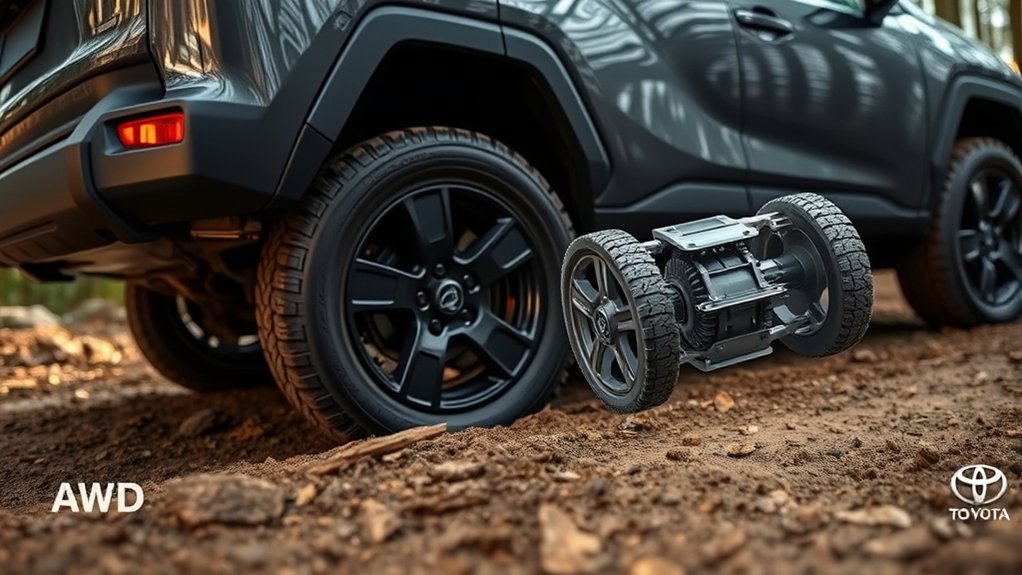
The first step is identifying the system fitted to your RAV4. The name “AWD” covers several designs that deliver rear-wheel power in different ways.
| Model and powertrain | Typical AWD design | How the rear wheels are powered | Driver controls |
|---|---|---|---|
| 2026 and newer Hybrid or Plug-in Hybrid | Electronic On-Demand AWD, where equipped | A dedicated electric motor drives the rear wheels when rear torque is useful. | AWD operation is automatic; available drive modes vary by grade. |
| 2019–2025 gas models with standard AWD | Dynamic Torque Control AWD | A mechanical coupling transfers some engine torque to the rear axle as needed. | Automatic AWD, with Snow Mode or Multi-Terrain Select on applicable vehicles. |
| Selected 2019–2025 gas trims | Dynamic Torque Vectoring AWD with Rear Driveline Disconnect | The system can send torque rearward and vary its distribution between the left and right rear wheels. | Automatic AWD plus applicable Snow and Multi-Terrain modes. Availability varies by trim and year. |
| 2019–2025 Hybrid and 2021–2025 Plug-in Hybrid | Electronic On-Demand AWD | An independent rear electric motor powers the rear wheels without a conventional propeller shaft from the front powertrain. | Automatic AWD; Trail Mode is available on applicable hybrid models. |
| Some 2018 and older AWD models | Earlier Dynamic Torque Control AWD | A mechanical coupling sends torque to the rear axle. | Some include an AWD Lock button that targets a fixed front-rear split at low speed and returns to automatic operation above about 25 mph. |
For 2025 gas models, Toyota offered standard AWD and Dynamic Torque Vectoring AWD. The torque-vectoring system was fitted to the AWD Limited and could send up to 50% of engine torque to the rear axle, then vary torque between the two rear wheels. Toyota’s 2025 RAV4 technical overview also describes Rear Driveline Disconnect, which can stop rear driveline rotation when AWD is unnecessary.
For 2026, the U.S. RAV4 lineup moved to Hybrid and Plug-in Hybrid powertrains. AWD-equipped versions use a dedicated rear electric motor and electronically control the amount of driving force sent to the rear wheels. Toyota explains the current system in its 2026 RAV4 technical announcement.
How the RAV4 Decides When to Add Rear Torque
The system does not always wait for obvious wheelspin. Depending on the version, the vehicle may consider accelerator input, steering angle, wheel speed, vehicle speed, yaw, and other operating data. It can add rear torque during a launch, when accelerating through a bend, or when conditions suggest that the front tires may lose grip.
When the vehicle is cruising steadily on a dry road, rear torque may be reduced because it is unnecessary. A disconnect-equipped gas system can disengage parts of the rear driveline to reduce drag. An electrified RAV4 can simply reduce or stop rear-motor output until the vehicle needs it again.
What the AWD Monitor Shows
Applicable RAV4 models can display an AWD or torque-distribution graphic in the multi-information display. The changing bars show how the control system is allocating driving force under current conditions. Treat the display as a useful operating illustration rather than a precision torque-measuring instrument.
Pro Tip: Look at the center-console buttons and your vehicle’s build specifications. An AWD Lock button generally indicates an older design; Snow and Multi-Terrain controls point to a recent gas AWD model; Trail Mode commonly identifies an applicable hybrid or plug-in system.
Dynamic Torque Control vs. Dynamic Torque Vectoring AWD
These names sound similar, but they describe different capabilities. Both can transfer engine torque from the front axle to the rear axle. Dynamic Torque Vectoring adds the ability to vary torque between the left and right rear wheels.
Dynamic Torque Control AWD
Dynamic Torque Control AWD uses an electronically managed coupling to vary front-rear torque distribution. During ordinary cruising, the RAV4 can favor the front wheels. When additional traction or stability support is useful, it can direct torque to the rear axle.
This can reduce front-wheel spin during acceleration and help the vehicle follow the driver’s intended path. The exact split is not fixed during normal automatic operation and changes with conditions.
Dynamic Torque Vectoring AWD
Dynamic Torque Vectoring AWD adds separate control at the rear axle. Clutches can vary the amount of torque delivered to each rear wheel, allowing the system to favor the wheel that can contribute more effectively during a turn or on uneven terrain.
| Feature | What it controls | Potential benefit |
|---|---|---|
| Front-rear torque distribution | How much engine torque is sent to the rear axle | Reduced front-wheel spin and improved launch traction |
| Left-right rear torque distribution | How rear torque is shared between the two rear wheels | Improved response in turns and on surfaces with uneven grip |
| Traction and stability control | Brake and power intervention when wheelspin or instability is detected | Helps the vehicle recover grip while remaining within tire limits |
| Rear Driveline Disconnect | Rear driveline engagement when AWD is not required | Reduces unnecessary mechanical drag during suitable driving conditions |
Torque vectoring can support handling, but it cannot create grip where the tires have none. On polished ice, deep mud, or a surface where multiple wheels are unloaded, the system may still be unable to move the vehicle.
Why Rear Driveline Disconnect Matters
The original claim that every RAV4 has a continuously spinning rear driveshaft is inaccurate. On Dynamic Torque Vectoring AWD with Rear Driveline Disconnect, Toyota uses clutches to disconnect the rear driveline when rear torque is unnecessary. Hybrid and plug-in RAV4 models take a different approach: a separate electric motor directly supplies rear-wheel torque.
How Torque Vectoring Can Help in Snow
On a RAV4 equipped with Dynamic Torque Vectoring AWD, the system can alter rear-wheel torque distribution as the vehicle starts, accelerates, and turns. This may improve stability when one side of the road has more grip than the other.
Electronic On-Demand AWD in hybrid and plug-in models does not use the same mechanical rear torque-vectoring differential. Instead, it controls front-rear driving force through the rear electric motor and works with the vehicle’s braking and stability systems.
Starting on a Slippery Surface
Applying rear torque can reduce the amount of work demanded from the front tires. This may help the RAV4 pull away with less front-wheel spin on packed snow, loose gravel, or a wet incline.
Use gentle accelerator input. A sudden full-throttle start can overwhelm the tires faster than the AWD system can manage the available grip.
Driving Where Grip Differs from Side to Side
One side of a snowy road may be cleared while the other remains covered. A torque-vectoring system can vary rear torque from side to side, while traction control can reduce power or apply brake pressure to a spinning wheel. These interventions can help the vehicle remain closer to the driver’s intended path.
Cornering on Snow
AWD may support stability while power is being applied through a bend, but safe cornering speed still depends on tire grip. Enter the turn slowly, use smooth steering, and avoid abrupt acceleration or braking.
Warning: AWD helps distribute driving force; it does not shorten stopping distance by itself. On snow or ice, slow down, increase following distance, and avoid assuming that easier acceleration means the road also offers strong braking grip.
Why AWD Helps in Snow—and What It Cannot Do
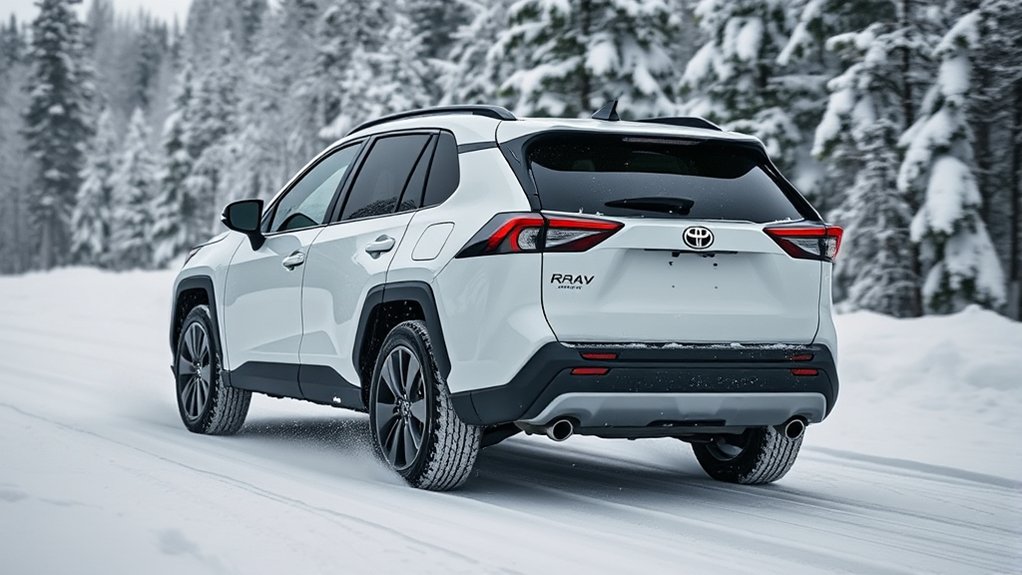
AWD is most useful when the vehicle is applying power. By spreading driving force across both axles, it can help the RAV4 start from a stop, climb a slippery grade, and maintain forward progress when the front tires alone would spin.
AWD can help the RAV4 get moving, but the tires still determine how well it turns and stops.
AWD cannot repeal the limits of friction. It does not prevent every skid, eliminate understeer, make hydroplaning impossible, or allow normal dry-road speeds on snow and ice. Stability control and antilock braking can assist, but they also depend on the tires maintaining usable contact with the road.
Winter Tires Matter More Than the AWD Badge
NHTSA tire guidance states that winter tires are more effective than all-season tires in deep snow. For consistent handling, install winter tires as a complete set rather than mixing winter and non-winter tires on different axles.
Check pressure when the tires are cold and use the specification on the driver-side door-jamb label, not the maximum pressure molded into the tire sidewall. Tire pressure falls as outdoor temperatures drop, so inspect it regularly during winter.
AWD in Heavy Rain
AWD can reduce wheelspin while accelerating on a wet road, but it cannot prevent hydroplaning. Hydroplaning occurs when a tire cannot clear enough water to maintain contact with the pavement. Slow down in standing water, avoid abrupt inputs, and replace tires that are damaged or excessively worn.
How to Use Snow, Multi-Terrain Select, and Trail Modes
Current and recent RAV4s may provide terrain-related modes, but the available controls depend on the powertrain and trim. These modes adjust power delivery and may coordinate AWD, braking, steering feel, and traction-control behavior. They do not physically lock every wheel together.
Snow Mode
On applicable gas AWD models, Snow Mode softens or manages power delivery to reduce unnecessary wheelspin on slippery roads. Toyota’s 2024 RAV4 Quick Reference Guide identifies separate controls for Dynamic Torque Control and Dynamic Torque Vectoring vehicles and notes that the mode is not applicable to the RAV4 Hybrid covered by that guide.
Select Snow Mode before driving on a snow-covered or similarly slippery road. It may cancel when the vehicle is turned off or when another terrain mode is selected.
Multi-Terrain Select
Applicable gas AWD RAV4 models offer modes such as Mud & Sand and Rock & Dirt. Choose the mode that most closely matches the surface. The system then adjusts relevant vehicle controls to improve drivability.
- Mud & Sand: Intended for loose, muddy, sandy, rough, or dirty surfaces where some controlled wheelspin may help maintain momentum.
- Rock & Dirt: Intended for rough, uneven, and unpaved surfaces where controlled low-speed progress is important.
Return to Normal mode when the special setting is no longer needed. Do not use a terrain mode as permission to exceed the vehicle’s ground-clearance, tire, temperature, or water-depth limits.
Trail Mode
Applicable Hybrid and Plug-in Hybrid models use Trail Mode rather than the gas model’s Multi-Terrain Select arrangement. Trail Mode coordinates electric AWD, braking, and drive-force control. If a wheel spins, the system may brake that wheel and direct more usable driving force to wheels with grip.
Trail Mode is designed to assist at low speed on uneven or loose surfaces. It is not equivalent to a locking differential, low-range transfer case, or dedicated rock-crawling system.
AWD Lock on Older RAV4 Models
Some older RAV4s, including applicable 2018 models, have an AWD Lock button. Toyota described this control as targeting a 50:50 front-rear torque distribution at speeds up to about 25 mph, after which the system returns to automatic operation.
Do not assume a newer RAV4 has this function simply because it is AWD. Follow the labels on your vehicle and the instructions for its exact model year.
Common Myths About RAV4 AWD Performance
- Myth: Every AWD RAV4 uses torque vectoring.
Only specific gas-powered grades and model years have Dynamic Torque Vectoring AWD. Other versions use Dynamic Torque Control or Electronic On-Demand AWD. - Myth: AWD makes winter tires unnecessary.
AWD can assist acceleration, but winter tires improve the tire-road connection needed for acceleration, steering, and braking. - Myth: The system waits for major wheelspin before responding.
Recent systems may add rear torque proactively based on acceleration, steering, wheel-speed, and vehicle-motion data. - Myth: AWD stops a vehicle faster.
Normal braking acts at all four wheels regardless of whether the powertrain is FWD or AWD. Stopping performance is governed primarily by tire grip, road conditions, speed, and braking-system operation. - Myth: AWD prevents hydroplaning.
AWD cannot force a tire through standing water. Speed, water depth, tread condition, and tire design remain decisive. - Myth: A RAV4 AWD is equivalent to a truck with low-range 4WD.
The RAV4 is designed for road use and light-duty unpaved conditions within the limits stated in its owner’s manual.
Is the RAV4 AWD Suitable for Off-Roading?
A properly equipped RAV4 AWD can handle maintained dirt roads, gravel, snow-covered access roads, moderate ruts, and some light trails. Capability depends heavily on tires, ground clearance, surface conditions, driver experience, load, and the installed AWD system.
Avoid treating the RAV4 as a severe off-road vehicle. Deep mud, deep sand, large rocks, water crossings, steep ledges, and terrain requiring low range or substantial wheel articulation can exceed its design limits.
Warning: Do not enter water unless you know its depth, current, surface, and the vehicle’s published limits. Hidden holes, water ingestion, electrical damage, loss of traction, and a submerged exhaust can disable the vehicle or create an immediate safety hazard.
Before leaving pavement, inspect the route, reduce speed, secure cargo, and plan a safe place to turn around. Stop if the vehicle repeatedly spins its wheels, strikes the ground, displays an AWD warning, overheats, or cannot proceed without excessive throttle.
RAV4 AWD Maintenance and Troubleshooting
AWD maintenance is not identical across all RAV4 models. Mechanical gas systems, hybrids, and plug-in hybrids use different components and may have different inspection or fluid requirements.
Keep the Tires Consistent
Use the tire size, load rating, and type specified for the vehicle. Avoid mixing materially different tire sizes, constructions, or tread types. A large difference in rolling circumference can confuse control systems and place unnecessary stress on AWD components.
- Check cold tire pressure at least monthly and before long trips.
- Rotate the tires at the interval in the maintenance guide.
- Inspect for cuts, bulges, punctures, uneven wear, and low tread.
- Ask a qualified tire professional whether one damaged tire can be replaced alone or whether additional tires must be replaced to keep rolling circumference sufficiently consistent.
- Use temporary spare tires only as directed in the owner’s manual.
Follow the Correct Driveline Service Schedule
Mechanical AWD models may require inspections of the rear differential, transfer-related components, seals, boots, and propeller-shaft hardware. Electrified AWD models use a rear electric drive unit and should be serviced according to the schedule for that exact powertrain.
Do not apply a generic fluid-change interval from another RAV4 generation. Use the Warranty and Maintenance Guide associated with your VIN or model year.
What to Do if an AWD Warning Appears
An AWD warning can result from a system fault, excessive temperature, unsuitable tire conditions, or another problem detected by the vehicle. The exact message and response vary by model.
- Reduce speed and avoid hard acceleration.
- Move to a safe location if the message instructs you to stop or if the vehicle behaves abnormally.
- Read the complete message in the instrument display.
- Check for an obviously damaged or severely underinflated tire.
- Allow the system to cool if the owner’s manual identifies overheating as a possible cause.
- Arrange diagnosis if the warning remains, returns, or is accompanied by noise, vibration, fluid leakage, or reduced drivability.
Do not repeatedly spin the wheels to test whether AWD is working. Sustained wheelspin can overheat components, damage tires, and dig the vehicle deeper into snow, sand, or mud.
Tips for Maximizing Your RAV4 AWD Experience
- Identify your system first: Confirm the model year, powertrain, trim, and installed controls.
- Use smooth inputs: Gradual steering, acceleration, and braking give the control systems more usable grip to work with.
- Select the correct mode: Use Snow, Mud & Sand, Rock & Dirt, or Trail only when the surface matches the mode’s intended purpose.
- Slow down early: AWD may mask how slippery the road is because the vehicle accelerates more easily than a two-wheel-drive vehicle.
- Increase following distance: NHTSA winter-driving guidance recommends allowing more room to stop on slick or snow-covered roads.
- Maintain the tires: Correct pressure, suitable tread, and a consistent set of tires are central to AWD performance.
- Know when to turn around: No drive mode can compensate for severe terrain, inadequate clearance, deep water, or tires that cannot grip the surface.
Related Guides
Frequently Asked Questions
Can I switch RAV4 AWD on and off manually?
On recent RAV4 models, normal AWD engagement is automatic. You may be able to select Snow, Multi-Terrain Select, or Trail Mode, but these controls modify system behavior rather than serving as a simple permanent AWD on/off switch. Some older models have an AWD Lock button for low-speed use.
Does RAV4 AWD reduce fuel efficiency?
AWD can add weight, mechanical drag, or electrical demand, so an AWD version may use more fuel than a comparable FWD version. The difference varies by year and powertrain. Rear Driveline Disconnect and electric rear-motor control help reduce unnecessary losses when rear torque is not needed.
Is RAV4 AWD suitable for off-roading?
It is suitable for maintained dirt roads, gravel, snow, and some light trails when the tires, ground clearance, and conditions are appropriate. It is not a replacement for low-range 4WD in deep mud, large rocks, deep water, or other severe terrain.
How does RAV4 AWD perform in heavy rain?
It can reduce wheelspin while accelerating, but it cannot prevent hydroplaning or guarantee short stopping distances. Reduce speed, avoid standing water, use smooth controls, and maintain adequate tire tread and pressure.
What maintenance does the RAV4 AWD system require?
Maintain a consistent set of correctly inflated tires and follow the Warranty and Maintenance Guide for your exact year and powertrain. Mechanical systems may require differential, seal, boot, and driveline inspections, while electrified systems use different rear-drive components.
Does AWD help a RAV4 stop faster in snow?
Not by itself. AWD changes how driving force reaches the wheels, while braking already acts at all four wheels. Tire grip, road surface, speed, antilock-brake operation, and following distance determine how effectively the vehicle can stop.
Which RAV4 models have Dynamic Torque Vectoring AWD?
Availability varies by year and trim. During the 2019–2025 generation, Toyota used Dynamic Torque Vectoring AWD on selected gas-powered grades, including Adventure, TRD Off-Road, or Limited in certain years. It was not the AWD system used by RAV4 Hybrid or Plug-in Hybrid models. Verify the specification for the exact vehicle before purchase or service.
Conclusion
The Toyota RAV4 AWD system can provide useful traction and stability support, but its operation depends on which RAV4 you own. Recent gas models may use Dynamic Torque Control or Dynamic Torque Vectoring, while hybrid and plug-in models use an electric rear motor. Older vehicles may include an AWD Lock button that newer models do not have.
For the best results, identify your system, use the correct drive mode, maintain a consistent set of suitable tires, and follow the manual for your model year. Most importantly, remember that AWD can help the RAV4 accelerate on a slippery surface, but safe braking and cornering still require adequate tire grip, reduced speed, and sufficient following distance.
Sources
- Toyota: The Next Adventure Begins—2026 RAV4 — current electrified lineup, rear electric motor, and Electronic On-Demand AWD operation.
- Toyota: 2025 RAV4 Technical Overview — gas, hybrid, Dynamic Torque Vectoring, Rear Driveline Disconnect, and terrain-mode information.
- Toyota 2024 RAV4 Quick Reference Guide — Snow Mode, Multi-Terrain Select, Trail Mode, and equipment distinctions.
- Toyota Manuals and Warranties — model-specific operating instructions and maintenance schedules.
- NHTSA Winter Weather Driving Tips — speed, following distance, tire-pressure, preparation, and winter-driving guidance.
- NHTSA TireWise — tire selection, winter-tire performance, ratings, and tire-safety information.

