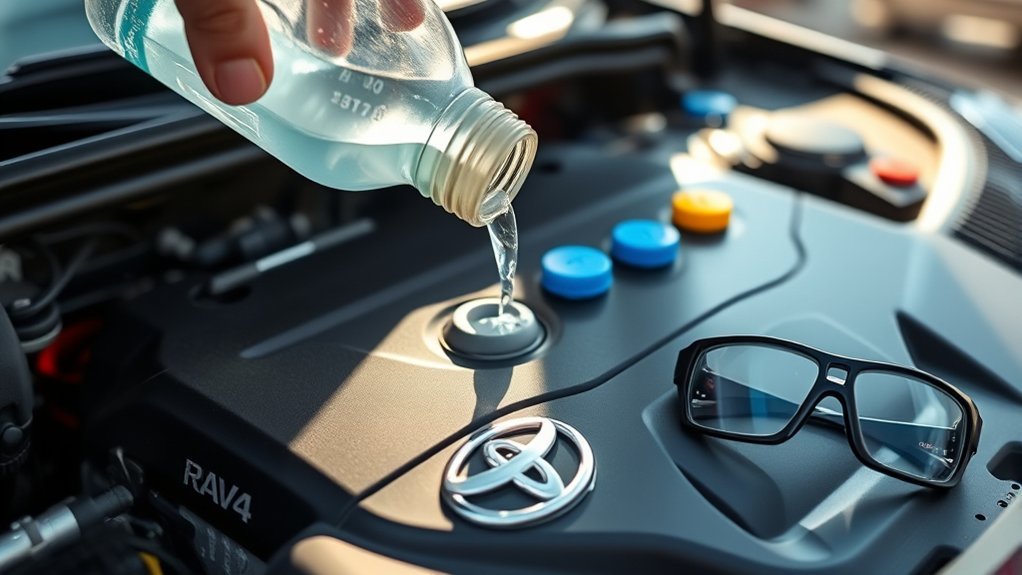
Adding brake fluid to a Toyota RAV4 is a simple top-up only when the reservoir is slightly low and the braking system otherwise feels normal. The more important job is identifying why the level dropped and using the exact fluid specified for your model year.
Park on a level surface, switch off the engine or hybrid system, set the parking brake, and let the vehicle cool before opening the hood. Read the reservoir through its translucent wall before removing the cap.
Last updated: September 19, 2026 — brake-fluid specifications, warning-light guidance, and handling cautions were rechecked against Toyota owner-manual guidance and FMVSS No. 116.
Quick Answer
Check the RAV4 brake-fluid reservoir on level ground. If the fluid is between MIN and MAX, do not add any. If it is slightly below MIN but the pedal feels normal and there is no visible leak, verify the exact fluid specification before making a small top-up. If the reservoir is empty, fluid is leaking, the brake warning stays on, or the pedal feels soft or sinks, do not drive; arrange professional service or towing.
Key Takeaways
- Toyota brake-fluid specifications vary by RAV4 model year and market. Use the exact grade listed in your owner’s manual or on the reservoir cap.
- A level between the MIN and MAX marks is acceptable. You do not need to fill the reservoir to MAX during every check.
- There is no universal top-up quantity. Add only enough approved fluid to return a low level to the acceptable marked range without exceeding MAX.
- A gradual level drop can accompany brake-pad wear, while a rapid or repeated drop can indicate a leak. Both deserve attention.
- Do not drive with an empty reservoir, visible active leak, persistent brake warning, reduced braking response, or a soft or sinking pedal.
At a Glance
| Time Required | 5–10 minutes for a visual check and careful top-up |
| Difficulty | Easy to check; use caution because low fluid can signal a brake-system fault |
| Tools Needed | Gloves, flashlight, clean lint-free cloth, and an optional clean funnel |
| Amount to Add | No fixed top-up quantity; add only enough approved fluid to bring a low level back within the MIN–MAX range without exceeding MAX |
Warning: Brake fluid is safety-critical. A low level is a symptom to investigate, not something to hide with repeated top-ups. Do not drive if the reservoir is empty, fluid is actively leaking, the brake warning remains on, braking response is reduced, or the pedal feels soft, unusually low, or sinks.
Which Brake Fluid Does a Toyota RAV4 Use?
Toyota has not used one universal brake-fluid specification for every RAV4. For example, U.S.-market 2010 and 2014 RAV4 owner-manual information specifies SAE J1703 or FMVSS No. 116 DOT 3 brake fluid, while 2023 U.S. RAV4 Hybrid documentation lists SAE J1703/FMVSS DOT 3 or SAE J1704/FMVSS DOT 4. That is why the exact model year, powertrain, and market matter.
| RAV4 Example | Owner-Manual Fluid Guidance |
|---|---|
| 2010 U.S. RAV4 | SAE J1703 or FMVSS No. 116 DOT 3 |
| 2014 U.S. RAV4 | FMVSS No. 116 DOT 3 or SAE J1703 |
| 2023 U.S. RAV4 Hybrid | FMVSS No. 116 DOT 3 / SAE J1703 or FMVSS No. 116 DOT 4 / SAE J1704 |
| Other model years and markets | Check the exact owner’s manual and reservoir-cap wording before adding fluid. |
Verification note: The model-year examples and safety guidance in this guide were rechecked against Toyota owner-manual information and federal brake-fluid requirements. This article does not claim hands-on brake-fluid testing. Use the Toyota owner’s manual portal to confirm the specification for your exact vehicle.
Why Does Brake Fluid Matter in Your Toyota RAV4?

When you press the brake pedal, brake fluid transmits hydraulic pressure through the system so the brakes can slow the vehicle. The system depends on the correct fluid, a sealed reservoir, and enough fluid to maintain proper operation.
The reservoir level also provides a useful warning. A gradual decrease can occur as brake-pad material wears and the caliper pistons extend. A sudden drop, repeated need for fluid, or wet area near a brake component can indicate a leak.
A low brake-fluid reservoir is a symptom to investigate, not a problem to hide with repeated top-ups.
Use the exact fluid listed in the Toyota owner’s manual for your model year or printed on the reservoir cap. Federal brake-fluid labels also instruct drivers to follow the vehicle manufacturer’s recommendation when adding fluid.
Brake fluid must remain clean and dry. Federal standards require container warnings about dirt, water, petroleum products, and moisture because contamination can damage the system or reduce dependable braking performance.
Keep the reservoir cap clean and tightly sealed. Use fluid from a newly opened or properly sealed original container, and never pour unused fluid back into the bottle.
How Do You Check Brake Fluid in a Toyota RAV4?
You can usually inspect the level without opening the reservoir. The container is translucent and has MIN and MAX marks molded or printed on its side.
Before You Start
- Park the RAV4 on a firm, level surface.
- Shift into Park, set the parking brake, and switch off the engine or hybrid system.
- Let hot under-hood components cool.
- Wear gloves and keep water, oil, dirt, and cleaning chemicals away from the reservoir.
- Protect painted surfaces with a clean cloth because spilled glycol-based brake fluid can damage paint.
Locate the Brake Fluid Reservoir
Open the hood and look near the rear of the engine compartment for a small translucent reservoir with a brake symbol or brake-fluid wording on the cap. The exact position can vary by RAV4 generation and powertrain, so use the under-hood diagram in your owner’s manual when needed.
| Brake Fluid Type | RAV4 Guidance |
|---|---|
| DOT 3 | Use when your exact owner’s manual or reservoir cap specifies DOT 3. Several older U.S. RAV4 manuals specify DOT 3. |
| DOT 4 | Use when Toyota specifies or permits DOT 4 for your model. Some newer RAV4 documentation lists both DOT 3 and DOT 4. |
| DOT 5 | Silicone-based and not an automatic substitute for DOT 3 or DOT 4. Do not add it unless the exact vehicle documentation explicitly requires it. |
| DOT 5.1 | Non-silicone, but still not a reason to ignore Toyota’s specification. Use it only when the vehicle documentation explicitly permits it. |
Assess the Fluid Level Without Shaking the Reservoir
Wipe dust from the outside of the reservoir, shine a flashlight through the side, and compare the visible fluid line with the MIN and MAX marks. Do not shake the reservoir. Fluid movement is not a test of fluid quality or brake condition.
If the level is between MIN and MAX, leave it alone. A reading below MAX does not automatically mean the system needs more fluid.
If the level is slightly below MIN, look for visible wetness and pay attention to pedal feel and warning lights before deciding whether a small top-up is appropriate. A repeated or rapid drop requires professional diagnosis.
Pro Tip: Take a clear photo of the level and odometer before adding anything. If the level falls again, the photos help a technician judge how quickly fluid is being lost.
Should You Add Brake Fluid or Stop and Get Service?
| What You Find | What to Do |
|---|---|
| Fluid between MIN and MAX; brakes feel normal | Do not add fluid. Reinstall nothing because the cap does not need to be opened for a visual check. |
| Fluid slightly below MIN; no visible leak; pedal feels normal | Verify the exact fluid specification, add only enough to return the level to the marked range, and investigate why it became low. |
| Level drops again after a top-up | Stop repeated top-ups and have the brake system inspected for pad wear, leakage, or another fault. |
| Empty reservoir, active leak, persistent brake warning, reduced braking, or soft/sinking pedal | Do not drive. Arrange professional diagnosis and towing as appropriate. |
How Do You Safely Add Brake Fluid to a Toyota RAV4?
Only top up the reservoir after you have verified the exact fluid specification and found no sign of an active leak, persistent brake warning, reduced braking response, or abnormal pedal feel. There is no universal amount to pour in; the MIN and MAX marks determine when to stop.
- Confirm the fluid. Match the DOT grade and any additional wording in the owner’s manual or on the reservoir cap. Do not rely only on a parts-store lookup.
- Clean the area. Wipe the cap and surrounding reservoir with a clean lint-free cloth so dirt cannot fall inside.
- Remove the cap carefully. Unscrew, unclip, or lift it according to its design. Do not force the cap or damage the rubber diaphragm.
- Inspect the fluid opening. If you see sludge, oil, debris, or an unusual separated appearance, stop and have the system serviced.
- Add a small amount. Pour slowly from a clean, recently opened container. Use a clean funnel only if needed.
- Stop within the marked range. Recheck the level through the side and do not exceed MAX.
- Seal and clean. Reinstall the cap securely, wipe away any drips, and rinse accidental paint spills promptly with plenty of water without spreading the fluid.
Note: Do not open a bleeder screw or attempt to bleed an ABS-equipped RAV4 as part of a simple reservoir top-up. Bleeding and fluid replacement are separate service procedures and may require model-specific service steps.
Why Is My Toyota RAV4 Brake Fluid Low?
Low fluid has several possible causes. The pattern of the drop, visible evidence, warning lights, and pedal feel matter more than the level alone.
How Worn Brake Pads Affect the Fluid Level
As disc-brake pads wear, the caliper pistons move farther outward. More fluid remains in the calipers, so the reservoir level can gradually move lower even when no external leak exists.
This does not mean you should automatically fill the reservoir to MAX. When new pads are installed and the pistons are pushed back, fluid returns toward the reservoir and can overflow if it was previously overfilled.
Have the pad thickness checked when the level approaches MIN, especially if the brakes squeal, grind, pulse, or require longer pedal travel.
What Are the Signs of a Brake-Fluid Leak?
A brake-fluid leak requires prompt attention. Look for these warning signs:
- A rapid or repeated drop in the reservoir level
- Wetness around the master cylinder, brake hoses, calipers, or wheel areas
- A puddle or oily-feeling clear-to-amber liquid under the vehicle
- A red brake warning light that remains on after the parking brake is released
- A soft, spongy, sinking, or unusually low brake pedal
- Reduced braking response or a need to pump the pedal
If any of these signs appear, do not keep topping up the reservoir. Arrange professional diagnosis. If braking response is reduced, the pedal is soft or sinking, the reservoir is empty, or an active leak is visible, do not drive the vehicle.
Why Is Brake-Fluid Contamination Dangerous?
Brake-fluid contamination is different from a leak. Dirt, water, engine oil, power-steering fluid, or other petroleum products can damage the braking system or reduce dependable braking performance.
Federal brake-fluid requirements specifically instruct users to keep brake fluid clean and dry and to keep the original container tightly closed to limit moisture absorption.
If the wrong fluid or another liquid enters the reservoir, stop the DIY procedure and contact a qualified brake technician or Toyota dealer before driving. Tell them exactly what product and approximately how much entered the reservoir.
How Do You Keep RAV4 Brake Fluid Clean?
Good storage and handling reduce the risk of introducing moisture or debris into the hydraulic system.
- Use the exact specification listed for your RAV4, not a fluid selected only because it has a higher DOT number.
- Buy brake fluid in a sealed original container from a reputable seller.
- Clean the cap area before opening the reservoir.
- Keep the bottle closed except while pouring, and store it upright in a cool, dry place.
- Do not use fluid from a bottle that was left open, appears contaminated, or has an uncertain history.
- Never mix brake fluid with engine oil, transmission fluid, power-steering fluid, coolant, or cleaning products.
- Follow the inspection and replacement guidance for your exact model year rather than using one universal change interval.
Note: Fluid appearance alone does not establish the complete condition or service history of the brake fluid. If the history is unknown or you suspect contamination, have the system evaluated during brake service.
What Are the Signs of Low Brake Fluid?
Check the reservoir promptly when you notice a red brake warning light, a soft or sinking pedal, reduced braking response, or visible fluid near a brake component. Toyota advises owners to consult the vehicle-specific manual for warning-light meanings, and its current warning-light guidance identifies red indicators as conditions requiring immediate attention.
- Move the vehicle to a safe place if you can do so without relying on weak brakes.
- Set the parking brake, switch off the vehicle, and inspect the reservoir without opening it.
- If the level is slightly below MIN but the pedal feels normal and no leak is visible, verify the correct fluid before making a small top-up and arrange inspection of the cause.
- If the reservoir is empty, fluid is actively leaking, the brake warning remains on, or the pedal is soft, low, sinking, or braking response is reduced, do not drive. Arrange professional service or towing.
- If the level is normal but the pedal feels abnormal, do not assume the problem is solved. Air, internal leakage, worn parts, or another brake fault may be present.
Warning: Do not test-drive a RAV4 with a sinking pedal, active leak, empty reservoir, persistent brake warning, or reduced braking response. A top-up cannot repair a failed hose, master cylinder, caliper, or other damaged component.
When Should You Stop Driving and Call a Mechanic?
Schedule professional brake service when:
- The fluid is at or below MIN and you cannot explain the drop
- You need to add fluid more than once
- You see wetness around brake parts or under the vehicle
- The brake warning or ABS light remains illuminated
- The pedal feels soft, sinks, pulses abnormally, or changes height
- You hear grinding or notice reduced stopping performance
- The wrong fluid or another liquid entered the reservoir
- The fluid appears contaminated or the service history is unknown
An inspection can cover pad thickness, hoses, calipers, wheel cylinders where fitted, the master cylinder, and ABS-related hydraulic components. A technician can also determine whether the system requires fluid replacement or a model-specific bleeding procedure rather than a simple top-up.
If the problem may involve a safety defect, use the NHTSA VIN recall lookup and contact a Toyota dealer. A recall search does not replace a brake inspection.
Related Guides
Frequently Asked Questions
Can I mix different types of brake fluid?
Do not choose or mix fluids based only on their DOT numbers. Use the exact fluid or fluids permitted by the owner’s manual for your RAV4. Some newer RAV4 documentation permits both DOT 3 and DOT 4, while older examples specify DOT 3 only. DOT 5 is silicone-based and must not be treated as an automatic substitute. If the existing fluid or specification is unknown, have a technician confirm the correct service approach.
How often should I check my brake fluid level?
Check it during routine under-hood inspections, before a long trip, and whenever a brake warning light or pedal change appears. Follow the owner’s manual and maintenance schedule for your exact model year instead of relying on one universal monthly interval.
What happens if I overfill the brake fluid reservoir?
Excess fluid can spill from the reservoir or overflow when worn pads are replaced and the caliper pistons are pushed back. It can also damage painted surfaces. Keep the level within the marked range and do not exceed MAX.
Where can I buy the correct brake fluid for my RAV4?
You can buy it from a Toyota dealer, reputable auto-parts store, or established online retailer. Before purchasing, compare the container label with the exact specification in your owner’s manual or on the reservoir cap.
Is it safe to drive with low brake fluid?
Do not ignore a level at or below MIN. If it is only slightly low, the pedal feels normal, and there is no visible leak, verify the correct fluid and investigate the cause before normal driving. Do not drive if the reservoir is empty, fluid is actively leaking, the brake warning remains on, braking response is reduced, or the pedal feels soft, low, or sinking.
Does adding brake fluid fix a spongy brake pedal?
Usually not. A spongy or sinking pedal can indicate air, a leak, overheated fluid, an internal hydraulic problem, or another fault. Adding fluid may raise the reservoir level without correcting the cause.
What should I do if I added the wrong brake fluid?
Stop the DIY procedure and contact a qualified brake technician or Toyota dealer before driving. Tell them exactly what product and approximately how much entered the reservoir. Brake-fluid contamination can require more than a simple reservoir top-up or fluid removal.
How much brake fluid should I add to my RAV4?
There is no universal top-up quantity. Add only enough of the approved fluid to bring a low level back within the reservoir’s MIN–MAX range, and stop before it exceeds MAX. If you need a substantial amount or the level drops again, have the brake system inspected.
Should the engine be running when I add brake fluid?
No for a normal reservoir check or top-up. Park on level ground, shift into Park, set the parking brake, and switch off the engine or hybrid system before working under the hood. Brake bleeding or diagnostic procedures are different and may require model-specific service instructions.
Conclusion
Checking RAV4 brake fluid is quick, but adding it should never become a routine way to hide a falling level. Read the reservoir on level ground, leave it alone when the fluid sits between MIN and MAX, and use only the specification Toyota permits for your exact model year and market.
If the level is low, identify the likely reason rather than simply filling to MAX. A repeated drop, active leak, persistent brake warning, reduced braking response, or soft or sinking pedal calls for professional brake service rather than another top-up.
Sources
- Toyota Manuals and Warranties — vehicle-specific owner’s manuals and maintenance information.
- Toyota Warning Lights — vehicle-specific warning-light guidance and Toyota’s explanation of red warning indicators.
- 49 CFR 571.116, Motor Vehicle Brake Fluids — DOT fluid standards, labeling, contamination, storage, and moisture warnings.
- NHTSA Recall Lookup — VIN-based safety recall information.
