As an Amazon Associate I earn from qualifying purchases.
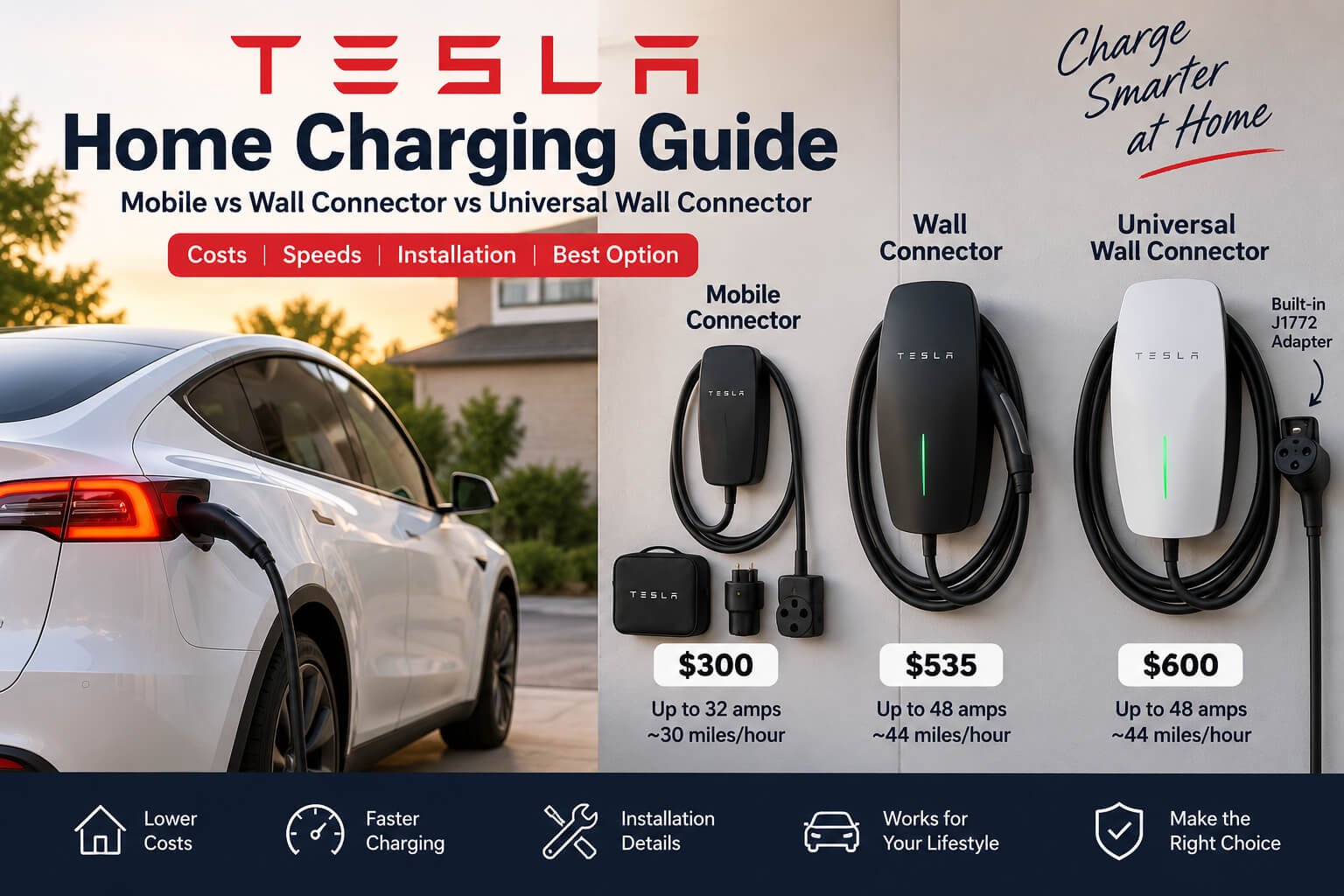
When you order a Tesla, home charging equipment is normally sold separately rather than included as standard equipment with the vehicle. For U.S. buyers, there are three practical Tesla home-charging options to consider: the Mobile Connector, the Wall Connector, and the Universal Wall Connector.
For most Tesla owners, choosing between them does not have to be complicated. The right charger depends on how far you drive, whether you need portability, how quickly you want to recharge overnight, the electrical capacity available at your home, and whether you also need to charge a non-Tesla EV.
Key Takeaways
- The Mobile Connector can deliver up to 32 amps and add up to about 30 miles of range per hour from a suitable 240-volt outlet, depending on the Tesla model.
- The Wall Connector can deliver up to 48 amps at 11.5 kW and add up to about 44 miles of range per hour on compatible vehicles.
- Some Tesla configurations are limited to 32-amp AC charging, so installing a 48-amp Wall Connector does not automatically mean every Tesla will charge at 48 amps.
- The Universal Wall Connector provides the same maximum charging output as the regular Wall Connector while adding an integrated J1772 adapter and support for certain Cybertruck Powershare installations.
- For many owners, a Mobile Connector paired with a properly installed NEMA 14-50 outlet provides enough charging for normal overnight use.
The Three Tesla Home Charging Options at a Glance
Here is the simple breakdown using Tesla’s U.S. retail pricing as of September 2026. Amazon and other marketplace prices can change and may be higher or lower than Tesla’s direct retail price.
- Tesla Mobile Connector: $300 Tesla retail price
- Tesla Wall Connector: $535 Tesla retail price
- Tesla Universal Wall Connector: $600 Tesla retail price
At current Tesla retail pricing, the Universal Wall Connector costs about $65 more than the regular Wall Connector. That relatively small difference buys broader connector compatibility and additional usefulness for certain Cybertruck Powershare configurations. If you only need straightforward NACS home charging, however, the regular Wall Connector remains the less expensive hardwired option.
1. Tesla Mobile Connector: The Best Starting Point for Many Owners
The Mobile Connector is Tesla’s least expensive and most portable charging option. It is not hardwired. Instead, it plugs into a compatible electrical outlet using an interchangeable adapter.
That makes it useful as an everyday home charger for some owners and as a portable backup charger that can stay in the vehicle.
The current U.S. Mobile Connector bundle includes adapters for:
- A standard 120-volt household outlet using the NEMA 5-15 adapter
- A 240-volt outlet using the NEMA 14-50 adapter
A normal 120-volt household outlet charges slowly. Tesla says charging from a standard household outlet can add up to about 3 miles of range per hour, depending on the vehicle.
Using the NEMA 14-50 adapter with an appropriate 240-volt outlet increases charging speed dramatically and can provide up to about 30 miles of range per hour, depending on the Tesla model.
What You Need for a NEMA 14-50 Setup
For faster home charging with the Mobile Connector, a qualified electrician can install a NEMA 14-50 outlet near your parking location. Tesla specifies the NEMA 14-50 adapter for a 240-volt outlet on a 50-amp circuit, while the Mobile Connector itself draws a maximum of 32 amps.
If you already have a suitable 240-volt outlet that an electrician approves for continuous EV charging, installation costs may be minimal. If a new outlet and circuit are required, Tesla currently estimates installation of a new 240-volt outlet at approximately $750 to $1,500.
Actual installation costs can vary significantly. The distance from the electrical panel, wire size, conduit requirements, permitting, panel capacity, local labor rates and any required electrical upgrades can all affect the final bill. Complicated installations can cost more than Tesla’s typical estimate.
EV charging is considered a continuous electrical load, so the breaker, conductors, receptacle and other equipment must be correctly sized and installed according to applicable electrical codes and Tesla’s requirements. A qualified electrician should determine the appropriate installation for your home.
Mobile Connector Charging Speed
With the NEMA 14-50 adapter and a suitable 240-volt circuit, the Mobile Connector can provide a maximum output of 32 amps. Tesla rates the setup at up to about 30 miles of range added per hour, depending on the vehicle.
In the Model Y example shown below, the vehicle reported approximately 29 miles of range per hour while charging at 32 amps.
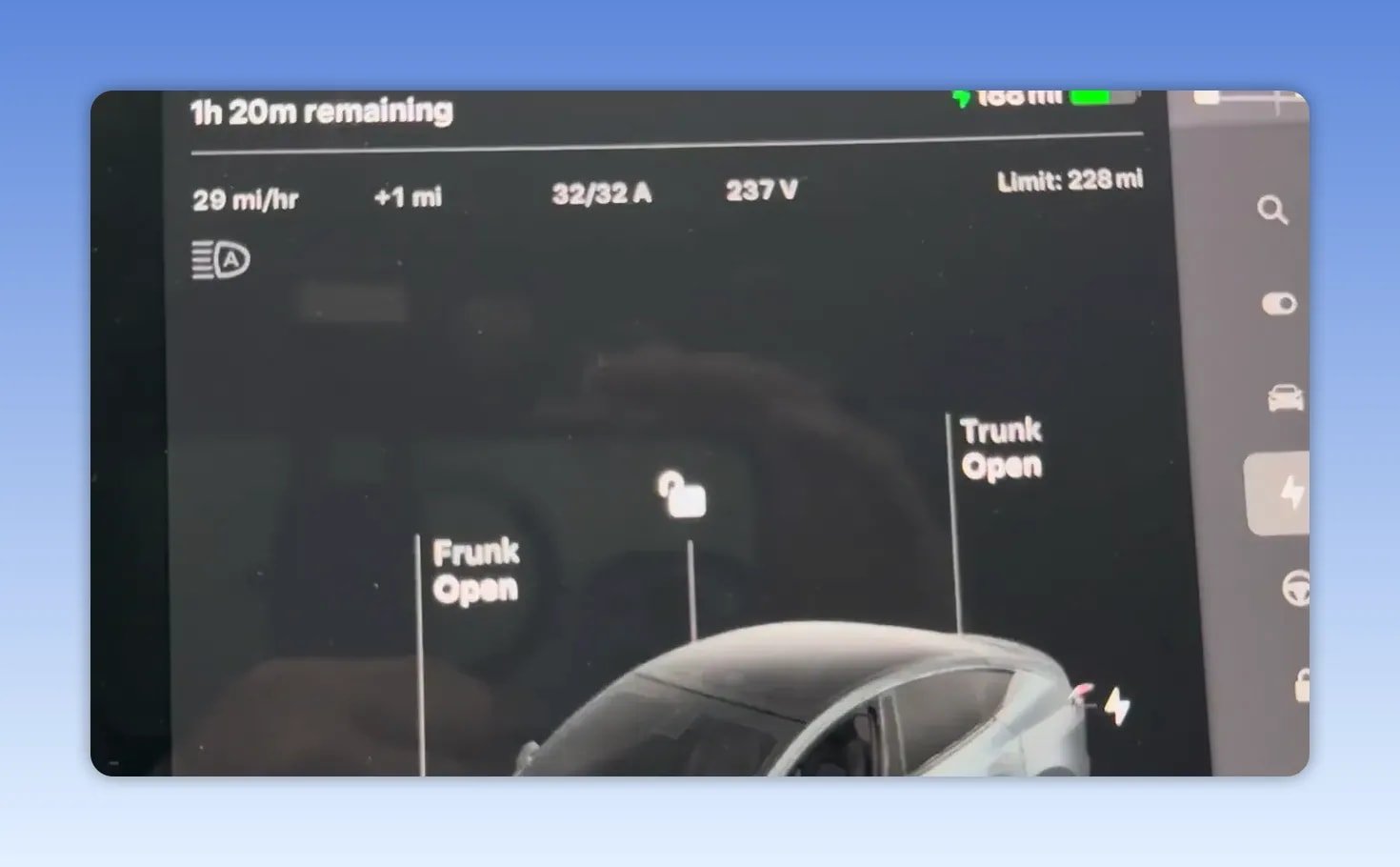
That level of charging is enough for many drivers. At approximately 29 miles of added range per hour, replacing roughly 150 miles of driving would take a little over five hours under similar conditions. Replacing 200 miles would take roughly seven hours.
Actual charging time will vary because miles of range added per hour is an estimate rather than a fixed energy-delivery measurement. Vehicle efficiency, temperature, battery conditions and the vehicle’s onboard charger can affect the displayed rate.
This is why the Mobile Connector can be such a practical value. Many drivers do not need the maximum possible AC charging rate when their vehicle sits at home for eight or more hours overnight.
Why the Mobile Connector Is Worth Keeping in the Car
The other major benefit is portability. You can coil it up, put it in its storage bag and keep it in the trunk.
If you stay at a friend’s house, rental property or another location with a suitable accessible outlet, the Mobile Connector can give you another charging option.
A standard 120-volt outlet is extremely slow compared with Level 2 charging, so it should not be treated as a replacement for fast road-trip charging. However, it can still provide useful emergency or overnight energy when faster charging is unavailable.
2. Tesla Wall Connector: The Better Permanent NACS Setup
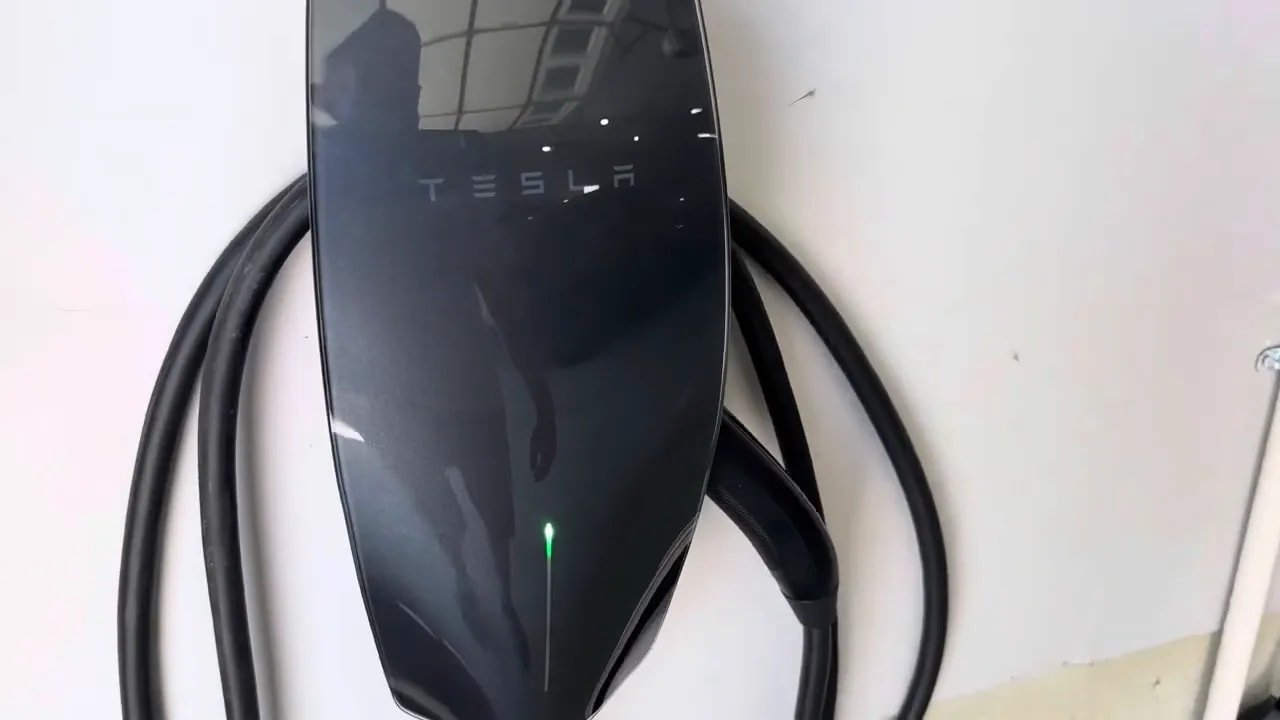
The standard Tesla Wall Connector is a hardwired, Wi-Fi-enabled charger that mounts permanently to a wall. Tesla’s current U.S. retail price is $535, which is $235 more than the $300 Mobile Connector before installation.
It provides a cleaner permanent installation, Tesla app integration, charging statistics, scheduling, access controls, remote diagnostics and potentially faster charging than the Mobile Connector when the vehicle itself supports a higher AC charging rate.
When installed on a 60-amp circuit, the Wall Connector can provide up to 48 amps at 11.5 kW. Tesla rates it at up to approximately 44 miles of range added per hour, depending on the vehicle.
However, 48 amps is the charger’s maximum output, not a speed every Tesla can accept. Some Tesla configurations have a maximum AC charging rate of 32 amps. For those vehicles, a Wall Connector can be configured appropriately, but it will not provide a 48-amp charging-speed advantage over a 32-amp Mobile Connector.
For a Tesla that supports the full 48-amp charging rate, the Wall Connector can add considerably more range per hour than a Mobile Connector operating at 32 amps. That can be useful for high-mileage drivers or situations where the vehicle has fewer hours available to charge.
When the Wall Connector Makes Sense
The Wall Connector is a good upgrade if any of these sound like you:
- You frequently need to replace a large amount of driving range overnight.
- Your Tesla supports a higher AC charging rate than the Mobile Connector can provide.
- You want a dedicated charger permanently mounted where you park.
- You want Wi-Fi connectivity, charging statistics, scheduling and access-control features.
- You have multiple EVs and want a more permanent home-charging system.
There is also the appearance factor. The Wall Connector provides a clean installation, and its 24-foot charging cable can be stored around the unit when it is not being used. Tesla also sells optional color-matched faceplates for owners who want the charger to coordinate with their vehicle.
Installation is an additional expense. Tesla currently estimates typical Wall Connector installation at approximately $750 to $1,500, although the actual price depends on the home’s electrical system and installation complexity.
If you want the regular Tesla Wall Connector, you can check the Wall Connector here. Remember that Amazon marketplace pricing can differ from Tesla’s direct retail price.
3. Tesla Universal Wall Connector: Best for Mixed-EV Homes and Certain Powershare Setups
The Universal Wall Connector is Tesla’s more versatile hardwired home charger. Tesla’s current U.S. retail price is $600.
Like the regular Wall Connector, it can provide up to 11.5 kW and 48 amps and add up to approximately 44 miles of range per hour, depending on the vehicle.
The major difference is connector compatibility. The Universal Wall Connector includes an integrated J1772 adapter, allowing it to charge vehicles with a NACS inlet as well as EVs that use J1772 for AC charging.
This can make it particularly useful for a household that owns vehicles with different charging inlets or for an owner who wants more flexibility for future vehicles.
What the Extra $65 Actually Gets You
At Tesla’s current retail prices, the Universal Wall Connector costs approximately $65 more than the regular Wall Connector: $600 versus $535.
The extra $65 does not give your Tesla a higher maximum normal AC charging speed. Both Wall Connector versions are rated for up to 48 amps at 11.5 kW and up to approximately 44 miles of range added per hour when the vehicle supports that rate.
The main advantages of the Universal version are its integrated J1772 compatibility and its role in certain Tesla Powershare configurations.
The Universal Wall Connector can also be part of a Cybertruck Powershare Home Backup installation. Tesla currently makes Powershare available for Cybertruck, and home-backup functionality requires specific compatible equipment and professional installation. Depending on the home’s energy setup, additional hardware such as a Powershare Gateway may be required.
So the Universal Wall Connector should not be viewed simply as a faster version of the Wall Connector. Its value is primarily compatibility and additional system flexibility.
If you have only Tesla vehicles and do not need J1772 compatibility or a relevant Powershare configuration, the standard Wall Connector may be all you need. On the other hand, because the current retail-price difference is only $65, some buyers may consider the Universal version worthwhile for future flexibility.
Mobile Connector vs Wall Connector vs Universal Wall Connector
| Option | Tesla U.S. Retail Price | Installation | Maximum Output | Advertised Range Added | Best For |
|---|---|---|---|---|---|
| Mobile Connector | $300 | Plugs into a compatible outlet | 32 amps | Up to about 30 miles/hour on 240V, depending on vehicle | Portability, existing 240V outlets and normal overnight charging |
| Wall Connector | $535 | Hardwired by a qualified electrician | 48 amps / 11.5 kW on a 60A circuit | Up to about 44 miles/hour, depending on vehicle | Permanent NACS charging, app features and faster charging on compatible vehicles |
| Universal Wall Connector | $600 | Hardwired by a qualified electrician | 48 amps / 11.5 kW on a 60A circuit | Up to about 44 miles/hour, depending on vehicle | NACS + J1772 households and certain Cybertruck Powershare setups |
Important: The maximum output of the charger does not guarantee that the vehicle will accept that rate. The vehicle’s onboard AC charger ultimately determines how much power it can receive.
My Recommendation for a New Tesla Owner
If you are just getting started and value portability, the $300 Mobile Connector can be an excellent option, especially if you already have an electrician-approved 240-volt outlet where you park.
With a NEMA 14-50 connection, it can deliver up to 32 amps and add up to approximately 30 miles of range per hour, depending on the vehicle. For many drivers, that is more than enough to replenish normal daily driving overnight.
However, installing a new NEMA 14-50 outlet is not free. Tesla currently estimates approximately $750 to $1,500 for installation of a new 240-volt outlet. Because installation costs can be similar to Wall Connector installation, it is worth getting quotes for both options before deciding.
If you want a cleaner permanent setup with app-connected charging features, the regular Wall Connector is a strong long-term choice.
A useful two-charger setup is:
- Install a Tesla Wall Connector where you normally park for everyday charging.
- Keep a Mobile Connector in the vehicle for portable or backup charging.
At current Tesla retail pricing, those two pieces of equipment cost $835 before installation: $535 for the Wall Connector plus $300 for the Mobile Connector.
Using Tesla’s estimated Wall Connector installation range of $750 to $1,500, a Wall Connector plus Mobile Connector setup could total roughly $1,585 to $2,335 before any unusual panel upgrades, long wiring runs, permits or other complex electrical work.
If you own different EV brands, expect to need J1772 compatibility, or have a compatible Cybertruck Powershare use case, the $600 Universal Wall Connector becomes much more attractive. With only a $65 price difference from the regular Wall Connector, some owners may also choose it simply for additional flexibility.
The Bottom Line
If portability and lower equipment cost are your priorities, start with the Mobile Connector. At $300, it can provide up to 32 amps and roughly 30 miles of added range per hour from an appropriate 240-volt outlet, depending on the vehicle.
The $535 Wall Connector is a better choice if you want a clean, permanent, Wi-Fi-enabled charging installation and your vehicle can benefit from its higher maximum output. It can provide up to 48 amps at 11.5 kW and up to approximately 44 miles of range per hour on compatible vehicles.
The $600 Universal Wall Connector provides the same maximum normal charging output while adding an integrated J1772 adapter and compatibility with certain Cybertruck Powershare installations.
The key is not to buy based only on the largest charging-speed number. Check your Tesla’s maximum AC charging capability, your daily mileage, your home’s electrical system and the installation cost before deciding.
|
Frequently Asked Questions
Is the Tesla Mobile Connector enough for home charging?
For many drivers, yes. With an appropriate 240-volt outlet and NEMA 14-50 adapter, the Mobile Connector can deliver up to 32 amps and add up to about 30 miles of range per hour, depending on the vehicle. That can replenish a substantial amount of daily driving during an overnight charging session.
What is the difference between the Tesla Wall Connector and Universal Wall Connector?
Both can provide up to 48 amps at 11.5 kW and up to approximately 44 miles of range per hour when the vehicle supports that charging rate. The Universal Wall Connector adds an integrated J1772 adapter for broader EV compatibility and can also be used in certain Cybertruck Powershare installations.
Do I need a Universal Wall Connector if I only own a Tesla?
Usually not. The regular Wall Connector is currently about $65 less and provides the same maximum normal AC charging output. However, the Universal Wall Connector may still be worth considering if you want built-in J1772 compatibility for future vehicles or need it for a compatible Cybertruck Powershare setup.
How fast does a Tesla Wall Connector charge?
The Wall Connector can provide up to 48 amps at 11.5 kW when installed on a 60-amp circuit and can add up to approximately 44 miles of range per hour, depending on the Tesla model. Some Tesla configurations are limited to 32 amps, so their maximum charging speed will be lower even when connected to a 48-amp-capable Wall Connector.
How much does Tesla home charger installation cost?
Tesla currently estimates approximately $750 to $1,500 to install a new 240-volt outlet and approximately $750 to $1,500 for a typical Wall Connector installation. Actual costs can be higher when panel upgrades, long wiring runs, permitting or other electrical work are required.
Is a Wall Connector always faster than a Mobile Connector?
No. The Wall Connector is capable of a higher maximum output, but the vehicle must also support that charging rate. Some Tesla configurations are limited to 32 amps, in which case their maximum AC charging rate may be similar whether they are connected to a 32-amp Mobile Connector or an appropriately configured Wall Connector.