A 2026 Toyota Tacoma does not have a Toyota-required 500-mile or 1,000-mile break-in oil change. Under normal use, Toyota schedules engine oil and filter replacement at 10,000 miles or 12 months, whichever comes first, while the truck still has a 5,000-mile or six-month maintenance checkpoint. An earlier oil change can be done for peace of mind, but it is optional unless the maintenance guide for your exact truck or a documented mechanical condition says otherwise.
The break-in period does matter, but Toyota’s instructions focus on how you drive the truck rather than requiring an early oil flush. For a 2026 Tacoma, avoid sudden stops during the first 200 miles, do not tow during the first 500 miles, and through 1,000 miles avoid extremely high speeds, sudden acceleration, continuous low-gear driving, and prolonged constant-speed driving.
Last updated: September 19, 2026 · Reviewed against current Tacoma owner and maintenance guidance, API engine-oil guidance, and FTC warranty guidance
Quick Answer
You do not need a 1,000-mile Tacoma break-in oil change simply because the truck is new. For a 2026 U.S.-market Tacoma under normal use, engine oil and filter replacement is scheduled at 10,000 miles or 12 months. The truck still receives maintenance at 5,000 miles or six months, and certain listed operating conditions can require earlier oil service or additional maintenance. An optional 500- or 1,000-mile oil change is extra owner maintenance, not a universal Toyota requirement.
Key Takeaways
- Toyota’s break-in instructions and oil-change schedule are separate: reaching 1,000 miles does not automatically make an oil change due.
- For a 2026 Tacoma under normal use, oil and filter replacement is scheduled at 10,000 miles or 12 months, while routine maintenance still occurs at 5,000 miles or six months.
- A 500- or 1,000-mile oil change is optional unless the documentation for your exact truck or a diagnosed condition says otherwise.
- Use the viscosity and performance standard specified for your exact model year and engine rather than choosing oil by brand name alone.
- Keep receipts, mileage, oil specification, and filter information for every service.
2026 Tacoma Break-In and First Oil Change at a Glance
| Mileage or Time | 2026 U.S. Tacoma Guidance | Does It Require an Oil Change? |
|---|---|---|
| First 200 miles | Avoid sudden stops when conditions allow. | No break-in oil change is specified just because 200 miles has been reached. |
| First 500 miles | Do not tow a trailer. | No universal 500-mile oil change is specified. |
| First 1,000 miles | Avoid extremely high speeds, sudden acceleration, continuous low-gear driving, and prolonged constant-speed driving. | A 1,000-mile oil change remains optional unless another documented condition requires service. |
| 5,000 miles or 6 months | Routine maintenance checkpoint. Listed special operating conditions can add earlier oil service or other maintenance. | Not automatically under normal use; check the exact condition-specific schedule. |
| 10,000 miles or 12 months | Normal-use engine oil and filter replacement for the 2026 U.S.-market Tacoma. | Yes, under the normal schedule. |
Important: This table is a 2026 U.S.-market example, not a universal interval for every Tacoma. Older model years, different engines, and trucks sold in other markets can use different oil specifications and maintenance schedules.
What Is the Toyota Tacoma Break-In Period?

The break-in period is the early phase of vehicle operation when drivetrain, brake, tire, and other components settle into normal use. For the 2026 Tacoma, Toyota’s owner guidance gives specific driving precautions through the first 1,000 miles rather than requiring a special break-in oil change.
During the first 200 miles, avoid sudden stops when possible. Do not tow during the first 500 miles. Through the first 1,000 miles, avoid extremely high speeds, sudden acceleration, continuous driving in low gears, and holding one constant speed for an extended period. Check the instructions for your exact truck through Toyota’s official manuals and warranties portal.
Note: Tacoma generations use different engines and maintenance schedules. Do not apply a 2026 interval automatically to an older four-cylinder or V6 Tacoma.
When Is the First Oil Change on a 2026 Tacoma?
For a 2026 U.S.-market Tacoma under normal use, the scheduled engine-oil and filter replacement is at 10,000 miles or 12 months, whichever comes first. Toyota still uses a 5,000-mile or six-month maintenance checkpoint for items such as tire rotation, fluid checks, brake inspection, and other scheduled work. A 5,000-mile service visit therefore does not automatically mean the engine oil must be replaced.
Certain operating conditions can add earlier oil service or other maintenance, so read the condition-specific notes in your exact Warranty and Maintenance Guide rather than treating every towing trip, short trip, or dusty-road drive as identical. For the broader recurring schedule, see the Toyota Tacoma maintenance schedule guide and the dedicated Tacoma oil-change interval guide.
How Do You Find the Correct Oil-Change Interval?
- Identify the truck: Confirm the model year, engine, market, and whether it is a hybrid.
- Open the correct guide: Use Toyota’s manuals portal or the documents supplied with the vehicle.
- Check mileage and time: Follow whichever limit the guide says comes first.
- Read the condition notes: Different operating conditions can change different maintenance items, so follow the exact footnote rather than using a generic “severe service” rule.
- Record the service: Save the date, mileage, oil specification, filter information, and receipt.
| Situation | Best Action |
|---|---|
| 2026 Tacoma, normal use | Use the 5,000-mile/6-month maintenance checkpoints and the normal 10,000-mile/12-month engine-oil and filter schedule. |
| Special operating condition listed by Toyota | Follow the extra inspection, lubrication, fluid replacement, or shorter oil interval specified for that exact condition. |
| Optional early change for peace of mind | Complete it correctly, document it, and continue following the factory schedule afterward. |
| Warning light, low level, leak, contamination, or abnormal noise | Stop relying on a mileage chart and have the truck inspected promptly. |
Does a Tacoma Have to Use Toyota-Branded Oil?
Toyota-branded oil is a valid choice, but the essential requirement is using oil that matches the viscosity and performance specification in the owner’s manual. The American Petroleum Institute instructs vehicle owners to consult the owner’s manual first and publishes the current API and ILSAC gasoline-engine performance categories.
Do not choose oil only because the bottle says “full synthetic,” “high mileage,” or “high performance.” Those labels do not replace the viscosity grade, API category, ILSAC standard, or another engine-specific requirement listed by Toyota.
Warning: Never guess the oil viscosity or overfill the crankcase. Use the specification and capacity for your exact engine, verify the level after service, and address leaks or warning lights immediately.
What Should You Do During the First 1,000 Miles?
Follow the break-in driving restrictions first. Avoid treating the truck as fully broken in before the specified period ends, especially when towing or using sustained high engine load. The break-in instructions and the oil-change schedule are separate requirements.
If you voluntarily change the oil early, use the correct oil and filter, replace the drain-plug gasket when required, tighten fasteners to the specified torque, check for leaks, and verify the final level on level ground. An unnecessary service performed incorrectly creates more risk than simply following the manual.
Should You Change Tacoma Oil at 500 or 1,000 Miles?
You can perform an early oil and filter change if you want a fresh maintenance baseline or simply prefer the extra service. That choice can be reasonable when the correct products and procedure are used.
What the evidence does not support is treating 500 or 1,000 miles as a mandatory first oil-change point for every Tacoma. Toyota’s 2026 break-in instructions identify driving restrictions through 1,000 miles but do not turn the end of that period into a separate mandatory oil-change event.
What Can an Early Oil Change Do — and What Can’t It Do?
- It can replace the factory-fill oil and filter sooner than the normal schedule.
- It can create a documented maintenance baseline for an owner who prefers one.
- It cannot prove that the engine would have been damaged if the factory interval had been followed.
- It cannot correct improper break-in driving, low oil level, an active leak, or a mechanical defect.
- It does not replace later maintenance required by mileage, time, or condition-specific instructions.
What Can the Oil Filter and Drain Oil Tell You?
An oil filter captures particles within its designed filtration range, while smaller material and normal wear products can remain suspended in the oil. Finding some material during an early service does not by itself prove that an engine has abnormal wear or that every Tacoma needs the same early change.
Large metal pieces, repeated heavy glitter, a damaged filter, fuel odor, coolant contamination, low oil pressure, or abnormal mechanical noise deserve professional evaluation. Oil color alone is not a reliable diagnosis because engine oil normally changes appearance during use.
Pro Tip: Photograph the odometer and receipt at every service. Good records are more useful than memory when you sell the truck, request warranty assistance, or compare repeated oil-analysis results.
Does a Tacoma Use Special Break-In Oil?
Do not assume a factory-new Tacoma contains a special break-in lubricant that must be drained at a fixed mileage. The safer rule is to use the engine-oil specification Toyota lists for the exact model year and powertrain unless official documentation for that truck specifically says otherwise.
Likewise, do not add aftermarket break-in additives, friction modifiers, engine flushes, or a thicker oil simply because the truck is new. A complete approved oil formulation is designed as a system, and an extra additive can change that balance.
The practical rule is simple: follow Toyota’s model-specific break-in instructions and maintenance schedule, then treat an earlier oil change as optional owner maintenance rather than a factory mandate.
How Does Oil Quality Affect Tacoma Engine Protection?

Engine oil must provide lubrication, deposit control, oxidation resistance, wear protection, and compatibility with the engine and emissions system. Current API gasoline-engine standards include performance requirements addressing issues such as timing-chain wear, high-temperature deposits, turbocharger deposits, sludge, varnish, and low-speed pre-ignition.
Use a sealed product from a reputable seller and confirm that the label matches the specification in the owner’s manual. Counterfeit, contaminated, incorrectly stored, or mislabeled oil can create risks even when the viscosity printed on the container appears correct.
Why Does Engine Oil Composition Matter?
Engine oil combines base oils with detergents, dispersants, anti-wear agents, antioxidants, viscosity modifiers, corrosion inhibitors, and other components. The finished formula is engineered to work as a system rather than as a collection of ingredients that should be increased individually.
Choose oil by the complete manufacturer-required specification rather than shopping by a single additive claim. API advises owners to follow the vehicle manufacturer’s recommendation first when selecting a service category or ILSAC standard.
What Do Common Oil Additives Do?
| Additive Group | General Purpose | Owner Guidance |
|---|---|---|
| Detergents and dispersants | Help control deposits and keep contaminants suspended. | Use a certified finished oil rather than routinely adding extra cleaners. |
| Anti-wear and friction-modifying agents | Help manage wear and friction under defined operating conditions. | More additive is not automatically better. |
| Antioxidants | Slow degradation caused by heat and oxygen. | They do not cancel the vehicle’s service interval. |
| Viscosity modifiers | Help multigrade oil perform across temperature ranges. | Use the viscosity grade Toyota specifies for the engine. |
Why Does the Maintenance Interval Still Matter?
Even an approved oil does not remain in service indefinitely. Heat cycles, contamination, fuel dilution, moisture, operating conditions, mileage, and time all affect the service requirement. Follow both the mileage and time limits in the maintenance guide.
Check the oil level between scheduled changes as well. An engine can consume or lose oil before its replacement interval arrives. For the correct checking procedure, see how to check the engine oil level on a Toyota Tacoma.
Does Break-In Wear Mean You Need an Early Oil Change?
Normal break-in can produce measurable wear metals, but one drained-oil observation or one laboratory sample does not establish that the engine has a problem or that Toyota’s normal schedule is unsafe. Results can vary with oil formulation, sampling method, service interval, contamination, and the engine’s operating history.
Used-oil analysis may be useful when tracking a known concern or comparing repeated samples under similar conditions. It is optional for routine Tacoma ownership and should not replace diagnosis when the truck has a warning light, abnormal noise, leak, low oil level, or loss of performance.
What Does Metal in the First Tacoma Oil Change Mean?
Do not assume that every visible particle proves internal engine damage. Material seen in drained oil can have several possible sources, including normal early wear, sealant or manufacturing residue, the drain pan, tools, or the service environment.
Clearly abnormal debris still deserves attention. If you find large flakes, magnetic chunks, copper-colored material, repeated heavy glitter, or a damaged filter, save the filter and a clean oil sample, document the mileage, and contact a Toyota dealer or qualified engine specialist. Avoid running the engine further when low oil pressure or severe mechanical noise is present.
What Do Tacoma Owners Report About Early Oil Changes?
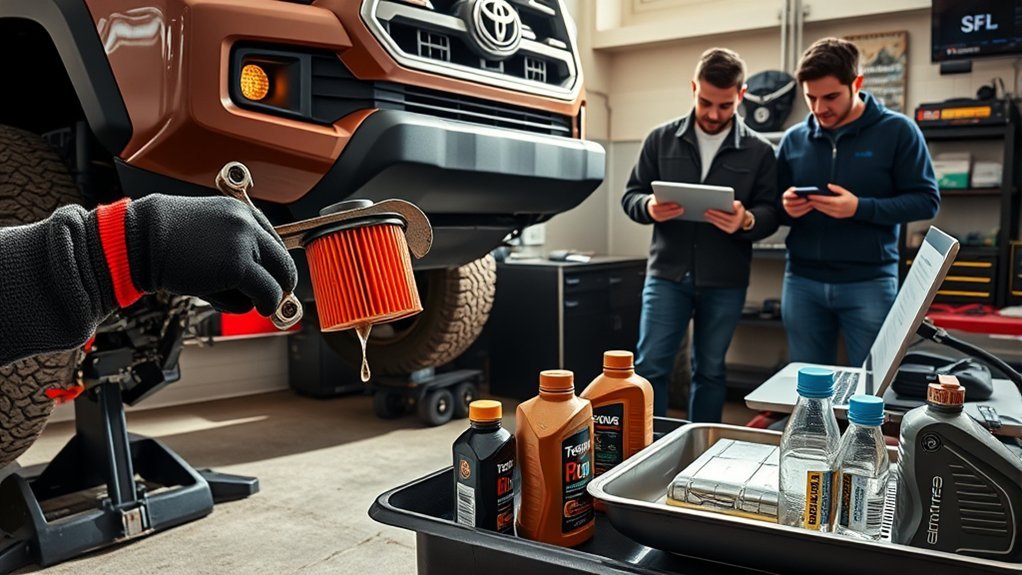
Tacoma owner communities contain both approaches: some owners follow the factory interval, while others pay for an extra early oil change at roughly 500 to 1,000 miles. Reports also vary on what owners see in drained oil and filters, which is one reason an individual photograph or oil-analysis result should not be treated as proof for every truck.
Use community experience to identify questions worth investigating, then confirm maintenance requirements in Toyota’s documentation for your exact model year, engine, and operating conditions.
| Common Owner Choice | Reasonable Interpretation |
|---|---|
| Change the factory-fill oil early | Optional peace-of-mind maintenance, not evidence that every Tacoma requires it. |
| Follow Toyota’s normal interval | Appropriate when you are using the correct schedule and no condition-specific instruction requires earlier service. |
| Use Toyota-branded oil | A convenient option when it matches the specification for the engine. |
| Use another reputable oil brand | Also appropriate when the product meets every required viscosity and performance specification. |
Is an Optional Early Oil Change Worth the Cost?
Oil-change prices vary by location, engine, oil capacity, filter, labor rate, taxes, and the access work required on the truck. Current written quotes for your exact Tacoma are more useful than a fixed national dollar estimate that can quickly become outdated.
An optional early service adds both cost and used oil. Some owners still value the documented starting point and peace of mind. Make that choice knowing that an extra 500- or 1,000-mile change is not established as a universal requirement for a new Tacoma.
What Are the Best Tacoma Engine-Maintenance Practices?
- Use the exact manual: Match the model year, engine, market, and powertrain.
- Follow the break-in driving instructions: Do not confuse them with the oil-change schedule.
- Use the specified oil: Match viscosity and every required API, ILSAC, or Toyota performance standard.
- Install the correct filter: Use the right application and replace seals or gaskets as directed.
- Check the level: Verify it after service and periodically between changes.
- Read special-condition footnotes: Different operating conditions can change different service items.
- Keep records: Save receipts, dates, mileage, oil details, and filter information.
- Investigate symptoms: Do not wait for the next scheduled service when you see a warning light, leak, low level, contamination, or abnormal noise.
Federal warranty rules generally prohibit tie-in provisions that require consumers to buy a specific branded item or service merely to retain warranty coverage, subject to exceptions such as items supplied free under the warranty or an FTC-approved waiver. A warrantor may still exclude damage caused by improper parts, maintenance, or third-party service. The Federal Trade Commission’s warranty guidance explains those rules. Keep documentation and follow the vehicle’s written requirements.
Frequently Asked Questions
Do I really need a break-in oil change on a new Tacoma?
No. For a 2026 U.S.-market Tacoma, Toyota does not schedule a mandatory 500- or 1,000-mile break-in oil change. Follow the factory schedule for the exact truck; an early change is optional unless a documented operating condition, repair, or mechanical concern calls for earlier service.
When should I change the oil on a 2026 Tacoma for the first time?
Under normal use, the 2026 U.S.-market Tacoma schedule places engine oil and filter replacement at 10,000 miles or 12 months, whichever comes first. The truck still has a 5,000-mile or six-month maintenance checkpoint, and listed operating conditions can require earlier oil service or additional maintenance.
What is the break-in period for a 2026 Toyota Tacoma?
Toyota says to avoid sudden stops during the first 200 miles, avoid trailer towing during the first 500 miles, and through the first 1,000 miles avoid extremely high speeds, sudden acceleration, continuous low-gear driving, and prolonged constant-speed driving.
Is it safe to go 10,000 miles between Tacoma oil changes?
It is appropriate when the maintenance guide for your exact Tacoma specifies a 10,000-mile or 12-month normal-use interval and your operating conditions fit that schedule. A listed special condition, time limit, low oil level, leak, warning light, or mechanical problem can require earlier attention.
Does a new Tacoma use special break-in oil?
Do not assume that a factory-new Tacoma uses a special break-in lubricant that must be drained early. Use the oil specification Toyota lists for your exact model year and engine unless official documentation for that truck specifically says otherwise.
Will using non-Toyota oil void my warranty?
A brand name generally cannot be required merely to preserve warranty coverage, subject to federal-law exceptions. The oil still must meet the specifications Toyota requires, and warranty coverage can exclude damage caused by an incorrect product, improper maintenance, or poor workmanship.
Conclusion
A Tacoma break-in oil change is optional owner maintenance, not a universal Toyota requirement. For a 2026 U.S.-market Tacoma, focus first on Toyota’s 200-, 500-, and 1,000-mile break-in driving restrictions. Under normal use, the scheduled engine-oil and filter replacement is at 10,000 miles or 12 months, while routine maintenance still begins at 5,000 miles or six months.
If you choose an early oil change, use the exact oil and filter specification, perform the service correctly, verify the final level, and keep complete records. For every other model year or market, confirm the schedule in the Warranty and Maintenance Guide for that exact truck rather than copying a 2026 interval.
Sources
- Toyota Manuals and Warranties – official access point for model-year-specific owner’s manuals and maintenance guides.
- ToyotaCare and Maintenance Plans – Toyota information about factory-scheduled maintenance coverage and vehicle-specific service details.
- American Petroleum Institute Oil Categories – current API and ILSAC gasoline-engine oil-performance categories and owner-manual guidance.
- Federal Trade Commission Warranty Guidance – federal guidance covering tie-in sales, branded-product requirements, exceptions, and damage caused by outside parts or service.