
Use 4HI in a part-time Toyota Tacoma when the road or trail is slippery or loose enough to let the tires slip slightly and you need more forward traction than 2H provides. Snow, ice, deep slush, gravel, dirt, sand, and mud are common examples. Keep 2H selected on normal dry or wet pavement, and reserve 4LO for slow, demanding terrain. Your Tacoma’s model year and drivetrain determine the exact shift procedure, so the owner’s manual takes priority.
Quick Answer
Use 4HI in a part-time 4WD Toyota Tacoma when snow, ice, gravel, dirt, sand, mud, deep slush, or another loose surface reduces traction and allows some tire slip. Keep 2H selected on dry or normally wet pavement. Some Tacoma configurations use full-time 4WD, so always follow the instructions for your exact year and trim.
Three-Question 4HI Decision Rule
- Can the surface permit tire slip? Think snow, ice, gravel, dirt, sand, mud, or deep slush.
- Do you need more forward traction than 2H is providing? If yes, 4HI may be appropriate.
- Do you still need high-range movement rather than slow crawling? If yes, choose 4HI; if the terrain requires very slow movement and greater control, review the procedure for 4LO.
Key Takeaways
- Use part-time 4HI on consistently slippery or loose surfaces, not ordinary dry pavement.
- Rain alone usually does not justify 4HI on a paved road because the tires may still have too much grip.
- Shift while traveling straight, at a steady and appropriate speed, and never while the wheels are spinning.
- A solid 4HI indicator normally confirms engagement; a flashing indicator means the shift may not be complete.
- 4HI can improve acceleration and forward traction, but it does not shorten braking distance on snow or ice.
- Some Tacoma configurations use full-time 4WD, so always check the manual for your exact year and trim.
Last updated: September 11, 2026
At a Glance
| Time Required | A few seconds to select 4HI, plus time to confirm the indicator has stopped flashing |
| Difficulty | Easy, but choosing the correct surface and following the model-specific procedure are essential |
| Tools Needed | No tools; keep your Tacoma owner’s manual available for the exact shift limits and indicator behavior |
| Cost | No direct cost when using the factory-installed system correctly |
Understanding What 4HI Does

On most four-wheel-drive Tacomas, 4HI, also shown as 4H or H4 on some controls and manuals, connects the front and rear drivetrains so both axles can help move the truck. This can reduce rear-wheel spin and improve forward traction when the surface is slippery or loose.
Part-time 4WD systems generally do not use an open center differential that continuously allows the front and rear axles to rotate at different average speeds. The tires therefore need a surface that permits a small amount of slip, especially during turns.
That controlled tire slip is available on snow, gravel, dirt, sand, and mud. It is usually unavailable on clean, dry pavement, which is why using part-time 4HI on a high-traction road can create binding and stress.
Note: Not every Tacoma uses the same drivetrain. Toyota documented part-time 4WD with an electronically controlled two-speed transfer case on several 2024 Tacoma grades, while the 2024 Limited i-FORCE MAX used full-time four-wheel drive with an electronic locking center differential. Equipment can change by model year, so follow the instructions for your exact year, trim, and drivetrain.
2H vs. 4HI vs. 4LO
If you need a broader explanation of the Tacoma transfer-case modes and controls, see the Toyota Tacoma 4WD system guide. For deciding specifically when to use 4HI, the surface and required vehicle speed are the main factors.
| Mode | Best Use | Avoid |
|---|---|---|
| 2H | Normal dry roads, normally wet paved roads, and everyday driving | Deep mud, deep snow, or loose terrain when rear-wheel traction is inadequate |
| 4HI | Snow, ice, slush, gravel, dirt, sand, mud, and moderate off-road travel | Dry high-traction pavement in a part-time system |
| 4LO | Very slow travel through steep, rocky, deeply rutted, or severely stuck conditions | Normal road speeds and ordinary winter driving |
When Should You Use 4HI in a Toyota Tacoma?
Snow-Covered and Icy Roads
Use 4HI when a road is consistently covered with packed snow, deep slush, or ice and the rear tires cannot maintain dependable traction in 2H. Driving all four wheels can make it easier to start moving, climb a grade, and maintain controlled momentum.
Return to 2H when the road becomes mostly clear and dry. Patchy conditions require judgment because a road may alternate between low-traction snow and high-traction pavement.
Warning: 4HI does not shorten your stopping distance. Slow down, make gentle steering and braking inputs, and leave more space ahead. NHTSA advises drivers to reduce speed and increase following distance on slick or snow-covered roads.
Loose Gravel and Dirt
Loose gravel does not provide excellent traction. Instead, stones can roll or shift beneath the tires, reducing grip. Selecting 4HI can distribute driving force between both axles and reduce excessive rear-wheel spin.
Gravel and dirt also allow a small amount of tire slip during turns. That makes these surfaces more suitable than clean pavement for exercising or testing a part-time 4WD system.
Mud, Sand, and Moderate Trails
4HI can help you maintain momentum through shallow mud, firm sand, forest roads, and moderate trails. Use smooth throttle inputs because sudden acceleration can dig the tires into sand or mud.
If the truck cannot move at a safe speed, the terrain is extremely steep, or you need greater low-speed control, stop and review the procedure for 4LO. Do not wait until the wheels are spinning rapidly before changing modes.
Can You Use 4HI in Rain?
Use 2H for ordinary rain on a paved road in a part-time 4WD Tacoma. Wet asphalt can still provide substantial grip, especially when turning, so the drivetrain may bind even though the road looks slippery.
4HI may become appropriate when rain is combined with mud, loose gravel, deep slush, snow, or another surface that permits tire slip and additional forward traction is needed. It does not prevent hydroplaning, so slower speed and smooth steering and braking remain essential.
How to Engage 4HI Safely
Toyota’s selector design, indicator behavior, and allowable shift speed vary across Tacoma model years. Check the Toyota Manuals and Warranties portal for the exact instructions for your vehicle.
- Confirm that 4HI is appropriate. The surface should be consistently slippery, loose, or unpaved.
- Point the truck straight. Avoid attempting the shift during a tight turn.
- Reduce wheelspin. Ease off the accelerator and do not shift while one or more tires are spinning.
- Select 4HI. Move the switch, dial, or lever from 2H to 4H according to your owner’s manual.
- Watch the indicator. A flashing light commonly means the shift is still in progress. A steady light normally confirms engagement.
- Accelerate gently. Test the truck’s response without abrupt throttle or steering input.
Some Tacoma manuals permit shifting from 2H to 4HI while the truck is moving below a specified speed. That number is not identical across every generation and configuration, so the limit in your own manual takes priority over generic online advice. A permitted shift speed also should not be interpreted as a recommended driving speed in snow, ice, mud, or other low-traction conditions.
Pro Tip: Make the shift while traveling straight at a steady, moderate speed before reaching the deepest snow, mud, or gravel. Engaging early is easier on the system than waiting until the tires are spinning.
How to Return to 2H
- Move onto a surface where 2H is suitable.
- Drive straight and reduce accelerator pressure.
- Select 2H according to the owner’s manual.
- Wait for the 4HI indicator to turn off.
- If it continues flashing, maintain a straight path and make a small, smooth speed change if your manual recommends it.
- Stop safely and seek service if the system will not disengage or the truck continues to bind.
Real-Life Scenarios for Using 4HI
| Driving Condition | Typical Choice | Reason |
|---|---|---|
| Dry city street | 2H | High traction can cause binding in part-time 4WD. |
| Light or moderate rain on pavement | 2H | Rain alone does not guarantee enough tire slip for part-time 4HI. |
| Fully snow-covered road | 4HI | Both axles can help maintain forward traction. |
| Loose gravel road | 4HI when added traction is needed | The surface permits tire slip and may reduce rear-wheel spin. |
| Muddy access road | 4HI | Helps maintain momentum without immediately using low range. |
| Steep rocky crawl | 4LO | Low range provides slower movement and greater control. |
What Happens if You Use Part-Time 4HI on Dry Pavement?
Driveline Wind-Up and Binding
During a turn, each tire follows a different path. The front and rear axles therefore need to rotate at slightly different average speeds. A part-time 4WD system can restrict that speed difference.
On gravel or snow, the tires can release the difference through minor slip. On dry pavement, the grip can prevent that release and store stress in the drivetrain. Drivers may notice heavy steering, hopping tires, jerking, or difficulty returning the selector to 2H.
Increased Drivetrain Stress
Continued binding can place unnecessary load on the transfer case, driveshafts, universal joints, axles, CV joints, differentials, and tires. A single accidental short drive may not cause immediate failure, but repeated or prolonged misuse increases wear.
Tire Wear and Tire Matching
Uneven tire sizes, pressures, or tread depths can make the front and rear axles rotate at different effective speeds even when you are traveling straight. That difference can increase stress whenever four-wheel drive is engaged.
Use four tires of the correct size and compatible construction. Keep them at the pressure shown on the driver-side Tire and Loading Information label and rotate them according to the maintenance schedule. NHTSA recommends checking tire pressure at least monthly when the tires are cold and checking the tread and tire condition at the same time.
Maintaining Your Tacoma’s 4WD System
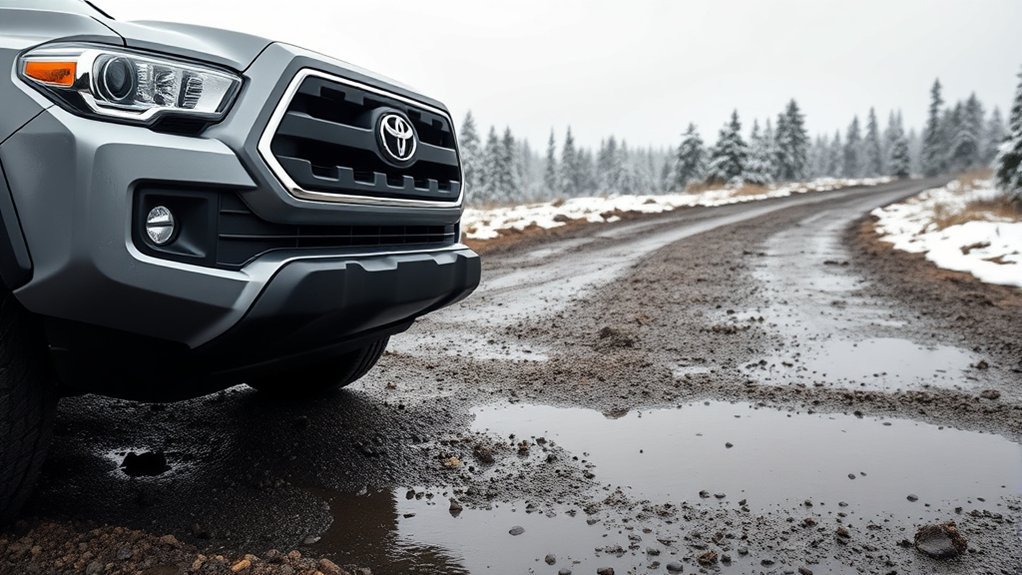
Periodic operation can help you confirm that the 4WD selector, actuator, transfer case, and dashboard indicators respond correctly. However, the often-repeated recommendation to drive exactly 10 miles in 4HI every month should not be treated as a universal rule for every Tacoma.
Check the owner’s manual and maintenance guide for your model year. If Toyota instructs you to operate the system periodically, do so on a suitable loose or slippery surface rather than dry pavement.
| Maintenance Item | When to Check | Purpose |
|---|---|---|
| Engage and disengage 4HI | Periodically, if required by your manual | Confirms that the system operates and the indicator responds. |
| Tire pressure and condition | Monthly and before long trips | Reduces tire mismatch and protects traction and handling. |
| Visible fluid leaks | During routine visual checks | May reveal a transfer-case, differential, or axle-seal problem. |
| Transfer-case and differential fluids | At Toyota’s scheduled service interval | Maintains lubrication and allows inspection for contamination. |
| Warning lights or unusual noise | Whenever noticed | Helps identify actuator, sensor, transfer-case, or drivetrain faults early. |
You do not need to disassemble or directly inspect internal bearings and seals every month. Have a qualified technician inspect the system if you find a leak, hear grinding, feel severe binding, or cannot engage or disengage four-wheel drive.
Troubleshooting 4HI Engagement Problems
The 4HI Indicator Keeps Flashing
A flashing light often means the shift has not finished. Keep the steering wheel straight, ease off the accelerator, and follow the engagement procedure in your owner’s manual. Do not continue switching rapidly between modes.
If the road is safe, a small and smooth change in vehicle speed may allow driveline components to align. Stop and seek service if the light keeps flashing, several 4WD warning lights appear together, or the system does not respond.
4HI Will Not Engage
First, confirm that you are using the correct selector position and shift procedure. Make sure the wheels are not spinning and that the truck is traveling straight if an on-the-fly shift is permitted.
Cold weather can make mechanical and electrical components respond more slowly, but extended idling is not a universal repair. If the system repeatedly fails after normal operation, arrange a professional diagnosis rather than forcing the selector.
The Truck Still Feels Bound After Selecting 2H
Move to a loose surface if one is safely available, drive straight, and gently accelerate and decelerate. This may release stored driveline tension. Do not make tight circles on dry pavement.
Stop driving and obtain service if the truck continues hopping, resists steering, makes grinding noises, or will not confirm 2H engagement.
Check the Tires
Confirm that all four tires have the specified size and appropriate inflation pressure. Major tread-depth differences or a temporary spare can change effective tire circumference and interfere with smooth four-wheel-drive operation.
Weather Considerations for Snow, Ice, Slush, and Rain
Snow and ice reduce the grip available for accelerating, turning, and braking. 4HI can help the truck move and may reduce wheelspin, but it cannot create traction that the tires do not have.
Winter or all-terrain tires suited to your conditions can matter more than the drivetrain mode alone. Keep the tread in safe condition and use the manufacturer’s recommended cold inflation pressure. NHTSA advises drivers to inspect tires at least monthly, slow down, and leave additional stopping distance in winter weather.
Deep slush may justify 4HI because it allows tire slip and can pull the truck away from ruts. Ordinary rain on asphalt usually calls for 2H, slower speed, smooth inputs, and greater following distance.
Four-wheel drive can help you get moving, but your tires still determine how well you turn and stop.
4HI Best-Practice Checklist
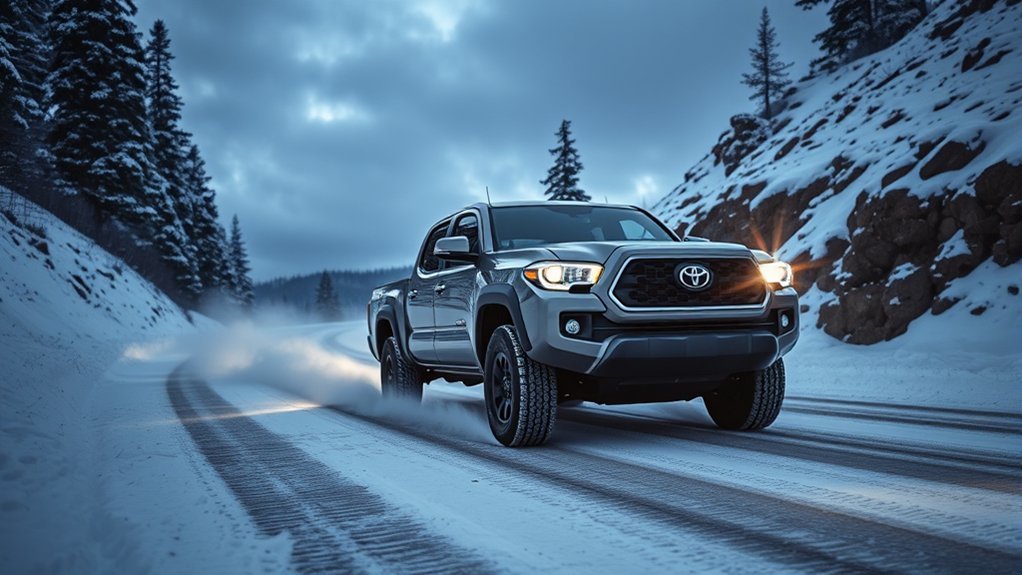
- Confirm that the surface is loose, slippery, snow-covered, muddy, or otherwise suitable for part-time 4WD.
- Engage 4HI before severe wheelspin begins.
- Travel straight and use a steady speed during the shift.
- Follow the shift-speed limit stated in your exact Tacoma owner’s manual.
- Wait for a steady indicator before assuming the system is fully engaged.
- Use gentle throttle, braking, and steering inputs.
- Avoid sharp turns on surfaces with mixed or improving traction.
- Return to 2H when you reach clear, high-traction pavement.
- Use 4LO only for low-speed situations that require greater control or torque multiplication.
- Arrange service if the indicator continues flashing or the drivetrain makes unusual noises.
Related Guides
Frequently Asked Questions
When should you use 4HI in a Toyota Tacoma?
Use part-time 4HI when you need additional forward traction on snow, ice, deep slush, loose gravel, dirt, sand, mud, or a moderate off-road trail. Keep 2H selected on ordinary dry or wet pavement unless your specific full-time 4WD system permits a different mode.
Is it safe to drive in 4HI all the time?
Not with a typical part-time Tacoma 4WD system. Continuous use on dry, high-traction pavement can cause binding, tire scrub, and unnecessary drivetrain stress. Some Tacoma configurations use full-time 4WD, so check the owner’s manual for your exact trim.
How fast can you drive in 4HI?
Tacoma shift and operating instructions vary by model year and drivetrain. Follow the limits and procedures in your vehicle’s manual rather than relying on a universal online number. A permitted 2H-to-4HI shift speed is not automatically a recommended driving speed. Snow, ice, gravel, mud, visibility, and stopping distance may require you to drive much slower.
Should you daily-drive in 2H, 4HI, or 4LO?
Use 2H for normal paved-road driving in a part-time 4WD Tacoma. Select 4HI for loose or slippery conditions and 4LO for very slow, difficult terrain that requires added control. Full-time 4WD configurations follow different instructions.
Does 4HI help you stop faster on snow or ice?
No. 4HI can help distribute power while accelerating, but braking still depends on tire grip, road conditions, vehicle speed, and available stopping distance. Slow down, leave extra space, and avoid abrupt braking or steering.
What should you do when the 4HI light keeps flashing?
Drive straight, reduce accelerator pressure, and follow the shift procedure in your owner’s manual. Do not force the selector or repeatedly cycle it. Have the system inspected if the light will not become steady, several warning lights flash, or the system will not engage or disengage.
Do you need to stop before shifting a Toyota Tacoma into 4HI?
Not necessarily. Some Tacoma part-time 4WD systems allow a 2H-to-4HI shift while the truck is moving below a model-specific speed. Keep the truck straight, reduce wheelspin, and follow the procedure in your exact owner’s manual. Shifting between 4HI and 4LO follows a different procedure and commonly requires the vehicle to be stopped.
Can you use 4HI in the rain?
Ordinary wet pavement usually calls for 2H in a part-time 4WD Tacoma because the road may still provide too much grip for the front and rear drivetrains to release speed differences during turns. 4HI may be appropriate when rain is combined with mud, loose gravel, deep slush, snow, or another low-traction surface that allows tire slip.
Is 4HI appropriate on a snow-covered highway?
4HI can be appropriate on a consistently snow-covered highway in a part-time Tacoma when additional traction is needed. It does not make highway speed safe. Reduce speed for visibility and grip, increase following distance, and return to 2H when the pavement becomes consistently clear and high-traction.
Why does a Tacoma hop or bind in 4HI?
A part-time Tacoma can hop, resist turning, or feel bound when 4HI is used on a high-traction surface that does not let the tires slip enough to release driveline tension. Return to 2H when safe. If severe binding, vibration, grinding, or clunking continues on a suitable loose surface, stop driving and have the drivetrain inspected.
Conclusion
Use 4HI in a part-time Toyota Tacoma when snow, ice, gravel, dirt, sand, mud, or deep slush reduces traction and permits some tire slip. Return to 2H when you reach clear, high-traction pavement, and reserve 4LO for slow, demanding terrain. Shift smoothly, confirm the indicator, maintain matching tires, and follow the owner’s manual for your exact model year and drivetrain.
Remember that 4HI improves your ability to move forward, not your ability to stop. Safe speed, suitable tires, greater following distance, and gentle controls remain essential in every low-traction condition.
Sources
- Toyota Manuals and Warranties — vehicle-specific operating instructions, warnings, and maintenance information
- Toyota USA Newsroom: 2024 Toyota Tacoma i-FORCE MAX — part-time 4WD configurations and the Limited full-time 4WD system with locking center differential
- Toyota: Current Tacoma Overview — current Tacoma lineup, trims, and capability features
- NHTSA Winter Weather Driving Tips — winter speed, following-distance, tire-pressure, and vehicle-preparation guidance
- NHTSA TireWise — tire pressure, tread, maintenance, and safety guidance
