The 4th gen Tacoma uses full synthetic oil, with SAE 0W-20 as the factory-recommended viscosity for best cold-start flow and fuel efficiency. SAE 5W-30 can be a practical choice for towing, sustained heat, or higher-mileage engines, where added film strength may improve protection. Oil capacity is about 6.2 quarts. Normal change intervals are 7,500 to 10,000 miles, with shorter service for severe use. The right viscosity depends on duty cycle, climate, and protection needs.
Key Takeaways
- The 4th Gen Tacoma is designed for full synthetic oil, with 0W-20 as the factory-recommended viscosity.
- 0W-20 improves cold-start flow, fuel efficiency, and emissions performance.
- 5W-30 can offer stronger film protection and may suit towing, heat, or high-mileage engines.
- Normal full synthetic oil changes are typically every 7,500 to 10,000 miles, with shorter intervals for severe use.
- Always use API SP and ILSAC GF-6A oils, and check the owner’s manual for the correct grade.
What Oil Does a Tacoma Use?
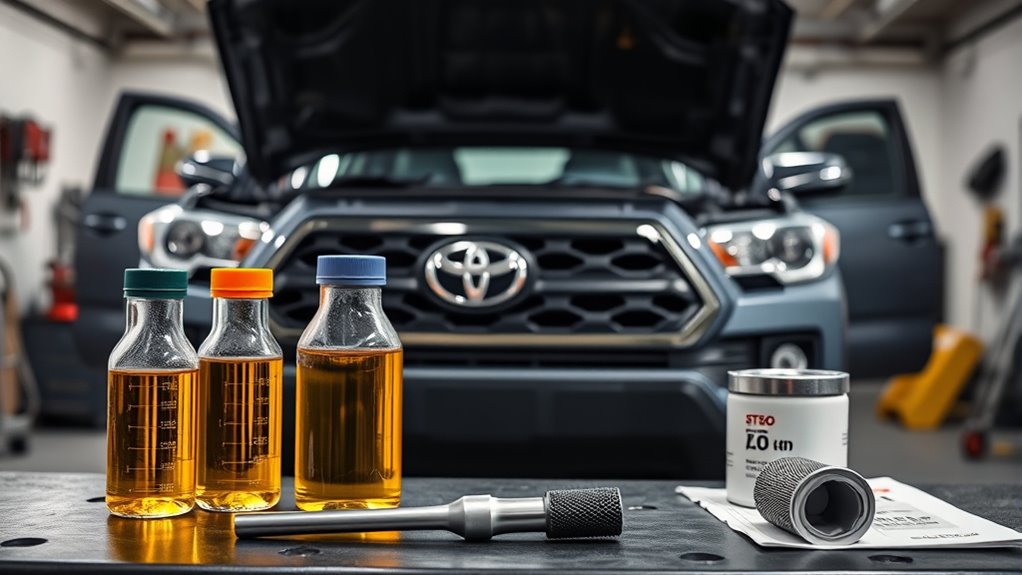
The 4th Gen Tacoma typically uses full synthetic engine oil, with SAE 0W-20 specified for ideal performance in most applications. This oil type supports low-friction operation, stable cold-start flow, and reliable thermal control across varied duty cycles.
As a synthetic oil formulation, it is designed to maintain viscosity integrity under heat and resist breakdown during extended service intervals. For most drivers, 0W-20 aligns with the engine’s lubrication demands and factory calibration, promoting efficient fuel use and consistent mechanical protection.
Oil capacity is approximately 6.2 quarts for both the 2.7L four-cylinder and 3.5L V6, including the filter. Correct specification matters because it affects wear control, emissions performance, and drivability.
Owners seeking mechanical autonomy should verify requirements in the owner’s manual or with a qualified technician, especially when model year or engine configuration may alter approved oil type.
0W-20 vs 5W-30 for Tacoma Oil
For the 4th Gen Tacoma, 0W-20 remains the factory-preferred viscosity for maximum fuel efficiency and cold-start flow, whereas 5W-30 is often chosen in more demanding service conditions where additional film strength and slightly better high-load protection are desired.
Both grades are technically acceptable, but their behavior differs. 0W-20 supports lower pumping losses, cleaner emissions targets, and quicker lubrication at startup, especially in cold weather.
By contrast, 5W-30 offers a thicker operating film that can enhance engine protection under sustained load, heat, or abrasive use, and it may marginally reduce mechanical noise.
The tradeoff is measurable: 5W-30 can slightly reduce fuel economy compared with 0W-20.
Oil capacity remains about 6.2 quarts for either viscosity, so the core decision is not volume but operating priority.
Selection should consequently follow duty cycle, climate, and the owner’s tolerance for efficiency versus protection.
When Tacoma Owners Choose 5W-30
When Tacoma owners choose 5W-30, the decision usually reflects a need for greater film strength, slightly higher oil pressure, and improved wear protection under sustained heat, towing, or aggressive use.
Tacoma owners often choose 5W-30 for stronger film protection, steadier pressure, and better defense under heat and load.
In this scenario, 5W-30 is often selected for engine protection when factory 0W-20 appears too light for the operating demand. Many Tacoma owners report quieter valvetrain operation and less ticking, especially in high-mileage engines or under repeated load.
The 2020 specification update for V6 models acknowledged this preference, allowing 5W-30 where direct-injection deposits and heavy-load stress were relevant.
Technical feedback also suggests better pressure retention during spirited driving, which can support durability without sacrificing control.
For drivers seeking mechanical independence from marginal lubrication margins, 5W-30 offers a measured, evidence-based choice. Its appeal is not based on hype; it is rooted in viscosity behavior, operational severity, and a practical desire for resilient engine protection.
Tacoma Oil in Cold Weather
In cold weather, oil viscosity becomes a primary factor in Tacoma cold-start behavior, with thicker 5W-30 sometimes contributing to slower circulation, increased noise, and harder starts.
By contrast, 0W-20 generally flows more readily at low temperatures, supporting faster oil delivery and reduced engine strain during frigid starts.
Seasonal viscosity changes can thus influence both startup performance and the effectiveness of systems such as VVT.
Cold Start Behavior
Cold-start behavior in the Tacoma is strongly influenced by oil viscosity, especially in subfreezing conditions. In this regime, cold start behavior depends on how rapidly the lubricant reaches bearings and valvetrain surfaces.
The factory-recommended 0W-20 moves more readily at low temperature, promoting quicker circulation, lower friction, and reduced engine noise during ignition. By contrast, heavier 5W-30 can resist flow, prolong startup intervals, and increase mechanical load. At temperatures near -14°F, that resistance may become audible as rougher operation.
For drivers seeking dependable winter performance, the lighter grade preserves responsiveness and helps protect components from early wear. In cold climates, selecting 0W-20 supports efficient lubrication and keeps the powertrain freer to operate with less constraint and less loss of mechanical dignity.
Winter Oil Choice
For winter use, the 4th Gen Tacoma is best served by 0W-20, as its lower low-temperature viscosity improves pumpability, shortens oil delivery time at startup, and reduces noise in subfreezing conditions.
In cold weather, the 0w rating supports rapid circulation when thickened oil can delay lubrication. Toyota’s lighter-oil calibration aligns with the engine’s design and fuel-economy targets, while preserving boundary protection during the first revolutions.
Reports of engine noise with 5W-30 at extreme lows, including near -14°F, indicate that heavier grades can hinder flow and amplify mechanical sound.
Regional guidance may vary, yet the technical pattern is consistent: lighter oil better sustains control, efficiency, and mechanical quiet when temperatures fall and operating freedom depends on immediate lubrication.
Tacoma Oil Capacity by Engine
Oil capacity varies slightly by Tacoma engine, with the 2.7L four-cylinder holding about 6.1 quarts during a full oil change with filter replacement and the 3.5L V6 requiring roughly 6.2 quarts under the same conditions.
That oil capacity is tied to engine type, and the Toyota Tacoma Oil specification should be matched to the exact configuration to preserve lubrication margins.
When old oil is drained without replacing the filter, the 2.7L typically needs about 5.8 quarts, while the V6 retains a similar volume profile.
These figures are not arbitrary; they reflect internal passage volume, oil pan geometry, and filter retention.
Exact capacity can vary slightly by model year, so the under-hood label and owner’s manual remain the authoritative references.
Maintaining the specified fill level supports stable pressure, efficient heat transfer, and mechanical durability.
Overfilling or underfilling narrows the operating window and can impair performance.
How Often to Change Tacoma Oil
How often a 4th Gen Tacoma needs fresh oil depends on both lubricant type and operating conditions, with full synthetic oil generally supporting intervals of 7,500 to 10,000 miles under normal use. A disciplined oil change schedule preserves mechanical autonomy and reduces frictional loss.
| Condition | Interval | Effect |
|---|---|---|
| Normal driving | 7,500–10,000 mi | Stable protection |
| Towing | Shorter | Higher stress |
| Off-road use | Shorter | Contamination risk |
| Oil life indicator | Monitor continuously | Data-driven timing |
| Filter replacement | Every oil change | Sustained flow |
Severe service, including towing and off-road travel, accelerates degradation and justifies earlier service. The oil life indicator provides a quantitative reference, aligning maintenance with actual duty cycle rather than habit. Each oil change should include a new filter to protect lubrication quality and engine performance. In practice, adherence to the schedule supports longevity, limits wear, and keeps the Tacoma efficient.
Signs Your Tacoma Needs an Oil Change
A Tacoma may require an oil change when the oil life indicator or dashboard warning light signals service due.
Physical inspection can also reveal dark, gritty, or burnt-smelling oil, which indicates contamination and degraded lubrication capacity.
Changes in engine acoustics, such as ticking or knocking, further suggest insufficient oil protection and warrant prompt attention.
Dashboard Warning Light
When the dashboard oil warning indicator illuminates on a Tacoma, it typically signals low engine oil or degraded oil life and indicates that service is due. This dashboard warning light is a calibrated alert, not decoration; it reflects measured engine oil condition and demands a timely oil change.
Many newer Tacoma models use oil-life monitoring software that estimates remaining service life, often near 7,500 to 10,000 miles, depending on duty cycle. A flickering pressure warning is more urgent, implying insufficient lubrication and possible engine damage.
Routine dipstick checks help maintain proper levels and reduce false alerts. Ignoring the signal can erode performance, accelerate wear, and force costly repairs. Respecting the warning preserves mechanical autonomy and long-term reliability.
Dark, Dirty Oil
Dark, dirty oil is a clear visual indicator that a Tacoma’s lubricant has begun to lose its protective properties.
In technical terms, the presence of dark, dirty oil suggests contamination by combustion byproducts and debris, reducing its capacity to shield the engine. A visible loss of clarity often means the fluid has oxidized and degraded, making maintenance necessary.
If the oil appears thick or sludgy, wear may already be advancing, and immediate service is prudent. For full synthetic formulations, replacement intervals of 7,500 to 10,000 miles support ideal engine health.
Monitoring color and consistency gives owners a practical means to preserve mechanical autonomy, avoid sludge buildup, and limit long-term damage. Clean oil is not cosmetic; it is functional, protective, and essential.
Engine Noise Changes
Increased engine noise often signals that a Tacoma’s oil is no longer providing ideal lubrication, especially if ticking, knocking, or a loud groan appears during cold starts.
That pattern usually indicates oil viscosity is mismatched to ambient temperature, limiting flow at startup and raising engine noise. In very cold climates, heavier grades such as 5W-30 may thicken enough to delay protection, making an oil change advisable.
Noise that grows after long idle periods or under high load can also reflect degraded oil quality or insufficient film strength.
Regular oil change intervals, ideally every 7,500 to 10,000 miles, help preserve quieter operation, reduce wear, and support long-term mechanical freedom.
Monitoring these acoustic changes gives owners a precise, low-cost method for protecting engine health.
Toyota Genuine Oil or Aftermarket Brands?
Toyota Genuine Oil is engineered to meet the specific performance and protection requirements of Tacoma engines, making it a straightforward choice for owners prioritizing manufacturer alignment and warranty consistency. Its formulation targets proper lubrication across the specified viscosity grade, reducing the probability of wear-related faults while keeping specification compliance simple.
Aftermarket brands can also be technically sound when they carry API SP and ILSAC GF-6A certification. Products from Mobil1 or Amsoil may deliver comparable protection, and in some cases a more economical ownership profile, without sacrificing required standards.
For some Tacoma engines, higher-viscosity choices such as 5W-30 have been associated with reduced oil consumption and satisfactory performance.
The decision is thus not ideological but functional: OEM oil offers certainty, while quality aftermarket brands offer flexibility and potential savings. Each path can support engine health when the oil matches Toyota’s requirements and the chosen operating conditions.
Best Tacoma Oil for Your Driving Style
Which viscosity best suits the 4th Gen Tacoma depends largely on how the truck is used, with 0W-20 remaining the factory baseline for fuel efficiency and cold-start performance, while 5W-30 is often favored for towing, hauling, and other high-load conditions.
In practical terms, oil viscosity should match operating demands rather than habit. For daily commuting and winter use, 0W-20 can support easier starts, lower drag, and reduced wear during cold operation.
For drivers seeking more composure under stress, 5W-30 may improve lubrication at temperature and can reduce engine noise. That advantage is most relevant when payload, trailer weight, or sustained heat increases.
The owner’s manual remains the decisive reference, because recommended grades may vary by model year and engine type.
A liberated maintenance strategy is informed, not improvised: select the grade that aligns with duty cycle, climate, and protection goals, then verify compliance before changing anything.
Frequently Asked Questions
Can I Use 75W90 Instead of 75W85 Tacoma?
Yes, 75W-90 can often replace 75W-85 in a Tacoma, but oil compatibility depends on the manual. The viscosity ratings suggest slightly thicker hot performance, potentially affecting engine performance, fuel economy, and cold-start behavior.
Can I Use 5W30 Instead of 0w20 in My Toyota?
Yes, 5W-30 can replace 0W-20 in some Toyotas, like a heavier shield in battle, preserving engine performance and oil longevity, though fuel efficiency may decline. Specification compliance, however, should be verified first.
Is Higher Viscosity Oil Better for Older Engines?
Usually, yes: older engines often benefit from higher viscosity ratings, improving film strength, oil performance, and reducing engine wear under load. However, the ideal choice remains dependent on clearances, climate, and manufacturer specifications.
Is Toyota Brand Oil Better Than Mobil 1?
Toyota oil is not inherently better than Mobil 1; oil performance depends on certification, viscosity, and operating conditions. Toyota oil may suit warranty-minded owners, while Mobil 1 often offers equal or superior synthetic protection.
Conclusion
To summarize, 4th gen Tacoma oil selection should align with engine specification, ambient temperature, and load profile. For most drivers, the factory-recommended viscosity provides the best balance of start-up protection, fuel economy, and wear control. In heavier towing, sustained heat, or extended service intervals, a carefully chosen 5W-30 may offer added thermal margin. Oil choice should be treated like calibration, not guesswork: precise, conditional, and grounded in operating demands.