
Cold weather can expose a weak Toyota Camry 12-volt battery, increase the effort needed to start a gasoline engine, lower tire pressure, thicken engine oil, and reduce visibility. A dependable winter setup starts with the exact instructions for your Camry’s model year and powertrain, followed by a battery and charging-system test, correct fluids, properly inflated tires, working visibility equipment, and suitable emergency supplies.
This guide covers conventional gasoline Camry models and Camry Hybrids. Hands-on battery inspection and jump-start guidance applies only to the low-voltage 12-volt system. Never open, jump, charge, disconnect, or attempt to service a hybrid high-voltage traction battery.
Last updated: July 13, 2026
Quick Answer
Before cold weather arrives, identify your Camry’s exact model year and powertrain, test its 12-volt battery and charging system, inspect the terminals, use only Toyota-approved engine oil, correct cold tire pressure, verify coolant and winter washer fluid, test the lights and defrosters, and stock safe emergency supplies.
Key Takeaways
- Cold weather reduces available 12-volt battery power while a gasoline engine may require more power to start.
- Slow cranking, clicking, dim lights, and repeated jump-starts are diagnostic clues, not proof that the battery alone has failed.
- Use only the engine-oil viscosity and performance specification permitted for your exact Camry engine.
- Brief weekly idling is not a dependable storage or charging plan. Use an appropriate smart maintainer or charger when needed, or drive normally when conditions are safe.
- Measure tire pressure after temperature drops; do not ignore or blindly reset a tire-pressure warning.
- Tires, coolant, washer fluid, wipers, lights, brakes, floor mats, defrosters, recalls, and emergency supplies matter as much as the battery.
At a Glance
| Time Required | About 25 to 60 minutes for a basic inspection |
| Difficulty | Easy for visual checks; moderate for terminal cleaning and electrical testing |
| Tools Needed | Gloves, eye protection, flashlight, tire-pressure gauge, terminal brush when appropriate, battery tester or professional test, and basic winter supplies |
| Cost | Low for inspection and basic supplies; higher if the battery, tires, fluids, cables, or charging components need service |
Start With Your Exact Camry Model Year and Powertrain
Toyota has produced many Camry engines, battery layouts, electrical systems, oil specifications, and jump-start procedures. Before opening the hood, confirm the model year, whether the vehicle is gasoline-only or hybrid, and where Toyota identifies the 12-volt battery or designated jump terminal.
Use the Toyota manuals and warranties lookup to select the exact vehicle. Review the sections covering engine oil, battery precautions, jump-starting, warning indicators, tires, fluids, and maintenance.
Note: A Camry Hybrid has both a low-voltage 12-volt system and a high-voltage traction system. Owner-level inspection and jump-starting concern only the 12-volt system and the connection points specified by Toyota.
How Cold Weather Affects Your Toyota Camry’s Battery Performance
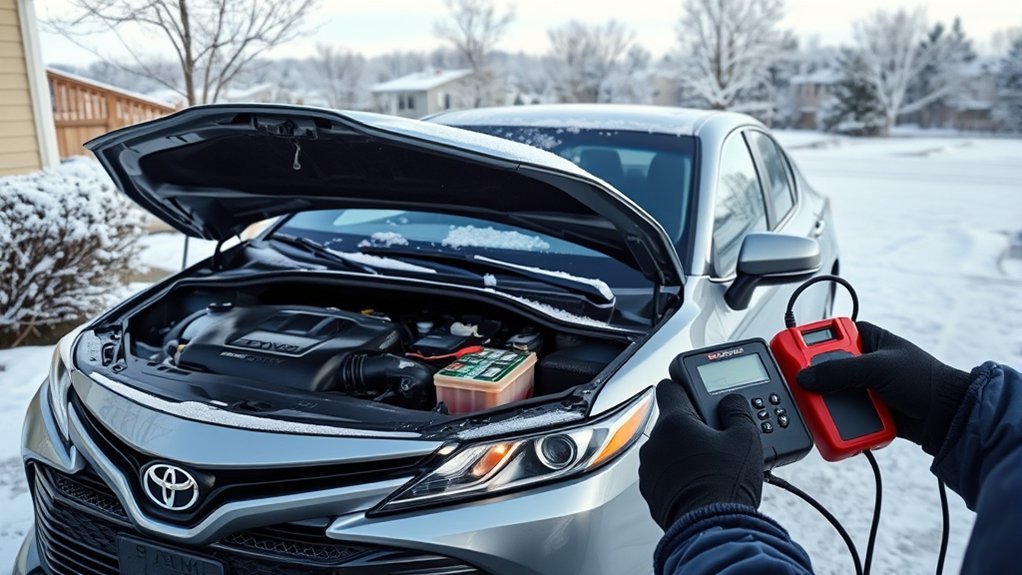
Cold temperatures slow the chemical reactions inside a conventional 12-volt automotive battery. That reduces the power the battery can deliver at the same time a gasoline Camry may need more power to turn the engine.
Engine oil also flows more slowly when it is cold. A suitable winter-rated multigrade oil reduces starting resistance, but the oil must still match the viscosity and performance specification Toyota lists for the exact model year and engine.
The National Highway Traffic Safety Administration advises drivers to have the battery, charging system, belts, and related components checked before winter. A marginal battery that appeared acceptable in mild weather may struggle during the first major temperature drop.
Cold weather reduces available 12-volt battery power while your Camry may require more electrical power to start.
A low state of charge can make winter starting problems worse. Common contributors include frequent short trips, long parking periods, lights or accessories left on, an aging battery, loose or corroded connections, a charging-system problem, or an aftermarket device that continues drawing power while the vehicle is parked.
Cold weather does not create every battery fault. It often reveals an existing weakness by reducing the reserve available to operate the starter, computers, relays, lights, blower, defrosters, heated seats, and other electrical equipment.
Essential Pre-Winter Battery Maintenance Tips
Complete these checks before the first hard freeze instead of waiting for a no-start morning. Work only in a safe, ventilated location away from moving traffic.
1. Inspect the Battery Before Touching the Terminals
Turn the vehicle off, remove the key or move the smart key away from the vehicle, apply the parking brake, and switch off all lights and accessories. Wear gloves and eye protection.
Look for a cracked case, swelling, leaking fluid, a strong sulfur odor, damaged cables, loose terminal clamps, or a missing hold-down. Stop if the battery appears cracked, leaking, swollen, severely damaged, or possibly frozen.
Warning: Do not charge, jump-start, disconnect, or clean a battery that appears cracked, leaking, swollen, or frozen. Batteries can contain corrosive material and release flammable gas. Keep flames, cigarettes, sparks, metal tools, and unprotected eyes away, and have a damaged battery handled by a qualified technician.
2. Check the Terminals, Cables, and Grounds
The terminal clamps should sit firmly on the posts without rotating by hand. Inspect the cables for fraying, cracked insulation, heavy corrosion, heat damage, or looseness where they connect to the body, engine, starter, fuse block, and charging system.
If light corrosion is present and you are comfortable cleaning it, follow the battery manufacturer’s instructions and the procedure in the Toyota manual. Disconnecting a Camry battery may erase settings or require initialization of certain systems, so confirm the approved sequence before removing a cable.
Do not place a wrench, jumper clamp, or other metal object across the battery terminals or between a positive terminal and grounded metal.
3. Test the Battery and Charging System
A resting-voltage reading can help indicate state of charge, but it does not prove that a battery can deliver sufficient current during a cold start. Temperature, recent charging, recent driving, surface charge, battery construction, and the test method can affect the reading.
A proper battery evaluation checks starting ability or conductance under controlled conditions. A charging-system test checks whether the alternator, voltage regulation, belt drive, wiring, and connections are restoring the 12-volt battery after startup.
If you do not know the battery’s age, check its date label or service records. Age alone does not prove failure, but an older battery deserves testing before severe weather, especially after slow starts, repeated jump-starts, or long parking periods.
4. Confirm the Battery Is Secure
A loose hold-down allows vibration to damage the battery and its connections. Make sure the battery is seated correctly, the hold-down is secure, and any positive-terminal cover or insulating shield is in place.
On models where the 12-volt battery is not easily visible, do not remove trim or covers unless the owner’s manual identifies them as owner-serviceable.
5. Prepare for Long Parking Periods
A Camry that sits for weeks can lose charge through normal standby loads and aftermarket equipment. Dashcams, trackers, alarm systems, chargers, wireless adapters, and accessories wired to constant power may increase the drain.
For extended storage, use a compatible automatic battery maintainer only when its instructions permit use with the battery type and parking environment. Verify the correct connection points, voltage, charging mode, ventilation requirements, and extension-cord restrictions. Do not use an unregulated charger as a permanent maintainer.
Pro Tip: A brief start-and-idle session is not a dependable storage plan. When roads are safe, normal driving is more useful than a short idle. A deeply discharged battery may still require an appropriate charger and a complete battery and charging-system test.
6. Reduce Unnecessary Parked Electrical Loads
Before leaving the vehicle, confirm that the interior lights, vanity lights, cargo-area lights, headlights, heated accessories, and plug-in devices are off. Investigate any light or module that remains active unexpectedly.
If the battery repeatedly goes flat while parked, request a parasitic-draw test instead of continuing to jump-start the vehicle. The underlying cause may be a battery fault, charging fault, wiring problem, control module, accessory, or connection issue.
Signs Your Camry’s Battery May Be Failing
Battery symptoms overlap with starter, alternator, wiring, ground, smart-key, and connection problems. Use these signs as diagnostic clues rather than proof that the battery needs replacement.
| Symptom | Possible Causes | Next Step |
| Slow or uneven cranking | Low charge, weak battery, poor cable connection, incorrect oil viscosity, or starter wear | Test the battery and charging system; inspect connections and verify the oil specification |
| Rapid clicking with no start | Low 12-volt battery voltage or a high-resistance connection | Turn off accessories and inspect or test the low-voltage starting system |
| One solid click | Starter, relay, cable, ground, connection, or battery problem | Test the complete starting circuit before replacing the battery |
| Dashboard and interior lights are completely dark | Fully discharged battery, disconnected terminal, damaged main connection, fuse or fusible-link issue, or another power-distribution fault | Stop repeated start attempts and inspect the 12-volt power supply safely |
| Dim or flickering lights | Low voltage, loose connection, alternator problem, ground fault, or lighting fault | Check battery condition, charging output, cables, and grounds |
| Repeated need for jump-starts | Weak battery, parasitic drain, charging fault, connection fault, or frequent short trips | Request battery, charging-system, cable, and parasitic-draw testing |
| Hybrid system does not show READY | Weak 12-volt supply, smart-key issue, brake-switch issue, selector-position issue, interlock, or hybrid-system fault | Check messages, key recognition, brake application, Park position, and the model-specific manual |
| Battery-shaped warning stays on while driving | Charging-system fault, belt issue, wiring problem, alternator fault, or related malfunction | Reduce electrical loads, move to a safe location, and arrange prompt inspection |
If the engine cranks at normal speed but does not start, the battery may not be the main problem. Fuel delivery, ignition, engine-management, immobilizer, sensor, or mechanical faults can produce that symptom.
A battery-shaped warning normally concerns the charging system, not simply the age or condition of the battery. Continuing to drive with a charging fault can eventually discharge the 12-volt system and cause the engine or vehicle electronics to shut down.
How to Choose Engine Oil for Your Toyota Camry in Cold Weather
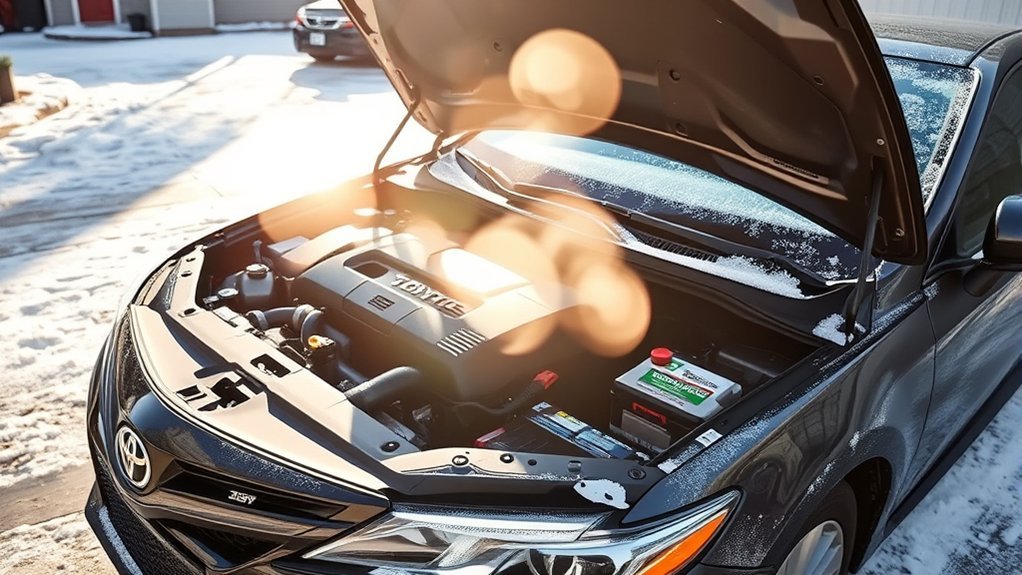
Do not choose a winter oil grade from a general Camry article alone. Toyota has produced many Camry engines across numerous model years, and the approved viscosity, oil capacity, quality standard, and service interval can differ.
Use the Toyota manuals and warranties lookup to select the exact year and model. Follow every viscosity, performance, capacity, and maintenance requirement in that manual.
What the “W” Rating Means
In a multigrade oil such as 0W-20 or 5W-30, the grade before the “W” relates to tested low-temperature cranking and pumping performance under the SAE J300 engine-oil viscosity classification. The second grade relates to viscosity requirements at higher operating temperatures.
A lower winter grade is not automatically better for every engine. Bearing clearances, oil-pump design, variable valve timing, emissions equipment, fuel-economy calibration, seals, and other engineering factors influence Toyota’s specification.
Note: Do not switch to 0W-30, 5W-30, or another grade merely because temperatures are falling. Use only a viscosity and performance specification Toyota permits for the exact Camry engine and operating conditions.
Synthetic Oil and Cold Starts
Many modern low-viscosity oils use synthetic or synthetic-blend base stocks, but the marketing label alone does not determine suitability. The finished oil must meet the viscosity and performance requirements listed in the manual.
The American Petroleum Institute also directs vehicle owners to consult the owner’s manual when selecting an oil performance category.
Change the oil at Toyota’s required time or mileage interval. Cold weather does not automatically justify an early oil change, although overdue, contaminated, diluted, or incorrect oil should be corrected before winter.
Avoid aftermarket oil stabilizers, viscosity modifiers, and engine treatments unless Toyota documentation specifically approves them. Finished motor oil already contains a balanced additive system, and adding another product may alter its viscosity or performance.
Top Winterization Tips for Your Toyota Camry
Battery care is only one part of winter preparation. Use this checklist to improve starting reliability, traction, visibility, braking, and emergency readiness.
Check Tire Pressure, Tread, and Damage
Air pressure falls as outdoor temperatures drop. Check all tires when they are cold and inflate them to the pressure listed on the driver-side door-jamb label or in the owner’s manual. Do not use the maximum pressure molded into the tire sidewall as the vehicle setting.
The NHTSA TireWise resource recommends checking tire pressure at least monthly when the tires are cold. A tire-pressure monitoring system is a warning system, not a substitute for measurement with an accurate gauge.
If the tire-pressure warning appears after a cold night, measure all tires and inspect for punctures or damage. Correct the pressure according to the vehicle placard. Do not simply reset or ignore the warning without checking the tires.
Inspect the tread and sidewalls for cuts, cracking, bulges, punctures, and uneven wear. Check the spare tire if the Camry has one. Replace tires that are damaged or worn to an unsafe tread depth.
Choose Suitable Winter Tires
Consider dedicated winter tires when you regularly drive in snow, ice, or sustained low temperatures. NHTSA notes that winter tires are more effective than all-season tires in deep snow.
Use the correct size, load capacity, speed rating, and fitment for the vehicle. Install a properly matched set as directed by the tire and vehicle manufacturers. Check local winter-tire laws because requirements and seasonal dates vary by jurisdiction.
Inspect the Cooling System
Make sure the coolant level is correct when the engine is cold. The coolant must meet Toyota’s specification and provide suitable freeze and corrosion protection.
Look for wet areas, dried residue, damaged hoses, a sweet odor, overheating, or other signs of leakage. Never remove a radiator cap or pressurized coolant cap from a hot engine.
If the coolant type, concentration, age, or service history is unknown, have it tested rather than mixing products or guessing at the required concentration.
Use Winter-Rated Washer Fluid
Fill the washer reservoir with fluid rated for the lowest temperatures you reasonably expect. Plain water or warm-weather fluid can freeze in the reservoir, lines, pump, or nozzles.
Confirm that the windshield washers, heater, front and rear defrosters, and mirror-defogging features work before the first storm.
Inspect Wipers, Lights, Cameras, and Sensors
Replace wiper blades that streak, chatter, split, or leave uncleared areas. Check the headlights, high beams, brake lights, turn signals, hazard lights, license-plate lights, and interior lights.
Clear snow and ice from all windows, mirrors, lights, cameras, radar areas, sensors, hood, trunk, and roof before driving. Snow left on the vehicle can block your view, interfere with driver-assistance systems, or slide onto another road user.
Do not pour hot water onto frozen glass. The temperature change can damage glass, and the water can refreeze around the wipers, doors, or roadway.
Check Brakes and Other Fluids
Have unusual brake noise, vibration, pulling, a soft pedal, reduced braking response, or a warning light inspected. Check the engine oil, brake fluid, transmission-fluid condition where owner inspection is permitted, and every service item listed in the maintenance schedule.
Inspect beneath the parked vehicle for fresh leaks. A fluid leak, burning odor, or warning message should be diagnosed before severe-weather travel.
Secure Winter Floor Mats
Use mats that fit the Camry correctly and attach to the factory retention points. Never stack one floor mat on top of another. Confirm that the driver’s mat cannot move forward or interfere with the accelerator or brake pedal.
Keep Fuel and Emergency Supplies Available
Keep adequate fuel for delays and detours, but do not treat prolonged idling as a safe heating plan. If stranded in snow, keep the exhaust outlet completely clear, remain alert for changing conditions, and run the engine only intermittently as needed.
The NHTSA winter checklist recommends carrying items such as an ice scraper, snow brush, small shovel, abrasive material, jumper cables or an appropriate jump pack, flashlight, warning markers, first-aid supplies, blankets, phone charger, water, food, and necessary medicine.
Check weather and road conditions before leaving. Delay nonessential travel when roads are unsafe, and tell someone your route and expected arrival time for longer trips.
Check for Open Recalls
Enter the Camry’s VIN in the official Toyota recall and service-campaign lookup. Recall and campaign repairs are separate from ordinary maintenance and should be completed according to Toyota’s instructions.
How to Start Your Toyota Camry Safely in Cold Weather
- Clear the vehicle first. Remove snow and ice from the windows, mirrors, lights, roof, hood, trunk, cameras, radar areas, and sensors.
- Confirm the exhaust outlet is clear. A tailpipe blocked by snow can allow carbon monoxide to enter the passenger area.
- Check the immediate surroundings. Make sure the vehicle is outdoors, the wheels and underbody are not trapped by packed snow, and nobody is standing near the exhaust outlet.
- Turn off unnecessary loads. If the 12-volt battery appears weak, switch off seat heaters, the rear defroster, high blower settings, the audio system, and accessory chargers before starting.
- Confirm Park and key recognition. Place the selector fully in Park, press the brake firmly, and check for smart-key or immobilizer messages.
- Start the vehicle normally. Use the key or POWER button exactly as the owner’s manual describes. Do not pump the accelerator unless the manual specifically instructs you to do so.
- Check the indicators. On a gasoline Camry, listen for normal cranking and startup. On a Camry Hybrid, confirm that the READY indicator appears. The gasoline engine may remain off even though the hybrid system is ready to drive.
- Clear the glass completely. Do not move until you have safe visibility through the windshield, windows, and mirrors.
- Drive gently. After confirming normal operation and clearing the glass, drive smoothly and avoid hard acceleration until the powertrain warms. Prolonged parked idling is generally unnecessary.
Warning: Never run your Camry inside an attached garage, even with the garage door open. Move the vehicle fully outdoors before starting. If stranded in snow, keep the tailpipe clear, run the engine only intermittently as needed, and allow fresh air into the passenger area.
What to Do if Your Toyota Camry Will Not Start
Move yourself and the vehicle away from traffic when possible. Do not open the hood, connect cables, or stand beside the vehicle where passing traffic, poor visibility, ice, or another hazard makes the work unsafe.
If the Dashboard Is Completely Dark
Check whether the interior lights, hazard lights, and instrument panel have any power. A completely dark vehicle may have a deeply discharged 12-volt battery, a disconnected or damaged main connection, or another power-distribution fault.
Do not repeatedly press the start button or turn the key. Inspect only for obvious external damage or loose connections that can be viewed safely without placing tools across electrical terminals.
If the Lights Are Weak or You Hear Rapid Clicking
Turn off all electrical accessories. Check for obviously loose or damaged battery connections without placing tools across the terminals. A jump-start may help if the 12-volt battery is discharged, but it will not repair a defective battery, loose connection, alternator problem, or parasitic drain.
If You Hear One Click but the Engine Does Not Turn
The problem may involve the battery, cables, starter relay, starter motor, engine ground, or another part of the starting circuit. Testing is more reliable than repeatedly attempting to start the vehicle.
If the Smart Key Is Not Recognized
Check the dashboard for a key warning or immobilizer message. Move other electronic keys or devices away, confirm that the selector is fully in Park, and press the brake pedal firmly.
A weak key-fob battery may require the model-specific backup starting method described in the owner’s manual. Do not assume the vehicle’s main 12-volt battery has failed solely because the smart key is not recognized.
If the Engine Cranks Normally but Does Not Start
Stop treating the issue as a battery-only problem. Check the fuel level, warning lights, security or immobilizer messages, and other dashboard information. Arrange diagnosis if the engine still does not run.
If the Battery-Shaped Warning Appears While Driving
Turn off nonessential electrical equipment and move to a safe location. The warning usually indicates a charging-system problem rather than simply an old battery.
The vehicle may be operating only on the remaining 12-volt battery charge if the charging system has failed. Continued driving can lead to an engine shutdown, loss of electrical functions, or an inability to restart.
Jump-Starting a Gasoline or Hybrid Camry
Use the jump-start procedure, connection sequence, grounding point, and terminal locations in the owner’s manual for the exact model year. Some Camry Hybrid models use a designated under-hood terminal for the 12-volt system.
Never connect jump equipment to or attempt to service the high-voltage hybrid traction battery. Do not jump-start a 12-volt battery that is cracked, leaking, swollen, severely damaged, or suspected of being frozen.
Verify cable polarity before making a connection. Keep clamps and cables away from fans, belts, pulleys, and other moving parts. Follow the jump pack or donor-vehicle instructions as well as Toyota’s procedure.
What to Do After a Successful Jump-Start
A successful jump proves only that outside electrical power helped the vehicle start. It does not identify whether the original problem was low charge, battery deterioration, a loose connection, a parasitic draw, or a charging-system fault.
Have the battery and charging system tested. A normal drive may restore some charge, but it may not fully recharge a deeply discharged battery. Use an appropriate charger when testing or the battery manufacturer’s instructions indicate that charging is needed.
If a charging-system warning remains on, lights continue to dim, the engine runs poorly, or electrical functions begin shutting down, move to a safe location and arrange service rather than continuing the trip.
Related Guides
Frequently Asked Questions
How often should I start my Camry to keep the battery charged in cold weather?
Do not rely on brief weekly idling. Starting uses battery power, and a short idle may not replace it. When roads are safe, normal driving is more useful. For extended storage, use a compatible automatic maintainer. A deeply discharged battery may need controlled charging and testing.
Can cold weather cause battery and starting problems?
Yes. Cold temperatures reduce the power a 12-volt battery can deliver while a gasoline engine may require more starting power. Weak batteries, poor connections, incorrect oil, charging faults, long parking periods, and frequent short trips are more likely to cause symptoms in cold weather.
How do I stop my Camry battery from draining in winter?
Turn off lights and accessories, unplug unnecessary devices, inspect aftermarket electronics, avoid relying only on short trips, and test the battery and charging system. Use a compatible smart maintainer when the vehicle will remain parked for an extended period.
Is it normal for a Camry battery to feel sluggish in cold weather?
A modest change in cranking sound can occur during severe cold, but repeated slow cranking, clicking, dim lights, or jump-starts should not be ignored. Test the battery, terminals, starter circuit, grounds, and charging system before replacing parts.
What engine oil should I use in my Camry during winter?
Use the exact viscosity and performance specification listed in the owner’s manual for the Camry’s model year and engine. Do not assume that 0W-30, 5W-30, or another grade is suitable merely because the weather is cold.
Can I jump-start a Toyota Camry Hybrid?
A discharged Camry Hybrid 12-volt system may be jump-started using the exact procedure and designated points in its owner’s manual. Never connect jump equipment to or attempt to service the high-voltage traction battery.
Should I replace my Camry battery after three years?
Not automatically. Battery life depends on climate, trip patterns, charging conditions, electrical loads, construction, maintenance, and vehicle use. Testing becomes increasingly useful as a battery ages, especially before winter or after slow starts, but test results should guide replacement.
Why did the tire-pressure warning appear on a cold morning?
Tire pressure falls as temperature drops, which can trigger the warning. Measure every tire when cold, inspect for damage, and adjust pressure to the driver-door placard. Do not rely only on the warning light or reset it without checking the tires.
How long should I warm up my Camry before driving in winter?
Start the vehicle normally, confirm that it is operating correctly, and wait only as needed to clear the glass and obtain safe visibility. Then drive gently and avoid hard acceleration until the powertrain warms. Do not idle in an attached garage or other enclosed area.
Does the battery-shaped warning mean the battery needs replacement?
Not necessarily. The warning usually indicates a charging-system fault involving the alternator, belt, wiring, regulation, or another related component. Reduce electrical loads, move to a safe location, and have the charging system inspected promptly.
Sources
- National Highway Traffic Safety Administration: Winter Weather Driving Tips — battery, tires, coolant, visibility, emergency supplies, carbon-monoxide precautions, and winter-driving preparation
- Toyota Manuals and Warranties — model-year-specific oil, battery, jump-start, warning-light, tire, and maintenance instructions
- NHTSA TireWise — cold tire pressure, placard pressure, TPMS limitations, tire damage, tread, sizing, and winter-tire guidance
- U.S. Department of Energy Alternative Fuels Data Center: Idle Reduction — fuel waste, pollution, and engine wear associated with unnecessary idling
- Centers for Disease Control and Prevention: Carbon Monoxide Poisoning Basics — vehicle exhaust and attached-garage safety
- Toyota Safety Recall and Service Campaign Lookup — VIN-based recall and campaign information
Conclusion
Prepare your Toyota Camry for winter by confirming the exact model year and powertrain, testing the 12-volt battery and charging system, inspecting terminals and cables, using the specified engine oil, adjusting cold tire pressure, and checking coolant, washer fluid, brakes, wipers, lights, defrosters, cameras, sensors, and floor mats.
Do not ignore slow cranking, repeated clicking, a dark dashboard, frequent jump-starts, a missing READY indicator, or a battery-shaped warning while driving. These symptoms require proper diagnosis because the battery is only one possible cause.
Keep emergency supplies in the vehicle, check for open recalls, avoid unnecessary idling, and follow the exact Toyota manual for every model-specific procedure. Never service a hybrid high-voltage battery, run the vehicle in an attached garage, or jump a damaged or possibly frozen 12-volt battery.
