
Toyota Tundra oil capacity depends on the model year, engine, and whether you replace the oil filter. A 5.7L V8 does not use the same amount as a 4.6L V8, and a third-generation twin-turbo truck should not be filled from a second-generation chart. Confirm the engine first, use the specified viscosity, and verify the final level with the dipstick.
Quick Answer
A 2012, 2017, or 2018 Toyota Tundra with the 5.7L V8 normally takes about 7.9 quarts with a new filter. The 4.6L V8 normally takes about 8.5 quarts. Other years and engines differ, so confirm the specification in your model-year owner’s manual before filling.
Key Takeaways
- Oil capacity is engine-specific, not generation-wide.
- For common 2012, 2017, and 2018 trucks, the 5.7L V8 uses about 7.9 quarts with a filter, while the 4.6L V8 uses about 8.5 quarts.
- Many 2018 Tundras specify SAE 0W-20, but the owner’s manual and oil-fill cap control.
- Use a filter confirmed by VIN or exact engine, then check for a stuck double gasket during removal.
- Do not exceed Toyota’s maintenance interval simply because a synthetic-oil bottle advertises a longer service life.
Understanding Oil Capacity for the Toyota Tundra
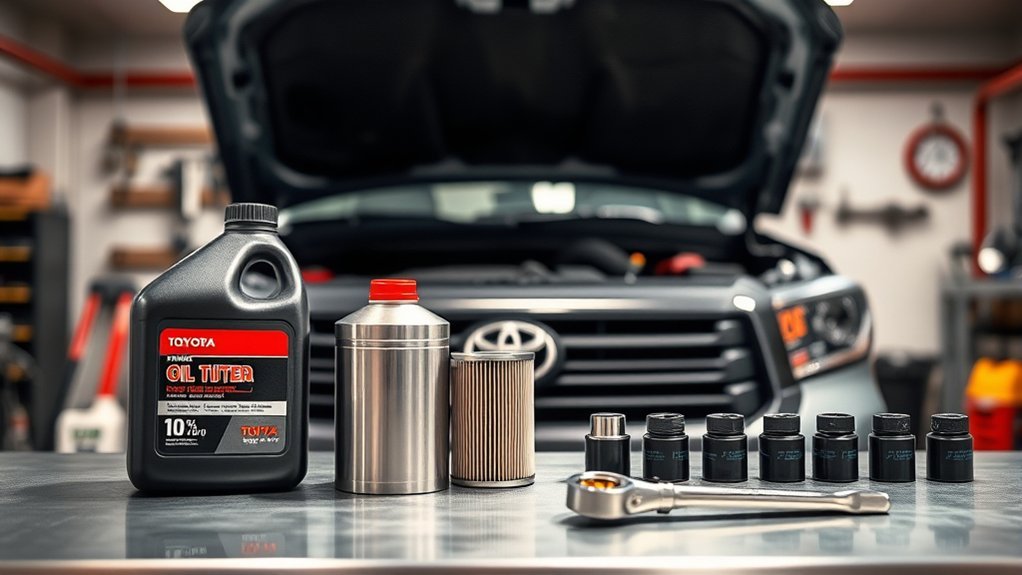
Your Tundra’s refill amount is based on its exact engine and whether the old filter was removed. The owner’s manual usually lists separate figures for a refill with a filter and without a filter. The amount that drains out can also vary slightly because some oil remains inside passages and the oil cooler.
The figures below cover the engines discussed most often in this article. They are useful starting points, but your model-year manual remains the final authority.
| Model Year | Engine | Approximate Refill With Filter |
|---|---|---|
| 2012 | 4.6L V8 | 8.5 qt (8.0 L) |
| 2012 | 5.7L V8 | 7.9 qt (7.5 L) |
| 2017 | 4.6L V8 | 8.5 qt (8.0 L) |
| 2017 | 5.7L V8 | 7.9 qt (7.5 L) |
| 2018 | 4.6L V8 | 8.5 qt (8.0 L) |
| 2018 | 5.7L V8 | 7.9 qt (7.5 L) |
Note: Do not use a claimed 9-quart or 9.8-quart capacity unless your truck has documented aftermarket oil-system modifications and the installer supplied a verified refill procedure. Factory specifications do not increase just because the truck tows or has an oil cooler.
After refilling, run the engine briefly, switch it off, wait several minutes on level ground, and check the dipstick. The final dipstick reading matters more than forcing the entire listed capacity into the engine at once.
How to Identify Your Tundra’s Engine Before Buying Oil
Do not rely only on the trim badge or cab style. A model year may have more than one engine, and two Tundras that look similar can use different oil quantities.
- Check the owner’s manual: Use Toyota’s manuals and warranties portal and select the correct year and model.
- Read the under-hood emissions label: It normally identifies the engine family and displacement.
- Check the oil-fill cap: The cap often shows the required viscosity, but it does not show capacity.
- Use the VIN for parts: Enter the full VIN on Toyota’s official parts site before choosing a filter.
Recommended Oil Types for Your 2018 Toyota Tundra
For a U.S.-spec 2018 Tundra, Toyota commonly specifies SAE 0W-20 for the 4.6L and 5.7L V8 engines. Confirm the wording in the 2018 Tundra owner’s manual, especially if the truck was sold outside the United States or has an engine replacement.
Choose oil carrying the correct API certification. The American Petroleum Institute states that current API SP oils include the performance properties of earlier gasoline-engine categories, and that ILSAC GF-6A can replace obsolete GF-5 when the viscosity grade matches the vehicle requirement.
Fully Synthetic Motor Oil
A quality 0W-20 full-synthetic oil is a practical choice for a 2018 Tundra. It flows well during cold starts, resists oxidation at high temperatures, and supports the maintenance interval Toyota specifies for engines using 0W-20.
Synthetic oil does not create permission to exceed the owner’s maintenance schedule. A bottle may advertise 15,000 or more miles, but Toyota’s time, mileage, and operating-condition limits still apply.
High-Mileage Oil Options
High-mileage oil is optional, not mandatory at 75,000 miles. It may contain seal conditioners and a different additive balance intended for older engines, but it cannot repair worn piston rings, damaged seals, or an active leak.
If your Tundra runs well and does not consume oil, you can continue using a correctly certified oil in the specified viscosity. If consumption rises, record how much oil the engine uses per 1,000 miles and have leaks or internal wear inspected rather than relying on a thicker oil without approval.
Towing Performance Considerations
Heavy towing raises engine load and oil temperature, but it does not automatically change the required viscosity or capacity. Use the oil grade listed by Toyota, keep the level near the full mark without overfilling, and follow the shorter maintenance interval listed for special operating conditions when your manual calls for it.
Pro Tip: Check the oil level before a long towing trip and again after the engine has cooled at your destination. A small leak or developing consumption problem is easier to catch before the low-oil warning appears.
Why Choosing the Right Oil Filter Matters
The oil filter must fit the exact engine, seal correctly, and provide the flow and filtration characteristics intended for that application. A filter that merely threads onto the mount is not automatically correct.
Oil Filter Performance Impact
A correctly specified filter removes damaging particles while allowing adequate oil flow. An incorrect filter can leak at the gasket, interfere with nearby components, or use unsuitable internal settings. Replace the filter at each oil change unless the model-year maintenance information explicitly says otherwise.
Genuine Toyota filters are designed for Toyota applications, but a reputable aftermarket filter can also be suitable when its manufacturer lists the exact Tundra year and engine. Avoid choosing a filter only by appearance, thread size, or an online comment.
Filter Compatibility and Selection
The safest selection method is a full-VIN lookup through Toyota’s official parts catalog or a reputable filter manufacturer’s application guide. Check the part number again when the truck has a replacement engine or a non-factory remote-filter system.
- Match the model year and engine displacement.
- Confirm whether the application uses a spin-on filter or cartridge element.
- Inspect the new filter or O-ring before installation.
- Make sure the old gasket is not stuck to the mounting surface.
- Lubricate the new gasket or O-ring with clean engine oil where the filter instructions require it.
Warning: A double gasket can cause a rapid oil leak after startup. Always verify that the old filter gasket came off with the filter before installing the replacement.
Step-by-Step Guide to Checking Your Tundra’s Oil Level
At a Glance
| Time Required | About 10 minutes, including settling time |
| Difficulty | Easy |
| Tools Needed | Lint-free cloth, correct oil, funnel, and gloves |
| Cost | No cost to inspect; topping-up cost depends on the oil used |
- Park on level ground and set the parking brake.
- Bring the engine to normal operating temperature if the manual directs you to check it warm.
- Switch the engine off and wait at least five minutes so oil can drain into the pan.
- Remove the dipstick and wipe it clean with a lint-free cloth.
- Insert the dipstick fully, then remove it again without turning it upside down.
- Read the level between the low and full marks. If it is low, add the specified oil through the fill opening in small amounts.
- Wait briefly and recheck. Stop when the level reaches the approved range.
Pro Tip: Add roughly one-quarter quart at a time when the level is close to full. This reduces the chance of overshooting the dipstick’s upper mark.
How Often Should You Change Oil in Your Tundra?

Use the maintenance guide for your exact model year rather than a generic “conventional versus synthetic” chart. Many later Tundras using 0W-20 allow an oil-and-filter change at 10,000 miles or 12 months under normal conditions. Toyota maintenance guides can require a 5,000-mile or six-month interval under listed special operating conditions.
| Use Pattern | What to Do |
|---|---|
| Normal mixed driving | Follow the normal interval in the model-year Warranty and Maintenance Guide. |
| Frequent towing or heavy loading | Use the special-operating-condition schedule when the guide lists your use pattern. |
| Repeated short trips, extensive idling, dusty roads, or very low annual mileage | Follow the applicable time-based or severe-service interval, even if mileage is low. |
| Unknown service history | Change the oil and filter, inspect for leaks, then start a documented schedule. |
Older Tundras may have a shorter normal interval than newer 0W-20 models. Check the 2012 Tundra documents, the 2018 Tundra documents, or the page for your specific model year.
Best Practices for Oil Changes in Toyota Tundra
- Verify the engine: Confirm displacement and model year before buying oil or a filter.
- Use the specified viscosity: Do not change viscosity solely because of towing, mileage, or summer weather unless Toyota permits it.
- Replace the drain-plug gasket: Reusing a crushed gasket can cause a slow leak.
- Use the correct torque: Follow the model-specific manual for the drain plug, filter housing, and skid-plate fasteners.
- Refill gradually: Add slightly less than the listed capacity, run the engine, inspect for leaks, then complete the fill by dipstick.
- Record the service: Note the date, mileage, oil brand and viscosity, filter part number, and amount added.
- Dispose of used oil properly: Take it to a local recycling or automotive collection site rather than pouring it into household drains or onto the ground.
How Oil Volume Affects Your Tundra’s Performance
The oil pump needs a stable supply of oil, and the crankcase needs enough open space to control aeration and pressure. Keeping the level within the dipstick’s approved range supports lubrication, cooling, and hydraulic systems such as variable valve timing.
The correct target is not “as much as possible” or “slightly low.” The correct target is the approved dipstick range after the engine has been run and allowed to settle.
Underfilling can uncover the oil pickup during braking, cornering, steep grades, or off-road use. Overfilling can let rotating parts whip air into the oil, which reduces lubrication quality and may raise crankcase pressure. Intentionally running below the full mark does not create a meaningful or safe performance advantage.
Warning: If the red oil-pressure warning appears while driving, stop safely and switch off the engine. That warning concerns oil pressure, not simply the amount shown on the dipstick, and continued operation can cause severe engine damage.
Benefits of Synthetic Oil Over Conventional Oil

Synthetic oil offers more consistent low-temperature flow and stronger resistance to oxidation and high-temperature breakdown than basic conventional oil. Those qualities are useful in a truck that sees cold starts, towing, long highway trips, or extended idling.
- Cold-start protection: The oil reaches critical components quickly at low temperatures.
- Heat resistance: Synthetic base stocks generally resist oxidation and deposit formation better under sustained load.
- Viscosity stability: The oil is formulated to remain within its grade across a wide temperature range.
- Cleaner operation: Modern detergent and dispersant packages help control deposits when the oil is changed on schedule.
These benefits do not guarantee a fuel-economy increase, stop an existing leak, or justify a 15,000-mile interval. Choose the correct viscosity and certification, then follow Toyota’s schedule.
Common Oil-Related Problems and Solutions for Your Tundra
| Symptom | Possible Cause | Next Step |
|---|---|---|
| Oil level drops between changes | External leak, oil consumption, or an incorrect previous fill | Check the level consistently, inspect for leaks, and document consumption. |
| Fresh oil under the truck after service | Loose drain plug, damaged gasket, loose filter, or double filter gasket | Switch off the engine and inspect before driving. |
| Level above the full mark | Overfill or an inaccurate check on uneven ground | Recheck correctly, then remove excess oil if the level remains high. |
| Milky oil | Condensation from short trips or possible coolant contamination | Avoid driving if coolant loss or overheating is present; arrange diagnosis. |
| Red oil-pressure warning | Low pressure caused by low oil, a leak, pump trouble, blockage, or internal wear | Stop the engine immediately and diagnose the pressure problem. |
Sludge, overheating, and accelerated wear can result from neglected maintenance, but an oil change alone cannot correct every engine problem. If the warning light stays on, the engine knocks, or the truck loses oil rapidly, avoid driving and have it inspected.
Related Guides
Frequently Asked Questions
How much oil does a Tundra 5.7 hold?
A 2012, 2017, or 2018 Tundra with the 5.7L V8 normally takes about 7.9 quarts with a new filter. Verify the model-year manual because refill specifications can change, especially when the engine or oil system has been modified.
How many quarts of oil does a 5.7L V8 take?
For the common second-generation Tundra 5.7L V8 applications covered here, use about 7.9 quarts when replacing the filter. Add slightly less at first, run the engine, wait several minutes, and finish the fill by dipstick.
How much oil does a 2017 Tundra take?
A 2017 Tundra with the 4.6L V8 normally takes about 8.5 quarts with a filter. The 5.7L V8 normally takes about 7.9 quarts. Identify the engine before buying oil.
How much oil does a 4.7L V8 take?
The 4.7L V8 appeared in more than one Tundra model year, so do not rely on a single generation-wide number. Check the exact year’s manual and whether the listed quantity includes a new filter. Refill gradually and verify the dipstick level.
What oil should a 2018 Toyota Tundra use?
Many U.S.-spec 2018 Tundras with the 4.6L or 5.7L V8 specify SAE 0W-20. Use the viscosity and certification shown in the owner’s manual and on the oil-fill cap.
Can I use API SP oil in an older Tundra?
Yes, when the viscosity is correct and the manual calls for an earlier gasoline-engine API category. API states that its latest gasoline category includes the performance properties of earlier categories. The owner’s manual still controls viscosity and application.
What happens if I overfill my Tundra’s engine oil?
Overfilling can aerate the oil, raise crankcase pressure, cause leaks, and reduce lubrication quality. Recheck on level ground after the engine has been off for several minutes, then remove excess oil if the level remains above the full mark.
Conclusion
The correct Toyota Tundra oil capacity comes from the model year and engine, not a broad generation range. For common 2012, 2017, and 2018 applications, remember the key distinction: about 7.9 quarts with a filter for the 5.7L V8 and about 8.5 quarts for the 4.6L V8. Use the specified viscosity, select the filter by VIN or exact engine, follow Toyota’s maintenance schedule, and make the dipstick your final check.
Sources
- Toyota 2012 Tundra Manuals and Warranties — model-year owner and maintenance information.
- Toyota 2018 Tundra Manuals and Warranties — oil specification and maintenance guidance for the 2018 model.
- Toyota 2024 Tundra Manuals and Warranties — current-generation manual access and powertrain-specific guidance.
- Toyota Genuine Parts — VIN-based oil-filter fitment lookup.
- American Petroleum Institute Oil Categories — current API SP and ILSAC GF-6A compatibility information.
