
If your Toyota Tundra is overheating, treat it as an urgent warning rather than a problem to watch for later. Pull over safely, shut the engine off, and let the cooling system become completely cold before checking the reservoir, hoses, radiator area, or coolant. The cause may be a simple leak, but continued driving can turn a cooling-system fault into major engine damage.
Quick Answer
A Toyota Tundra can overheat because of low coolant, a leak, restricted radiator airflow, a faulty fan system, a stuck thermostat, poor coolant circulation, or an internal engine problem. Stop driving, let the truck cool fully, check for obvious faults, and tow it for diagnosis if the temperature rises again.
Key Takeaways
- Never remove a radiator or pressurized coolant cap while the engine is hot.
- A low reservoir is a clue, not a complete repair. Coolant loss usually means a leak or another fault needs diagnosis.
- Overheating at idle often points toward an airflow or fan problem, while overheating under load can indicate restricted flow, poor circulation, or insufficient cooling capacity.
- Thermostat and coolant replacement intervals are model-year specific. Follow your Tundra’s maintenance guide instead of a universal mileage rule.
- Repeated overheating, coolant loss, white exhaust, misfires, or oil contamination require professional testing.
At a Glance
| Time Required | About 10–20 minutes for a basic inspection after the engine is fully cold; diagnostic testing and repairs take longer. |
| Difficulty | Basic for cold visual checks; intermediate to advanced for pressure testing, electrical diagnosis, bleeding, or component replacement. |
| Tools Needed | Gloves, flashlight, clean rag, and the correct premixed coolant if a safe top-off is appropriate. An OBD-II scanner and cooling-system pressure tester are optional diagnostic tools. |
| Cost | A visual inspection may require no parts. Coolant, towing, testing, and repair costs vary by model year and failed component. |
Warning: Hot coolant is pressurized and can cause severe burns. Do not open the radiator cap, coolant reservoir pressure cap, or any cooling-system fitting until the engine is completely cold. Keep clear of steam, moving fans, belts, and pulleys.
Recognizing Overheating Symptoms and Immediate Actions for Your Toyota Tundra
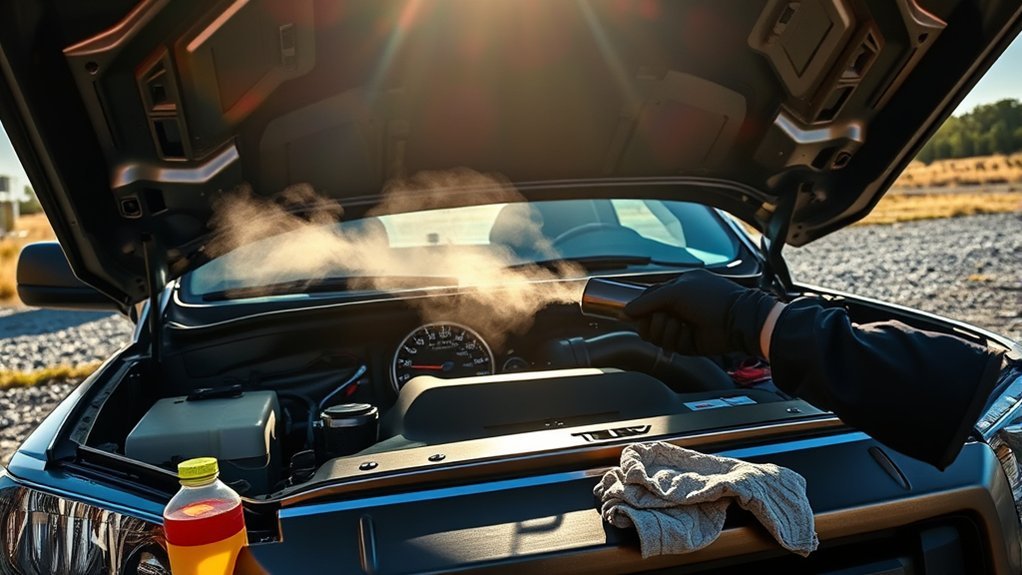
Your Tundra may be overheating if the temperature gauge climbs above its normal range, a high-coolant-temperature warning appears, steam escapes from under the hood, or coolant pushes into or out of the overflow reservoir. You may also notice reduced power, a sweet coolant smell, cabin heat that suddenly turns cold, or knocking and pinging under load.
A cold heater during an overheating event can suggest low coolant or poor circulation, but it does not prove the heater core is clogged. The same symptom can come from trapped air, a thermostat fault, or another cooling-system problem.
What to Do Immediately
- Move to a safe location. Turn off the air conditioner. Use the heater only if you need a brief reduction in engine temperature while reaching a safe shoulder; do not use it as permission to continue driving.
- Stop the engine. If you see steam or sprayed coolant, stay clear of the hood area until the release stops.
- Let the truck cool completely. Cooling time varies with ambient temperature, load, and the severity of the event.
- Look for danger before touching anything. Check the ground for a large coolant puddle, a split hose, or obvious spraying. Do not restart the engine if coolant is pouring out.
- Arrange a tow when necessary. Tow the truck if the gauge reached the hot zone, steam was present, the reservoir is empty, the engine runs poorly, or the temperature rises again after a careful cold check.
Note: Tundra warning displays, fan systems, cooling circuits, coolant specifications, and bleeding procedures vary by model year and powertrain. Use Toyota’s model-specific owner’s manual and maintenance guide before adding coolant or attempting service.
What the Overheating Pattern Can Tell You
When the engine is cold and safe to inspect, note exactly when the problem occurs. The pattern often narrows the list of likely causes before parts are removed.
| Overheating Pattern | Likely Areas to Check |
|---|---|
| Mostly at idle or in slow traffic | Cooling fan operation, fan clutch or fan controls, blocked radiator or condenser fins, and low coolant. |
| Mostly at highway speed or while towing | Low coolant, restricted radiator flow, a thermostat that does not open fully, weak pump circulation, heavy load, or an internal engine fault. |
| Soon after cold startup | A stuck thermostat, severe circulation problem, false sensor reading, or combustion gas entering the cooling system. |
| After coolant or component service | Trapped air, incorrect fill level, a loose clamp, an unplugged connector, or an incorrect bleeding procedure. |
| Only with the air conditioner on | Insufficient airflow, fan-control trouble, debris between heat exchangers, or a cooling system already operating near its limit. |
Essential Diagnostic Steps to Identify Overheating Causes
Start with checks that are safe, visible, and unlikely to create a new problem. Do not replace a thermostat, water pump, fan, or radiator based only on the temperature gauge.
| Diagnostic Step | Action Required |
|---|---|
| Check coolant level when cold | Compare the reservoir level with the cold marks. An empty or repeatedly low reservoir requires leak diagnosis, not repeated topping off. |
| Inspect for external leaks | Look around hose joints, the radiator, reservoir, pump area, thermostat housing, heater hoses, and under the truck for wetness or dried coolant residue. |
| Inspect the cap and reservoir | When fully cold, check seals, the filler neck, cracks, and overflow hoses. A pressure cap should be tested rather than guessed at. |
| Check radiator airflow | Inspect accessible fins for leaves, mud, insects, bent areas, or debris trapped between the condenser and radiator. Use low-pressure cleaning methods. |
| Evaluate the fan system | Check the model-specific fan, clutch, fuse, relay, wiring, sensor input, and commanded operation. Keep hands and tools away because an electric fan can start unexpectedly. |
| Check coolant circulation | A technician may compare hose temperatures, scan live data, test the thermostat, inspect the drive belt where applicable, and assess water-pump flow or leakage. |
| Pressure-test the system | A controlled cold pressure test can expose leaks that are not obvious during a visual inspection. Do not exceed the specified test pressure. |
| Check for internal leakage | Persistent bubbles, unexplained coolant loss, white exhaust after warm-up, misfires, or contaminated oil may justify a combustion-gas, compression, or leak-down test. |
| Verify the temperature reading | Compare scan-tool coolant-temperature data with the gauge, warning message, and an independent temperature check. A sensor or wiring fault can create a false warning. |
Pro Tip: Photograph the cold coolant level, any residue, puddles, warning messages, and scan data before cleaning. The record helps a technician distinguish an active leak from old residue.
Common Causes of Overheating and How to Fix Them
Low Coolant or an External Leak
Low coolant reduces the system’s ability to carry heat away from the engine. Common leak points include hoses, clamps, the radiator, reservoir, pressure cap, thermostat housing, heater hoses, and water-pump area.
Fix: Repair the source of the leak, then refill and bleed the system with the coolant type and procedure specified for your model year. Do not mix coolants based only on color.
Cooling Fan, Fan Clutch, or Control Fault
Insufficient fan airflow often becomes most obvious in traffic, at idle, or with the air conditioner operating. The fault may be mechanical, electrical, or related to a sensor or control command.
Fix: Test the fan system used on your Tundra instead of checking only whether a blade spins. Diagnosis may include the clutch, motor, fuse, relay, wiring, sensor data, or engine-control command.
Thermostat That Sticks or Opens Incompletely
A thermostat that remains closed can cause a rapid temperature rise. One that opens only partway may allow normal light-load driving but overheat during towing, climbing, or hot weather.
Fix: Confirm the fault with temperature and flow checks, then install the correct thermostat and seal. A thermostat is not normally replaced on a universal 50,000-mile schedule.
Restricted or Damaged Radiator
External debris reduces airflow, while internal deposits, damaged tubes, or poor previous repairs can reduce coolant flow. A radiator may also leak only when hot and pressurized.
Fix: Clean external fins carefully, pressure-test for leaks, and evaluate temperature distribution across the core. Replace the radiator if it is restricted or structurally damaged; a flush cannot repair every blockage.
Water-Pump or Drive Problem
A worn pump, damaged impeller, leaking seal, or drive problem can reduce coolant circulation. Depending on the engine design, clues may include coolant residue, bearing noise, belt trouble, or overheating that worsens with load.
Fix: Inspect the complete drive and pump system. Replace a confirmed failed pump and any affected belt, tensioner, seal, or contaminated component.
Trapped Air or an Incorrect Fill Procedure
Air pockets can interrupt circulation after a hose, radiator, thermostat, pump, or coolant service. Gurgling, unstable heat, a fluctuating gauge, or repeated reservoir changes after service can support this diagnosis.
Fix: Correct leaks first, then use the model-specific filling and air-bleeding procedure. Avoid opening bleed points or pressurized caps on a hot engine.
Head-Gasket or Internal Engine Problem
An internal leak can pressurize the cooling system, consume coolant, contaminate oil, or send coolant into a cylinder. White vapor after the engine is fully warm, persistent misfires, hard cooling hoses shortly after a cold start, or unexplained coolant loss need further testing.
Fix: Stop driving and have the engine tested. Replacing the thermostat or radiator will not correct combustion gas entering the cooling system.
Temperature Sensor, Wiring, or Gauge Error
The engine may not be physically overheating if the sensor circuit, wiring, instrument display, or control module reports an incorrect temperature. However, assume the warning is real until testing proves otherwise.
Fix: Read diagnostic trouble codes and live temperature data, inspect connectors, and compare the reported value with an independent measurement.
Key Maintenance Tips to Prevent Overheating in Your Toyota Tundra

- Follow the correct schedule: Use the warranty and maintenance guide for your exact model year, engine, and market. A universal 30,000-mile flush interval is not reliable guidance for every Tundra.
- Check the cold reservoir before long trips: A falling level deserves investigation, even when the truck has not overheated yet.
- Inspect hoses and connections: Look for cracks, swelling, soft spots, abrasion, loose clamps, and dried coolant residue.
- Keep heat exchangers clean: Remove packed insects, leaves, mud, and road debris without crushing fins or using damaging pressure.
- Use the specified coolant: Match Toyota’s model-specific specification and mixing instructions. Coolant color alone does not confirm compatibility.
- Watch temperatures under load: Towing, steep grades, low-speed off-road use, and extreme heat increase cooling demand. Reduce load and stop safely if the warning appears.
- Check campaigns and recalls: Search your VIN through Toyota’s recall and service-campaign lookup and the NHTSA recall database.
Replace the thermostat, water pump, radiator, fan components, or pressure cap when testing shows a fault, not simply because the truck reached a generic mileage. Keep service records so you know which coolant was used and when the system was opened.
When to Call the Experts for Overheating Troubles
Basic cold inspections are reasonable for many owners, but cooling-system diagnosis can involve hot pressurized fluid, moving parts, electrical controls, and engine damage. Arrange professional service or towing when any of the following occurs:
- The gauge enters the hot zone, a high-temperature warning remains on, or the truck overheats more than once.
- Steam, active spraying, a large puddle, or an empty reservoir is present.
- The engine misfires, knocks, loses power, stalls, or produces persistent white exhaust after warming up.
- Coolant disappears without a visible external leak.
- The oil looks milky, the coolant contains oil, or the cooling system becomes pressurized soon after a cold start.
- The truck overheats after a repair or coolant service.
- You cannot verify the correct coolant, fill method, fan operation, or model-specific procedure.
A technician can pressure-test the cooling system and cap, command fan operation, inspect live sensor data, test for combustion gases, and verify thermostat and pump performance before recommending parts.
Frequently Asked Questions
What causes a Toyota Tundra to overheat?
Common causes include low coolant, external leaks, a weak pressure cap, restricted radiator airflow or flow, a faulty fan system, a stuck thermostat, poor water-pump circulation, trapped air, an incorrect coolant fill, an internal engine leak, or an inaccurate temperature signal.
What are 10 common causes of overheating on a Toyota?
Ten common causes are low coolant, a coolant leak, a faulty pressure cap, blocked radiator fins, internal radiator restriction, fan-system failure, a stuck thermostat, a failing water pump or drive, trapped air after service, and a head-gasket or other internal engine leak.
What are three simple things to check if my Tundra is overheating?
After the engine is completely cold, check the reservoir level, look for visible coolant leaks or residue, and inspect the radiator area for blocked airflow or obvious fan-system damage. These checks can identify clues, but they do not replace pressure, electrical, or internal-engine testing.
How can I tell if the heater core is bad or clogged?
Possible signs include weak cabin heat after the engine warms, a sweet smell inside, damp carpet, window fog with an oily film, or a large temperature difference between the heater hoses. Low coolant, trapped air, a blend-door fault, or a thermostat problem can create similar symptoms, so test before replacing the core.
Can I drive a short distance with an overheating Tundra?
Driving is risky once the gauge reaches the hot range, a warning appears, or steam is present. Move only as far as needed to reach a safe stopping point, shut the engine off, and arrange a tow if the cause is not clearly corrected or the temperature rises again.
Can low engine oil make a Tundra overheat?
Very low oil can increase friction and engine heat and may cause serious damage, but it does not create radiator airflow. Check the oil level safely and address any oil-pressure warning immediately, while continuing to diagnose the cooling system separately.
Should I bleed the cooling system myself?
Only use the procedure specified for your exact model year and powertrain. An incorrect fill can trap air or expose you to hot coolant. If the truck overheated after service, loses heat, or will not maintain a stable cold level, professional vacuum filling or bleeding may be safer.
Conclusion
A Toyota Tundra that overheats needs a safe stop first and diagnosis second. Once the engine is fully cold, check the coolant level, leaks, airflow, fan system, and service history, then use the overheating pattern to guide further testing. Do not rely on repeated top-offs or universal replacement intervals. If the warning returns, coolant disappears, or engine symptoms appear, stop driving and arrange professional service.
Sources
- Toyota Manuals and Warranties — model-specific owner’s manuals, coolant instructions, warning procedures, and maintenance guides.
- Toyota Warning Lights — model-specific warning-light guidance and owner’s-manual access.
- Toyota Recall and Service Campaign Lookup — VIN-based Toyota recall and campaign information.
- National Highway Traffic Safety Administration Recall Lookup — U.S. recall, investigation, complaint, and manufacturer-communication records.
- U.S. Environmental Protection Agency: Household Hazardous Waste — safe handling, storage, and local disposal guidance for hazardous automotive fluids.
