
If your Toyota Tundra won’t start, begin by identifying exactly what happens when you press the engine switch or turn the key. A truck that does not crank requires a different diagnostic path from one that cranks normally but will not fire. Starting, key-fob, fuse, hybrid, and fuel-system procedures also vary by model year, so confirm model-specific steps in the Toyota owner’s manual for your Tundra.
Quick Answer
Set the parking brake, shift to Park, press the brake pedal, and classify the symptom. Rapid clicking or slow cranking usually points first to the 12-volt battery or its connections. If the engine cranks normally, scan for codes and investigate fuel, ignition control, crankshaft signals, compression, and immobilizer authorization.
Key Takeaways
- Separate a no-crank condition from a cranks-but-won’t-start condition before replacing any parts.
- A resting battery-voltage reading is only an initial clue; the battery and cables must also perform under starter load.
- Try starting in Neutral, check for key-detection messages, and test a spare programmed key when available.
- Do not bridge starter-relay terminals or open pressurized fuel lines as a casual DIY test.
- Record diagnostic codes and check your VIN for recalls or service campaigns before clearing data or buying parts.
At a Glance
| Time Required | 10–30 minutes for basic checks; advanced diagnosis may take longer |
| Difficulty | Beginner for visual checks; intermediate or professional for circuit, fuel-pressure, or mechanical testing |
| Tools Needed | Digital multimeter, OBD-II scanner, safety glasses, gloves, flashlight, and battery-terminal brush |
| Cost | $0–$60 for basic inspection and testing; replacement parts and professional labor are additional |
Warning: Work outdoors or in a well-ventilated area, set the parking brake, keep sparks and flames away from the battery and fuel system, and stop if you smell fuel. Never jump-start a frozen, swollen, cracked, or leaking battery. On an i-FORCE MAX hybrid, do not touch orange high-voltage cables, connectors, or covers. Do not bridge starter-relay terminals or open pressurized fuel lines without the correct repair procedure and equipment.
Common Starting Problems in a Toyota Tundra
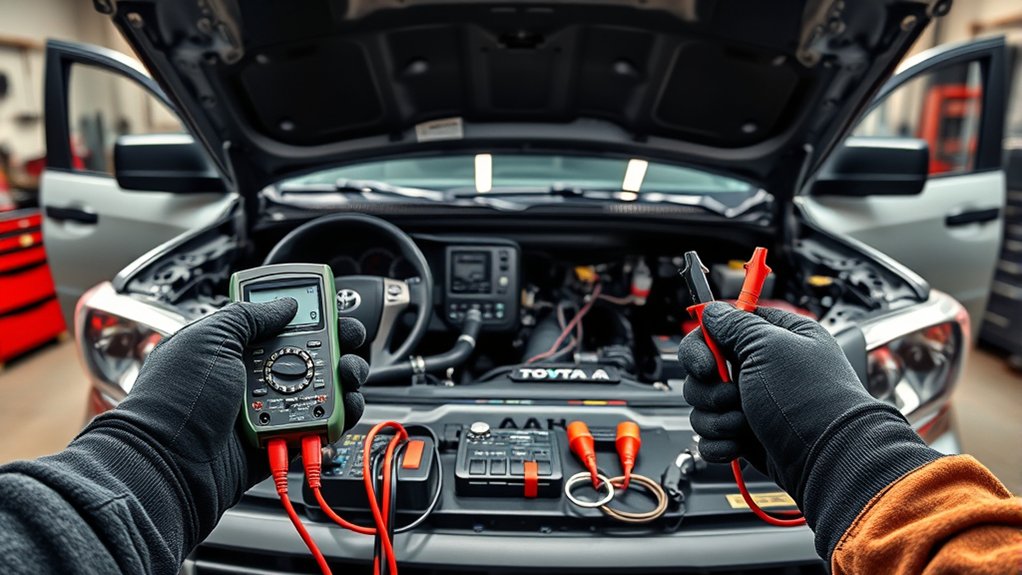
The sound and behavior during a start attempt provide the fastest way to narrow the problem. Do not assume that dashboard lights prove the battery is healthy: lights and electronics require far less current than the starter system.
| Symptom | Check First | Other Possibilities |
|---|---|---|
| Rapid clicking | Low battery charge, corroded terminals, loose cables, or a poor ground | Damaged battery cable, starter-solenoid problem, or failing starter |
| One heavy click | Battery and high-current cable condition | Starter, solenoid, seized accessory, or internal engine problem |
| Slow cranking | Weak battery, cold temperature, cable resistance, or poor grounds | Starter wear, incorrect oil viscosity, or mechanical drag |
| No sound and no crank | Park/Neutral position, brake-pedal recognition, battery connections, fuses, and key detection | Starter relay/control circuit, ignition switch, range switch, wiring, or immobilizer |
| Cranks normally but will not start | Fuel level, warning messages, diagnostic codes, and engine-speed data while cranking | Fuel delivery, ignition power, crank/cam signal, injector control, compression, or timing |
| Starts and stalls | Security messages, air-intake obstruction, electronic throttle, and stored codes | Vacuum leak, fuel-pressure loss, contaminated airflow sensor, or mechanical fault |
The most useful first diagnosis is not “battery or starter.” It is “no crank, slow crank, normal crank, or starts and stalls.”
A stall at idle is not proof of a failed idle air control valve. Depending on the model year, the Tundra may use electronic throttle control rather than a separate serviceable IAC valve. Intake leaks, throttle deposits, airflow-sensor faults, low fuel pressure, and electrical problems can produce similar symptoms.
Initial Steps for Diagnosing the No-Start Issue
- Make the area safe. Set the parking brake, shift to Park, turn off accessories, and keep the key or fob under your control.
- Classify the symptom. Note whether the engine is silent, clicks, cranks slowly, cranks normally, or starts and stalls.
- Verify the simple inputs. Confirm that there is fuel in the tank, the transmission is fully in Park, and the brake pedal is being pressed on push-button models. With the brake held, try Neutral once. Do not allow the truck to move.
- Read the dashboard. Record messages such as “Key Not Detected,” charging-system warnings, hybrid-system warnings, or a flashing malfunction indicator.
- Inspect the 12-volt battery and connections. Look for loose terminals, corrosion, damaged cables, an unsecured battery, swelling, cracks, or leakage.
- Scan before clearing anything. Use an OBD-II scanner to record stored, pending, and permanent codes plus freeze-frame data. The California Air Resources Board’s OBD overview explains how onboard diagnostics monitor emissions-related systems and store malfunction information.
- Check recall status by VIN. Search both the Toyota recall and service-campaign lookup and the NHTSA recall database.
- Stop when the test exceeds your equipment or training. Fuel-pressure, high-current starter-circuit, immobilizer-programming, compression, and mechanical-timing tests may require professional service information and tools.
Note: On an i-FORCE MAX hybrid, the gasoline engine may remain off even when the hybrid system is ready to drive. Check the READY indicator rather than relying only on engine sound. If READY does not appear or a hybrid-system warning is displayed, follow the hybrid-specific owner’s manual and avoid high-voltage components.
Check the Battery and Electrical Connections
The starter draws far more current than the lights, radio, or dashboard. A Tundra can therefore appear to have electrical power while its battery, terminals, or ground path cannot support cranking.
Inspect Battery Voltage and Condition
With the truck off and accessories disabled, measure voltage directly across the battery posts rather than on the cable clamps. A conventional 12-volt lead-acid battery at rest commonly reads around 12.6 volts when charged. A reading near 12.4 volts indicates some charge remains, but it should not automatically be described as fully charged. Temperature, battery chemistry, recent charging, and surface charge can affect the result.
A resting reading also does not show whether the battery can deliver starter current. Watch what happens during a start attempt. If voltage collapses sharply, the lights go out, or the meter resets, have the battery load-tested or conductance-tested and perform voltage-drop tests on the positive and ground circuits. Test specifications vary with temperature, battery type, and model year.
If the battery is discharged, use only the jump-start procedure and connection points specified in the Toyota owner’s manual. Do not jump-start a battery that is frozen, swollen, cracked, leaking, or giving off a strong sulfur odor.
Check Connection Integrity
Inspect both battery terminals for corrosion, looseness, overheating, or damaged clamps. Confirm that the battery hold-down is secure and that the positive cable is not rubbing against metal. Follow the negative cable to its body or engine ground and look for looseness, broken strands, corrosion, or collision damage.
Also inspect accessible starter, alternator, fuse-box, and ground connections without pulling on the wiring. Rodent damage, recent accessory installation, an aftermarket remote starter, or repair work near the battery can create an open circuit or excessive resistance.
Check starting-system and ignition fuses against the diagram for your exact model year. Replace a blown fuse only with the specified amperage. If the replacement fuse opens again, stop and diagnose the short circuit instead of installing another fuse.
Pro Tip: If a jump-start gets the Tundra running, do not assume the battery was the only problem. Have the battery and charging system tested, inspect for a parasitic drain if it goes flat again, and record any warning lights before shutting the truck off.
Inspect Fuel-System Causes Safely
Fuel delivery becomes a stronger possibility when the engine cranks at normal speed but does not start. First confirm that the gauge is believable and add a small amount of the correct fuel if the tank may be nearly empty or the truck is parked on a steep incline.
Inspect underneath and around the vehicle for a fresh fuel leak or strong fuel odor. Do not continue cranking if either is present. Depending on the model year, you may hear brief fuel-pump operation during a commanded test or start attempt, but the absence of an audible sound does not prove the pump has failed.
Check the applicable fuel-pump fuse, relay, and scan-tool data using model-specific service information. Many Tundra fuel filters are part of the in-tank module rather than a simple external maintenance item. Later fuel systems may also use direct injection and hazardous pressure, so pressure testing, line opening, and injector testing should be left to a qualified technician with the correct equipment.
Lean codes such as P0171 or P0174 can support an intake-leak or fuel-delivery diagnosis when the engine runs, but they do not by themselves identify the cause of a complete no-start. Smoke testing, fuel-trim interpretation, and pressure testing should follow the correct repair procedure.
When the Engine Cranks but Will Not Start
A gasoline engine needs the correct fuel delivery, ignition at the proper time, adequate compression, and valid engine-position information. A technician may check:
- Whether scan data shows engine RPM while cranking, which helps evaluate the crankshaft-position signal
- Crankshaft- and camshaft-position codes or synchronization data
- Power and control for the ignition coils and fuel injectors
- Fuel pressure and volume using model-specific equipment
- Compression, valve timing, and signs of an internal mechanical problem
- Air-intake blockage, electronic-throttle operation, and severe vacuum leaks
A single worn spark plug or failed ignition coil normally causes a misfire rather than preventing every cylinder from firing. A complete no-start is more likely when all coils or injectors lose power, the engine-control system lacks a valid timing signal, fuel pressure is unavailable, or mechanical compression is lost.
Test the Ignition System and Key
Traditional key-start and push-button Tundras use different starting controls. Physical key wear can affect a mechanical lock cylinder, while transponder or Smart Key recognition is an electronic issue. One does not automatically prove the other.
| Component | Action | What the Result Suggests |
|---|---|---|
| Ignition switch or engine switch | Observe whether accessory, ignition, and start modes respond normally | Missing modes may indicate a switch, brake-input, power-supply, or control-circuit problem |
| Smart Key | Try a spare programmed key and follow the dead-fob procedure in the owner’s manual | If one key works and another does not, the failed key or its battery may be responsible |
| Mechanical key and lock cylinder | Check for binding, visible damage, or a key that will not turn on key-start models | Mechanical wear may require a locksmith or ignition-cylinder repair |
| Immobilizer | Record security messages and abnormal indicator behavior during the start attempt | A recognized key with continued no-start symptoms points the diagnosis elsewhere |
| Ignition coils and spark plugs | Check stored misfire and ignition-circuit codes; avoid improvised spark testing near fuel | One failed coil commonly causes a misfire; loss of power to all coils can cause a no-start |
| Crank/cam signals | Review codes and engine-speed or synchronization data while cranking | A missing signal may prevent correctly timed ignition and injection |
On a push-button model, the mechanical emergency key generally unlocks the door; it is not inserted into an ignition cylinder. When the fob battery is weak, many Toyota Smart Key procedures involve holding the electronic key close to the engine switch while pressing the brake, but the exact sequence must be confirmed in the owner’s manual for the truck.
Investigate Starter-Motor and Relay Issues
If the battery is charged, the terminals are secure, and the engine still does not crank, investigate the starter-control and high-current circuits in a safe order:
- Listen and observe. Note whether there is rapid clicking, one heavy click, complete silence, dimming lights, or a dashboard reset.
- Try Neutral once. Hold the brake firmly, set the parking brake, move the selector to Neutral, and attempt to start. A change may point to a transmission-range or selector-position issue.
- Inspect approved fuses and relays. Use the exact fuse-box diagram. If the manual identifies an identical interchangeable relay, it may be swapped only as directed. Never bridge relay terminals.
- Test the cables under load. A voltage-drop test can reveal resistance in the positive cable, battery clamps, engine ground, or body ground that a visual inspection misses.
- Verify starter command and current professionally. If battery and cable tests pass, a technician can confirm whether the starter receives the proper command and whether the starter motor is seized, worn, or drawing abnormal current.
If the starter turns but the crankshaft does not move, or if the engine stops abruptly with a heavy mechanical sound, do not keep trying. The problem may involve the starter drive, flexplate, seized accessory, internal engine damage, or another mechanical fault.
Is the Security System Causing the Starting Problem?
A security indicator that flashes while the parked truck is off may simply show that the immobilizer is armed. It becomes diagnostically important when the truck displays “Key Not Detected,” the indicator behaves abnormally during a start attempt, a known programmed key is rejected, or the engine starts and immediately shuts down.
Security-System Malfunction Indicators
- Key-detection message: The truck cannot detect or authenticate the Smart Key.
- Only one key fails: The key battery, key electronics, or programming may be at fault.
- Both programmed keys fail: Check the 12-volt battery, related fuses, antennas, wiring, and immobilizer system.
- Problem began after accessory installation: An aftermarket alarm, remote starter, tracker, or wiring modification may be interfering.
- Problem began after collision or water intrusion: Wiring, connectors, antennas, modules, and fuel-system components may require professional inspection.
Do not assume that the Tundra has a universal manually resettable inertia switch. After a collision, rely on stored codes, a physical inspection, and Toyota repair information rather than searching for an unsupported reset button.
Safe Security-System Checks
- Move other keys, metal objects, and radio-frequency devices away from the fob.
- Try the spare programmed key if one is available.
- Replace the fob battery with the specified type if key detection is intermittent.
- Use the model-specific dead-fob starting procedure in the owner’s manual.
- Lock and unlock the truck normally, then retry the start procedure.
- Have a Toyota dealer or qualified automotive locksmith diagnose key registration, immobilizer codes, antennas, or module communication if both keys fail.
Note: Disconnecting the battery is not a dependable immobilizer reset. It can also erase useful diagnostic information, learned settings, and emissions-monitor readiness. Record codes and test results before disconnecting power.
Next Steps After Finding the Problem
Once testing identifies a likely cause, avoid replacing additional parts “just in case.” Follow a controlled repair and verification process:
- Document the evidence. Record the symptom, battery readings, diagnostic codes, warning messages, weather, fuel level, and recent repair history.
- Confirm the failed circuit or component. A low voltage reading, code, or clicking sound is evidence to investigate—not automatic proof that a specific part has failed.
- Use the correct replacement. Match battery type, fuse rating, relay specification, starter, sensor, or key component to the VIN and model year.
- Repair wiring and grounds properly. Loose terminals, damaged ground straps, rodent-chewed wiring, and poor aftermarket connections can imitate component failure.
- Retest under the original conditions. Confirm that the truck starts repeatedly and that warning lights, charging voltage, and idle behavior are normal.
- Rescan after the repair. Check for returning codes and complete any required relearn or initialization procedure.
- Check recalls and campaigns. A VIN-specific manufacturer repair may be available at no charge and may supersede ordinary troubleshooting.
When to Seek Professional Help for Starting Issues
Arrange professional diagnosis when the basic checks do not identify the cause or when the next test involves significant electrical, fuel, mechanical, or hybrid-system risk. Stop DIY troubleshooting if:
- You smell fuel, see a fuel leak, or suspect a pressurized fuel-system problem
- The battery is swollen, frozen, cracked, leaking, overheating, or repeatedly going flat
- The starter or cables become hot, smoke, or continue operating after the start control is released
- The engine cranks unevenly, stops abruptly, knocks, or shows signs of lost compression or timing
- A hybrid-system warning appears or testing would require access near orange high-voltage components
- The scan tool cannot communicate with required modules
- Both programmed keys fail or immobilizer programming is required
- A replacement fuse immediately blows again
- The truck is included in an open recall or service campaign related to its symptoms
A qualified technician can perform battery load testing, cable voltage-drop testing, starter-current analysis, bidirectional scan-tool tests, fuel-pressure testing, waveform analysis, compression testing, and immobilizer diagnosis without replacing parts based only on symptoms.
Frequently Asked Questions
What would cause a Toyota Tundra not to start?
Common causes include a discharged battery, corroded or loose connections, a failed starter circuit, an unrecognized key, a Park/Neutral or brake-input problem, a blown fuse, missing fuel pressure, loss of ignition or injector power, a crankshaft-position signal fault, or a mechanical compression or timing problem. The correct branch depends on whether the engine cranks.
Why does my Toyota have power but won’t start?
Dashboard lights do not prove the battery or cables can supply starter current. Check the battery under load, both terminals, the engine and body grounds, Park/Neutral recognition, brake-pedal input, key detection, fuses, and the starter-control circuit. If the engine cranks normally, move to fuel, ignition, engine-position, and compression testing.
What is the first step in diagnosing a no-start problem?
The first step is to classify the symptom: no crank, rapid clicking, slow cranking, normal cranking without starting, or starts and stalls. Then inspect the 12-volt battery and connections, read dashboard messages, and scan for diagnostic codes before clearing data or disconnecting the battery.
How do you manually start a Toyota Tundra?
A traditional key-start Tundra uses its ignition key normally. On a push-button model, the mechanical emergency key generally unlocks the door but is not inserted into an ignition cylinder. Use the dead-fob procedure specified in the model-year owner’s manual, which may direct you to hold the electronic key near the engine switch while pressing the brake.
Is a flashing Toyota security light normal?
A flashing security indicator while the parked truck is off may be normal and can show that the immobilizer is armed. Investigate further when the light behaves abnormally during a start attempt, the dashboard says the key is not detected, or a known programmed key is rejected.
Can one bad ignition coil keep a Toyota Tundra from starting?
One failed coil usually causes a misfire, rough running, and a cylinder-specific code rather than a complete no-start. A no-start becomes more likely if every coil loses power or control, the crankshaft or camshaft signal is missing, fuel delivery is unavailable, or the engine has lost compression or correct timing.
Conclusion
Diagnosing a Toyota Tundra that won’t start is easier when you follow the symptom instead of guessing at parts. Begin with Park or Neutral, key recognition, the 12-volt battery, terminals, grounds, and stored codes. If the engine cranks normally, investigate fuel delivery, ignition control, crank and cam signals, compression, and timing. Use model-specific Toyota instructions, preserve diagnostic information, check the VIN for campaigns, and leave high-current, pressurized-fuel, immobilizer, mechanical, and hybrid-system testing to a qualified technician.
Sources
- Toyota Manuals and Warranties — model-specific starting, Smart Key, jump-start, fuse, and hybrid safety procedures
- Toyota Recall and Service Campaign Lookup — VIN-specific Toyota recalls and service campaigns
- National Highway Traffic Safety Administration Recalls — federal safety-recall and VIN information
- California Air Resources Board OBD II Fact Sheet — diagnostic-code storage, readiness information, and OBD-system background
