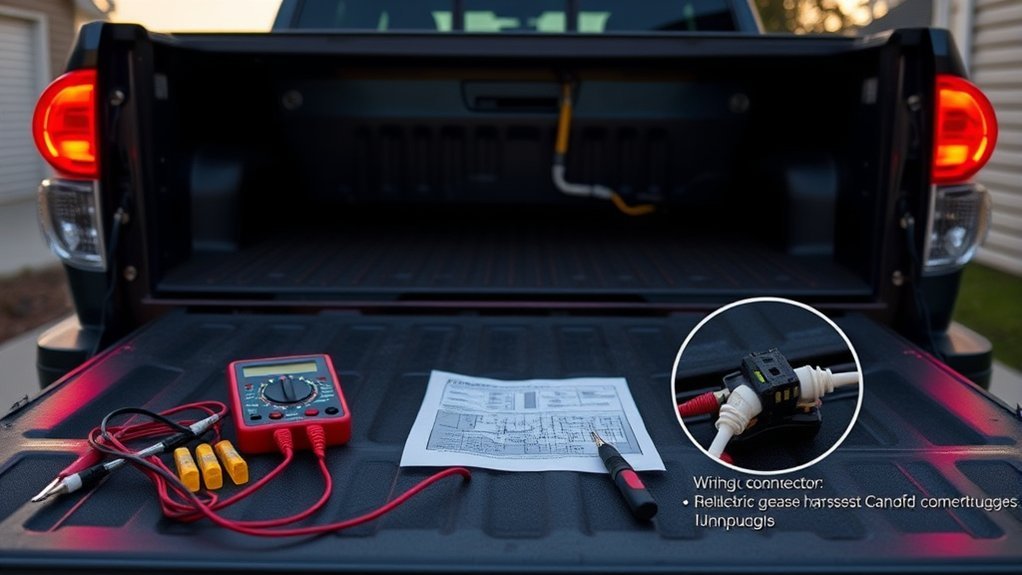
If your Toyota Tundra’s trailer lights are not working, start with the simple checks before you replace parts. Most failures come from a blown towing fuse, a corroded connector, a loose ground, a bad adapter, damaged trailer wiring, or a trailer-side short. The safest approach is to test the truck-side connector first, then test the trailer separately so you know which side has the fault.
Quick Answer
If your Toyota Tundra trailer lights do not work, inspect the plug and ground first, then check the correct towing fuses for your model year. Use a multimeter or trailer light tester to test each connector function. If the truck has power, the problem is likely in the trailer wiring, lights, ground, or adapter.
Key Takeaways
- Do not rely on wire color alone. Test trailer connector pins by function because wiring colors can vary.
- Check the fuse-box cover and your exact Tundra owner’s manual before replacing towing fuses or relays.
- A weak or rusty ground can cause flickering lights, dim lights, or only some trailer lights to work.
- If the Tundra connector tests correctly, move to the trailer plug, trailer ground, lamp grounds, bulbs, and wiring harness.
- Do not tow on public roads until brake lights, turn signals, tail lamps, and required marker lights work properly.
At a Glance
| Time Required | 15 to 45 minutes for basic testing; longer if you need wiring repair |
| Difficulty | Easy to moderate |
| Tools Needed | Multimeter or trailer light tester, fuse puller, spare fuses, contact cleaner, small wire brush, dielectric grease, flashlight, and basic hand tools |
| Cost | Often under the cost of a fuse, tester, or connector cleaner; wiring repairs cost more if a harness or socket is damaged |
Warning: Do not tow on public roads if the trailer’s brake lights, turn signals, tail lamps, or required marker lights are not working. Failed trailer lighting can make the trailer harder to see and can keep other drivers from reading your braking or turning signals.
Understanding Common Causes of Trailer Light Failures

Trailer light problems usually come from a few repeat issues. Start with these before you assume the Tundra has a major electrical fault:
- Corroded connector pins: Moisture, road salt, dirt, and loose caps can keep power from passing through the plug.
- Loose or rusty grounds: A weak ground can make lights flicker, dim, backfeed, or fail only when several lights run at once.
- Blown towing fuse: A shorted trailer wire or wet connector can blow a fuse in the truck’s towing circuit.
- Bad adapter: A 4-way to 7-way adapter or aftermarket harness can fail even when the truck and trailer are both fine.
- Damaged trailer wiring: Pinched, cut, stretched, or rubbed wires often fail near the tongue, axle, suspension, or tail lamps.
- Bulb or lamp failure: Older incandescent bulbs, cracked housings, and water-filled lamps can stop one function from working.
Test by function first, not by wire color. Trailer wiring colors are helpful clues, but repairs, adapters, and manufacturer differences can change what each wire does.
Identify Your Connector and Model Year First
Before you test anything, confirm what setup your Tundra and trailer use. A basic utility trailer may use a 4-way flat connector, while campers, equipment trailers, and trailers with electric brakes often use a 7-way RV-style blade connector.
Also confirm whether your Tundra has a factory tow package or an aftermarket harness. Factory wiring, aftermarket T-connectors, splice-in converters, and adapters can all fail in different ways.
Note: Fuse names and locations vary by model year. Use the fuse-box cover and the correct Toyota owner’s manual for your exact Tundra before replacing fuses or relays.
Critical Fuses and Relays to Check for Trailer Lights
If none of the trailer lights work, check the Tundra’s towing fuses early in the process. Some Tundra years may label a running-light circuit as TOW TAIL, but do not assume every model year uses the same label.
Open the fuse-box cover and look for labels related to trailer, towing, tail lamps, stop lamps, turn signals, parking lamps, and trailer brake output. Check each related fuse with a fuse tester or multimeter instead of judging by sight only. A fuse can look fine and still fail under testing.
If a new fuse blows right away, do not keep replacing fuses. A repeated failure usually means the trailer, adapter, socket, or harness has a short to ground. Unplug the trailer and test the truck-side connector by itself before reconnecting the trailer.
How to Test Your Trailer Connector for Power
Use a multimeter or trailer light tester at the truck-side connector. Test one function at a time while a helper activates the Tundra’s lights.
Inspect Connector Pins Thoroughly
Inspect the connector before you test voltage. Look for green corrosion, bent blades, loose sockets, broken covers, packed dirt, water, or a plug that does not seat firmly. Clean light corrosion with electrical contact cleaner and a small brush. Replace the connector if pins are loose, badly pitted, cracked, or pushed back into the housing.
Check for Voltage Consistency
With the trailer unplugged, test the truck-side connector by function:
- Tail/running lights: Turn on the parking lights or headlights and test the tail/running-light pin.
- Left turn and brake: Activate the left signal and press the brake pedal if your tester requires it.
- Right turn and brake: Activate the right signal and press the brake pedal if needed.
- Ground: Connect your meter or tester to the connector ground and confirm the ground path is solid.
- 7-way auxiliary functions: If equipped, test electric brake output, reverse lights, and 12-volt auxiliary power by function, not by color alone.
A healthy 12-volt lighting circuit often reads close to battery voltage when that function is active. Small differences can happen under load, but no voltage on one function points toward a fuse, relay, harness, connector, switch, or module issue on the truck side.
Test Ground Connections Securely
A weak ground can mimic several other problems. Set your multimeter to continuity or resistance and test between the connector ground and a clean metal ground on the truck. You want continuity or very low resistance. If the reading is high or unstable, clean and tighten the ground connection before you keep testing.
Pro Tip: If a trailer light works alone but fails when the brake lights and running lights are on together, suspect a weak ground. Higher load often exposes a ground problem that a single light test may miss.
The Importance of Ground Connections: What to Look For

A reliable ground connection is one of the most important parts of the trailer lighting system. On many trailer plugs, the white wire is commonly used for ground, but you should still verify the circuit by function. A trailer also needs clean lamp grounds at the rear lights.
| What to Look For | Action |
|---|---|
| Rust, paint, or undercoating under a ground screw | Move the ground to clean bare metal or clean the mounting point |
| Loose ground screw or ring terminal | Tighten securely and replace damaged terminals |
| High or unstable resistance reading | Clean, retest, and run a dedicated ground wire if needed |
| Lights mounted to wood, plastic, or heavy paint | Add a dedicated ground wire to each lamp assembly |
After cleaning grounds, apply a small amount of dielectric grease around the finished connection to help slow future corrosion. Do not use grease as a substitute for clean metal-to-metal contact.
How to Identify Common Wiring Issues
If the Tundra connector tests correctly, shift your attention to the trailer. Most trailer-side wiring failures happen where wires move, rub, bend, or collect water.
Inspect Wiring Color Codes Carefully
Common trailer wiring colors can help you start, but they are not proof. A typical 4-way flat trailer connector often uses white for ground, brown for tail/running lights, yellow for left stop/turn, and green for right stop/turn. A typical 7-way RV-style setup may add functions such as electric brake output, auxiliary power, and reverse lights.
Because wire colors can vary, confirm each wire with a tester. If someone repaired the trailer before you owned it, the colors may no longer match any standard diagram.
Check Ground Connections
On the trailer, check the main ground near the tongue first. Then check each tail lamp. Many trailer lights ground through their mounting studs, so rust, paint, plastic brackets, loose bolts, or a cracked lamp base can break the ground path.
If your trailer has a tilt bed, folding tongue, or removable rear section, the frame may not pass ground reliably through the hinge or pivot. In that case, run a dedicated ground wire from the front connector to the rear lamps.
Test Connector Integrity
A damaged trailer plug can stop all lights or only one function. Open the plug if it is serviceable and look for loose set screws, broken strands, corrosion, or wires touching inside the plug. Replace the plug if the blades are worn, the housing is cracked, or the wire clamp no longer holds the cable securely.
- Check for pinched wires above the axle, near suspension parts, and behind tail lights.
- Look for wires rubbed bare where they pass through frame holes.
- Inspect splices for corrosion, loose crimping, or exposed copper.
- Check lamp housings for water, cracked lenses, and burned bulbs.
Test With a Multimeter for Accurate Troubleshooting
A multimeter helps you avoid guessing. Use it to check voltage, continuity, and ground quality. If you are not comfortable working around vehicle wiring, stop and use a qualified technician.
| Test | What It Tells You |
|---|---|
| Truck connector voltage by function | Confirms whether the Tundra is sending power to the correct connector pins |
| Connector ground continuity | Shows whether the ground path is complete and stable |
| Trailer plug continuity | Helps locate broken wires, bad splices, or a faulty trailer plug |
| Lamp ground test | Finds rusty mounting points, weak lamp grounds, or missing ground wires |
| Trailer-side 12-volt test | Confirms whether the trailer lights can work when powered separately from the truck |
When testing a trailer directly with a 12-volt battery, use fused jumper leads if possible. Touch only the function you are testing, and avoid letting positive power touch the trailer frame or another exposed wire.
Separate Truck Problems From Trailer Problems
The fastest way to avoid wasted repairs is to isolate the fault:
- Test the Tundra with no trailer connected. If the truck-side connector has no output on one function, check fuses, relays, socket wiring, the tow module if equipped, and the harness.
- Test the trailer on another known-good tow vehicle. If the lights still fail, the trailer has the problem.
- Test a known-good trailer on your Tundra. If that trailer works, your original trailer or adapter likely has the issue.
- Remove adapters from the test. A failed adapter can make both the truck and trailer look bad.
If your Tundra shows trailer-light warnings or has repeated fuse failures, check for open recalls or service campaigns by VIN through NHTSA’s recall lookup and Toyota owner resources.
Where to Find Help and Shared Solutions in the Community
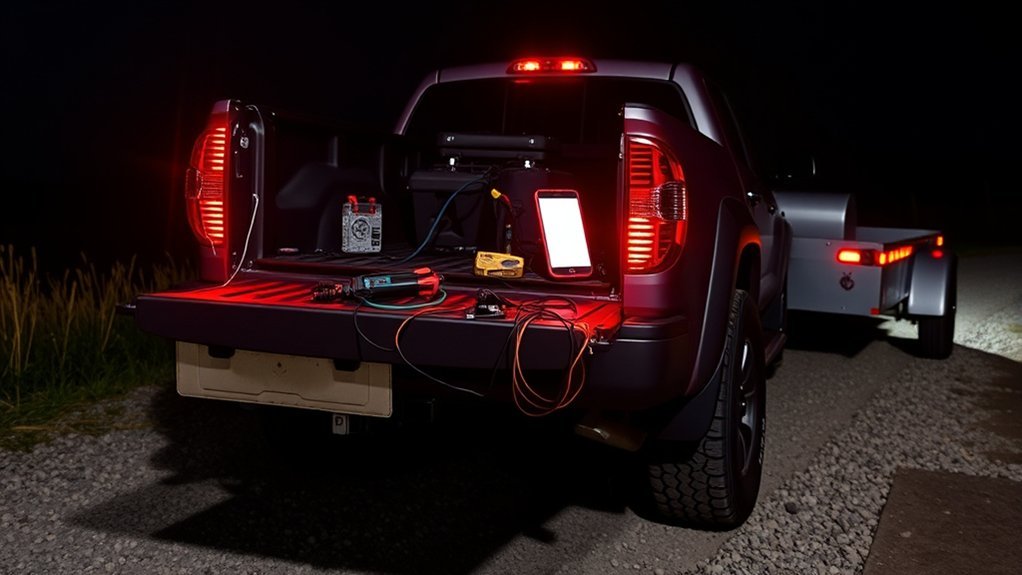
If the basic checks do not solve the problem, Toyota Tundra owner forums and towing communities can help you compare symptoms with other owners. Search by your exact model year, connector type, tow package, and symptom.
Useful search phrases include:
- “Toyota Tundra trailer running lights not working”
- “Tundra TOW TAIL fuse keeps blowing”
- “Tundra 7 pin no brake lights trailer”
- “Tundra trailer lights work except running lights”
Use community advice as a supplement, not as a replacement for the owner’s manual, fuse-box labels, and direct testing. A fix that works on one model year may not apply to another.
Tips for Preventing Future Trailer Light Problems
Once the lights work, a little preventive maintenance can help keep the problem from coming back.
| Maintenance Tip | Purpose |
|---|---|
| Clean the truck and trailer connectors before towing season | Reduces corrosion and poor pin contact |
| Keep connector caps closed when not in use | Helps keep water, dirt, and road salt out of the socket |
| Inspect trailer wiring routing | Prevents rubbing, pinching, and cuts near the axle or suspension |
| Check grounds before long trips | Catches rust or looseness before it causes lighting failure |
| Carry spare fuses and a small tester | Makes roadside diagnosis faster if a simple fuse or connector issue appears |
Before each trip, connect the trailer and test running lights, left signal, right signal, brake lights, reverse lights if equipped, and marker lights. Ask a helper to stand behind the trailer, or use a reflective surface where you can see the lamps from the driver’s seat.
What to Do If Your Trailer Lights Still Don’t Work?
If your trailer lights still do not work after the basic checks, slow down and isolate the circuit. Do not replace the truck socket, trailer plug, or tow module until you know where power stops.
- Unplug the trailer and test the Tundra connector by function.
- Remove any adapter and test again.
- Check every towing-related fuse listed for your model year.
- Test the trailer plug and main ground.
- Power each trailer light function separately with a fused 12-volt test lead.
- Inspect the trailer wiring from the tongue to the rear lamps.
- Repair damaged wires with proper automotive connectors and weather-resistant protection.
If the Tundra connector has no output after good fuses, good grounds, and a clean socket, the issue may involve the factory harness, aftermarket converter, relay, trailer brake controller circuit, or body electrical system. At that point, a Toyota dealer or qualified auto-electric technician can diagnose the circuit with the correct wiring diagram for your model year.
Frequently Asked Questions
What would cause trailer lights to stop working?
Common causes include a blown towing fuse, corroded connector pins, a loose ground, a failed adapter, damaged trailer wiring, burned bulbs, water inside a lamp, or a short in the trailer harness.
Where is the fuse for Toyota Tundra trailer lights?
The fuse location depends on your Tundra’s model year and tow package. Check the fuse-box cover and the correct Toyota owner’s manual for labels related to towing, trailer, tail lamps, stop lamps, turn signals, and parking lamps. Some years may use a label such as TOW TAIL for trailer running lights.
Are there separate fuses for trailer lights?
Many tow packages use separate circuits or fuses for trailer lighting functions, but the exact layout varies by model year. If only one function fails, such as running lights or one turn signal, check the fuse and wiring for that function instead of replacing unrelated parts.
Should I test trailer wiring by wire color?
Use wire colors only as a starting clue. Trailer wiring colors can vary by manufacturer, adapter, and past repairs. A multimeter or circuit tester gives a safer answer because it confirms what each pin or wire actually does.
What if the Tundra lights work but the trailer lights do not?
If the truck’s own lights work, test the truck-side trailer connector next. If the connector has power on every function, the problem is likely in the trailer plug, trailer ground, adapter, wiring harness, bulbs, or lamp grounds.
Does the Toyota Tundra model year affect trailer light troubleshooting?
Yes. Fuse labels, connector wiring, tow-package equipment, and electrical modules can vary by model year. Use your exact owner’s manual and wiring information before assuming a fix from another Tundra applies to yours.
Conclusion
Trailer light problems on a Toyota Tundra usually come down to power, ground, connector condition, fuses, adapters, or trailer-side wiring. Start with a visual inspection, test the truck-side connector by function, confirm the correct towing fuses for your model year, then test the trailer separately.
Do not keep towing if the required trailer lights are not working. Once you repair the fault, retest running lights, brake lights, turn signals, marker lights, and reverse lights if equipped before you drive. If fuses keep blowing or the truck connector has no output after basic checks, get the circuit diagnosed by a qualified technician.
Sources
- Toyota Owners Manuals and Warranties: model-year owner manual and fuse-reference guidance
- 49 CFR 571.108, Standard No. 108: federal lighting, reflective device, and vehicle conspicuity requirements
- eTrailer Trailer Wiring Diagrams: connector-function testing, wire-color caution, and ground troubleshooting guidance
- NHTSA Recall Lookup: recall, investigation, complaint, and manufacturer communication checks by vehicle or equipment
