
A TPMS reset and a TPMS relearn are related, but they are not always the same procedure. The correct term and method depend on whether your vehicle uses direct or indirect tire pressure monitoring, whether sensor IDs have changed, and whether the vehicle tracks each sensor’s wheel position. Checking the owner’s manual or model-specific service information is therefore essential before pressing a reset button, starting a drive cycle, or connecting a scan tool.
Quick Answer
A TPMS reset usually clears or initializes a pressure baseline, especially on indirect systems. A TPMS relearn registers direct-sensor IDs or wheel positions with the vehicle. Sensor programming configures certain blank aftermarket sensors before installation. The correct step depends on the vehicle, sensor type, and service performed.
Key Takeaways
- Reset, relearn, and programming are different operations. Manufacturers may use the words differently, so always follow the instructions for the exact year, make, and model.
- Indirect TPMS usually needs calibration or initialization. Direct TPMS may need sensor-ID or wheel-position relearning.
- New tire rubber does not automatically mean new sensor programming. The required procedure depends on whether the sensors or their IDs changed.
- Not every aftermarket sensor is blank. Some are direct-fit or preprogrammed, while others must be programmed before relearning.
- TPMS is not a substitute for a pressure gauge. Check cold tire pressure monthly and use the vehicle placard rather than the maximum pressure printed on the tire sidewall.
At a Glance
| Time Required | About 5–30 minutes, although an automatic relearn may require a longer drive cycle. |
| Difficulty | Easy for dashboard calibration; moderate for stationary or OBD relearns and sensor programming. |
| Tools Needed | Accurate tire-pressure gauge, air source, owner’s manual, and—when specified—a TPMS activation, programming, or OBD-capable diagnostic tool. |
| Cost | Often $0 for an owner-performed calibration or automatic relearn. Shop pricing varies by vehicle, labor, required tools, and whether sensors must be replaced or programmed. |
Understanding TPMS Reset vs. Relearn: What’s the Difference?

The phrase TPMS reset is often used loosely, which is why instructions can appear contradictory. Depending on the manufacturer, “reset” may mean clearing a low-pressure warning after inflation, starting an indirect-system calibration, or completing a direct-system relearn.
A TPMS relearn normally applies to a direct TPMS vehicle that stores the unique identification numbers of the pressure sensors. The relearn allows the vehicle’s control module to recognize newly installed sensor IDs, confirm their positions, or update the positions after a wheel rotation when the vehicle requires it.
Sensor programming is a separate step. Certain universal or cloneable aftermarket sensors are supplied blank and must first be configured with the correct vehicle protocol and sensor information. After programming, the sensor may still need to be relearned to the vehicle. Other replacement sensors are direct-fit or preprogrammed and do not require this programming step.
| Procedure | What It Does | Common Reasons |
| Reset, initialization, or calibration | Stores a new pressure or wheel-speed baseline, most commonly on an indirect TPMS. | Pressure correction, tire rotation, tire replacement, or wheel change when the owner’s manual requires calibration. |
| Relearn | Registers direct-sensor IDs or wheel positions with the vehicle. | New sensor IDs, seasonal wheel sets, certain tire rotations, or TPMS module service. |
| Programming | Writes the correct vehicle protocol and sensor data to a compatible blank aftermarket sensor. | Installing a programmable, universal, or cloneable replacement sensor. |
| Activation or triggering | Wakes a direct sensor and reads its ID, pressure, and available status data. | Testing sensors, confirming operation, or completing a stationary relearn. |
Direct TPMS vs. Indirect TPMS
A direct TPMS uses battery-powered sensors mounted in or on the wheel assemblies. These sensors transmit pressure information and a unique ID to the vehicle. A direct system may display the pressure for each wheel, although some vehicles only provide a general warning light.
An indirect TPMS normally does not use pressure sensors inside the wheels. Instead, it analyzes wheel-speed and other vehicle data to detect changes associated with underinflation. Because it works from a learned baseline, it commonly requires calibration after pressure correction, tire rotation, or tire replacement.
The National Highway Traffic Safety Administration explains that both direct and indirect systems warn drivers of significant underinflation, but neither system replaces regular pressure checks with an accurate gauge.
Note: Manufacturers do not use TPMS terminology consistently. A menu labeled “Reset,” “Calibrate,” “Initialize,” “Learn,” or “Set Pressure” may perform a different function from the same term on another vehicle.
When Should You Perform a TPMS Reset?
Perform a reset, initialization, or calibration only when the vehicle manufacturer calls for it. This is most common with indirect TPMS, which must learn a new reference after tire pressure or tire characteristics change.
A reset may be required after:
- Correcting all tires to the specified cold pressure
- Rotating the tires on an indirect TPMS vehicle
- Replacing one or more tires
- Switching between seasonal wheel-and-tire sets
- Changing tire size when the size is approved by the vehicle manufacturer
- Repairing a condition that caused the warning light
Before starting the procedure, inflate all tires to the pressure on the vehicle’s tire-and-loading placard or in the owner’s manual. The placard is commonly on the driver-side door edge or doorjamb. Do not use the maximum pressure molded into the tire sidewall as the vehicle’s normal inflation target.
Adjust the tires to the vehicle manufacturer’s recommended cold pressure before starting any TPMS reset, calibration, or relearn procedure.
Some vehicles use a physical button, while others place the calibration command in the instrument-cluster or infotainment menu. The system may then require a drive cycle to learn the new baseline. Never use a generic button sequence unless it matches the procedure for the exact vehicle.
Warning: Do not reset or calibrate an indirect TPMS while a tire is underinflated. The system may store the incorrect pressures as its normal baseline and delay a future warning.
Do New Tires Always Require a Reset?
No. If a direct TPMS vehicle receives new tire rubber while its original working sensors remain installed, the sensor IDs have not changed. The vehicle may need no electronic service beyond confirming correct pressure and checking that the warning light turns off.
A reset or calibration may still be required on an indirect system because tire diameter, tread depth, or wheel-speed behavior changed. Always follow the owner’s manual after installing tires.
Does a Tire Rotation Always Require a Reset or Relearn?
No. The answer depends on the vehicle:
- A vehicle that does not display individual wheel locations may continue operating normally without a manual relearn.
- A vehicle with automatic sensor localization may update the positions after driving.
- A vehicle that stores each sensor’s wheel position may require a stationary or OBD relearn.
- An indirect TPMS may require calibration after the rotation.
Why Is TPMS Relearning Essential for Effective Sensor Functionality?
A direct-TPMS relearn allows the vehicle to recognize the sensors that are actually installed. Each direct sensor transmits a unique identification code so the vehicle can separate its own sensors from nearby signals and, when supported, associate each sensor with a wheel position.
A relearn is commonly required when:
- A replacement sensor with a new ID is installed
- A second set of seasonal wheels introduces different sensor IDs
- The vehicle requires position learning after a tire rotation
- The TPMS receiver or related control module has been replaced
- Stored sensor information has been erased or is no longer correct
Installing new tires alone does not necessarily introduce new IDs. Similarly, rotating the wheels does not require the same procedure on every vehicle.
Ensures Accurate Sensor Communication
The relearn confirms that the vehicle can receive and recognize the installed direct sensors. When the vehicle displays individual tire pressures, the procedure may also match each ID to the correct wheel location.
Without a required relearn, the vehicle may show a malfunction warning, omit one or more pressure readings, display pressures in the wrong positions, or continue looking for sensors that are no longer installed.
Maintains Tire Pressure Monitoring
Correct sensor registration allows the system to monitor the intended wheels and report faults accurately. The required method is prescribed by the vehicle manufacturer and may be automatic, stationary, OBD-based, or a combination of methods.
The REDI-Sensor technical guide emphasizes that programming an aftermarket sensor and relearning it to the vehicle are separate operations. A sensor can be correctly programmed yet still remain unrecognized if the required vehicle relearn is skipped.
Sensor Programming vs. Relearning
Programming changes the configuration inside certain replacement sensors. Relearning changes the information stored by the vehicle. Completing one operation does not automatically complete the other.
Replacement-sensor categories include:
- OE or direct-fit sensors: Built for specific vehicle applications and normally supplied with the required protocol.
- Preprogrammed multi-application sensors: Carry supported protocols from the factory and generally do not need shop programming.
- Programmable universal sensors: Must be configured for the vehicle with a compatible programming tool.
- Cloneable sensors: May copy the old sensor’s ID when the equipment and application support cloning.
Even when an old ID is cloned, the technician must still follow the sensor manufacturer’s and vehicle manufacturer’s instructions. Some vehicles may accept the cloned sensor without an ID registration procedure, while others still require verification, position learning, or a drive cycle.
The Schrader TPMS technical FAQ explains that its blank programmable sensors must be configured for the vehicle before use, whereas OE-replacement sensors are supplied for specific applications.
Tools Required for TPMS Reset and Relearn Processes
The correct tools depend on the system and procedure. A dashboard calibration may require nothing more than a pressure gauge and the owner’s manual, while replacement-sensor work may require activation, programming, and OBD equipment.
Essential Programming Tools
Common TPMS service tools include:
- Accurate tire-pressure gauge: Confirms that every tire is set to the placard pressure before electronic service begins.
- TPMS activation or trigger tool: Wakes a direct sensor and reads its ID, pressure, frequency, and available status information.
- TPMS programming tool: Configures supported blank aftermarket sensors for the selected vehicle application.
- OBD-capable TPMS diagnostic tool: Transfers sensor IDs to the vehicle through the diagnostic connector when an OBD relearn is required.
- Model-specific service information: Provides the correct sequence, sensor order, drive conditions, and verification steps.
Pro Tip: Test every direct sensor before dismounting the tires. Recording the sensor IDs, pressure readings, and battery or status information can reveal a weak sensor and prevent repeating the tire-removal work.
Relearn Tool Variations
There are four broad TPMS learning methods:
- Automatic relearn: The vehicle recognizes the sensors after driving under specified conditions.
- Stationary relearn: The vehicle enters a learn mode, and each sensor is triggered in a prescribed order.
- OBD relearn: A diagnostic tool reads the sensor IDs and transfers them to the vehicle through the OBD-II connector.
- Indirect-system calibration: The driver starts a calibration through a button or vehicle menu, followed by a learning drive when required.
The ATEQ TPMS procedure guide documents automatic, stationary, OBD, and indirect-system methods and stresses that the correct procedure varies by manufacturer and model.
Compatibility and Updates
A sensor must match the vehicle’s application, communication protocol, and supported radio frequency. Physical fit alone does not establish compatibility. A valve-mounted sensor that attaches to the wheel but transmits the wrong protocol will not communicate correctly with the vehicle.
Professional TPMS tools also need current software because vehicle coverage, sensor support, and relearn instructions change as new models and sensor products are released.
Safe TPMS Reset and Relearn Workflow
Because there is no universal button sequence, use this workflow to determine the correct service rather than guessing:
- Identify the TPMS type. Check the owner’s manual or service information to determine whether the system is direct or indirect.
- Inspect the tires. Look for punctures, damage, uneven wear, incorrect sizing, and obvious valve or sensor damage.
- Check pressure cold. Adjust every monitored tire to the pressure on the vehicle placard.
- Test direct sensors. If the vehicle uses direct TPMS, activate each sensor and verify that it responds.
- Confirm sensor compatibility. Before installation, verify the replacement part by year, make, model, trim, and applicable production details.
- Program only when required. Configure a blank programmable sensor with a supported tool. Do not attempt to program a direct-fit or factory-preprogrammed sensor unless its instructions call for it.
- Complete the specified reset or relearn. Follow the exact automatic, stationary, OBD, or calibration procedure for the vehicle.
- Verify the repair. Confirm that the warning light goes out, all available pressure readings appear, and the displayed wheel positions are correct.
- Recheck for stored faults. If the light flashes or returns, diagnose the fault rather than repeatedly resetting the system.
Top Mistakes to Avoid in TPMS Reset and Relearn Processes
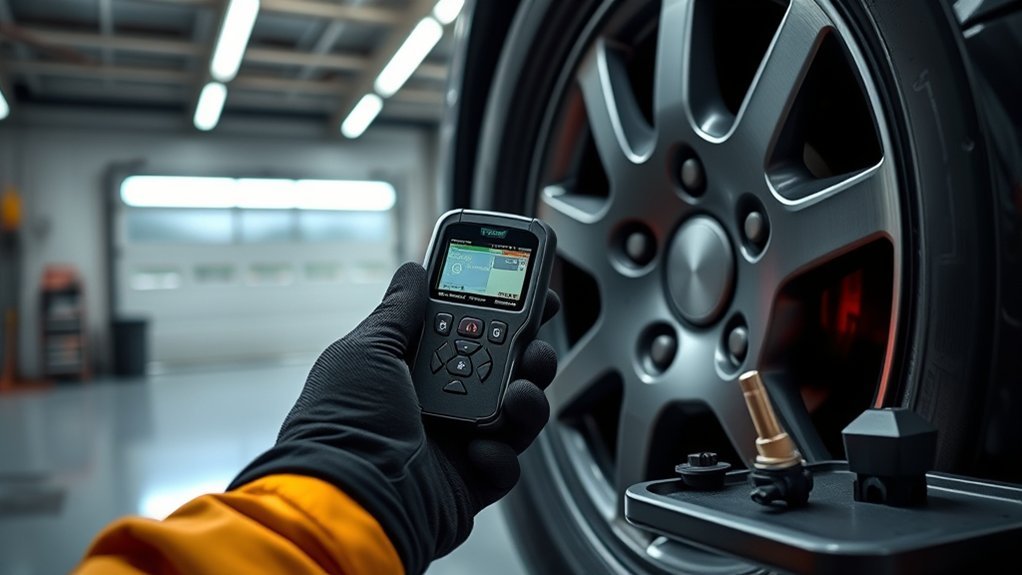
A successful TPMS service depends on identifying the correct system before selecting a procedure. Avoid these common mistakes:
- Resetting before correcting pressure: An indirect system can learn an unsafe baseline if the tires are not properly inflated.
- Using the tire sidewall maximum: The correct normal pressure comes from the vehicle placard or owner’s manual.
- Assuming new tires require new sensor IDs: Tire rubber and electronic sensors are separate components.
- Confusing programming with relearning: Programming prepares certain sensors; relearning registers them with the vehicle.
- Assuming every aftermarket sensor is programmable: Some sensors are direct-fit or preprogrammed.
- Skipping compatibility checks: The wrong protocol, frequency, application, or sensor type can prevent communication.
- Using a generic procedure: Ignition sequences, sensor order, drive speed, and learning time vary by vehicle.
- Ignoring the spare tire: Some vehicles monitor a full-size spare, while others do not.
- Repeatedly clearing the light: A recurring or flashing warning usually needs diagnosis, not another blind reset.
Troubleshooting a TPMS Warning Light
The Light Stays On Steadily
A steady TPMS warning normally means at least one tire is significantly underinflated. Inspect the tires and check every pressure with a gauge as soon as it is safe. Cold weather can lower tire pressure enough to activate the warning even when no puncture is present.
After correcting the pressure, some vehicles turn the light off automatically. Others require calibration or a drive cycle. If the pressure drops again, inspect the tire for a leak rather than repeatedly adding air.
The Light Flashes and Then Stays On
On vehicles subject to the U.S. TPMS standard, a light that flashes for roughly 60–90 seconds and then remains illuminated indicates a system malfunction. Possible causes include a dead sensor battery, damaged sensor, incompatible replacement sensor, missing sensor ID, receiver problem, or incomplete relearn.
The NHTSA tire-safety guide recommends having the system inspected when the malfunction warning continues.
The Relearn Failed
If the procedure does not complete, check the following:
- All tires are inflated to the placard pressure
- Every installed sensor responds to an activation tool
- The replacement sensor is compatible with the exact vehicle
- A programmable sensor was configured before installation
- The correct sensor order was followed
- The vehicle was placed in the correct learning mode
- The diagnostic tool has current software and vehicle coverage
- The OBD connector, ignition position, and tool connection match the procedure
- No duplicate, corrupted, or incorrectly entered IDs are present
- The vehicle is not still detecting an old seasonal wheel set stored nearby during the process
How to Keep Your TPMS System in Top Shape
TPMS works best when it supports regular tire maintenance rather than replacing it. Follow these practices:
- Check pressure monthly: Measure all tires when cold with an accurate gauge and check again before long trips.
- Use the placard pressure: Follow the vehicle manufacturer’s cold-pressure specification.
- Respond promptly to warnings: A steady light calls for a pressure check; a flashing-then-steady light calls for system diagnosis.
- Inspect valves and service components: Replace applicable seals, valve cores, caps, nuts, or rubber stems according to the sensor manufacturer’s service instructions.
- Test sensors during tire service: Checking sensor response before dismounting the tire helps identify weak or failed components.
- Follow rotation and seasonal-swap instructions: Complete any required calibration, location relearn, or ID registration.
- Keep tools updated: Current software improves compatibility with newer vehicles and replacement sensors.
Note: A TPMS warning is intentionally designed to alert you after pressure has become significantly low. Monthly gauge checks can detect smaller pressure losses before the dashboard warning appears.
Frequently Asked Questions
Is a TPMS reset the same as a relearn?
Not necessarily. A reset, initialization, or calibration often stores a new pressure baseline, especially on an indirect TPMS. A relearn normally registers direct-sensor IDs or wheel positions with the vehicle. Some manufacturers use “reset” as a general label, so the owner’s manual determines what the command actually does.
Do aftermarket TPMS sensors need to be programmed?
Some do and some do not. Blank universal, programmable, or cloneable sensors generally require compatible programming equipment. Direct-fit and preprogrammed sensors already contain the required protocol. A replacement sensor may still need to be relearned to the vehicle even when no programming is required.
Does it matter which TPMS sensor you use?
Yes. The sensor must be approved for the vehicle’s year, make, model, applicable trim, communication protocol, frequency, and mounting design. A sensor that physically fits the wheel may still be electronically incompatible.
How much does it cost to relearn a TPMS sensor?
The cost varies by vehicle and service provider. An owner-performed calibration or automatic drive relearn may cost nothing. A shop may include relearning with tire installation, rotation, or sensor replacement, while OBD programming, tire dismounting, diagnostics, and new sensor parts can increase the total.
Do I need a TPMS relearn after rotating the tires?
Only when the vehicle requires it. Some systems automatically detect the new positions, some do not track positions, and others require a stationary or OBD relearn. Indirect systems may require calibration after a rotation.
Do new tires require new TPMS sensors?
No. New tire rubber can normally be installed with the existing sensors if those sensors are compatible, undamaged, and operating properly. A technician may recommend replacement when a sensor is damaged, its sealed battery is weak, or its age makes another tire dismount likely in the near future.
Can I drive with the TPMS light on?
Check the tires as soon as it is safe. A steady light may indicate significant underinflation, which can affect handling, heat buildup, tire wear, and fuel use. A flashing-then-steady light indicates a system malfunction, meaning the vehicle may not warn you reliably about low pressure.
Conclusion
A TPMS reset, relearn, and sensor-programming procedure each serves a different purpose. Resetting or calibrating normally establishes a monitoring baseline, relearning registers direct-sensor IDs or positions, and programming configures certain replacement sensors before installation. Because the terminology and steps vary by vehicle, use the exact owner’s-manual or service procedure rather than a universal reset sequence.
Start every service by checking the tires at the correct cold pressure, identifying whether the system is direct or indirect, and confirming that each installed sensor is compatible and functioning. Proper diagnosis prevents inaccurate readings, recurring warning lights, unnecessary sensor replacement, and avoidable tire-safety risks.
Sources
- National Highway Traffic Safety Administration — TireWise — tire-pressure maintenance, direct and indirect TPMS, warning-light behavior, and placard-pressure guidance.
- Schrader TPMS Solutions — Technical FAQ — direct versus indirect systems, replacement-sensor types, programming, relearning, and sensor IDs.
- REDI-Sensor — Relearn vs. Sensor Programming — distinction between configuring a replacement sensor and registering it with the vehicle.
- ATEQ TPMS — How-To and Procedure Guide — automatic, stationary, OBD, and indirect TPMS learning methods.
