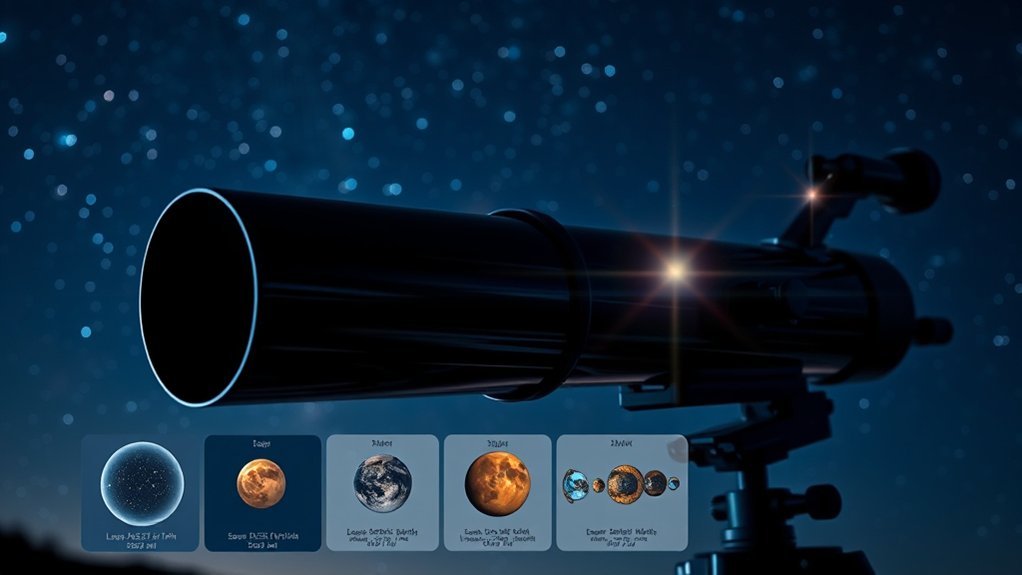
Scope magnification helps you match a scope to your viewing distance, target size, field of view needs, and eye relief. The best choice is not automatically the highest power. A useful scope balances magnification with optical quality, reticle design, objective size, mounting position, and the conditions in which you actually use it.
Last updated: September 21, 2026
Quick Answer
Scope magnification describes how much larger a target appears through the optic compared with your unaided view. Lower magnification usually gives you a wider field of view and faster target pickup. Higher magnification reveals more apparent detail, but it also narrows the visible area, makes movement easier to notice, and—at the same objective size—creates a smaller exit pupil.
Key Takeaways
- Magnification numbers such as 4x, 10x, or 3-9x describe how much larger the image appears compared with your unaided view.
- Higher magnification reveals more distant detail, but it normally narrows field of view and makes movement more noticeable.
- Objective lens size affects exit pupil and perceived brightness, but a larger objective is not automatically better.
- Eye relief matters for comfort and safety, especially when using firearms with stronger recoil.
- Choose magnification according to target size, viewing conditions, field of view, optical quality, firearm setup, and how quickly you need to acquire the target.
For beginners, the main goal is to choose enough magnification to see the required detail without making the sight picture unnecessarily narrow, shaky, dim, heavy, or difficult to use. Fixed versus variable power, objective diameter, exit pupil, eye relief, reticle behavior, and mounting fit all contribute to that decision.
Warning: Always follow firearm safety rules, local laws, range rules, and manufacturer instructions. A scope can support more precise aiming, but it does not replace safe handling, proper training, responsible target identification, or awareness of what is beyond the target.
What Is Scope Magnification?

Scope magnification describes the apparent enlargement produced by the optic. At 4x magnification, a target appears about four times larger in angular size than it does to your unaided eye. At 10x, it appears about ten times larger.Leupold, Riflescope Magnification 101
Magnification is only one part of a useful sight picture. Lower power normally shows more of the surrounding scene and makes target acquisition easier. Higher power reveals more apparent detail, but it also makes normal body movement, atmospheric distortion, and a narrow viewing angle more noticeable.
Do not treat magnification as a direct distance rating. Target size, lighting, contrast, optical quality, eyesight, support, firearm setup, and the shooting environment all affect how much magnification is actually useful.
How Scope Magnification Works

Magnification changes how large the viewed image appears through the optic. It also affects how much of the surrounding area fits inside the sight picture, how noticeable movement becomes, and how forgiving the optic feels when your eye is not perfectly centered.
Three ideas matter most at first: magnification power, field of view, and eye relief. Exit pupil, focal plane, and parallax become useful secondary concepts once those basics are clear.
Magnification Power Explained
Magnification power tells you how much larger an object appears through the optic compared with your unaided view. For example, a scope set to 10x magnification produces an image with about ten times the apparent angular size.
In a simplified telescope-like optical system, magnification can be described through the relationship between objective and eyepiece focal lengths.NASA GSFC Space Math, 2014 Variable riflescopes use more complex internal lens systems, so the marked magnification range is the practical specification to follow.
Higher magnification can make fine distant detail easier to resolve, but it does not automatically produce a more useful image. A clear, stable 6x or 8x sight picture can be more usable than a shaky or optically soft view at substantially higher power.
How Does Magnification Affect Field of View?
When you increase the magnification power of a scope, its field of view normally becomes narrower. As you zoom in, less of the surrounding scene fits inside the image. Vortex Optics describes magnification and field of view as having an inverse relationship.Vortex Optics, 2023-08-31
A narrower view can make moving objects harder to follow and can make it slower to relocate something that leaves the sight picture. Higher power also makes small body movements more visually obvious.
Lower magnification provides a wider field of view, which is often easier for locating a target and maintaining awareness of the surrounding scene. The useful setting is therefore the lowest power that still gives you enough visible detail for the task.
Pro Tip: Start at a lower magnification when locating a target, then increase power only when additional detail is useful. This avoids beginning with an unnecessarily narrow field of view.
What Is Eye Relief on a Scope?
Eye relief is the distance between your eye and the scope’s eyepiece where you can still see the complete field of view. Correct eye relief gives you a full image without forcing your head forward or producing a dark ring around the sight picture.
Adequate eye relief is also a safety consideration because recoil can move the firearm and optic rearward. Leupold states that typical riflescope eye relief is around 3 to 4 inches, depending on the model, and recommends checking eye relief carefully when mounting an optic.Leupold Riflescope Support
Eye relief is model-specific and may also feel less forgiving at high magnification. Consider your normal shooting position, firearm setup, recoil level, stock fit, and the manufacturer’s published eye-relief specification.
Different Types of Magnification

Two broad forms of magnification appear in modern optics: optical magnification and digital magnification. Optical magnification uses lenses to enlarge the apparent image before it reaches your eye. Digital magnification enlarges an image produced by an electronic sensor.
They are not interchangeable. Optical magnification preserves real optical detail within the limits of the lens system. Digital zoom may simply crop and enlarge sensor pixels, so image quality depends heavily on sensor resolution, display quality, and processing.
[Amazon Products Picked for You]

Adjustable Illuminated Setting: Green and red illuminations, 5-level brightness available, allow the hunter to use normally in any light conditions.
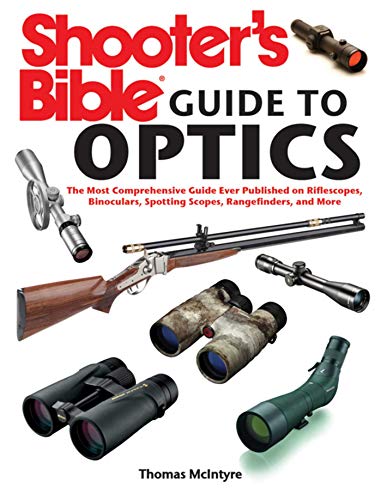

PRECISION HUNTING RIFLESCOPE - Hawke Vantage 3-9x50 riflescope delivers dependable field performance with a durable 1" mono-tube chassis and fast focus eyebell for quick reticle clarity, while nitrogen-purged shockproof, waterproof, and fog proof construction ensures reliability in changing outdoor environments
Optical Magnification Explained
Optical magnification uses lenses to bend and focus light. In a riflescope, the objective lens gathers incoming light, internal lens groups form and magnify the image, and the eyepiece presents the image to your eye.
Optics texts distinguish concepts such as linear magnification and angular magnification. For a riflescope user, angular magnification is the more intuitive idea because it describes how much larger a distant object appears from your viewing position.
Microscopes, telescopes, binoculars, spotting scopes, and riflescopes all apply optical magnification principles, but each is designed around a different viewing task.
Digital Magnification Overview
Digital magnification enlarges an electronic image from a camera sensor or display. It appears in some night-vision optics, thermal optics, digital day/night scopes, and other camera-based viewing systems.
Digital zoom can be useful, but cropping and enlarging the sensor image can reduce effective detail. A large digital-zoom number therefore does not guarantee a clearer picture.
When comparing digital optics, consider sensor quality, display resolution, refresh rate, battery life, low-light performance, durability, and native optical magnification in addition to the advertised digital zoom.
Fixed vs. Variable Magnification
Fixed magnification scopes operate at one set power, such as 4x or 10x. Their sight-picture scale stays consistent because there is no magnification range to adjust.
Fixed scopes can suit situations where the expected viewing conditions change little. However, fixed power should not automatically be assumed to mean better glass, greater brightness, or better accuracy; those qualities depend on the individual optic.
Variable magnification scopes provide a range of powers. A scope marked 3-9x can be adjusted from 3x through 9x, while a 1-6x model spans 1x through 6x. This allows the user to trade a wider view at lower power for more apparent detail at higher power.
The tradeoff is additional adjustment and a sight picture that may feel different across the zoom range. Eye box, field of view, exit pupil, optical clarity, and eye relief can all vary by model and magnification setting.
| Scope Type | Best For | Main Tradeoff |
| Fixed magnification | Simple setups and predictable viewing conditions | No flexibility when the desired image scale changes |
| Variable magnification | Mixed distances, changing target sizes, and general-purpose use | More adjustment and model-specific changes across the zoom range |
For a deeper explanation of what happens when you change power, including exit pupil, eye relief, parallax, and troubleshooting, see the GoMyReview guide to rifle scope magnification power changes.
[Amazon Products Picked for You]

Bright. Accurate. Dependable. We'll assume your stand is in the right spot and suggest our Banner Dusk & Dawn series to capitalize on the latter. With their Dusk & Dawn Brightness (DDB) multi-coated lenses, these riflescopes cast clarity and brightness.
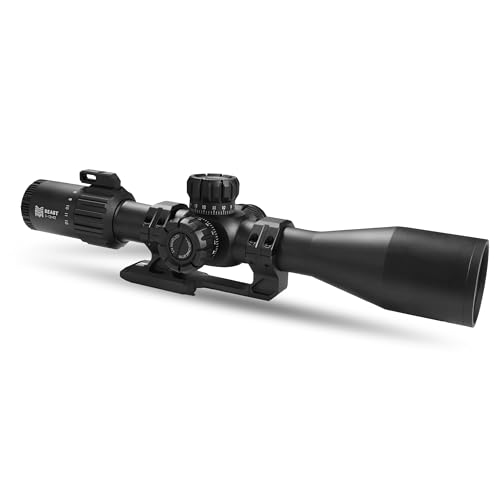
Mid power variable optic MPVO from 3-12x magnification and a wider 44mm objective lens allowing for more light transmission and a wider field of view

2-10x Magnification Range: Flexible zoom range for close to mid-range shooting.
How Focal Plane Changes Reticle Behavior
Variable scopes may use a first focal plane (FFP) or second focal plane (SFP) reticle. In an FFP scope, the reticle appears to grow or shrink along with the magnified image. In an SFP scope, the reticle stays the same apparent size as magnification changes.SIG Sauer Focal Plane Glossary
This matters most when the reticle includes graduated measurement marks. Check the manufacturer’s reticle manual rather than assuming every design behaves the same way. For the full comparison, see first vs. second focal plane scopes.
What Does 3-9×40 Mean on a Scope?
A scope’s numbers combine magnification and objective-lens information. In 3-9×40, the 3-9x portion means the optic has variable magnification from 3x through 9x. The 40 refers to an approximately 40 mm objective lens diameter.
A fixed 4x scope remains at 4x. A variable 3-9x scope lets you choose settings within that range. The objective number does not tell you how much magnification the scope has.
Do not choose a scope only from these headline numbers. Field of view, optical clarity, eye relief, exit pupil, reticle design, focal plane, weight, mounting height, parallax system, and durability can be equally important.
A moderate magnification range with clear optics and a comfortable eye position can be more useful than a high-power model that is difficult to hold steady or use consistently.
The Importance of Objective Lens Size
The objective lens is the front lens of the scope and is normally measured in millimeters. In a 3-9×40 scope, the 40 indicates an approximately 40 mm objective diameter.
A larger objective can support a larger exit pupil at the same magnification, which can improve perceived brightness in some low-light conditions. However, objective diameter by itself does not determine image quality. Glass quality, lens coatings, optical design, magnification, and the size of your own pupil also matter.
How Objective Size Affects Exit Pupil
Exit pupil is the diameter of the beam of light leaving the eyepiece. For a simple comparison, it is calculated by dividing effective objective diameter by magnification.Nikon Sport Optics
For example, a 40 mm objective at 8x gives a 5 mm exit pupil. A 50 mm objective at 10x also gives a 5 mm exit pupil. That comparison shows why objective diameter and magnification should be considered together rather than independently.
Nikon also notes that the human pupil changes size with ambient light. Once an optic’s exit pupil is larger than your eye can use under the current conditions, making the exit pupil even larger does not provide the same visible benefit.Nikon Sport Optics
Does a Bigger Objective Lens Always Make a Scope Brighter?
No. A larger objective lens can support a larger exit pupil at a given magnification, which can help in low light, but it is not an automatic guarantee of a visibly brighter or better image.
Reducing magnification also increases exit pupil on the same scope. For example, a 40 mm objective produces a 10 mm exit pupil at 4x but about a 4.4 mm exit pupil at 9x. Your eye may not be able to use all of that larger light bundle, especially in brighter conditions.
Large objectives can also add size and weight and may require higher rings. That can raise the optic above the stock and affect how naturally your eye aligns with the eyepiece. Balance brightness against mounting height, weight, optical quality, and comfort.
Eye Relief and Its Impact on Shooting
Understanding eye relief is important because it affects comfort, sight-picture consistency, and recoil clearance. Eye relief is the distance from your eye to the scope’s ocular lens where you can see the complete image.
If your eye is outside the usable eye-relief position, you may see dark edges, shadowing, or a cropped field of view. If the scope is mounted too close on a firearm with meaningful recoil, the rear of the optic may move toward your face when the firearm recoils.
The most comfortable setup allows you to assume your normal shooting position and see a full image without stretching your neck toward the eyepiece. Leupold recommends confirming eye relief while the shooter is present and checking high magnification carefully because it can be the least forgiving setting on some scopes.Leupold Riflescope Support
Always follow the scope and firearm manufacturers’ mounting instructions because usable eye relief is model-specific.
Factors to Consider When Choosing a Scope
Start with the magnification range, but do not stop there. The useful range is the one that gives enough detail at the high end while keeping sufficient field of view and an easy sight picture at the low end.
Next, consider the objective lens diameter, optical quality, and exit pupil. A larger objective can help under some low-light conditions but may also add weight and require taller mounting hardware.
Review the reticle and focal-plane design. A simple reticle may be easier to read quickly, while graduated designs add measurement references. On variable optics, FFP and SFP reticles behave differently as magnification changes.
Eye relief and eye-box forgiveness also matter. Confirm that the scope provides a full, comfortable sight picture in your normal shooting position and across the magnification settings you expect to use.
Parallax is another consideration, particularly on scopes designed for higher magnification or varied distances. Some optics use a fixed parallax setting, while others include an adjustable objective or side-focus control. For a deeper explanation, see the GoMyReview guide to parallax in rifle scopes.
Finally, consider build quality, weather resistance, weight, mounting height, manufacturer support, and budget. A clear, reliable moderate-power optic can be more useful than a high-power scope with poor clarity or an uncomfortable mounting position.
Note: Scope fit is personal. Your body position, stock length, recoil level, eyesight, mounting height, and shooting environment can change what feels comfortable behind the optic.
[Amazon Products Picked for You]

True 1x With Zero Distortion: The Ronin delivers genuine 1x magnification with extra-low dispersion glass and fully multicoated lenses, so your sight picture stays sharp and color-true from edge to edge. Shoot both eyes open at close quarters for fast target transitions, then dial to 6x for precision at distance. A 3.5-inch eye relief keeps you comfortable through rapid follow-ups, whether you're running 3-gun stages, hunting, or tactical training drills
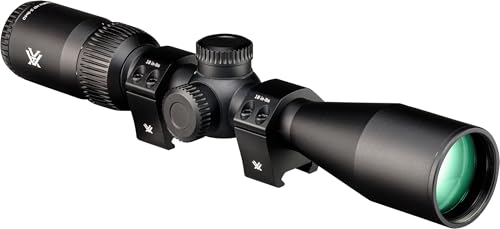
Designed for newer hunters looking for quality gear without complexity, the Triumph HD 3-9x40 riflescope kit simplifies setup and delivers confidence in the field. It includes a riflescope, new 1" Hunter Rings (0.90" Low Height) and a neoprene case.
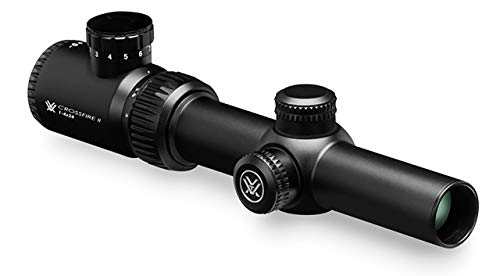
The 1-4x24 Crossfire II riflescope is one of many configurations in the Crossfire II line. The V-Brite reticle uses the V-Plex format with an illuminated the center dot.
A 4-Step Scope Magnification Check
- Start with the low end: Consider your closest normal viewing conditions and how much surrounding area you need to see. The minimum power should not feel unnecessarily narrow.
- Define the detail you need: Choose enough top-end magnification to resolve the smallest normal target detail without assuming maximum power will always be useful.
- Check both ends of the range: Compare field of view, eye relief, exit pupil, and image clarity at low and high power rather than judging the scope only by its maximum number.
- Evaluate the complete setup: Reticle behavior, objective size, mounting height, weight, parallax design, optical quality, and comfort should all fit the intended use.
Common Uses for Different Levels of Magnification
Magnification ranges are best treated as general starting points, not distance formulas. Target size, optical quality, lighting, stability, terrain, eyesight, and shooting discipline can change what feels useful.
For closer or faster-moving situations, low magnification such as 1x to 4x provides a wider field of view and generally makes it easier to locate and follow the target.
Moderate magnification from roughly 4x to 10x can provide a balance between visible detail and field of view for many general range and lawful hunting applications.
Higher settings such as 10x to 20x or more can reveal additional detail on distant or small targets, but they also magnify visible movement and atmospheric distortion and make the sight picture narrower.
Variable scopes are useful when viewing conditions change. Fixed scopes can remain practical where one consistent image scale meets the user’s needs. Magnification alone does not establish a safe, effective, or appropriate shooting distance.
| Magnification Range | Common Use | Main Benefit |
| 1x to 4x | Closer viewing, moving targets, and situations where a wide view matters | Wide field of view and easier target acquisition |
| 4x to 10x | General range use, lawful hunting, and mixed viewing distances | Balance of visible detail and usability |
| 10x to 20x+ | Distant or small targets and deliberate precision range work | More apparent detail when conditions and optical quality support it |
Tips for Using a Scope Effectively
Make sure the scope is properly mounted and aligned according to the firearm, scope, ring, and base manufacturers’ instructions. Loose hardware, incorrect mounting, or an uncomfortable position can undermine consistency even when the optic itself is working correctly.
Set eye relief before finalizing the scope position. Assume your normal shooting position and confirm a complete sight picture without forcing your head forward. Check the manufacturer’s instructions because eye-relief behavior can vary across the zoom range.
Learn the reticle and understand whether the scope uses a first- or second-focal-plane design. If the reticle contains graduated MOA, MRAD, BDC, or other measurement marks, follow the manufacturer’s reticle manual rather than assuming those references behave identically at every magnification.
Do not leave a variable scope at maximum power simply because it is available. Higher magnification can narrow field of view, shrink exit pupil, and make body movement or atmospheric distortion more noticeable. Use only as much magnification as provides a clear, manageable sight picture.
Maintain the optic with lens-safe cleaning tools, protect the lenses when possible, and inspect the scope and mounting hardware after impacts or unusual recoil. Always follow local laws, range rules, manufacturer instructions, and the primary rules of firearm safety.Hunter-Ed
Scope Magnification FAQ
What does 3-9×40 mean on a scope?
A 3-9×40 scope has variable magnification from 3x to 9x and an approximately 40 mm objective lens. The first two numbers describe the magnification range; the final number describes objective diameter in millimeters.
Is higher scope magnification always better?
No. Higher magnification can reveal more apparent detail, but it also normally narrows field of view and makes movement and atmospheric distortion easier to notice. The best setting is the amount of magnification that gives enough detail while keeping the image clear and manageable.
Does a larger objective lens automatically make a scope brighter?
No. A larger objective can support a larger exit pupil at the same magnification, which can help in low light, but perceived brightness also depends on magnification, lens coatings, glass quality, optical design, and the size of your eye’s pupil.
What is eye relief on a scope?
Eye relief is the distance between your eye and the eyepiece where you can see the scope’s full field of view. Correct eye relief supports a comfortable sight picture and provides clearance between your face and the optic during recoil.
How does magnification affect field of view?
Increasing magnification normally narrows field of view, so less of the surrounding scene is visible. Lower magnification generally gives a wider view and makes it easier to locate or follow a target.
Conclusion
Scope magnification is not simply a measure of how far an optic can “zoom.” It changes apparent image size, field of view, exit pupil, visible movement, and how forgiving the sight picture feels.
The most useful scope matches your actual viewing conditions rather than chasing the largest magnification number. Start with a usable low end, choose only as much high-end power as you need, and evaluate eye relief, optical quality, objective size, reticle behavior, parallax design, weight, and mounting fit as one system.
If you are comparing variable scopes, judge them at both ends of their magnification range. A comfortable, clear, stable sight picture is more useful than a specification that looks impressive on paper but is difficult to use in practice.
Sources
- Leupold: Riflescope Magnification 101 — supports magnification basics, fixed versus variable power, and field-of-view tradeoffs.
- NASA GSFC Space Math — supports basic optical focal-length and magnification principles.
- Vortex Optics: Understanding Magnification and Field of View — supports the relationship between magnification and field of view.
- Leupold Riflescope Support — supports eye-relief definitions, typical 3–4-inch eye relief, and mounting considerations.
- Nikon Sport Optics Guide — supports exit pupil basics, the objective-diameter-divided-by-magnification formula, and pupil-size considerations.
- SIG Sauer Focal Plane Glossary — supports the basic difference between first- and second-focal-plane reticle behavior.
- Hunter-Ed: Four Primary Rules of Firearm Safety — supports firearm-safety guidance.
