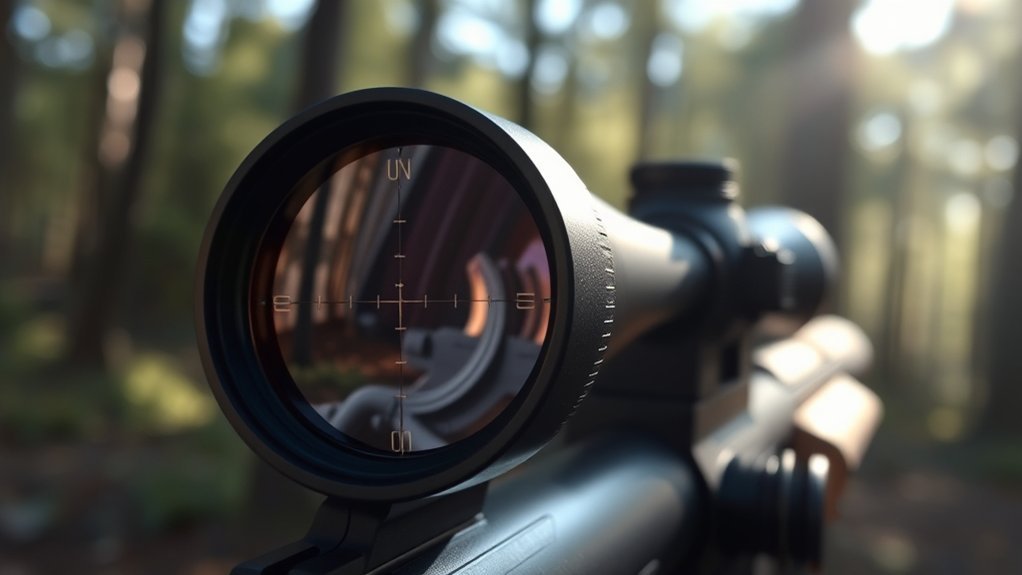
Many shooters overlook how much parallax in a rifle scope can shift their point of impact. When your eye moves away from the ideal position, the reticle may appear to slide across the target, especially at longer distances. Learning to spot and adjust for parallax helps you tighten groups and keep shots closer to your intended point of aim.
Rifle scope parallax is the apparent movement of the reticle over the target when you move your eye behind the scope. It happens because the target image and the reticle are in different focal planes. Correct parallax adjustment keeps them aligned, reducing aiming error at medium and long range.
Key takeaways
- Parallax is the apparent movement of the reticle over the target when your eye is not centered behind the scope.
- Parallax error usually becomes more noticeable with more distance and higher magnification, so it matters most for medium- and long-range shooting.
- Fixed-parallax scopes are set for one distance, while AO and side-focus scopes let you adjust for many ranges.
- A simple head-movement test and careful use of the parallax knob can greatly reduce avoidable aiming errors.
Understanding parallax: the basics
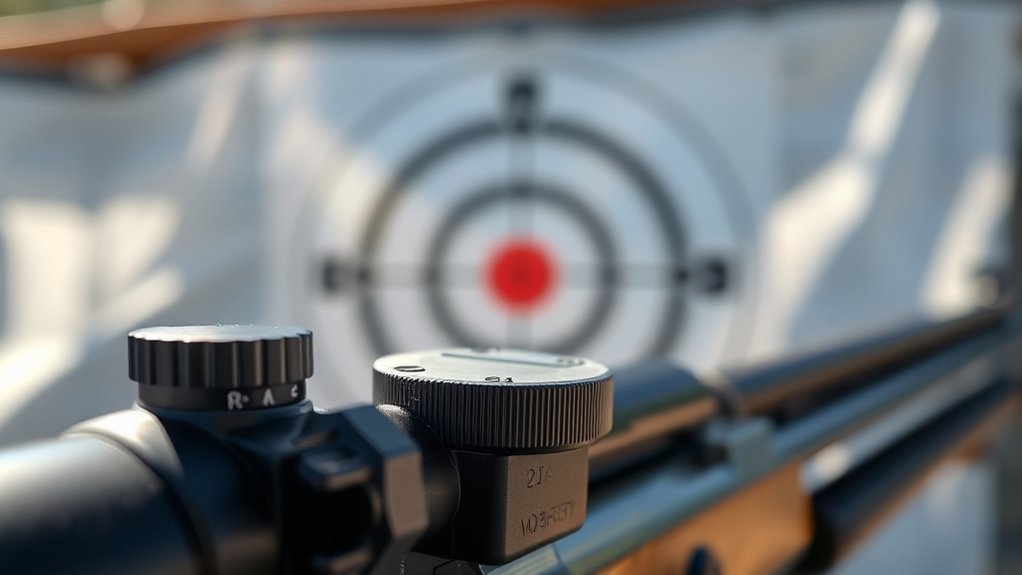
In a rifle scope, parallax can quietly cost you accuracy. Parallax is the apparent shift of the reticle on the target as you move your head or eye position behind the scope. This effect is easier to notice at longer ranges and higher magnifications. Many modern rifle scopes include parallax adjustment, so you can align the reticle with the target at a chosen distance and maintain more consistent precision from different shooting positions.
How parallax affects accuracy
Parallax happens when the reticle and the target image are not in the same focal plane, which can create a small aiming error if your eye position shifts. This becomes more noticeable as distance and magnification increase. To keep your aiming point consistent, it helps to adjust your scope’s parallax to match your shooting distance whenever your optic allows it.
Definition of parallax
Parallax in a rifle scope describes what happens when the reticle and the target do not line up perfectly because your eye is not centered behind the optic. As you move your head, the reticle appears to float over the target instead of staying locked in place. That apparent movement is parallax error, and it can shift your point of impact.
Impact on shooting
Even a small amount of parallax can affect accuracy when you are aiming through a scope. If your eye position changes from shot to shot, the reticle may not truly mark the same point on the target, leading to vertical or horizontal stringing at longer ranges. Higher magnification tends to magnify these errors, so consistent eye alignment becomes more important as you dial up the power.
Adjusting for parallax
To reduce parallax, start by locating the parallax or side-focus setting on your scope, usually marked in yards or meters. Aim at your target from a stable rest and slowly rotate the adjustment until the reticle appears to stay fixed on the target as you gently move your head. When the reticle no longer seems to shift, parallax is minimized for that distance.
The relationship between distance and parallax
As you increase the distance to your target, parallax becomes more noticeable and can have a bigger effect on where your shots land. A small misalignment between your line of sight and the scope’s optical axis may not matter much at close range, but at longer distances it can move your impact noticeably away from the intended point of aim. Matching your parallax setting to your approximate shooting distance helps keep longer-range groups tight.
Types of parallax adjustments in scopes
When choosing a rifle scope, it helps to understand the different ways manufacturers handle parallax. Some scopes use a fixed parallax setting for a specific distance, while others give you adjustable controls such as an adjustable objective ring on the bell or a side-focus knob near the turrets.
Fixed parallax settings
While many shooters appreciate the versatility of adjustable parallax settings, fixed-parallax scopes offer a straightforward option for those who prefer simple controls. These scopes are designed to be effectively parallax-free at a specific distance—often around 100 or 150 yards for centerfire hunting scopes, and closer, often 50 to 75 yards, for rimfire or air-rifle models. [SOURCE NEEDED] As long as you maintain proper eye relief and shoot near that distance, the reticle will stay closely aligned with the target without extra adjustments. Accuracy may drop slightly at ranges that are very different from the fixed setting, especially at high magnification.
Adjustable parallax features
Adjustable parallax features in rifle scopes provide the flexibility needed for varying shooting distances and conditions. These features typically include a tactile knob or dial that allows you to fine-tune the parallax setting based on the target distance. By adjusting the parallax, you help ensure that the reticle remains on target even if your eye is not perfectly centered behind the scope. Many adjustable scopes cover close distances out to “infinity,” but the exact range depends on the model.
Side focus mechanism
A side focus mechanism is one of the most popular types of parallax adjustments found in modern rifle scopes. This system lets you adjust parallax without moving your head much, which helps you stay comfortable and maintain your position. You will typically find the adjustment knob located on the side of the scope, making it easy to access while keeping your shooting position. By turning the knob, you can fine-tune the setting for various target distances, effectively minimizing parallax error. This is especially helpful when you are shooting small targets or using higher magnification, where tiny misalignments can show up on paper.
Identifying parallax issues while shooting
Understanding how to spot parallax while shooting helps you stay accurate. As you look through your scope, watch how the reticle behaves against the target. If it seems to move as your head moves, you are likely seeing parallax error. To test this, position your rifle on a stable rest, keep it pointed in a safe direction, and focus on a fixed target. Move your head slightly up, down, left, and right without moving the rifle. If the reticle appears to drift, adjust the parallax setting on your scope until the reticle remains aligned with the target. Also verify your eye relief and cheek weld are consistent; variations can make parallax easier to trigger and lead to missed shots.
The importance of parallax-free scopes
Scopes marketed as “parallax-free” are designed to reduce the effects of parallax and make aiming more forgiving. Within their intended distance, the reticle should stay essentially aligned with the target even if your eye position is not perfect. This helps reduce the gap between where you think you are aiming and where the bullet actually lands. A low-parallax design can also help in faster or higher-pressure moments because you are not constantly chasing a perfect sight picture. Keep in mind, however, that most optics are only truly parallax-free at one specific distance (or a limited range), so good eye position still matters.
Tips for minimizing parallax errors
To minimize parallax errors effectively, start by ensuring that your scope is properly mounted and aligned according to the manufacturer’s instructions. Regularly check your setup so the reticle is sharp to your eye, and pay attention to head position and cheek weld. Use the following table as a guide for common practices:
| Tip | Description |
|---|---|
| Proper eye relief | Maintain the correct distance from the scope to see a full, clear image without shadows. |
| Parallax adjustment | Adjust the parallax setting for different distances so the reticle stays on target when your head moves slightly. |
| Consistent shooting position | Use the same stance and cheek weld on every shot to reduce variation in eye position. |
Additionally, practice shooting at various distances to understand how parallax affects your aim. The more familiar you are with your scope’s controls and behavior, the easier it becomes to spot and correct parallax errors. By applying these tips, you will improve your accuracy and overall shooting performance.
Choosing the right scope for your needs
How do you know which rifle scope is best suited for your shooting style and needs? Selecting the right scope involves considering several critical factors:
- Magnification: Choose a magnification range that matches your typical shooting distance. For close-range shooting, lower magnification is ideal, while long-range work benefits from higher power.
- Objective lens diameter: A larger objective lens allows more light into the scope, improving visibility in low-light conditions, though it can add weight and bulk.
- Reticle type: Decide between duplex, mil-dot, or illuminated reticles based on how you prefer to hold over, dial elevation, or acquire targets quickly.
- Parallax adjustment: If you often shoot at varying distances or beyond about 100 yards, a scope with adjustable parallax settings or side focus can improve consistency.
Glossary
- Parallax
- A shift in the apparent position of the reticle against the target when your eye moves off the optic’s center because the reticle and target are in different focal planes.
- Focal plane
- The position inside the scope where the image comes into focus. For parallax-free aiming, the target image and reticle should share the same focal plane.
- Eye relief
- The distance between your eye and the scope’s eyepiece that still shows a full, clear image without shadowing or vignetting.
- Parallax-free scope
- A scope designed or adjusted so that, at a specific distance (or limited range of distances), moving your eye slightly does not noticeably shift the reticle on the target.
Conclusion
In precision shooting, understanding rifle scope parallax is a practical way to gain more control over where your shots land. By recognizing how parallax works and using your scope’s adjustment features correctly, you can reduce avoidable aiming error and build greater confidence behind the rifle.
FAQs
Do I need to adjust parallax for every shot?
You do not need to touch the parallax knob between every shot if your target distance and magnification stay about the same. Set it for the distance you are shooting, then recheck only when you change range significantly.
At what distance does scope parallax matter most?
Parallax becomes more noticeable at longer distances and higher magnification, where a small error at the scope can move the impact noticeably on the target. At short range with low magnification, it usually has much less effect.
Is parallax the same thing as focus on a rifle scope?
No. Focus makes the target and reticle look sharp to your eye, while parallax adjustment aligns the target image with the reticle’s focal plane so the reticle does not appear to move when your head shifts.
What is a typical parallax setting for hunting scopes?
Many fixed-parallax hunting scopes are factory set around 100 or 150 yards for centerfire rifles, while rimfire or air-rifle scopes may be set closer, often around 50 to 75 yards. [SOURCE NEEDED]
How can I quickly check for parallax at the range?
Rest the rifle securely, aim at a small target, and move your head slightly up, down, left, and right without moving the rifle. If the reticle seems to slide over the target, adjust the parallax knob until that apparent movement disappears.
Can I ignore parallax if I only shoot at short range?
At close distances with low magnification, parallax error is usually small, so eye position and a stable shooting stance matter more. However, learning to set parallax correctly still builds good habits for any future longer-range shooting.
