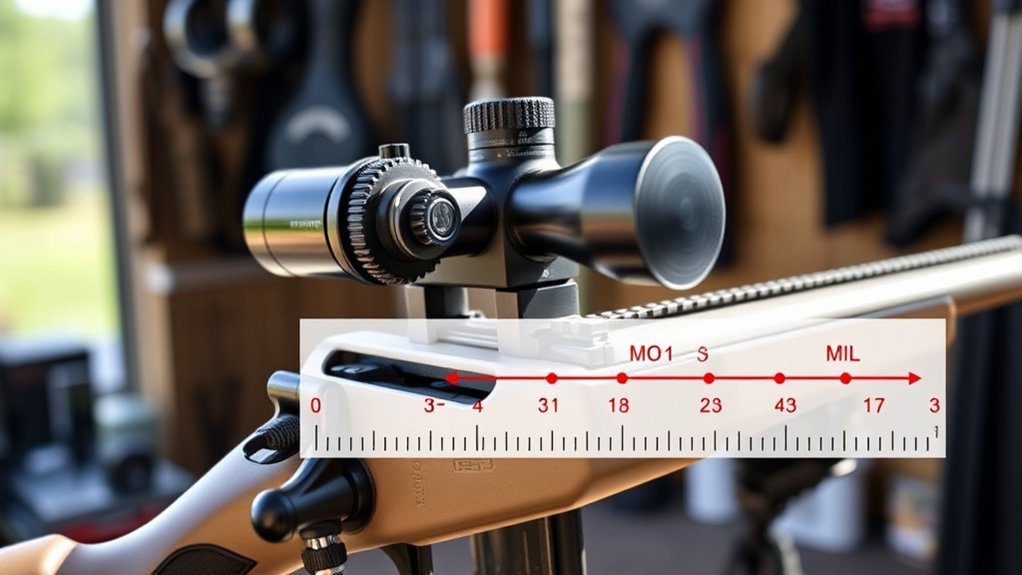
MOA and MIL are two angular measurement systems used for scope adjustments and reticle holds. Neither system is inherently more accurate. One MOA equals about 1.047 inches at 100 yards, while one MIL equals about 3.6 inches at 100 yards. Common MOA scopes use 1/4-MOA clicks, while common MIL scopes use 0.1-MIL clicks. The best choice is usually the system that keeps your reticle, turrets, ballistic data, and shooting partners using the same unit.
Last updated: September 11, 2026 — angular values, comparison logic, source references, focal-plane guidance, and FAQs were rechecked and updated.
Quick Answer
Choose MOA if you already use MOA equipment or prefer its common 1/4-MOA adjustment increments. Choose MIL if your optic, spotter, match environment, or ballistic data already use MILs. MIL works with yards or meters; it does not require metric distances. Neither system automatically produces better accuracy, so matching the reticle and turrets matters more than choosing one unit over the other.
Key Takeaways
- MOA and MIL are both angular measurements, so the physical distance represented by either unit grows as range increases.
- One MOA equals about 1.047 inches at 100 yards; one MIL equals about 3.6 inches at 100 yards.
- A common 1/4-MOA click moves about 0.26 inches at 100 yards; a common 0.1-MIL click moves about 0.36 inches.
- MIL is an angular system, not a metric-only system. You can use MILs while measuring target distance in yards.
- For the cleanest workflow, use the same measurement system in your reticle, turrets, ballistic data, and range notes.
MOA vs MIL at a Glance
| Feature | MOA | MIL |
|---|---|---|
| Angular definition | 1/60 of one degree | 0.001 radian |
| Value at 100 yards | ~1.047 inches | ~3.6 inches |
| Common turret increment | 1/4 MOA | 0.1 MIL |
| Common click movement at 100 yards | ~0.26 inches | ~0.36 inches |
| Often feels natural for | Shooters already using inch/yard-based MOA data | Shooters using decimal holds, spotter calls, or MIL-based competition data |
| Most important rule | Match MOA reticle with MOA turrets | Match MIL reticle with MIL turrets |
Understanding MOA: Definition and Basics
Minute of Angle, or MOA, is an angular measurement, not a fixed inch value. One MOA equals 1/60th of one degree and translates to approximately 1.047 inches at 100 yards. Many shooters round that to “about 1 inch at 100 yards” for quick field math, but the exact value becomes more noticeable as distance increases. The NSSF MOA guide also explains how MOA scales with target distance.
A scope may use 1/4-MOA clicks, although adjustment increments vary by model. With a 1/4-MOA turret, one click moves the point of impact about 0.26 inches at 100 yards. At 200 yards, that same click represents about 0.52 inches. At 300 yards, it represents about 0.78 inches.
For example, a 3 MOA angular correction at 300 yards represents roughly 9.42 inches because one MOA at that distance is about 3.141 inches. Knowing the relationship between MOA and distance also makes it easier to understand shooting skills and how angular measurements appear on different targets.
Understanding MIL: Definition and Basics
MIL, also written as milliradian or MRAD, is another angular unit. One milliradian equals 0.001 radian. In practical scope terms, one MIL subtends approximately 3.6 inches at 100 yards or 10 centimeters at 100 meters.
MIL does not require metric distances. The same angular system works whether your range is listed in yards or meters. At 1,000 meters, one MIL corresponds to one meter; at 500 meters, one MIL corresponds to 0.5 meter. At 100 yards, the same one-MIL angle corresponds to about 3.6 inches.
Many MIL-based scopes use 0.1-MIL turret clicks, although the exact adjustment value depends on the optic. A 0.1-MIL click represents about 0.36 inches at 100 yards. MIL reticles also commonly show full- and partial-MIL hash marks, allowing a correction observed in the reticle to be expressed in the same unit used by a matching MIL turret.
The Mathematical Difference Between MOA and MIL

MOA is based on degrees: one MOA equals 1/60th of one degree, or about 0.0167 degree. MIL is based on radians: one milliradian equals about 0.0573 degree. The NRA Shooting Illustrated explanation of MIL and MOA gives the same core angular relationships and conversion values.
At 100 yards, one MOA equals about 1.047 inches and one MIL equals about 3.6 inches. That difference in unit size does not make MIL less precise or MOA inherently more accurate. A common 1/4-MOA turret does have a smaller adjustment step than a common 0.1-MIL turret, but actual scope performance also depends on tracking accuracy, repeatability, calibration, zero, ammunition, rifle performance, and shooter consistency.
| Measurement | Angular Value | At 100 Yards | Common Turret Step |
|---|---|---|---|
| MOA | 1/60° | ~1.047 inches | 1/4 MOA (~0.26 inches) |
| MIL | 0.001 radian (~0.0573°) | ~3.6 inches | 0.1 MIL (~0.36 inches) |
Note: MOA and MIL both measure angle. Their inch or centimeter equivalents change with distance, so do not treat either unit as a fixed linear measurement.
How MOA Adjustments Work in Shooting
MOA adjustments scale with range. You first determine the distance to the target and the amount of correction, then express that correction as an angular value that matches the optic.
For example, at 200 yards, one MOA represents about 2.094 inches. A correction of roughly 2 inches therefore corresponds to about one MOA. On a scope with 1/4-MOA adjustments, one MOA equals four clicks.
The basic relationship is:
- MOA correction = inches of correction ÷ inches represented by one MOA at that distance.
- Inches per true MOA = 1.047 × distance in yards ÷ 100.
A 1/4-MOA click represents about 0.26 inches at 100 yards, 0.52 inches at 200 yards, and 1.05 inches at 400 yards. When establishing a baseline optic setting, it also helps to understand what zeroing a rifle means before interpreting later corrections.
How MIL Adjustments Work in Shooting
MIL adjustments are easiest to use when the reticle, turrets, and ballistic data all use MILs. That lets a correction observed through the reticle be expressed in the same unit used by the turret, without an MOA-to-MIL conversion.
For example, if an observed offset is 0.4 MIL, a common 0.1-MIL turret represents that angular amount in four clicks. The important idea is not the number of clicks itself but keeping the observation and adjustment in the same measurement system.
Understanding Milliradian Basics
| MIL Adjustment | Angle in Degrees |
|---|---|
| 1 MIL | 0.0573° |
| 2 MIL | 0.1146° |
| 3 MIL | 0.1719° |
One MIL at 100 meters represents approximately 10 centimeters, while one MIL at 100 yards represents about 3.6 inches. The angle itself does not change; only the physical distance covered by that angle changes with range.
Calculating Elevation and Windage
Elevation and windage corrections should come from verified ballistic data, observed impacts, or a properly configured ballistic tool rather than a fixed universal rule. Each MIL represents 1/1000 of the distance to the target, so its physical equivalent scales directly with range.
Wind drift varies with cartridge, bullet ballistic coefficient, muzzle velocity, atmospheric conditions, and wind direction. That is why a fixed rule such as “a certain wind speed always equals a certain MIL correction” is unreliable across different rifles and conditions. Verified range data and a suitable ballistic solver provide a more repeatable reference.
Pro Tip: Keep your reticle and turrets in the same system. A MIL reticle with MOA turrets, or the reverse, adds a conversion step every time you translate an observed correction.
Pros and Cons of Using MOA
MOA is familiar to many shooters who already use yards, inches, and 1/4-MOA scope adjustments. At 100 yards, one MOA is close to one inch, so the relationship can feel intuitive when using inch-based targets.
A typical 1/4-MOA turret also provides a slightly smaller angular adjustment step than a typical 0.1-MIL turret. That is a difference in adjustment resolution, not proof that an MOA optic will track more accurately or produce smaller groups.
The main drawback is workflow. Exact true MOA is 1.047 inches at 100 yards rather than exactly one inch, and repeated conversions become cumbersome if your reticle, spotter, or ballistic data use MILs.
Pros and Cons of Using MIL
MIL offers decimal-style corrections and a simple relationship between the angular unit and distance. It is also common in modern long-range competition environments, which can simplify communication when several shooters or spotters use the same system.
Precision and Accuracy
MIL does not automatically make a rifle or scope more accurate. A common 0.1-MIL turret moves in larger angular steps than a common 1/4-MOA turret, but adjustment resolution is only one part of the system.
Real performance depends on factors such as optic tracking and repeatability, reticle calibration, rifle and ammunition consistency, zero quality, environmental conditions, and shooter skill. The practical benefit of MIL is usually workflow efficiency rather than an inherent accuracy advantage.
Learning Curve Challenges
The main challenge with MIL adjustments is familiarity. Shooters accustomed to MOA may initially keep translating MIL values back into inches or MOA, which defeats much of the system’s simplicity.
MIL does not require thinking in meters. Once you learn to read a MIL reticle and use matching MIL turrets, the correction can stay in MILs from observation to adjustment. Repeated use of one system is usually easier than switching back and forth.
When to Use MOA vs. MIL
Use MOA when your existing scope, reticle, ballistic records, and shooting habits already use MOA. It is also a practical fit for shooters who are comfortable with common 1/4-MOA adjustments and do not need to translate data from MIL-based partners or equipment.
Use MIL when your optic ecosystem, spotter, training group, or competition environment uses MIL. A Precision Rifle Blog survey of the top 200 ranked PRS shooters, published in 2025 from the 2024 season, described mrad/MIL-based scopes as almost universal among that group. That does not make MIL inherently superior; it shows the communication advantage of using the same system as the people around you.
The most important rule is consistency. Keep the scope turrets, reticle, ballistic app, range card, and practice notes in one angular system whenever possible.
Real-World Applications of MOA and MIL Adjustments
Neither MOA nor MIL owns a particular shooting distance. Both can be used for short-, medium-, and long-range precision work. The cleaner choice comes from the rest of your equipment and workflow.
| Scenario | Usually the Cleaner Choice | Why |
|---|---|---|
| Existing MOA scope and records | MOA | Avoids replacing or converting an established system |
| Existing MIL scope and records | MIL | Keeps observed holds and turret corrections in the same unit |
| PRS-style group or MIL-using spotter | MIL | Makes shared correction calls easier to communicate |
| Shooter already fluent in MOA | MOA | Existing familiarity may matter more than changing systems |
| Choosing between two otherwise comparable optics | Either | Prioritize matched turrets/reticle, tracking, reticle design, and the system used by your data and shooting partners |
MOA and MIL are therefore better viewed as two angular languages rather than tools for different distances. A shooter who understands one system thoroughly and keeps the entire optic workflow consistent avoids unnecessary conversion errors.
Warning: Always follow local laws, range rules, and standard firearms safety practices. Keep the firearm pointed in a safe direction, confirm your target and backstop, and use proper eye and ear protection.
Common MOA and MIL Mistakes to Avoid
The first mistake is treating MOA or MIL as fixed inch values. One MOA is about 1.047 inches at 100 yards but about 5.235 inches at 500 yards. One MIL is about 3.6 inches at 100 yards but about 18 inches at 500 yards.
The second mistake is mixing reticle and turret systems. A MIL reticle and MOA turret can still function, but observed values must be converted before dialing. A matched system removes that extra step.
The third mistake is treating rounded “one inch per 100 yards” MOA math as exact at every distance. The rounded rule is convenient for quick estimates, while true MOA is about 1.047 inches per 100 yards.
The fourth mistake is relying on unverified ballistic data. Manufacturer velocity figures, generic charts, and app defaults are starting points. Real-world zero and ballistic data should be confirmed under safe range conditions before being relied on.
Simple Conversion Rules for MOA and MIL
Constant conversion should not be necessary when the optic system is matched, but conversion values are useful when comparing data. One MIL equals about 3.438 MOA, while one MOA equals about 0.291 MIL.
- MIL to MOA: multiply MIL by approximately 3.438.
- MOA to MIL: multiply MOA by approximately 0.291.
- Quick comparison: 1 MIL is about 3.5 MOA.
For comparison, 2 MIL equals about 6.88 MOA, while 10 MOA equals about 2.91 MIL. A matched reticle and turret system is still simpler than making these conversions during normal use.
Does Focal Plane Change MOA or MIL Reticle Values?
Focal plane affects how reticle subtensions behave as magnification changes. In a first focal plane (FFP) scope, the apparent reticle size changes with magnification, so its MOA or MIL subtensions remain proportional to the target throughout the magnification range.
In a second focal plane (SFP) scope, the reticle appears the same size as magnification changes. Ranging or holdover subtensions are therefore normally accurate only at the magnification specified by the scope manufacturer. The exact calibration point varies by optic, so check the manual rather than assuming it is always maximum power.
This focal-plane choice is separate from the MOA-versus-MIL decision. Both measurement systems can be used in FFP or SFP optics. If you rely heavily on reticle holds at changing magnification, focal-plane behavior can matter as much as the unit printed on the turret.
Choosing the Right System for Your Scope
Start with the optic itself. A clean setup pairs MOA turrets with an MOA reticle or MIL turrets with a MIL reticle. If you are still comparing designs, see the guide to choosing reticle types before focusing only on the unit name.
Next, consider the system around the scope. If your established data, targets, and notes use MOA, staying with MOA may be simplest. If the people you shoot with, your competition environment, or your existing data use MIL, matching that ecosystem can reduce conversions.
Also consider other optic factors independently of the measurement unit. Reliable tracking, usable elevation range, reticle design, zero-stop operation, focal plane, and parallax behavior can influence practical scope use more than the MOA-or-MIL label by itself.
Finally, choose one system for your main setup and use it consistently. Familiarity with one coherent system is usually more valuable than repeatedly switching because one unit appears theoretically better.
MOA vs MIL FAQ
Is MIL or MOA more accurate?
Neither is inherently more accurate. A common 1/4-MOA turret has a smaller adjustment step than a common 0.1-MIL turret, but real accuracy also depends on optic tracking, calibration, rifle and ammunition consistency, environmental conditions, and shooter performance.
Which is better for long-range shooting, MOA or MIL?
Either system can work at long range. MIL is common in modern PRS-style competition and group communication, while MOA remains effective for shooters who already use MOA-based optics and data. Matching your reticle, turrets, ballistic data, and shooting partners is more important than distance alone.
How many MOA are in one MIL?
One MIL equals approximately 3.438 MOA. In the other direction, one MOA equals approximately 0.291 MIL.
Can you use a MIL reticle with MOA turrets?
Yes, but it adds conversion work. If a correction is observed in MIL through the reticle and the turret adjusts in MOA, the value must be translated before dialing. A matched reticle and turret system is simpler.
Does MIL only work with metric distances?
No. MIL is an angular measurement, so it works with yards, meters, inches, centimeters, or other consistent distance units. Many shooters use MIL-based scopes while their target distances are still given in yards.
Conclusion
MOA and MIL are two ways to express angular correction, not competing levels of accuracy. MOA may feel more familiar if you already use MOA optics and inch/yard-based records. MIL offers decimal-style corrections and is common in modern precision-rifle competition and spotter communication.
If you already own a matched optic, there is usually little reason to change systems solely because another unit is popular. If you are buying a new scope, compare the reticle, turrets, focal plane, tracking, adjustment range, and the measurement system used by your data and shooting partners. Then choose one system and stay consistent with it.
Sources
- NSSF: Minute of Angle (MOA) — explains MOA scaling, correction calculations, and common turret increments.
- NRA Shooting Illustrated: Mil, MOA or Inches? — supports true-MOA values, MIL values, conversions, and focal-plane context.
- Precision Rifle Blog: Best Rifle Scope for Long Range Precision Shooting — What the Pros Use — reports optic and MIL/MRAD usage among surveyed top-ranked PRS competitors.
- Precision Rifle Blog: Best Rifle Scope — What the Pros Use (2026) — provides updated 2026 context on scopes and MIL reticles used by leading PRS competitors.
- Backfire: Wind Deflection — supports the point that wind drift varies with projectile, velocity, and environmental conditions.