How Much Do Fishing Boats Cost in 2026?
Fishing boat prices currently stretch from roughly $3,000–$5,000 for a small bare utility hull to more than $1 million for a large premium offshore boat. A fishing-ready new setup usually costs much more than a bare hull because the engine, trailer, batteries, electronics, trolling motor, rigging, freight, dealer preparation, taxes, and registration can all change the final number.
A practical way to compare boats is to ignore the headline price until you know exactly what it includes. Compare the complete boat-motor-trailer package, then add the equipment you need on day one and the ownership costs you will face after the purchase.
Last updated: September 11, 2026. Pricing and market examples were refreshed using current manufacturer, dealer-inventory, NMMA, BoatUS, and U.S. Coast Guard information.
Quick Answer
A small bare fishing-boat hull can start in the low thousands, while a new fishing-ready aluminum, bass, bay, pontoon, or personal-watercraft setup commonly moves into the five-figure range. Large offshore boats can reach six figures or even more than $1 million. The number that matters is the complete out-the-door package, not the advertised base price.
Key Takeaways
- A bare-hull price is not comparable with a fishing-ready boat-and-motor package.
- Boat type, size, engine power, trailer, electronics, batteries, and fishing equipment create the biggest price differences.
- MSRP is only a starting point; freight, preparation, options, taxes, registration, and local dealer pricing affect the final total.
- Used boats can reduce the upfront cost, but condition, service history, engine health, trailer condition, and electronics deserve careful inspection.
- Set three budgets before shopping: your purchase ceiling, your day-one setup budget, and your annual ownership budget.
Fishing Boat Prices at a Glance
The examples below show why there is no single “average fishing boat price.” They represent different types of craft and different levels of equipment. Prices were checked on September 11, 2026 and can change with model year, configuration, dealer, location, freight, preparation, taxes, and registration.
| Current Example | Category | Advertised Price | What the Number Represents |
|---|---|---|---|
| 2027 G3 Guide V14 | Small aluminum utility/fishing hull | Starting at $3,424 | A basic hull-level starting point; engine, trailer, rigging, and options can raise the package price. |
| 2026 Sea-Doo FishPro Scout | Fishing personal watercraft | Starting at $15,849 | Manufacturer starting MSRP; transportation and preparation are not included. |
| 2027 G3 Sportsman 1610 | Aluminum freshwater fishing boat | Starting at $22,225 | Manufacturer starting price for a more complete fishing-boat platform. |
| 2026 Xpress H20B Hyper-Lift Bay | Aluminum bay boat | $35,495 with Yamaha VF115LB | A boat-and-engine package; optional equipment can increase the final price. |
| 2026 Boston Whaler 365 Conquest | Premium offshore fishing/cabin boat | About $1.09 million dealer-listed base MSRP | Large premium offshore platform; selected options can move the final price higher. |
Price-comparison rule: compare the boat, engine, trailer, factory options, installed electronics, batteries, trolling motor, freight, preparation, taxes, and registration together. Two boats with similar advertised prices may have very different out-the-door totals.
Understanding MSRP
MSRP means Manufacturer’s Suggested Retail Price. It is useful as a starting point, but it is not automatically the amount you will pay to take the boat home.
The final selling price can change when freight, dealer preparation, rigging, documentation fees, engine choices, electronics, trailer options, taxes, and registration are added. Dealer discounts or incentives can lower the number, while high-demand configurations or added equipment can push it higher.
Manufacturers also price boats differently. One advertised figure may represent little more than the hull. Another may include an outboard and trailer. A third may include batteries, trolling motor, fish finder, livewell equipment, or other fishing features.
Before comparing two boats by MSRP, request an itemized quote showing exactly what is included. That gives you an apples-to-apples comparison instead of comparing two headline prices that represent different packages.
The Type of Boat Matters

Boat type is one of the strongest price drivers because different fishing environments require different hulls, power, range, capacity, and equipment.
Small jon boats and utility aluminum boats sit near the lower end. They are light, simple, easy to tow, and useful on protected lakes, rivers, ponds, and backwaters. Remember that a low advertised hull price may not include the engine or trailer.
Aluminum freshwater and bass boats cost more as you add larger outboards, casting decks, rod lockers, livewells, trolling motors, fish finders, batteries, and purpose-built trailers.
Fishing pontoons trade some sport-fishing specialization for seating, stability, and family space. Their prices vary widely with length, engine size, flooring, electronics, fishing stations, shade, seating, and entertainment features.
Do not compare boat types by price alone. Compare the water they can safely handle, the complete equipment package, towing requirements, passenger needs, and the type of fishing you actually do.
Bay boats and center consoles move further up the range because buyers often need more power, fuel capacity, deck space, navigation equipment, and saltwater-ready construction.
Large offshore fishing boats sit at the top because they may require multiple high-output engines, large fuel systems, stronger hulls, radar, advanced navigation electronics, cabins, generators, safety systems, refrigeration, and more complex maintenance.
Where You Live Can Impact the Price

Your location affects both the purchase price and the long-term cost of owning a fishing boat. Dealer competition, transportation distance, taxes, registration, marina prices, storage, service labor, and seasonal demand all vary by region.
A boat that looks cheaper several states away may stop being a bargain after you include delivery, travel, inspection, registration differences, or the cost of returning to that dealer for warranty work.
Storage can also change the budget dramatically. A trailerable boat stored at home may have relatively low storage costs, while a marina slip, dry-stack facility, or indoor winter storage adds a recurring bill.
Instead of asking only which dealer advertises the lowest number, compare the complete out-the-door price and the service options available near where you live and boat.
Upgrades and Options Add Up Quickly

A base boat can move into a much higher price tier once it is configured for your fishing style. This is why the lowest advertised price should not automatically become your shopping budget.
Upgrades are valuable when they solve a real fishing or safety need. They are expensive when you pay for features you rarely use.
Common upgrades that can increase your final cost include:
- Higher-horsepower or premium outboard packages.
- Fish finders, GPS mapping, side imaging, radar, and networked displays.
- Trolling motors, lithium batteries, onboard chargers, and upgraded wiring.
- Livewells, baitwells, rod storage, tackle systems, washdowns, and deck lighting.
- Premium seating, flooring, shade, covers, and weather protection.
- Trailer brakes, spare tires, upgraded tires, bunks, winches, and swing-away tongues.
Separate your options into three groups: required on day one, useful later, and purely optional. Put safety, reliable power, the correct trailer, navigation needs, and the fishing equipment essential to your normal trips in the first group.
Pro Tip: Ask the dealer for two numbers: the base configuration and the exact fishing-ready configuration you intend to buy. The difference shows what your upgrades are really costing.
[Amazon Products Picked for You]

Clear Vu scanning Sonar shows you more of what is in the water around your boat; This high frequency sonar gives near photographic images with detailed representations of objects, structure and fish

✦ Fish Finder and Depth Finder : It is a portable fish finder that could display approximate fish location and water depth. The sonar transducer can be attached to the hull of kayak or boat in order to understand the changing of water depth when you are moving by. The water depth detection range is between 3ft(1m) and 328ft (100m) when the transducer is completely immersed in the water.

The Economy and Market Conditions

Financing conditions, consumer demand, dealer inventory, and the broader economy can affect both prices and negotiating room.
The National Marine Manufacturers Association reported in July 2026 that U.S. new powerboat retail unit sales were down 7.1% on a rolling 12-month basis through April 2026. Freshwater fishing boats were more resilient, posting a slight 0.4% year-over-year increase over the same period.
That mixed market matters to buyers. Softer overall demand can improve your negotiating position on some inventory, but popular fishing models or specific engine packages may remain firm if local supply is tight.
Interest rates matter too because a lower advertised boat price can still become expensive when financed over a long term. Compare the amount financed, APR, loan term, down payment, fees, and total interest—not only the monthly payment.
Shop multiple dealers, compare inventory, and avoid assuming that a temporary payment promotion represents the lowest total cost.
[Amazon Products Picked for You]

1. Floating Design Creates a Unique Aquarium Scene: Transform your aquarium with this floating aquarium decor featuring a detailed fishing boat, fisherman figure and realistic nautical design. Unlike traditional decorations, this floating fish tank decor creates a beautiful water surface focal point while adding storytelling charm to freshwater environments


Features That Influence Pricing
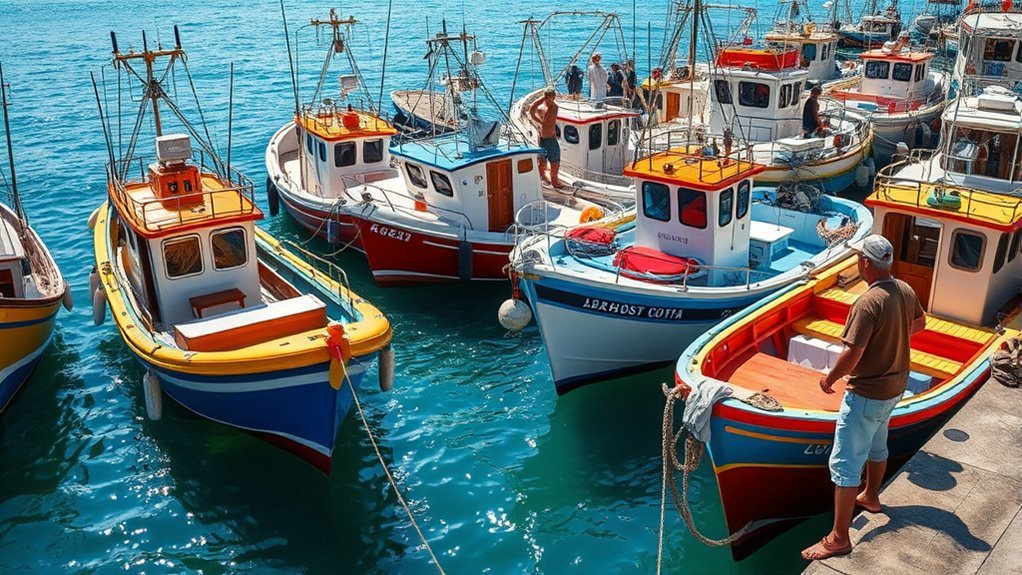
Two fishing boats of similar length can have very different prices because the hull, engine, trailer, electronics, and fishing systems may be completely different.
The biggest pricing factors include:
- Hull construction and material, including aluminum and fiberglass.
- Length, beam, weight, passenger capacity, and offshore capability.
- Engine brand, horsepower, controls, steering, and rigging.
- Fuel capacity and range.
- Livewells, bait stations, casting decks, rod storage, and tackle storage.
- GPS, sonar, side imaging, radar, networking, and touchscreen displays.
- Trolling motor and battery system.
- Seats, flooring, shade, cabin space, and other comfort features.
- Trailer construction, brakes, tires, lights, bunks, and winch.
- Warranty terms, dealer support, and access to qualified service.
Pay extra for features that solve a real need. Offshore anglers may reasonably prioritize fuel range, navigation, communication, weather protection, and seaworthiness. A lake angler may receive more value from a trolling motor, sonar, livewell, and organized rod storage.
[Amazon Products Picked for You]

JUST TWO INGREDIENTS: We use only sea salt and black anchovies caught off of the crystal clear waters of Vietnam’s Phú Quốc archipelago

🍂🍂Keep Dry and Comfortable: The men's deck boots are made from durable neoprene and soft rubber, providing 100% waterproof protection and resistance to seawater, salt, acid, and alkali. The breathable lining and dual-density neoprene keeps feet cool, dry, and comfortable all-day. FIT WARNING: This style runs small. We recommend ordering **ONE SIZE UP** from your usual size.

Comparing Different Boat Models
Use current model prices as market anchors, not as a ranking of the “best” boats. The examples in this guide have not been presented as hands-on tests. Their purpose is to show how quickly prices change as you move from a bare aluminum hull to a fishing personal watercraft, a packaged freshwater boat, a bay boat, and a premium offshore platform.
For example, G3 currently lists a 2027 Guide V14 at $3,424, but that is a basic utility-boat starting point rather than a fully rigged fishing package. Its 2027 Sportsman 1610 starts at $22,225 and represents a much more complete freshwater fishing platform.
Sea-Doo lists the 2026 FishPro Scout at $15,849, while its 2026 FishPro Sport starts at $18,149 and the FishPro Trophy at $22,649. Transportation and preparation are additional.
Xpress lists its 2026 H20B Hyper-Lift Bay package with a Yamaha VF115LB at $35,495. At the other end of the market, a 2026 Boston Whaler 365 Conquest can be advertised at more than $1 million before selected options.
These examples show why a single “average” number can mislead you. Compare boats within the same use case and equipment level, then obtain current local quotes before making a decision.
New vs. Used Fishing Boats
New and used fishing boats solve different budget problems. A new boat gives you a known ownership starting point, current equipment choices, warranty coverage, and easier package configuration. A used boat can lower the upfront cost or let the same budget reach a larger or better-equipped model.
The used market is not a small niche. NMMA reported that pre-owned boats represented 79.7% of U.S. boat unit sales in 2025.
A used boat may also include expensive equipment such as a trolling motor, fish finders, batteries, cover, or upgraded trailer. Those additions only have real value if they work properly and fit your needs.
Inspect the hull, transom, engine, engine hours where available, service records, steering, fuel system, wiring, batteries, electronics, bilge pump, livewell, trailer frame, bearings, brakes, tires, lights, bunks, winch, and paperwork.
BoatUS describes a marine survey as the boat equivalent of a home inspection and appraisal. For a larger, more complex, or higher-value used boat, an independent survey and appropriate mechanical inspection can reveal issues that cosmetics alone will not show.
Warning: A clean interior does not prove that a used boat is mechanically sound. Engine problems, previous hull repairs, corrosion, damaged wiring, weak batteries, trailer faults, or neglected maintenance can turn a low purchase price into an expensive project.
Hidden Costs of Owning a Fishing Boat
The purchase price is only the first part of your boat budget. Before you buy, estimate the costs you will face during the first year and every year after that.
Common ownership costs include:
- Sales tax, title, registration, and local permits.
- Insurance and any lender-required coverage.
- Fuel, oil, filters, batteries, and routine engine service.
- Trailer tires, wheel bearings, brakes, lights, bunks, and winch repairs.
- Marina slips, dry-stack storage, trailer parking, or home-storage preparation.
- Winterization, shrink wrap, seasonal storage, and spring commissioning where applicable.
- Life jackets, fire extinguishers, anchors, lines, fenders, signaling equipment, and other safety gear.
- Electronics, fishing equipment, covers, cleaning supplies, and replacement accessories.
The U.S. Coast Guard generally requires a Coast Guard-approved wearable life jacket of the correct size for each person aboard a recreational vessel. Boats over 16 feet also generally need an approved throwable device, with specific exceptions. Check the requirements that apply to your boat and waters before launching.
Do not use a simple percentage of purchase price as your only ownership estimate. Storage, fuel use, engine size, local labor rates, climate, freshwater versus saltwater use, and how many hours you boat can make two owners of similarly priced boats spend very different amounts each year.
Tips for Budgeting Your Boat Purchase
A better boat budget uses three separate numbers instead of one.
- Purchase ceiling: the most you are willing to pay for the boat, motor, trailer, freight, preparation, taxes, and registration.
- Day-one setup budget: safety gear, electronics, batteries, trolling motor, cover, dock lines, anchor, fishing equipment, and any immediate trailer or storage needs.
- Annual ownership budget: insurance, fuel, storage, maintenance, seasonal service, registration, repairs, and replacement gear.
Once those three numbers are clear, use these shopping rules:
- Choose the water and fishing style before choosing the boat.
- Get itemized out-the-door quotes from multiple dealers.
- Compare the same engine horsepower and similar equipment packages.
- Confirm whether the trailer is included.
- Check insurance and storage costs before signing.
- Compare financing by total cost, not only monthly payment.
- Keep part of your available cash or credit capacity for repairs and upgrades after purchase.
A boat that consumes your entire available budget on purchase day may be harder to enjoy once fuel, service, storage, and unexpected repairs begin.
How to Choose the Right Fishing Boat for Your Budget
The best-value fishing boat is the smallest and simplest boat that safely handles your normal water, crew, fishing style, range, and equipment needs without creating an ownership budget you cannot comfortably support.
Start by answering these questions:
- Will you fish small lakes, large reservoirs, rivers, bays, nearshore water, or offshore?
- How many people will normally be aboard?
- How much fishing gear must the boat carry?
- Do you need a trailer, or will the boat stay in a marina or storage facility?
- Can your tow vehicle handle the complete loaded boat-and-trailer weight?
- Do you need shallow-water access, offshore range, family seating, or overnight accommodations?
- Which electronics and fishing systems are essential on day one?
- What can be added later without making the boat unusable now?
If you normally fish alone or with one partner on protected freshwater, a smaller aluminum boat may meet your needs without the expense of a larger platform. Family anglers may value extra beam, seating, storage, and stability. Offshore anglers must give much more weight to hull design, range, power, communications, navigation, weather protection, and safety.
Do not choose a boat only because your vehicle can technically tow its advertised dry weight. The trailer, engine, batteries, fuel, water, safety gear, fishing equipment, coolers, and accessories all add to the loaded trailer weight.
Leaving room below your maximum budget can make ownership easier because you still have money available for fuel, maintenance, storage, gear, and repairs.
Related Guides
Frequently Asked Questions
How much does a fishing boat cost?
Fishing boats span an unusually wide price range. Small bare aluminum utility hulls can start in the low thousands, while fishing-ready new boats commonly cost five figures. Large premium offshore boats can cost hundreds of thousands of dollars or more than $1 million. Always check what the advertised price includes before comparing models.
How much does a small fishing boat cost?
A small bare aluminum hull can cost only a few thousand dollars, but a fishing-ready package with an engine, trailer, batteries, trolling motor, electronics, rigging, freight, and dealer preparation can cost several times more. Compare complete packages rather than hull prices.
Is a used fishing boat cheaper than a new one?
A used fishing boat normally has a lower upfront price than a comparable new boat and may already include electronics or other upgrades. The trade-off is condition risk. Inspect the hull, engine, service history, wiring, electronics, batteries, trailer, and paperwork, and consider an independent marine survey for a larger or higher-value purchase.
How much does it cost to own a fishing boat each year?
There is no reliable single percentage that fits every owner. Annual costs can include insurance, fuel, storage, marina fees, registration, routine maintenance, winterization, trailer service, repairs, safety equipment, and fishing gear. Engine size, location, usage hours, storage method, and freshwater versus saltwater use all change the total.
Is it cheaper to buy a fishing boat in the off-season?
It can be. Dealers may discount leftover inventory or become more flexible when demand is slower, but the best timing depends on location, inventory, model popularity, manufacturer incentives, and financing conditions. Compare the full out-the-door price rather than the advertised discount.
What should I check before buying a used fishing boat?
Check the hull and transom, engine condition and service records, steering, fuel system, wiring, batteries, electronics, pumps, livewell, flooring, trailer frame, bearings, brakes, tires, lights, bunks, winch, title, and registration documents. Start the engine and arrange an appropriate sea trial or professional inspection when practical.
Conclusion
Fishing boat prices make more sense once you compare complete packages instead of headline MSRPs. A small bare hull can cost only a few thousand dollars, while a fishing-ready freshwater or bay boat quickly moves into five figures and a premium offshore boat can cost hundreds of thousands or more than $1 million.
Start with the water you fish, the people and gear you carry, your towing and storage limits, and the features you genuinely need. Then get itemized out-the-door quotes and build your purchase, day-one setup, and annual ownership budgets separately. The best boat is not the most equipment you can finance. It is the boat you can safely use, maintain, store, and enjoy without turning every fishing trip into a financial strain.