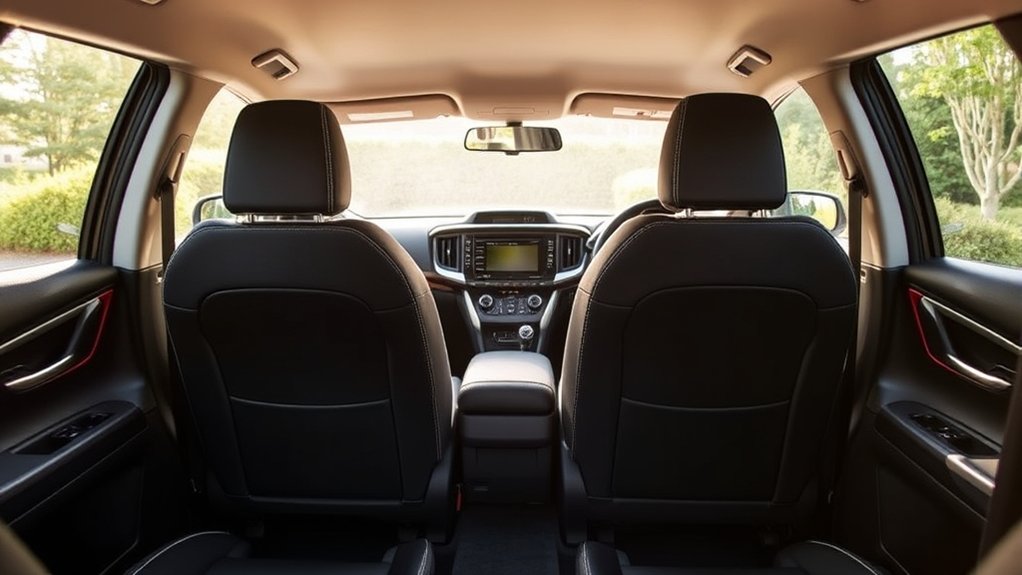
Most Toyota RAV4 models can hold two child car seats in the rear, but a safe fit depends on more than the number of seats. Your RAV4’s model year, each restraint’s width and rear-facing depth, the children’s sizes, and the installation method can all affect the final setup.
Last updated: July 15, 2026
Quick Answer
Yes. Most 2019 through 2025 Toyota RAV4s can hold two child restraints in the rear outboard seats. Comfort depends on each seat’s width and rear-facing depth, plus the front-seat position. The center position needs special care because its lower anchors may be borrowed from the outboard positions.
Key Takeaways
- Two restraints usually fit most easily in the rear outboard positions.
- The 2019 through 2025 U.S. RAV4 has two complete outboard LATCH positions and three rear tether anchors.
- The center position may borrow lower anchors, but borrowed anchors cannot also secure an adjacent outboard seat.
- A narrow seat is not automatically compatible. You still need to test recline, buckle access, front-seat space, and installation tightness.
- Always follow your exact Toyota manual and child-seat manual. A certified child passenger safety technician can check the final setup.
At a Glance
| Time Required | About 20 to 45 minutes for two seats |
| Difficulty | Moderate; seat shape and position can affect access |
| Tools Needed | Toyota owner’s manual, both child-seat manuals, and a flashlight |
| Cost | No installation cost; many professional inspection events are free |
Warning: This guide provides general information, not approval for a specific restraint or configuration. Your exact Toyota owner’s manual and child-seat instructions take priority. Do not use an installation method, anchor position, accessory, or seating arrangement that either manual prohibits.
Can the Toyota RAV4 Fit Two Car Seats Comfortably?
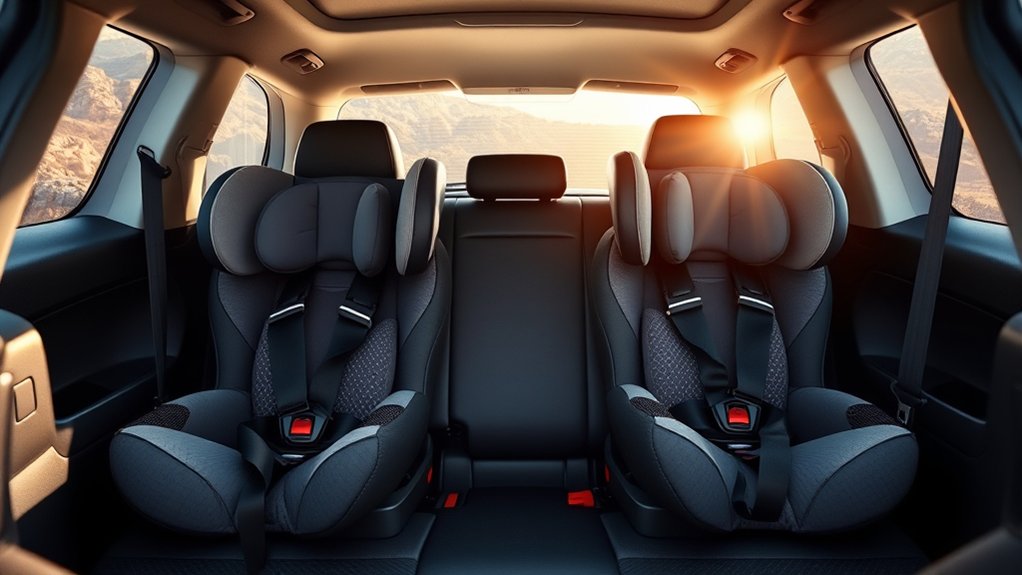
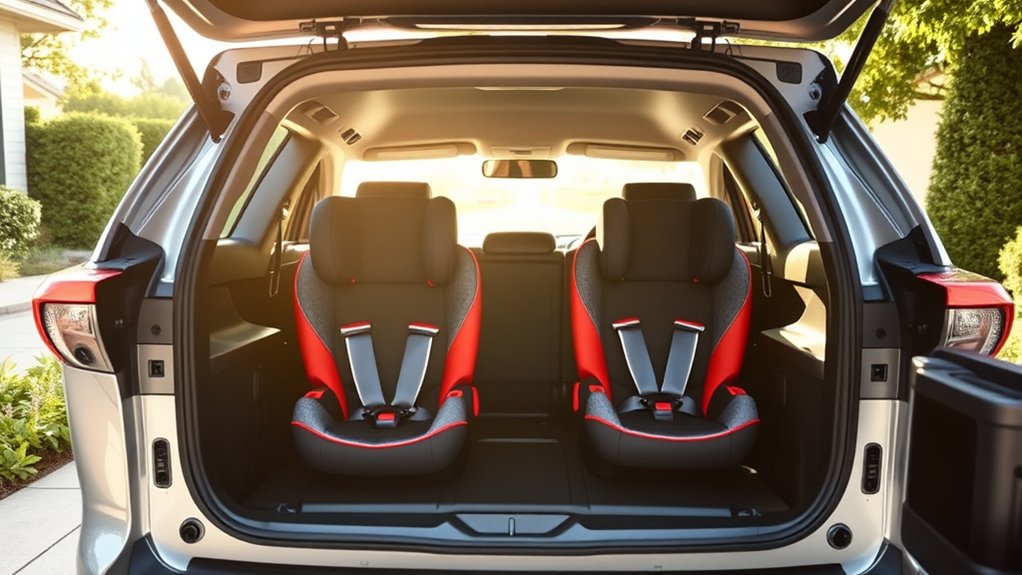
Yes, two child restraints can usually fit in a Toyota RAV4’s rear seat. The simplest arrangement is normally one restraint in each outboard position. This setup gives each seat access to a complete set of lower anchors in compatible model years and leaves the center position unused.
However, “fits” and “fits comfortably” are different standards. Two seats may install correctly while limiting front-passenger legroom, blocking a buckle, or leaving too little space for an adult in the center.
Two car seats can fit in a RAV4, but a safe fit is defined by correct installation and usable seating positions, not by the amount of empty space left over.
Rear-facing restraints create the greatest front-to-back challenge. A deep infant carrier or convertible seat may require the front passenger seat to move forward. The driver and front passenger must still be able to sit upright, maintain safe clearance from the dashboard and airbags, and use their seat belts correctly.
Before buying a second restraint, place both seats in the RAV4 and test the complete arrangement. Check the seats with their bases, required recline settings, anti-rebound bars, support legs, cup holders, and other approved components attached.
Understanding the Toyota RAV4’s LATCH System
LATCH stands for Lower Anchors and Tethers for Children. In markets that use different terminology, you may see related systems described as ISOFIX or LUAS. Hardware and installation rules can vary by country, so use the manual supplied with your exact vehicle.
According to the Insurance Institute for Highway Safety’s RAV4 evaluation, the U.S. 2019 through 2025 RAV4 has two rear seating positions with complete LATCH hardware. These are the driver-side and passenger-side outboard seats.
All three rear seating positions have tether anchors in the IIHS-tested configuration. The tether anchors are located on the seatbacks. Nearby hardware may look similar, so use the labeled anchor identified in your Toyota manual rather than attaching the tether to a cargo tie-down.
Outboard and Center Anchor Rules
The center rear position does not have an independent pair of lower anchors in the same way as the outboard positions. IIHS reports that it can borrow lower anchors from the adjacent positions in the tested 2019 through 2025 RAV4.
Borrowing those anchors changes what you can do with the neighboring seats. An anchor being used for a center installation is no longer available for its normal outboard position. Therefore, you generally cannot install one restraint in the center with borrowed anchors and another restraint on the affected outboard anchors.
A locked vehicle seat belt is often the more practical installation method for a center restraint. Use a center LATCH setup only when the Toyota manual and child-seat manual both permit the anchor spacing and installation.
Note: Do not attach one child restraint with both the lower anchors and vehicle seat belt unless both manufacturers explicitly allow that method. For a forward-facing seat, the top tether is used in addition to either approved installation method.
Lower-Anchor Weight Limits
Lower anchors do not have an unlimited capacity. NHTSA explains that the combined weight of the child and child restraint must not exceed 65 pounds unless the vehicle or restraint provides a lower limit.
Check the label and installation diagram on the child seat. Once your child exceeds the allowed lower-anchor weight, reinstall the restraint with the vehicle seat belt if the child seat permits it. Continue using the top tether with a forward-facing seat when both manuals allow it.
Evaluating Space for Infant Car Seats in the RAV4
Infant seats and rear-facing convertible seats usually create more front-to-back pressure than forward-facing restraints. Their required recline angle must be maintained, particularly for a newborn who needs adequate head and airway support.
Install each seat at the manufacturer’s required angle before judging the amount of space. An upright display model may look compact in a store but require much more room after its base and recline setting are configured correctly.
Car Seat Compatibility Options
The RAV4 supports seat-belt installation and lower-anchor installation in compatible positions. Neither method is automatically safer when used correctly. Choose the method that produces a tight, approved installation and keeps the other seating positions usable.
For two infant seats, begin by testing both outboard positions. Check these points:
- The carrier locks into and releases from its base without hitting the door, roof, or neighboring restraint.
- The front seats remain in a safe and usable position.
- The child seat maintains its required recline angle.
- The vehicle belt or lower-anchor strap follows the correct rear-facing belt path.
- A support leg rests only on an approved floor location.
- The child seat touches the front seat only when both manuals permit contact.
Installation Ease and Challenges
IIHS gave the 2019 through 2025 RAV4 a Good+ rating for LATCH ease of use. Its outboard lower anchors are close to the seat bight and generally require little force to connect.
That rating measures anchor access, not compatibility with every restraint. Wide side-impact protection panels, rigid connectors, cup holders, anti-rebound bars, or deeply recessed belt paths can still make a particular combination difficult.
When two seats are installed, open and close both rear doors. Make sure you can tighten each harness, reach release buttons, and remove an infant carrier without disturbing the neighboring restraint.
What Car Seats Fit Best in the RAV4?
No single child restraint is guaranteed to be the best fit for every RAV4. The right seat must fit your child’s age, weight, height, and developmental needs. It must also install correctly in your exact RAV4 model year.
Models such as the Clek Fllo, Clek Foonf, Chicco KeyFit 30, and Diono Radian are often considered when shoppers want narrow or compact designs. However, a product name alone does not prove compatibility. Designs and dimensions may change between versions, and a seat that works rear-facing may create different challenges when turned forward-facing.
A child seat that fits one RAV4 and one child may not fit another configuration. Test the exact seat, base, vehicle position, and installation mode you plan to use.
Compare the following measurements and features:
| Overall width | Affects overlap, buckle access, and space for another passenger. |
| Rear-facing depth | Determines how far the front seat may need to move forward. |
| Base shape | Must sit securely on the vehicle cushion without prohibited overhang. |
| Belt path and lock-off | Can make a center seat-belt installation easier or harder. |
| Harness access | You should be able to tighten and release the harness without moving the other seat. |
| Support leg or anti-rebound bar | Must be used only as the child-seat and vehicle manuals direct. |
Pro Tip: Ask a retailer whether you can test the floor model in your RAV4 before buying. Install both restraints at the same time and adjust the front seats before deciding that the combination fits.
Forward-Facing Seat Installation Tips
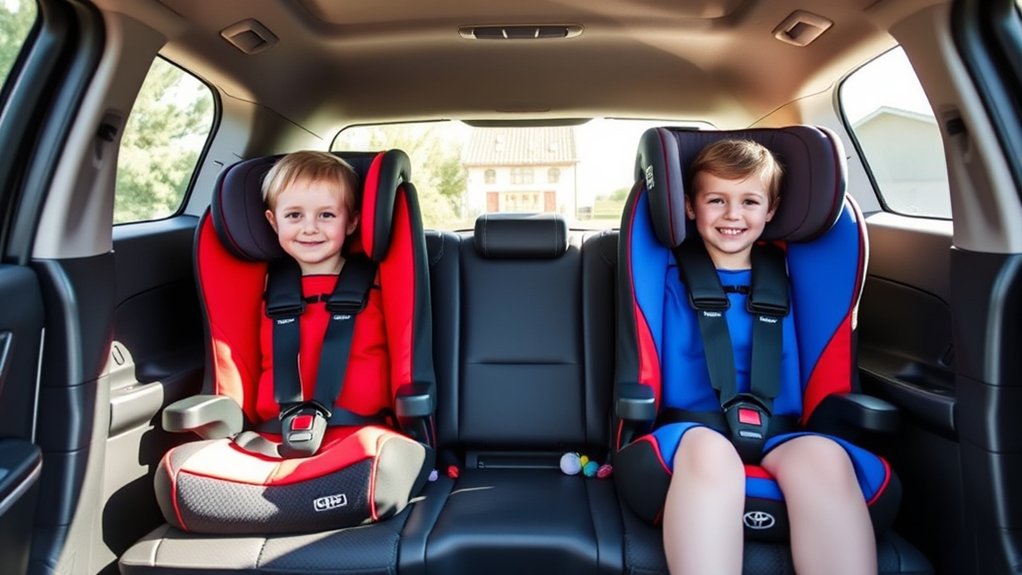
A forward-facing restraint can take up less front-to-back space than a rear-facing seat, but it introduces an essential additional step: the top tether.
The tether reduces forward movement of the restraint and the child’s head during a crash. Use it with either an approved lower-anchor installation or an approved vehicle-belt installation.
Tether Anchor Accessibility Challenges
In the IIHS-tested 2019 through 2025 RAV4, the tether anchors are on the rear seatbacks and are labeled. Nearby cargo hardware can still cause confusion, so confirm the correct location in the Toyota manual before attaching the hook.
Fold or recline the seatback only as the manual permits. Route the tether over or around the vehicle head restraint according to both manuals, then remove slack from the strap.
Do not automatically remove the head restraint. Remove or reposition it only when the Toyota manual and child-seat instructions allow that configuration. Reinstall it before the position is used by a passenger without a child restraint.
Proper Seat Belt Usage
When installing a forward-facing restraint with the vehicle belt, route the belt through the forward-facing belt path. Buckle it, activate the required locking method, and tighten the restraint while applying pressure where the child-seat instructions direct.
Test movement at the belt path, not at the top of the restraint. The seat should move less than one inch from side to side or front to back at that location.
Attach and tighten the top tether after securing the lower portion. Recheck the belt path because tether tightening can sometimes change the seat’s position.
Selecting the Most Compatible Booster Seat for the RAV4
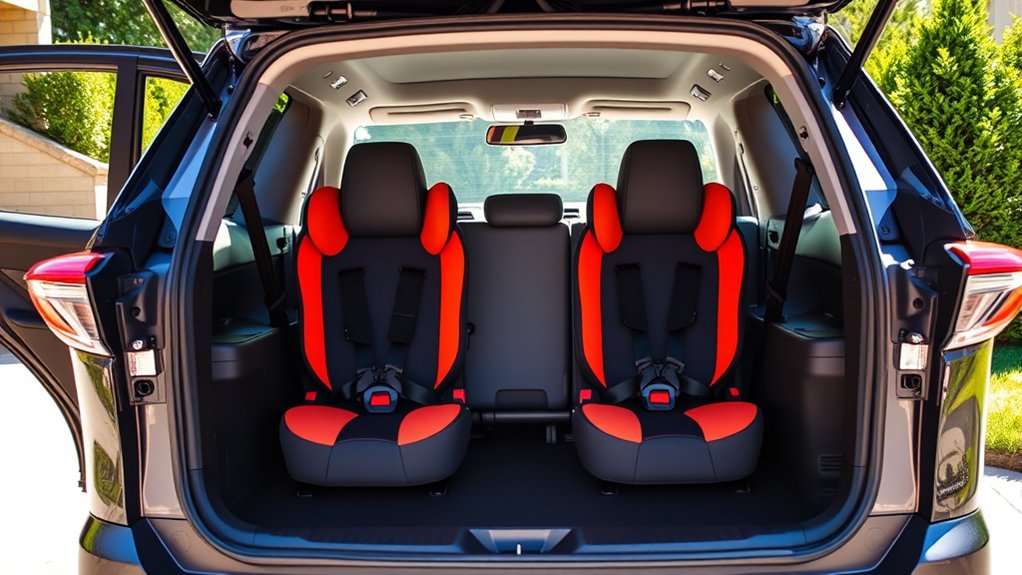
A booster seat does not use a built-in harness to restrain the child. It positions the RAV4’s lap-and-shoulder belt across the stronger parts of the child’s body.
Choose a booster only after your child has outgrown the height or weight limit of a forward-facing harnessed seat and can remain seated correctly for the entire trip.
Test the booster in the planned seating position and confirm that:
- The lap belt lies low and snug across the upper thighs, not the abdomen.
- The shoulder belt crosses the center of the chest and shoulder, not the neck or face.
- The buckle is easy for the child or caregiver to reach.
- The buckle is not trapped beneath or pressed against the booster’s shell.
- The shoulder belt retracts freely after the child leans forward and sits back.
- A backless booster receives adequate head support from the vehicle seat and head restraint.
Some boosters have lower-anchor connectors that hold the empty booster in place. Follow the booster manual for their use. The lap-and-shoulder belt still restrains the child.
How Safe Are Car Seats in the RAV4?
A properly selected and correctly installed child restraint can provide effective protection in a RAV4. However, the vehicle’s overall crash rating cannot confirm that your specific seat is installed correctly.
Crash Test Ratings
The IIHS vehicle page for the 2021 RAV4 reports strong results in several crashworthiness tests and gives its child-seat anchors a Good+ ease-of-use rating. The anchor evaluation applies to 2019 through 2025 models.
These results support the RAV4’s family usability, but they do not replace the fit test. A loose restraint, incorrect belt path, unused tether, or unsuitable booster position can reduce protection in any vehicle.
Installation Guidelines Explained
NHTSA recommends selecting a restraint based on the child’s age and size, confirming that it fits the vehicle, and using it correctly every trip.
Use either the lower anchors or the vehicle seat belt to secure the lower portion unless both manuals specifically allow simultaneous use. For a forward-facing seat, use the top tether whenever the manuals permit it.
Keep children rear-facing until they reach the rear-facing height or weight limit of their restraint. Move to a forward-facing harness only after the rear-facing limit is reached. Use a booster until the vehicle belt fits correctly without it.
Child Seat Compatibility
Compatibility involves the child, the restraint, the vehicle, and the selected seating position. A seat can meet federal safety standards and still be a poor physical fit in a particular position.
For two restraints, prioritize positions where each seat can be installed independently and tightly. Do not choose the center simply because it is often described as safer. The safest practical position is one where you can achieve and maintain a correct installation.
Do not assume an adult can sit safely between two installed restraints. The adult must have enough room to sit upright, buckle independently, keep the lap belt low across the thighs, and keep the shoulder belt centered across the chest.
Tips for Proper Car Seat Installation in the RAV4
Use this process each time you install or move a restraint:
- Read both manuals. Review the child-restraint section in your exact RAV4 manual and the complete installation instructions for each seat.
- Choose the positions. Start with the two outboard seats. Consider a center installation only after reviewing the center anchor and seat-belt rules.
- Select one approved installation method. Use either the lower anchors or a locked vehicle belt unless both manuals allow another method.
- Use the correct belt path. Rear-facing and forward-facing restraints normally use different paths.
- Tighten at the belt path. Apply pressure as the child-seat manual directs and remove slack from the belt or lower-anchor strap.
- Check movement. Confirm less than one inch of movement from side to side and front to back at the belt path.
- Attach the tether when forward-facing. Connect it to the labeled tether anchor, not a cargo hook.
- Verify the recline and harness. Follow the seat’s indicators and position the harness for the direction of use.
- Check the surrounding seats. Make sure the front occupants can sit safely and the second restraint remains independently secure.
- Repeat the check regularly. Reinspect the setup after moving a seat, adjusting a vehicle seatback, or changing the restraint’s mode.
A correct installation should remain secure without depending on the neighboring child restraint, door, front seat, or an unapproved accessory to hold it in place.
Common Mistakes to Avoid When Installing Car Seats
Avoid these common problems when installing two restraints:
- Using both the lower anchors and seat belt without permission: More attachment points do not automatically create a safer installation.
- Borrowing center anchors incorrectly: A borrowed anchor cannot also secure the neighboring outboard restraint.
- Attaching the tether to a cargo hook: Use only the labeled tether anchor identified in the Toyota manual.
- Exceeding the lower-anchor limit: Check the child-seat label and combined child-and-seat weight.
- Testing movement at the top: Check tightness only at the belt path.
- Using the wrong belt path: Convertible seats normally have separate rear-facing and forward-facing paths.
- Changing the head restraint without checking: Its position must follow both manuals.
- Adding unapproved padding or protectors: Mats, inserts, cushions, and belt-positioning devices may interfere with the installation.
- Allowing bulky coats beneath the harness: Compressed clothing can leave unsafe slack.
- Moving a child to a booster too early: Use the harness until the child reaches its permitted height or weight limit and is ready for booster behavior.
What to Do if You Can’t Fit Two Car Seats in the RAV4?
If two restraints do not fit securely, do not force them together or accept a loose installation. Work through these options:
- Install both restraints in the outboard positions and compare the result with your current arrangement.
- Try an approved seat-belt installation, which may position a restraint differently from lower-anchor connectors.
- Switch which child sits on each side, especially when one restraint is deeper or wider.
- Test a narrower or more compact seat that still fits the child and supports the required direction of travel.
- Remove optional cup holders or accessories only when the child-seat manufacturer permits removal.
- Adjust the front seats while maintaining safe seating posture and airbag clearance.
- Have the setup checked by a certified child passenger safety technician.
Do not move an older child into a booster solely to create room. The child should first outgrow the forward-facing harness and be able to sit correctly throughout every journey.
Model-Year and Market Differences
The detailed IIHS anchor information used in this article applies to U.S. 2019 through 2025 RAV4 models. Do not assume that a 2026 RAV4, an earlier generation, or a RAV4 sold in another country uses the same anchors, spacing, labels, or installation rules.
Use Toyota’s official Manuals and Warranties portal to select your exact model year. Owners outside the United States should use the manual supplied for their local vehicle.
Terms can also differ by market. U.S. manuals usually use LATCH, while other regions may use ISOFIX or another local term. Similar names do not guarantee identical rules.
When to Get Professional Installation Help
Professional help is worthwhile when:
- You cannot achieve less than one inch of movement at the belt path.
- You are unsure whether a center anchor arrangement is permitted.
- The tether hook appears to fit more than one piece of hardware.
- Two seats overlap or press against each other.
- A support leg, anti-rebound bar, or vehicle-seat contact creates uncertainty.
- The front passenger cannot sit safely after a rear-facing installation.
- You are transporting a child with special healthcare or positioning needs.
A certified child passenger safety technician can teach you how to install and use the seats correctly. Use the National CPS Certification inspection resource to locate help.
Related Guides
Frequently Asked Questions
What is the maximum weight limit for car seats in the RAV4?
The RAV4 does not have one universal child weight limit for every car seat. Follow the height and weight limits printed on the restraint. For lower-anchor installation, the child and restraint generally must weigh no more than 65 pounds combined unless either manufacturer sets a lower limit. A seat-belt installation may remain available after the lower-anchor limit is reached.
Can I use a booster seat with a regular seat belt in the RAV4?
Yes, but the booster must use a lap-and-shoulder belt. The lap portion should lie low across the upper thighs, and the shoulder portion should cross the center of the chest and shoulder. Never use a belt-positioning booster with a lap-only belt.
Are there height restrictions for car seats in the RAV4?
Height limits come mainly from the child-seat manufacturer, not from one general RAV4 limit. Your child must remain within the seat’s stated limits, and the restraint must fit the vehicle without prohibited contact, overhang, head-restraint conflict, or incorrect belt routing.
Can the RAV4 accommodate infant car seats with bases?
Yes, many infant seats with bases can fit in the RAV4. Install the complete base at its required recline angle and confirm that the carrier can lock into and release from the base. Also check front-seat space, approved overhang, support-leg rules, and permitted contact with the front seat.
Can two rear-facing car seats fit in a Toyota RAV4?
They often can, especially in the two outboard positions. Rear-facing depth varies widely, so test both seats at their required recline angles. Make sure the driver and front passenger can still sit safely and that neither restraint depends on the other seat for support.
Can an adult sit between two car seats in the RAV4?
Possibly, but many two-seat combinations leave limited center room. The adult must be able to sit upright, use an independent lap-and-shoulder belt correctly, and avoid pressing against either restraint. Do not treat a cramped or poorly positioned belt as an acceptable fit.
How do I clean a child car seat used in the Toyota RAV4?
Follow the child-seat manufacturer’s cleaning instructions. Remove and wash only the covers or pads approved for removal. Do not steam-clean, soak, bleach, lubricate, or apply harsh chemicals to the harness, buckle, foam, or shell unless the manufacturer specifically permits that method.
Conclusion
A Toyota RAV4 can usually accommodate two child restraints, particularly when both are installed in the rear outboard positions. The final result depends on the exact vehicle year, seat dimensions, installation method, child size, and front-seat needs.
Check both manuals, respect the center-anchor borrowing rules, use the top tether for an approved forward-facing installation, and confirm less than one inch of movement at each belt path. When the fit remains uncertain, have a certified technician inspect the complete two-seat setup.
Sources
- Insurance Institute for Highway Safety: 2021 Toyota RAV4 — RAV4 crash-test results, LATCH rating, anchor positions, and applicable model years.
- National Highway Traffic Safety Administration: Car Seats and Booster Seats — restraint selection, lower-anchor limits, tether use, installation checks, and inspection help.
- American Academy of Pediatrics: Car Seats Information for Families — rear-facing, forward-facing, booster, harness, belt-fit, and installation guidance.
- Toyota Manuals and Warranties — official access to model-year-specific Toyota owner’s manuals.
- National CPS Certification: Get a Car Seat Checked — certified child passenger safety inspection resources.
