
Yes. The U.S.-spec 2026 Toyota RAV4 uses an electronically controlled continuously variable transmission in both its Hybrid and Plug-in Hybrid lineups. Toyota abbreviates it as ECVT, while owners commonly write eCVT. Unlike a conventional belt-and-pulley CVT, the RAV4 Hybrid uses motor-generators and a planetary power-split transaxle, so it does not shift through a normal set of fixed forward gears.
Last updated: September 19, 2026 — checked against current Toyota U.S. and Toyota Canada 2026 specifications.
Quick Answer
Yes. For 2026, the U.S. RAV4 lineup is fully electrified: Hybrid and Plug-in Hybrid models use Toyota’s electronically controlled continuously variable transmission (ECVT/eCVT). The regular Hybrid uses a planetary power-split design rather than the belt-and-pulley hardware found in many conventional CVTs.
Key Takeaways
- Every U.S.-spec 2026 RAV4 is a Hybrid or Plug-in Hybrid; Toyota lists an electronically controlled CVT for the 2026 lineup rather than the gas-model eight-speed automatic used through 2025.
- U.S. hybrid output is 226 horsepower with front-wheel drive or 236 horsepower with all-wheel drive; Canadian hybrids have standard AWD and 236 horsepower.
- The RAV4 Plug-in Hybrid is a separate 324-horsepower model with its own performance and efficiency ratings.
- Sequential shift mode, shift-by-wire, and available paddle controls change electronic driver commands and response; they do not create conventional fixed gears inside the eCVT.
- Fuel economy and towing capacity vary by market, trim, drivetrain, wheels, and equipment.
Does the 2026 Toyota RAV4 Have a CVT?
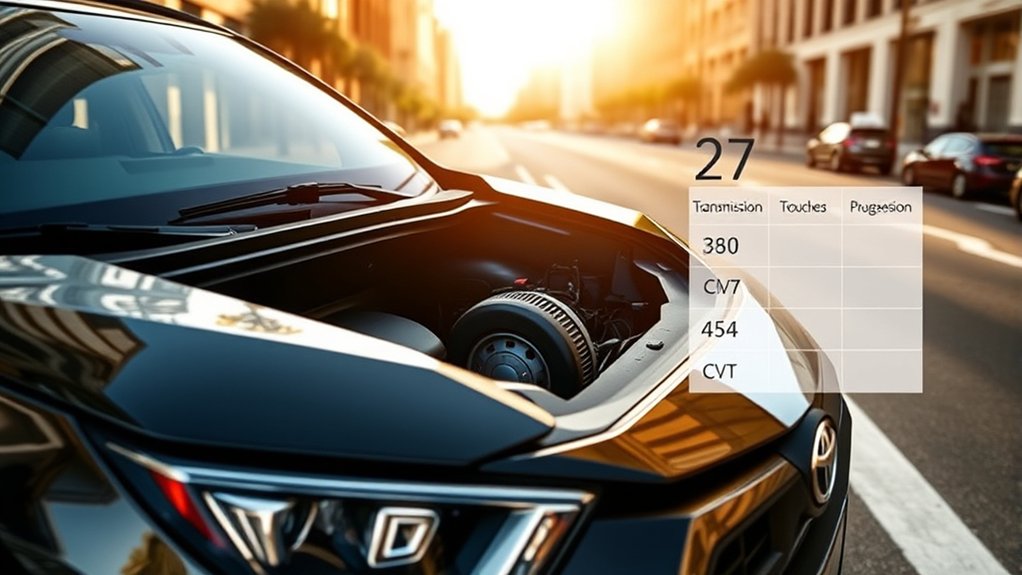
Yes. Toyota’s U.S. technical material describes the regular 2026 RAV4 Hybrid as using a planetary-type continuously variable transmission, while Toyota’s 2026 brochure uses the name Electronically controlled Continuously Variable Transmission (ECVT) with sequential shift mode. The shorter term eCVT is common in owner discussions and automotive references.
The important distinction is the hardware. A conventional CVT usually changes ratio with variable-diameter pulleys and a steel belt or chain. The RAV4 Hybrid instead uses a planetary power-split device, electric motor-generators, and electronic controls to divide and combine power. If you are comparing older gasoline-only RAV4s, see the separate RAV4 gas-model transmission guide; U.S. gas models through 2025 used conventional stepped automatics rather than this hybrid eCVT.
Note: Calling the RAV4’s transmission an eCVT does not mean it has a conventional belt-driven CVT with electronics added. The two systems use fundamentally different hardware.
How the RAV4 Hybrid eCVT Works
The 2026 RAV4 Hybrid combines a 2.5-liter gasoline engine with electric motor-generators and a planetary power-split device. Instead of shifting between first, second, third, and higher gears, the system continuously adjusts how much work comes from the engine and electric motors.
The main components perform several jobs:
- Gasoline engine: Supplies sustained power and can operate near an efficient engine speed.
- Drive motor: Propels the vehicle electrically, assists the engine, and captures energy during regenerative braking.
- Generator motor: Starts the engine, generates electricity, and helps control the effective transmission ratio.
- Planetary power-split device: Connects the engine and motor-generators so their speed and torque can be blended without conventional gear changes.
- Hybrid control system: Decides when to use electric power, gasoline power, or both.
This arrangement provides uninterrupted acceleration because there are no conventional shift events. It also allows the gasoline engine to shut off during some low-load situations and lets the electric motor recover energy as the vehicle slows.
How Is the RAV4 eCVT Different From a Traditional CVT?
| Feature | Toyota Hybrid eCVT | Belt-Driven CVT | Stepped Automatic |
|---|---|---|---|
| Main ratio mechanism | Planetary power-split device and motor-generators | Variable pulleys with a belt or chain | Multiple fixed gear ratios and clutches |
| Conventional shifts | No | No, although some simulate shifts | Yes |
| Electric-motor integration | Central to transmission operation | Not required | Not required |
| Driving feel | Smooth, with engine speed varying independently of road speed | Smooth, sometimes with sustained engine rpm | Distinct gear changes |
| Regenerative braking | Integrated into the hybrid system | Not inherent to the transmission | Not inherent to the transmission |
2026 RAV4 Powertrains and Transmissions by Market
The 2026 RAV4 lineup differs between the United States and Canada, so transmission, drivetrain, output, fuel-economy, and towing details should be matched to the vehicle’s market and grade. The U.S. Hybrid can be FWD or AWD depending on grade; Toyota Canada lists AWD across its regular 2026 Hybrid lineup.
| Configuration | System output | Drive system | Transmission operation |
|---|---|---|---|
| U.S. RAV4 Hybrid FWD | 226 horsepower | Front-wheel drive | Planetary-type hybrid eCVT |
| U.S. RAV4 Hybrid AWD | 236 horsepower | Electronic all-wheel drive with a rear motor | Planetary-type hybrid eCVT |
| Canadian RAV4 Hybrid | 236 horsepower | Standard electronic all-wheel drive | Hybrid transaxle with eCVT operation |
| 2026 RAV4 Plug-in Hybrid | Up to 324 horsepower | All-wheel drive | Electronically controlled CVT/eCVT hybrid transaxle |
Toyota offers different trims and option combinations in each country. A trim name alone is therefore not enough to confirm the drivetrain, output, fuel rating, or towing capacity. Check the vehicle’s window sticker, VIN-specific documentation, or official regional specification page.
In the United States, the 2026 RAV4 Hybrid produces 226 horsepower with front-wheel drive or 236 horsepower with all-wheel drive. Canadian hybrid models pair 236 horsepower with standard all-wheel drive.
Benefits of the Hybrid eCVT
The eCVT helps the RAV4 deliver smooth power while reducing mechanical complexity compared with a transmission that must repeatedly engage different gearsets and clutches. Its main benefits include:
- Smooth acceleration: There is no pause for a conventional gear change.
- Efficient engine operation: The system can choose an engine speed based on power demand and efficiency rather than a fixed road-speed-to-gear relationship.
- Electric assistance: The drive motor can provide immediate torque when pulling away or accelerating.
- Regenerative braking: The motor can recover part of the vehicle’s kinetic energy and return it to the hybrid battery.
- Seamless power blending: The vehicle can move with electric power, gasoline power, or a combination of both.
One characteristic may initially feel unfamiliar: during firm acceleration, engine rpm can rise and remain relatively steady while vehicle speed continues to increase. This is normal eCVT operation and does not mean the transmission is slipping.
Fuel Economy and Performance
Fuel economy varies with drivetrain, trim, wheels, tires, temperature, traffic, and driving style. On its current U.S. model page, Toyota lists selected 2026 RAV4 Hybrid grades at up to 47 mpg city and 40 mpg highway. Woodland, XSE, Limited, and other configurations have different ratings.
Canadian buyers should use the official Natural Resources Canada EnerGuide rating for the exact model rather than assuming that a U.S. mpg figure or an unofficial conversion applies to every Canadian trim.
The regular hybrid and plug-in hybrid should not be confused:
- The regular U.S. hybrid produces 226 horsepower with FWD or 236 horsepower with AWD.
- The RAV4 Plug-in Hybrid produces up to 324 horsepower.
- Toyota advertises a 5.4-second 0–60-mph time for the plug-in hybrid, not the regular RAV4 Hybrid.
- The plug-in hybrid can travel on externally charged battery power before operating like a conventional hybrid.
Because ratings can change with equipment and certification, the Monroney label or Canadian EnerGuide label on the actual vehicle is the best source for its official consumption estimate.
All-Wheel Drive and Towing
On AWD hybrid models, an electric motor drives the rear axle when additional traction or power is needed. This arrangement does not require a conventional mechanical driveshaft connecting the gasoline engine to the rear wheels.
Towing capacity is determined by the complete vehicle configuration—not by the eCVT alone. In the United States, Toyota lists 3,500 pounds for Hybrid XLE, Woodland, SE, XSE, and Limited grades with AWD, plus Plug-in Hybrid SE, XSE, and Woodland grades with AWD. Toyota lists 1,750 pounds for all FWD models and the Hybrid LE AWD. In Canada, Toyota’s current regular-Hybrid specifications list 1,750 pounds for LE AWD and 3,500 pounds for XLE, Woodland, XSE, and Limited AWD.
Warning: Never assume that every 2026 RAV4 can tow 3,500 pounds. Confirm the rating for the exact market, grade, drivetrain, hitch equipment, cargo load, and trailer type in the owner’s manual and vehicle documentation before towing.
Can You Manually Shift a RAV4 Hybrid?
You cannot manually select physical first, second, or third gears because the eCVT does not contain a conventional set of forward gear ratios. Moving the selector into Drive, Reverse, Neutral, or a braking-oriented range changes the system’s operating command rather than mechanically choosing a gear.
Toyota lists a sequential shift mode on the 2026 ECVT, and some grades also provide paddle controls. These electronic controls can change response or engine-braking behavior, but they do not give the transaxle a conventional stack of driver-selectable forward gears.
Likewise, shift by wire refers to an electronic gear-selector interface. It is not a separate transmission design.
What Buyers Should Know Before Choosing a Trim
When comparing RAV4 trims, focus on the complete configuration rather than assuming every hybrid has identical specifications. Review:
- Whether the vehicle is front-wheel drive or all-wheel drive
- Regular-hybrid versus plug-in-hybrid powertrain
- Official horsepower for that drivetrain
- EPA or EnerGuide fuel-economy rating
- Wheel and tire package
- Maximum towing capacity
- Availability of shift-by-wire controls or paddle controls
- Charging equipment and electric range on plug-in-hybrid models
There is no practical factory “transmission upgrade” from one conventional gearbox to another because the eCVT is integrated into the hybrid powertrain. Meaningful powertrain differences are obtained by selecting the appropriate drivetrain or choosing the plug-in-hybrid model.
What Maintenance Does the 2026 RAV4 eCVT Need?
Toyota’s hybrid eCVT does not use the variable pulleys and steel belt found in a traditional belt-driven CVT. It still contains gears, bearings, seals, lubricant, motor-generators, electronics, and cooling-related components that must be serviced according to Toyota’s schedule for the exact vehicle and market.
Do not apply a generic belt-CVT service interval or “CVT fluid” recommendation to this hybrid transaxle. Follow the maintenance schedule supplied for the exact vehicle and market. Owners should also:
- Investigate warning lights or fluid leaks promptly.
- Use only the fluid specification Toyota lists for the vehicle.
- Avoid assuming that a generic transmission-service interval applies.
- Keep the hybrid battery cooling intake clear as directed in the owner’s documentation.
- Have towing-related maintenance performed according to the severe-use guidance when applicable.
Pro Tip: Before approving a transmission-fluid flush or additive, compare the recommendation with Toyota’s maintenance guide. Use the specified fluid and service procedure rather than a universal CVT product intended for belt-driven transmissions.
The 2026 generation is also too new for credible long-term mileage claims about this exact transaxle. Older Toyota hybrid experience can provide context, but it cannot prove how every 2026 unit will age. Service history, operating conditions, collision damage, overheating, contamination, and manufacturing variation all affect longevity.
Buying takeaway: If your concern is “CVT reliability,” first separate Toyota’s hybrid eCVT from a belt-driven CVT. The hardware is different, so failure stories, fluid advice, and service intervals for pulley-and-belt CVTs should not be transferred automatically to the 2026 RAV4.
What Does the 2026 RAV4 eCVT Feel Like to Drive?
Acceleration and Power Delivery
The electric motor can provide immediate assistance from low speed, while the eCVT blends engine and motor output without interrupting acceleration for gear changes. AWD models add rear-motor assistance when the vehicle needs more traction or propulsion.
Under heavy throttle, the engine may settle at an efficient high-power rpm while road speed continues to build. Drivers accustomed to a stepped automatic may initially interpret this as a lack of shifting, but it is normal for a power-split hybrid.
Fuel-Efficiency Performance
Hybrid efficiency is usually strongest in mixed and urban driving, where regenerative braking and low-speed electric assistance can recover or reduce energy use. Highway speed, cold weather, short trips, roof accessories, cargo, all-terrain tires, and aggressive acceleration can reduce real-world economy.
The Woodland’s more adventure-oriented equipment and tires may produce different consumption than efficiency-focused trims. Compare official ratings for the exact version instead of treating one number as representative of the entire lineup.
Driving Dynamics and Handling
Toyota revised the 2026 RAV4’s structure and suspension along with its electrified powertrain. Those chassis changes affect ride and handling, while the eCVT mainly changes how engine speed and propulsion are coordinated. Do not expect normal stepped-automatic shift feel; the sequential mode does not turn the transaxle into a conventional automatic.
Active aerodynamic components on applicable versions can reduce drag at higher speeds. Toyota also reinforced key structural areas, but buyers should avoid relying on unsupported percentage claims unless they appear in specifications for their market.
Frequently Asked Questions
Does every U.S. 2026 Toyota RAV4 have an eCVT?
Yes. The 2026 U.S. RAV4 lineup is fully electrified, with Hybrid and Plug-in Hybrid powertrains. Toyota lists an electronically controlled continuously variable transmission for the 2026 lineup rather than the gas-model eight-speed automatic used through 2025.
What is the difference between an eCVT and a traditional CVT?
Toyota’s hybrid eCVT uses a planetary power-split device and electric motor-generators. A traditional CVT normally changes ratios with variable pulleys and a belt or chain. Both can vary the effective ratio continuously, but their internal hardware and operating methods are different.
Does the 2026 RAV4 Hybrid use a conventional automatic transmission?
No. The regular hybrid uses a planetary-type continuously variable hybrid transaxle, commonly called an eCVT. It does not shift through a conventional series of fixed forward gears.
Can I manually shift gears in a 2026 RAV4 Hybrid?
You cannot manually select physical gears because the eCVT has no conventional stepped gearset. Some configurations provide paddle controls or sequential modes that alter response or engine braking, but they do not add physical stepped gears.
Does shift by wire mean the RAV4 has a different transmission?
No. Shift by wire means the selector sends an electronic command instead of moving the transmission through a direct mechanical linkage. It does not change the underlying eCVT design.
Is the RAV4 Hybrid eCVT suitable for towing?
Selected 2026 configurations are rated to tow up to 3,500 pounds, but limits vary. Suitability depends on the exact trim, drivetrain, cooling capacity, hitch equipment, cargo, and trailer. Always follow the rating in the vehicle’s owner documentation.
Does the eCVT require transmission-fluid changes?
Service requirements depend on Toyota’s schedule for the vehicle, market, and operating conditions. Check the maintenance guide before authorizing a fluid change, flush, additive, or generic CVT service.
Why does the engine get louder without a gear change?
The eCVT can hold the engine near an efficient or high-power rpm while the motor-generators continuously vary the effective ratio. Engine sound therefore does not always rise and fall in steps as it would with a conventional automatic.
Are U.S. and Canadian 2026 RAV4 Hybrid specifications identical?
No. The United States offers both front-wheel-drive and all-wheel-drive regular Hybrid configurations, while Toyota Canada specifies standard all-wheel drive for its regular 2026 Hybrid lineup. Trim names, ratings, towing limits, and equipment can also differ.
Does the 2026 RAV4 Plug-in Hybrid use the same powertrain as the regular hybrid?
No. Both use Toyota’s power-split hybrid principles, but the plug-in hybrid has a larger externally rechargeable battery, different electric capability, and up to 324 horsepower. Its acceleration, electric range, efficiency, and charging specifications should not be assigned to the regular hybrid.
Conclusion
Yes, the 2026 Toyota RAV4 uses an electronically controlled continuously variable transmission. For the regular Hybrid, Toyota describes a planetary-type continuously variable transmission; it is commonly called an eCVT. It does not use the belt-and-pulley mechanism of a traditional CVT, and it does not shift through a conventional stack of fixed forward gears.
The system’s smooth response, electric assistance, regenerative braking, and efficient power blending are central to how the RAV4 Hybrid operates. Because horsepower, fuel economy, towing capacity, and equipment vary by country and configuration, verify those details for the exact vehicle rather than relying on a single lineup-wide figure.
Sources
- Toyota USA Newsroom: 2026 RAV4 Arrival and Technical Details — supports the planetary-type CVT description, hybrid outputs, drivetrain choices, aerodynamics, and selected features.
- Toyota Canada: All-New 2026 RAV4 Debut — supports Canadian AWD availability, hybrid output, towing information, and market-specific equipment.
- Toyota Canada: 2026 RAV4 Hybrid Product Information — supports current Canadian ECVT naming and model-specific specifications.
- Toyota: 2026 RAV4 Brochure — supports Toyota’s ECVT terminology and sequential-shift description for U.S. models.
- Toyota USA Newsroom: 2025 RAV4 Powertrain Information — supports the Direct Shift eight-speed automatic used by 2025 U.S. gas-powered RAV4 grades.
- Toyota: Current 2026 RAV4 Model and Grade Information — supports current U.S. trim, fuel-economy, output, and towing information.
- Toyota: Current 2026 RAV4 Plug-in Hybrid Information — supports plug-in-hybrid horsepower, acceleration, electric-range, efficiency, and towing specifications.
- Toyota Owners: Warranty and Owner’s Manuals — provides vehicle-specific operating, towing, fluid, and maintenance instructions.

