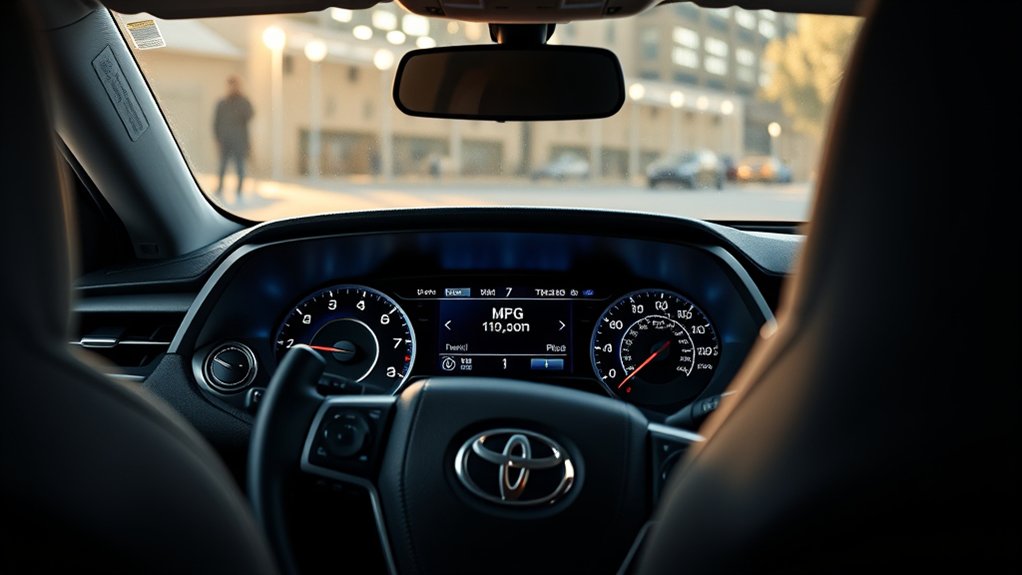
Checking the MPG on your Toyota RAV4 XLE is usually a matter of opening the fuel-economy information on the multi-information display (MID) and choosing the average you want to see. The exact buttons and screen layout vary by model year, instrument cluster, and whether your RAV4 is gasoline or hybrid, so it helps to know the difference between the fuel-economy display and the separate Trip A/Trip B meters.
Quick Answer
Park your RAV4, switch the vehicle and instrument display on, then use the steering-wheel meter controls to open the fuel-economy or drive-information screen. Look for current fuel economy or average fuel economy. On many newer RAV4s, an “after reset” average can be cleared by displaying it and pressing and holding the OK/meter-control switch.
Key Takeaways
- The RAV4 can show current and average fuel economy, but the available choices depend on the model year and display.
- Resetting Trip A or Trip B is not necessarily the same as resetting the average MPG display.
- For a useful real-world check, divide miles driven by gallons added at the next full fill-up.
- Treat the dashboard MPG as a reference value; driving conditions, temperature, route, tires, and other factors can change actual fuel economy.
At a Glance
| Time Required | About 1–2 minutes to check the display; one full tank cycle for a manual MPG calculation |
| Difficulty | Easy |
| Tools Needed | None for the dashboard reading; fuel receipt or notes app for manual tracking |
| Cost | $0 |
Accessing the MPG Screen on Your RAV4 XLE
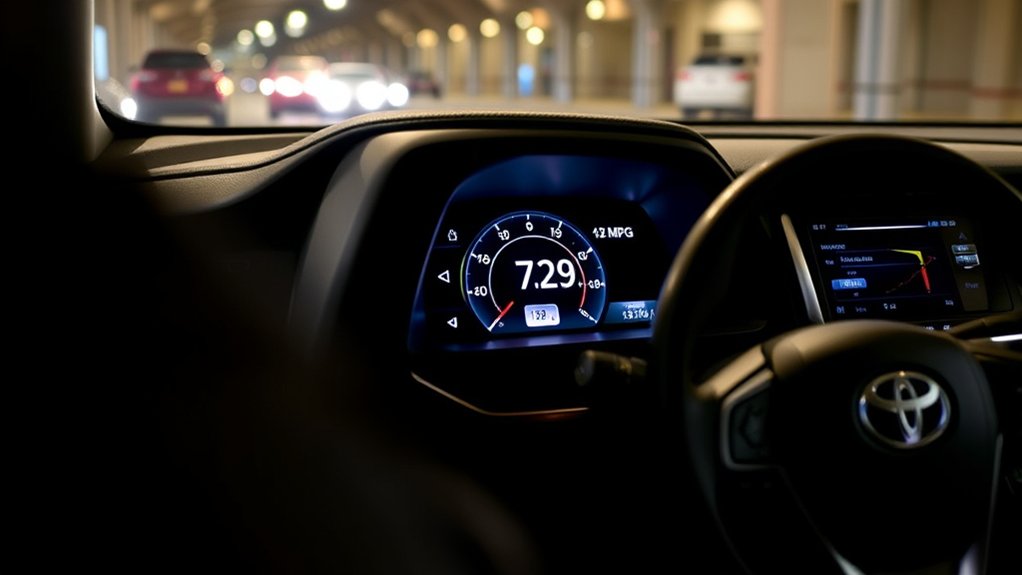
To check miles per gallon (MPG) on a Toyota RAV4 XLE, start with the vehicle safely parked. The fuel-economy information appears in the instrument cluster’s multi-information display on supported models.
Warning: Make display changes while parked whenever possible. Toyota warns against continuously looking at or operating the multi-information display while driving because it can distract you from the road.
On many RAV4 models, you can check MPG with these basic steps:
- Park the vehicle safely. Turn the engine or hybrid system on so the instrument display is operating.
- Use the meter controls on the steering wheel. Move through the available information pages until you reach the fuel-economy or drive-information display.
- Find the fuel-economy reading. Depending on the model year and display, you may see current fuel economy, average fuel economy, distance to empty, or several fuel-economy averages.
- Select the average you want to track. Some RAV4s offer averages after starting, after resetting, or after refueling.
Toyota describes the displayed fuel-consumption values as reference information, so a small difference between the dashboard reading and a manually calculated MPG figure is normal. See your exact model-year instructions in the Toyota Owners manuals library.
Note: Toyota has used several instrument-cluster layouts across RAV4 model years. A 4.2-inch, 7-inch, or 12.3-inch display may organize the information differently, so do not worry if your screen does not match another RAV4 exactly.
What Do Current MPG and Average MPG Mean?
Current fuel economy is an instantaneous reading that changes quickly as you accelerate, coast, climb hills, or slow down. It is useful for seeing how your driving affects fuel consumption at that moment.
Average fuel economy smooths those changes over a longer period. Depending on the RAV4, the display may calculate the average since the engine or hybrid system started, since you manually reset the reading, or since the vehicle was refueled.
Trip A and Trip B Are Different
Trip A and Trip B are primarily distance counters. They let you track two different distances independently. For example, you might use Trip A for each tank of fuel and Trip B for a longer road trip.
Resetting a trip meter does not always reset the fuel-economy average you are viewing. Toyota provides separate reset controls for some fuel-economy displays, which is why it is important to identify the exact item before holding a reset button.
How to Reset Average MPG Correctly
Resetting the average MPG is useful when you want to measure fuel economy from a specific point, such as the start of a road trip or after making a change to your driving habits.
On many newer RAV4 instrument displays:
- Park the RAV4 and switch the instrument display on.
- Use the steering-wheel meter controls to open the fuel-economy display.
- Select the average fuel economy that is identified as an after-reset or resettable average.
- Press and hold the indicated OK or meter-control switch until that average resets.
Older RAV4 versions may use a different button arrangement. Some models also provide an “after refuel” average that resets automatically after a qualifying refueling event.
Pro Tip: If you want to compare the dashboard MPG with your own calculation, reset the appropriate trip meter and the resettable average at the same full fill-up. Then compare both figures the next time you fill the tank.
How to Reset Trip A or Trip B
If your goal is to reset only the distance counter, display Trip A or Trip B and use the trip-meter reset procedure for your model. On RAV4s equipped with an ODO/TRIP switch, Toyota states that pressing and holding the switch while the desired trip meter is displayed resets that trip meter.
This is separate from resetting a fuel-economy average on RAV4 displays that use the steering-wheel meter controls.
How to Calculate Your Overall MPG
You can check your RAV4 XLE’s real-world fuel economy without relying only on the dashboard. The most useful method is a full-tank-to-full-tank calculation.
- Fill the fuel tank completely. Stop when the pump automatically shuts off rather than repeatedly topping off the tank.
- Reset Trip A or record the current odometer reading.
- Drive normally. A longer sample usually gives you a more useful average than a short trip.
- Fill the tank again. Ideally, use a similar fueling method.
- Record the gallons added.
- Divide the miles driven by the gallons added.
MPG = miles driven ÷ gallons of fuel used. If you drove 360 miles and added 12 gallons, your calculated fuel economy is 30 MPG.
You do not need to reset the vehicle’s permanent odometer. Use Trip A, Trip B, or record the odometer reading instead.
Keeping a simple log of mileage, gallons purchased, and driving conditions can show whether your fuel economy is changing over several tanks.
Why Dashboard MPG and Manual MPG May Differ
Your dashboard MPG is calculated from vehicle data, while a fill-to-fill calculation depends on the amount of fuel dispensed at the pump. Small differences can occur because of fuel-pump shutoff variation, parking angle, temperature, tank fill level, trip length, and rounding.
For that reason, it is better to compare several complete tanks rather than judging the RAV4 from one short drive or one fill-up.
Understanding How Driving Habits Affect Fuel Economy
Your Toyota RAV4’s fuel economy depends on more than its EPA estimate. Traffic, speed, temperature, route, cargo, tires, HVAC use, and your driving style can all change real-world MPG.
The U.S. Department of Energy’s Alternative Fuels Data Center reports that aggressive driving, including speeding and rapid acceleration and braking, can reduce fuel economy by roughly 15%–30% at highway speeds and 10%–40% in stop-and-go traffic.
- Accelerate smoothly: Hard acceleration demands more energy and can reduce fuel economy.
- Maintain a reasonable, steady speed: Avoid unnecessary speed changes. Cruise control can help maintain a constant speed on suitable highway terrain, although there is no universal MPG improvement percentage.
- Limit unnecessary idling: Idling consumes fuel while producing no miles traveled.
- Combine short trips when practical: A cold engine is less efficient during its warm-up period, so several short cold-start trips can use more fuel than one combined trip.
- Expect weather effects: Cold temperatures can reduce fuel economy, particularly on short trips and in hybrid vehicles.
Practical Tips for Enhancing Fuel Efficiency in Your RAV4

You cannot guarantee a particular MPG number, but several practical habits can help your RAV4 operate efficiently.
Keep the Tires at the Correct Cold Pressure
Incorrect tire pressure can reduce fuel economy, handling, tire life, and safety. Check the tires when they are cold and use the recommended pressure printed on the vehicle’s tire-and-loading information label or specified in the owner’s manual—not the maximum pressure molded into the tire sidewall.
Toyota recommends regular pressure checks and notes that incorrect inflation can reduce fuel economy. You can review Toyota’s tire guidance in its RAV4 tire-inflation documentation.
Follow the Recommended Maintenance Schedule
Use the correct engine oil specification and keep up with scheduled maintenance. A malfunctioning or poorly maintained vehicle can use more fuel.
Replace a clogged engine air filter when required for proper maintenance and performance. However, do not expect an air-filter replacement by itself to increase MPG on a modern fuel-injected RAV4. The U.S. Department of Energy’s gas-saving guidance explains that replacing a clogged filter on modern computer-controlled gasoline engines can improve performance but generally does not improve fuel economy.
Remove Unnecessary Weight and Exterior Drag
Remove heavy items you do not need and take off roof-mounted cargo equipment when it is not being used. Added weight requires additional energy, while roof-mounted equipment can increase aerodynamic drag at highway speeds.
Use Eco Drive Mode When It Suits Your Trip
If your RAV4 is equipped with Eco drive mode, it can make accelerator response more moderate and adjust heating or cooling operation to prioritize fuel efficiency. It does not create a guaranteed MPG increase, and you can switch back to Normal mode when you want different throttle or climate-control response.
Why Your RAV4 MPG May Suddenly Drop
A lower reading does not automatically mean something is wrong. Before assuming there is a mechanical problem, consider what changed recently.
- More city traffic: Frequent braking and acceleration usually lowers MPG.
- Cold weather: Engines and hybrid systems can be less efficient during warm-up.
- Short trips: The vehicle may spend more of each drive below its most efficient operating temperature.
- Low tire pressure: Check the specified cold pressures.
- Higher speeds: Aerodynamic resistance increases substantially as speed rises.
- Roof racks or cargo: Added weight and drag can reduce efficiency.
- Heavy HVAC use: Heating and cooling require energy.
- A recent MPG reset: A new average can move sharply until enough miles have accumulated.
If fuel economy remains unusually low across several tanks and there has been no obvious change in weather, route, load, or driving style, check for warning lights, verify tire pressure, and make sure scheduled maintenance is current.
What to Do If You Cannot Find the MPG Display
If you do not see an MPG screen, the display may be configured differently rather than missing the feature.
- Park the vehicle.
- Use the steering-wheel meter controls to move through the instrument-display pages.
- Look for a fuel-economy, leaf, drive-information, or vehicle-information screen.
- Open the display settings if your RAV4 allows information pages to be enabled or disabled.
- Check the owner’s manual for your exact year, trim, powertrain, and instrument display if the menu still does not match.
Do not rely on instructions for a different RAV4 model year if its instrument cluster looks substantially different from yours.
Related Guides
Frequently Asked Questions
How Often Should I Check My MPG?
You can glance at the dashboard MPG whenever you want, but checking a manual fill-to-fill average every few tanks gives you a better long-term picture. Compare similar driving conditions because weather, traffic, trip length, speed, and cargo can change fuel economy considerably.
What Units Are Used for Fuel Efficiency in a RAV4?
U.S.-market RAV4s commonly display miles per gallon (MPG). Depending on the market and the unit settings, a RAV4 may use another fuel-consumption unit such as liters per 100 kilometers (L/100 km). Many Toyota displays allow the measurement units to be changed in the settings menu.
Can I Reset the Trip Computer While Driving?
Do not make unnecessary instrument-display changes while driving. Toyota cautions drivers to avoid operating meter controls or continuously watching the multi-information display while the vehicle is moving. Park safely before resetting Trip A, Trip B, or a fuel-economy average.
Does Tire Pressure Affect My RAV4’s Fuel Economy?
Yes. Incorrect tire inflation can reduce fuel economy and can also affect handling and tire wear. Check pressure when the tires are cold and inflate them to the specification on the vehicle’s tire-and-loading label or in the owner’s manual.
What Is the Typical MPG Range for a RAV4 XLE?
There is no single MPG figure for every RAV4 XLE. The rating depends on model year, gasoline versus hybrid powertrain, and drivetrain. For example, Toyota listed the 2025 gasoline RAV4 XLE at 27 city/35 highway MPG and the 2025 RAV4 Hybrid XLE at 41 city/38 highway MPG. Use the EPA estimate or Toyota specification for your exact vehicle rather than comparing every XLE to one number.
Why Is My Dashboard MPG Different From My Calculated MPG?
The dashboard estimates fuel consumption from vehicle data, while your manual calculation uses miles driven and the amount of fuel dispensed at the pump. Pump shutoff variation, temperature, tank fill level, rounding, and the distance covered can produce a small difference. Compare several complete tanks for a more meaningful trend.
Does Resetting Trip A Reset the Average MPG?
Not necessarily. On many RAV4s, Trip A and Trip B are distance counters, while the average fuel-economy display has its own reset function. Display the specific average-MPG item you want to reset and follow the meter-control instructions for your model year.
Conclusion
To check MPG on your Toyota RAV4 XLE, use the multi-information display to find the current or average fuel-economy reading, keeping in mind that the exact menu and reset controls depend on the model year and instrument cluster. Do not confuse resetting Trip A or Trip B with resetting the average MPG display. For the best real-world check, compare the dashboard reading with miles driven divided by gallons added over several full tanks. Smooth driving, correct tire pressure, sensible speeds, reduced unnecessary weight, and regular maintenance can also help your RAV4 operate efficiently.
Sources
- Toyota Owners — Manuals and Warranties — model-year-specific RAV4 instrument-display, trip-meter, fuel-economy, and operating instructions.
- Toyota 2025 RAV4 Hybrid Owner’s Manual — Multi-Information Display — current and average fuel-economy display behavior, reset controls, and display safety guidance.
- U.S. Department of Energy Alternative Fuels Data Center — Efficient Driving — effects of aggressive driving on fuel economy.
- U.S. Department of Energy — Gas-Saving Tips — vehicle maintenance, engine air-filter, tire, and driving-efficiency guidance.
- Toyota RAV4 Owner’s Manual — Tire Inflation Pressure — cold tire-pressure checks and the fuel-economy effects of incorrect inflation.

