
Toyota RAV4 AWD systems differ by model year and powertrain. On U.S.-market 2019–2025 gas models, engine torque reaches the rear axle through a mechanical driveline, while selected gas trims add left-to-right rear torque vectoring. RAV4 Hybrid and Plug-in Hybrid AWD use a dedicated rear electric motor instead, with no mechanical propeller shaft connecting the front and rear axles. For 2026, Toyota eliminated the U.S. gas-only RAV4 and moved to Hybrid and Plug-in Hybrid powertrains.
Quick Answer
Gas RAV4 AWD uses a mechanical front-to-rear driveline. Hybrid RAV4 E-AWD uses a dedicated rear electric motor and has no mechanical driveshaft between the axles. Dynamic Torque Vectoring AWD adds independent left-to-right rear torque control. One model-year caveat matters: Toyota’s public descriptions of Rear Driveline Disconnect on non-vectoring Dynamic Torque Control AWD changed during the fifth generation, so the exact year and configuration should be checked before making a claim about propeller-shaft decoupling.
Key Takeaways
- The 2019–2025 RAV4 used two different gas AWD layouts, not one.
- Hybrid Electronic On-Demand AWD powers the rear axle with a separate electric motor.
- Dynamic Torque Vectoring AWD can vary drive torque between the two rear wheels.
- Toyota’s model-year wording around Rear Driveline Disconnect on non-vectoring gas AWD is not consistent across fifth-generation product releases, so verify the exact vehicle rather than relying on the system name alone.
- Fewer mechanical driveline parts do not, by themselves, prove that the hybrid will always be more reliable or cheaper to maintain.
- AWD improves the ability to accelerate on slippery surfaces, but tires remain critical for braking and cornering.
Scope: This comparison primarily applies to U.S.-market 2019–2025 RAV4 models. For 2026, Toyota moved the U.S. RAV4 to a fully electrified lineup with Hybrid and Plug-in Hybrid powertrains. Selected Hybrid grades may have front-wheel drive or Electronic On-Demand AWD, while 2026 Plug-in Hybrid grades use AWD.
Last updated: September 22, 2026. AWD architecture, trim availability, output, maintenance items, and the 2026 changes were cross-checked against Toyota U.S. product information and Toyota maintenance guides. This article does not claim instrumented snow, traction, or off-road testing.
What Are the Key Differences Between RAV4 Gas and Hybrid AWD?
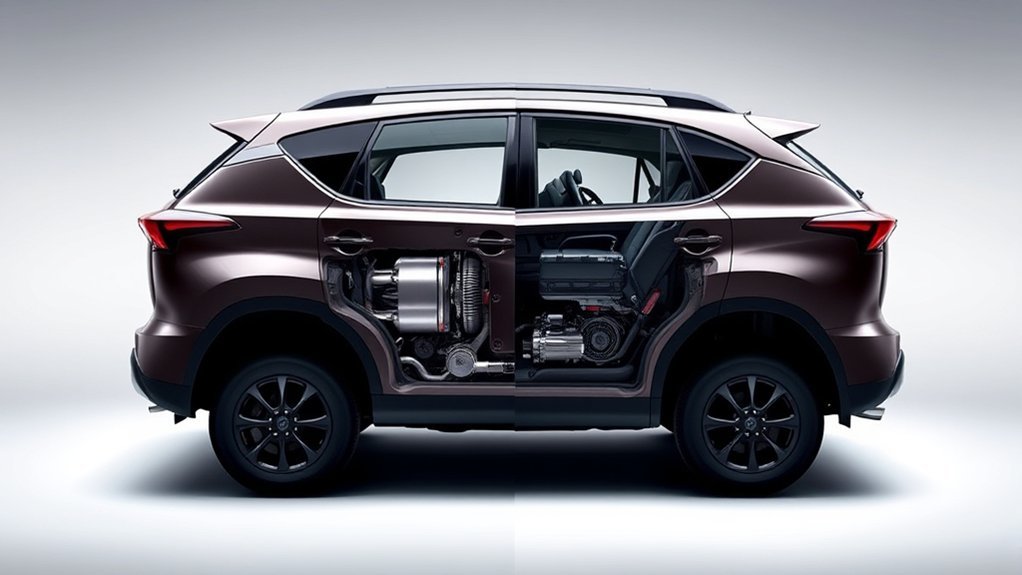
For the fifth-generation RAV4, introduced for 2019, Toyota offered three relevant AWD configurations. The exact trim availability and Toyota’s description of the disconnect hardware changed by model year, so buyers should verify the original specification sheet or Toyota documentation for a particular vehicle.
| System | How the Rear Wheels Are Driven | Main Distinction |
|---|---|---|
| Dynamic Torque Control AWD | A transfer unit and mechanical propeller shaft carry engine power toward the rear axle, where an electronically controlled coupling manages rear-wheel assistance. | Provides automatic front-to-rear torque distribution but does not independently vector drive torque between the left and right rear wheels. |
| Dynamic Torque Vectoring AWD | Uses a mechanical propeller shaft plus controlled rear couplings. | Can vary torque between the left and right rear wheels. Toyota also documents Rear Driveline Disconnect on applicable torque-vectoring models. |
| Electronic On-Demand AWD | A dedicated electric motor drives the rear axle independently of the front hybrid transaxle. | Has no mechanical propeller shaft connecting the front and rear axles. |
On 2025 gas models, the LE, XLE, and XLE Premium could be equipped with standard AWD, while the AWD Limited used Dynamic Torque Vectoring AWD. Earlier model years also offered torque-vectoring AWD on certain Adventure and TRD Off-Road models. Toyota explains the fifth-generation layouts in its 2019 RAV4 engineering overview and details the 2025 grade lineup in its 2025 RAV4 product information.
Model-year detail matters: Toyota’s 2020–2022 U.S. product material explicitly described some non-vectoring Dynamic Torque Control AWD models with Rear Driveline Disconnect, while its 2024–2025 material uses less uniform wording. Do not identify the exact disconnect mechanism from the AWD badge or system name alone.
[Amazon Products Picked for You]

GENUINE OEM: Original Toyota/Lexus factory oil filter part number 90915-YZZN1, ensuring perfect fit and optimal performance for your vehicle

[Vehicle Fitment]: Replacement for Toyota: Avalon (2019-2022), Camry (2018-2025), Corolla (2019-2025), Corolla Cross (2022-2025), CROWN (2023-2024), C-HR (2018-2022) [IMPORTANT: Fits Japan Built Models ONLY, VIN starts with 'J'],Highlander (2020-2025), Prius (2016-2025), Prius AWD-E (2019-2022), Prius Prime (2017-2024), RAV4 (2019-2025), RAV4 Prime (2021-2024), Sienna (2021-2025), Venza (2021-2024), Grand Highlander (2024-2025), GR Corolla (2023-2025).
【Compatibility】KAX 512374 Wheel Hub Assembly for 2013-2018 Toyota RAV4 AWD, 2006-2012 Toyota RAV4 4WD, 2018-2021 Lexus NX300 AWD, 2015-2017 Lexus NX200t AWD, 2017-2021 Lexus NX300h, 2015-2016 Lexus NX300h AWD
How Does Mechanical AWD Work in a Gas RAV4?
In a gas RAV4, the engine and eight-speed automatic transmission send power through a mechanical front-to-rear driveline when rear-wheel assistance is needed. Unlike the Hybrid system, a gas AWD model has a propeller shaft connecting the front drivetrain to the rear-drive hardware.
Dynamic Torque Control AWD
Dynamic Torque Control AWD uses an electronically controlled coupling near the rear axle. The control system monitors vehicle and driver inputs and can add rear-wheel drive force during acceleration, cornering, or reduced-traction conditions rather than waiting for prolonged wheelspin.
Toyota has stated that Dynamic Torque Control AWD can send up to 50 percent of available engine torque to the rear wheels when needed. The important model-year caveat is the disconnect hardware: Toyota’s 2020–2022 U.S. product releases explicitly paired Dynamic Torque Control AWD on certain core grades with Rear Driveline Disconnect, while 2024–2025 product information describes the standard system without the same detailed propeller-shaft wording. Verify the exact model year, trim, and Toyota documentation before stating whether a particular non-vectoring RAV4 physically stops propeller-shaft rotation.
Dynamic Torque Vectoring AWD with Rear Driveline Disconnect
Dynamic Torque Vectoring AWD adds two clearly documented functions:
- Rear torque vectoring: Controlled rear couplings can vary drive torque between the left and right rear wheels. This can improve traction and vehicle response when grip differs from side to side.
- Rear Driveline Disconnect: Toyota describes ratchet-type dog clutches that disengage the rear driveline when AWD is unnecessary, reducing rotational losses.
The stable distinction between the two gas AWD layouts is therefore rear torque vectoring: Dynamic Torque Vectoring AWD can manage drive torque independently between the rear wheels, while Dynamic Torque Control AWD manages front-to-rear distribution without that same left-to-right drive-torque function.
Note: Neither gas AWD design is a traditional selectable truck-style four-wheel-drive system with low-range gearing. These are automatically controlled all-wheel-drive systems.
How Does the RAV4 Hybrid’s Electronic AWD Work?
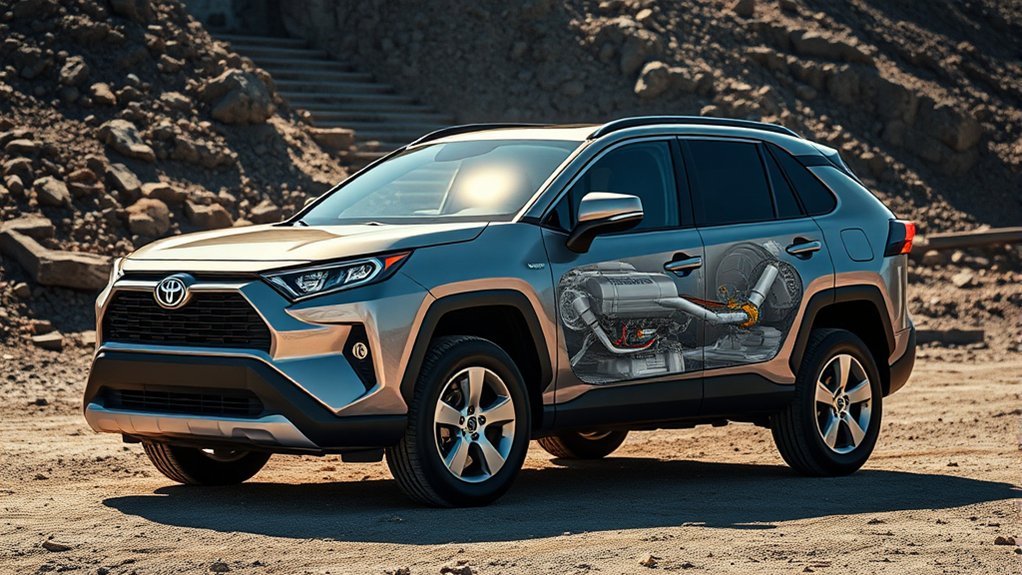
The RAV4 Hybrid uses Electronic On-Demand AWD. The gasoline engine, hybrid transaxle, and front motor-generators power the front axle, while a separate electric motor can provide propulsion at the rear axle.
Because the rear motor receives electrical power rather than engine torque through a front-to-rear propeller shaft, there is no mechanical driveshaft connecting the two axles. Toyota says rear-motor assistance can be commanded proactively during acceleration and when additional traction or stability is useful.
For the 2025 U.S. RAV4 Hybrid, Toyota states that the Electronic On-Demand AWD system operates at all vehicle speeds. That means rear assistance is available across the operating range; it does not mean the rear motor supplies torque continuously. The controller varies rear-motor output according to driving conditions.
Advantages of Electronic On-Demand AWD
- No front-to-rear propeller shaft: Rear-wheel propulsion comes from a dedicated electric motor rather than the gas AWD model’s long mechanical connection.
- Electronic rear-torque control: Rear-motor output can be varied directly according to the vehicle’s control logic.
- Proactive engagement: Toyota says the system can add rear torque during initial acceleration as well as reduced-traction conditions.
- Hybrid efficiency: The complete powertrain combines electric assistance, regenerative braking, and efficient engine operation.
- Trail Mode: On applicable Hybrid models, Trail Mode integrates AWD, braking, and drive-force control to help when a driven wheel spins on rough or uneven surfaces.
The hybrid’s fuel-economy advantage should not be attributed only to the lack of a propeller shaft. The engine, hybrid transaxle, electric motors, traction battery, regenerative braking system, and power-management software all contribute.
Electronic AWD Limitations
Electronic On-Demand AWD is designed for everyday road use, slippery conditions, gravel roads, and light off-pavement driving. It does not provide low-range gearing, a mechanically locked center transfer case, or the articulation and underbody protection of a purpose-built off-road vehicle.
Trail Mode also does not create a physical locking differential. Toyota describes it as integrated AWD, brake, and drive-force control. Selective braking can control a spinning wheel so the vehicle can make better use of the available traction at the other driven wheels.
How Do Fuel Economy, Power, and Weight Compare?
For 2025, Toyota rated the gas RAV4 at 203 horsepower and the RAV4 Hybrid at 219 net combined horsepower. Toyota listed an EPA-estimated 41 city/38 highway/39 combined mpg for the 2025 Hybrid LE and most other non-Woodland Hybrid grades. Actual fuel economy varies with trim, tires, temperature, terrain, speed, and driving style.
The redesigned 2026 RAV4 no longer offers a gas-only powertrain in the United States. According to Toyota’s 2026 RAV4 product information, standard Hybrid models produce 226 net combined horsepower with FWD and 236 net combined horsepower with AWD. AWD versions use a dedicated rear electric motor. The separate 2026 Plug-in Hybrid powertrain also uses a dedicated rear motor and has AWD standard.
Do not assume that a hybrid RAV4 is lighter. Curb weight depends on the model year, grade, wheels, options, battery, motors, and other equipment. Hybrid hardware can add mass even though E-AWD eliminates the gas AWD model’s front-to-rear propeller shaft. Compare the exact vehicles on Toyota’s specification sheets rather than relying on a general rule.
What Maintenance Do Gas and Hybrid RAV4 AWD Systems Need?
Electronic AWD has fewer mechanical components connecting the front and rear axles, but component count alone cannot prove that one system will be more reliable over the vehicle’s life. Reliability and repair cost also depend on manufacturing quality, age, corrosion exposure, fluid condition, tire matching, accident history, software, service history, and which component actually fails.
Gas AWD Maintenance Items
Toyota’s 2025 gas RAV4 maintenance guide includes AWD-related inspections or service items such as:
- Rear differential oil inspection or replacement when specified
- Transfer case oil inspection or replacement when applicable
- Propeller-shaft bolt checks where applicable
- Drive-shaft boot inspection
- Regular tire rotation
The exact interval depends on the maintenance chart and operating conditions. Toyota specifies additional maintenance under conditions such as frequent towing or heavy loading and regular operation on dirt or dusty roads.
Hybrid E-AWD Maintenance Items
The Hybrid eliminates the gas AWD model’s mechanical front-to-rear propeller shaft and transfer case. However, Toyota’s 2025 RAV4 Hybrid maintenance guide still lists maintenance and inspections that include:
- Rear differential oil inspection or replacement when specified
- Drive-shaft boot inspection at the axles
- Engine and inverter coolant checks
- Hybrid battery cooling intake filter inspection and cleaning
- Regular tire rotation
For example, Toyota’s 2025 Hybrid maintenance chart instructs owners to visually check the HEV battery cooling intake filter for dirt or dust every 5,000 miles and clean it if necessary, with scheduled cleaning every 20,000 miles. Rear differential oil replacement also appears under specified special operating conditions. Follow the maintenance guide for the exact model year and use pattern rather than applying one universal interval to every RAV4.
Pro Tip: When buying a used AWD RAV4, prioritize a documented maintenance history, four evenly worn tires of the correct size, no visible drivetrain-fluid leaks, and a pre-purchase inspection. Those checks are more useful than assuming one AWD architecture is automatically trouble-free.
Which RAV4 AWD Is Better for Snow, Rain, and Light Off-Road Use?
All three AWD layouts can improve traction while accelerating on wet pavement, snow, loose gravel, or uneven surfaces. Their main differences are how they create rear-wheel drive force and whether the gas system can actively vary drive torque between the two rear wheels.
- Dynamic Torque Control AWD: Suits normal all-weather driving and maintained unpaved roads, with automatic front-to-rear torque management.
- Dynamic Torque Vectoring AWD: Adds left-to-right rear drive-torque control, which can be useful where grip differs from one rear wheel to the other.
- Hybrid E-AWD: Uses responsive rear electric assistance for everyday snow, rain, gravel, and light off-pavement driving.
Drive modes can also alter throttle response, transmission or hybrid behavior, braking intervention, and traction-control logic. Equipment varies by year and trim. Gas AWD models may use Multi-Terrain Select and Snow-related control modes, while fifth-generation RAV4 Hybrid models include Trail Mode in Toyota’s U.S. documentation.
Warning: AWD mainly improves the ability to accelerate when traction is limited. It does not eliminate the need for safe speed, adequate following distance, or appropriate tires, and AWD by itself does not provide extra tire grip for braking or cornering on snow and ice.
For drivers who regularly encounter snow and ice, four suitable winter tires can make a major difference in braking, steering, and traction regardless of which AWD architecture is underneath the RAV4. Michelin’s AWD and winter-tire safety guidance explains why AWD assistance during acceleration does not replace winter-tire grip during braking and cornering.
[Amazon Products Picked for You]

Covered by Nexen's best-in-class Total Coverage Warranty, which includes 36 months of Roadside Assistance

Angled wave shape and micro-thin kerfs deliver outstanding wet and snow perforamnces

Anti-slip Tool: Our snow chains for car tires feature a serrated design to enhance anti-slip effect and grip, significantly improving safety and comfort while driving
Which Toyota RAV4 AWD System Should You Choose?
The useful choice depends on the model years you are considering, the roads you drive, fuel-economy priorities, and the condition of the individual vehicle.
[Amazon Products Picked for You]

6Qt Genuine 00289-ATFWS

And Vehicle Specific

For best performance, follow the manufacturer's recommendations in your vehicle owner’s manual.
Choose Conventional Gas AWD When
- You are shopping for a 2019–2025 used gas RAV4 with standard AWD.
- You want automatic AWD for rain, snow, and maintained gravel roads without needing rear left-to-right torque vectoring.
- You have found a gas model whose price, condition, and service history suit your needs.
- The vehicle has matching tires and documented drivetrain-fluid service where required.
Choose Dynamic Torque Vectoring AWD When
- You specifically want the fifth-generation gas system that can vary drive torque between the left and right rear wheels.
- You regularly encounter winding, uneven, gravel, or lightly rutted roads.
- You are considering an applicable Limited, Adventure, or TRD Off-Road grade from a model year that offered the system.
- You are comfortable maintaining the additional mechanical driveline hardware according to Toyota’s schedule.
Choose Hybrid Electronic On-Demand AWD When
- Fuel economy and smooth hybrid operation are major priorities.
- You want automatic rear-motor assistance without a mechanical front-to-rear propeller shaft.
- Your driving consists mainly of commuting, highway travel, snow, rain, gravel roads, and light trails.
- You are buying a 2026 AWD RAV4: every current U.S. AWD configuration uses a dedicated rear electric motor rather than the previous gas-only mechanical AWD architecture.
For serious rock crawling, deep mud, repeated heavy off-road use, or situations requiring low-range gearing, none of these RAV4 systems is a substitute for a purpose-built four-wheel-drive vehicle.
How Can You Identify Which AWD System a RAV4 Has?
The safest method is to check the original window sticker, Toyota specification sheet, owner documentation, or VIN-specific vehicle information. Do not rely only on an “AWD” badge because it does not identify the internal AWD architecture.
As a general guide for U.S. models:
- 2019–2025 RAV4 Hybrid: Electronic On-Demand AWD with a dedicated rear electric motor; the 2025 U.S. Hybrid lineup had AWD standard.
- 2025 LE, XLE, and XLE Premium gas AWD: Standard mechanical AWD using Dynamic Torque Control.
- 2025 Limited gas AWD: Dynamic Torque Vectoring AWD with Rear Driveline Disconnect.
- Earlier fifth-generation Adventure, TRD Off-Road, and certain Limited AWD models: Dynamic Torque Vectoring AWD was offered, but exact availability must be verified by model year.
- 2026 Hybrid LE, SE, and XLE Premium: Available with FWD or Electronic On-Demand AWD depending on configuration.
- 2026 Hybrid Woodland, XSE, and Limited: AWD is listed in Toyota’s U.S. powertrain matrix.
- 2026 Plug-in Hybrid SE, XSE, Woodland, and GR SPORT: Electronic rear-motor AWD is standard.
Grade availability and system names can differ outside the United States, so owners in other markets should use the Toyota documentation for their region and model year.
Related Guides
Frequently Asked Questions
Can I switch between AWD and 2WD modes in the RAV4?
Not in the way a traditional part-time 4WD vehicle switches between 2WD and 4WD. An AWD-equipped RAV4 automatically controls rear-wheel assistance. Snow, Trail, Eco, Sport, and Multi-Terrain modes may change the control strategy, but they do not turn the vehicle into a manually selectable low-range 4WD system. A factory-FWD RAV4 also cannot activate rear drive because it lacks the required rear-drive hardware.
Is the RAV4 Hybrid’s electronic AWD real AWD?
Yes. An AWD RAV4 Hybrid can apply propulsion torque at both the front and rear axles. The difference is that the rear axle is driven by a dedicated electric motor instead of receiving engine torque through a mechanical front-to-rear propeller shaft. It is AWD, but it is not the same as a mechanically locked four-wheel-drive system with low range.
Does Dynamic Torque Control AWD have Rear Driveline Disconnect?
Toyota’s public wording varies by model year. U.S. product information for some 2020–2022 RAV4 core gas grades explicitly described Dynamic Torque Control AWD with Rear Driveline Disconnect. Toyota’s 2024–2025 material describes the standard AWD system without giving the same detailed disconnect explanation and reserves the clearest propeller-shaft-stopping description for Dynamic Torque Vectoring AWD. Check documentation for the exact year and trim instead of assuming from the system name alone.
Which RAV4 AWD system is best in snow?
All three systems can improve acceleration in snow. Dynamic Torque Vectoring AWD can also vary drive torque between the rear wheels, while Hybrid E-AWD can add rear torque through its electric motor. For braking and cornering, tire type, tread condition, tire pressure, speed, and driver input remain critical. Use four suitable winter tires when conditions justify them.
Does the RAV4 Hybrid have Trail Mode?
Fifth-generation U.S. RAV4 Hybrid documentation includes Trail Mode. It integrates AWD, braking, and drive-force control to help the vehicle use available traction on rough or uneven surfaces. Trail Mode is not a mechanical differential lock and does not add low-range gearing. Equipment can change by model year and market, so check the owner’s manual for the exact vehicle.
Is the gas or hybrid RAV4 better for off-road driving?
Both can handle mild trails when appropriately equipped. Dynamic Torque Vectoring AWD offers independent rear-wheel drive-torque management on applicable gas trims, while Hybrid E-AWD uses rear-motor control and Trail Mode on applicable models. Tires, ground clearance, underbody protection, surface conditions, and trail difficulty remain important. Neither architecture provides low-range gearing.
Is the hybrid RAV4 lighter than the gas AWD model?
Not as a general rule. Curb weight varies by model year, grade, wheels, and options. The Hybrid eliminates the mechanical front-to-rear propeller shaft but adds a traction battery, electric motors, power electronics, and related cooling equipment. Compare exact trims in Toyota’s specifications rather than assuming either powertrain is always lighter.
What maintenance is required for the AWD systems?
Gas AWD service may include transfer case oil, rear differential oil, propeller-shaft bolt checks, axle boots, and tire rotation. Hybrid E-AWD removes the mechanical front-to-rear propeller shaft and gas-model transfer case but still requires rear differential, axle, tire, coolant, and hybrid-system maintenance such as battery cooling intake inspection. Follow the maintenance guide for the exact model year and driving conditions.
Does AWD significantly reduce RAV4 fuel economy?
Mechanical AWD can reduce fuel economy compared with an equivalent front-wheel-drive gas model because it adds mass and driveline losses. Hybrid AWD can still deliver substantially better fuel economy than a gas RAV4 because the complete hybrid system changes how the vehicle produces and recovers energy. Compare EPA ratings for the exact year, trim, wheels, and drivetrain rather than evaluating AWD in isolation.
Does the 2026 RAV4 still offer gas AWD?
No gas-only RAV4 is offered in the U.S. for 2026. Toyota moved the lineup to Hybrid and Plug-in Hybrid powertrains. Selected standard Hybrid grades offer FWD or Electronic On-Demand AWD, while the 2026 Plug-in Hybrid grades use AWD.
Conclusion
The RAV4’s gas and hybrid AWD systems create rear-wheel drive force in fundamentally different ways. Fifth-generation gas AWD uses a mechanical front-to-rear driveline. Dynamic Torque Vectoring AWD adds independent left-to-right rear drive-torque control. Hybrid Electronic On-Demand AWD removes the mechanical connection between the axles and uses a dedicated electric rear motor.
For a used 2019–2025 RAV4, identify the exact model year and trim before assuming which mechanical AWD features it has, especially because Toyota’s Rear Driveline Disconnect wording changed across model-year product releases. For a 2026 U.S. RAV4, remember that there is no gas-only powertrain: AWD Hybrid and Plug-in Hybrid versions use the rear-motor electronic architecture. Whatever the system, check the vehicle’s service history, tires, condition, and VIN-specific equipment before buying.
Sources
- Toyota: All-New 2019 RAV4 Engineering Overview — fifth-generation gas torque-vectoring AWD, Rear Driveline Disconnect, and hybrid rear-motor operation.
- Toyota: 2020 RAV4 Product Information — model-year wording describing Dynamic Torque Control AWD with Rear Driveline Disconnect on core gas grades.
- Toyota: 2025 RAV4 Product Information — 2025 trims, powertrains, horsepower, fuel economy, standard gas AWD, torque-vectoring AWD, and Electronic On-Demand AWD operation.
- Toyota: 2026 RAV4 Product Information — current Hybrid/PHEV lineup, FWD/AWD availability, rear-motor AWD, and 2026 output specifications.
- Toyota: 2025 RAV4 Warranty and Maintenance Guide — gas AWD transfer case, rear differential, propeller-shaft, and related maintenance items.
- Toyota: 2025 RAV4 Hybrid Warranty and Maintenance Guide — hybrid rear differential, HV battery cooling intake, coolant, tire, and inspection requirements.
- Michelin: AWD and Winter Tire Safety — the different roles of AWD and tires in winter acceleration, braking, and cornering.
