
If your vehicle is the standard Toyota RAV4 Hybrid, you do not plug its traction battery into an outlet or charging station. You fill the vehicle with gasoline, drive normally, and let the hybrid system manage battery charge through regenerative braking and engine-driven motor-generators. The RAV4 Plug-in Hybrid, called RAV4 Prime on earlier U.S. models, is different because it has an external charging port.
Last updated: September 19, 2026. This update rechecked the 2026 RAV4 Hybrid and Plug-in Hybrid specifications, current U.S. PHEV electric-range rating, Toyota hybrid-battery warranty, fuel-consumption figures, and towing information against current Toyota and U.S. Department of Energy sources.
Quick Answer
No. A standard Toyota RAV4 Hybrid is a non-plug-in hybrid, so you never connect its traction battery to an external charger. Regenerative braking and engine-driven motor-generators replenish the battery while you drive. A RAV4 Plug-in Hybrid is different: it can continue driving in hybrid mode without an external charge, but plugging it in is how you obtain its longer electric-only driving range.
Key Takeaways
- The standard RAV4 Hybrid does not have an external charging connection for its traction battery.
- Regenerative braking recovers some energy that would otherwise be lost as heat.
- The gasoline engine and motor-generators can also produce electricity when the hybrid system needs it.
- Standard Hybrid EV mode is intended for short, low-speed operation when conditions allow.
- A RAV4 Plug-in Hybrid has a larger battery and should be plugged in regularly to maximize electric driving.
Need charging instructions? This page answers whether a RAV4 needs to be plugged in. For a deeper explanation of the standard model, see how to charge a Toyota RAV4 Hybrid battery. If you own the plug-in version, use the separate RAV4 Plug-in Hybrid charging guide.
How Does the RAV4 Hybrid Charge Its Battery?
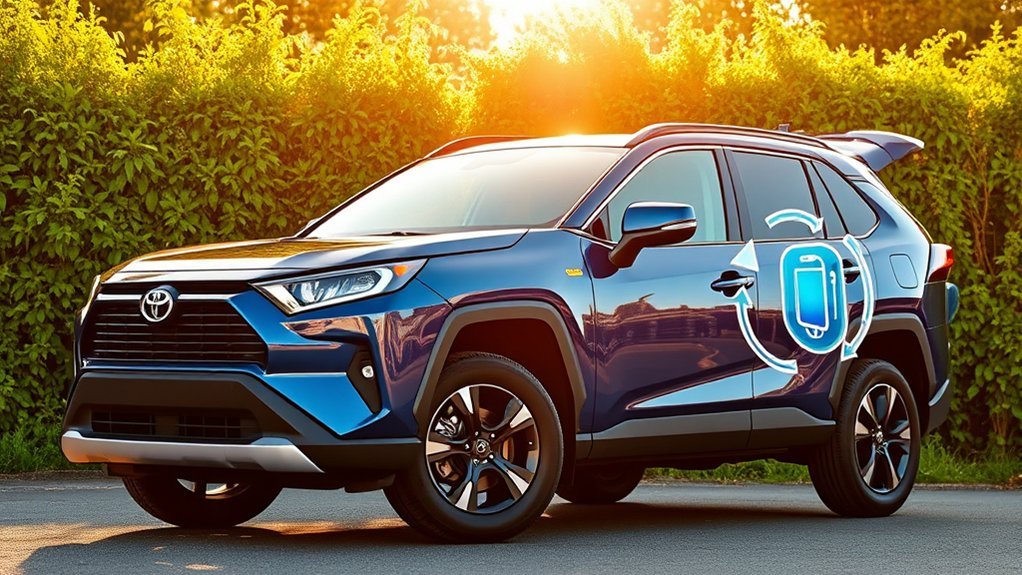
The RAV4 Hybrid combines a gasoline engine, electric motor-generators, and a high-voltage traction battery. Its computer automatically decides when to use gasoline power, electric assistance, or a combination of both.
According to the U.S. Department of Energy, a conventional hybrid cannot be plugged into an outside electricity source. Instead, it replenishes its battery through regenerative braking and the internal-combustion engine.
| Method | What Happens |
|---|---|
| Regenerative braking | A motor-generator converts part of the vehicle’s motion into electricity while you slow down or brake. |
| Engine-generated electricity | The hybrid system can use gasoline-engine power to operate a motor-generator and replenish the battery when needed. |
| Automatic energy management | The vehicle controls the flow of power among the engine, battery, and electric motors without requiring driver input. |
Note: “Self-charging” does not mean the vehicle creates free energy. Electricity comes from gasoline-engine power or from recovering some of the vehicle’s existing motion during deceleration.
What Powers the RAV4 Hybrid?
The exact components vary by model year and market. Current RAV4 Hybrid models combine a gasoline engine with electric motor-generators and an electronically controlled continuously variable transmission, commonly called an eCVT.
For the U.S. 2026 model, Toyota identifies a 2.5-liter four-cylinder engine, two front motor-generators, and a lithium-ion traction battery. All-wheel-drive versions also use a separate rear electric motor. Older RAV4 Hybrid versions may use different batteries, outputs, and control systems, so you should not assume that one specification applies to every model year.
During normal driving, the system may:
- Move the vehicle with electric power for brief periods
- Use the gasoline engine by itself
- Combine engine and electric-motor power during acceleration
- Shut the engine off while stopped or when its power is not required
- Recover electrical energy while slowing down
RAV4 Hybrid vs. RAV4 Plug-in Hybrid
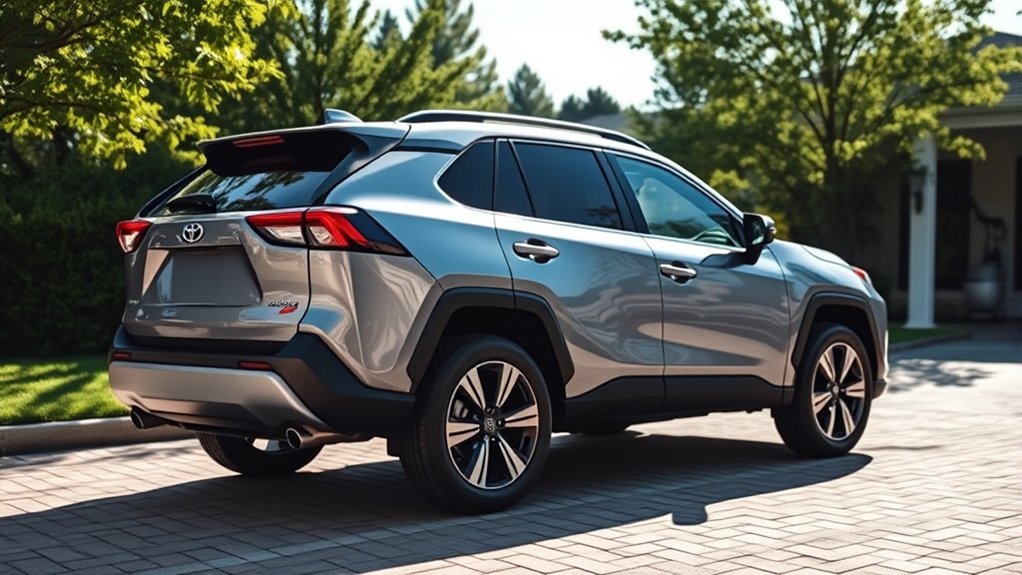
The word “Hybrid” can cause confusion because Toyota sells both a conventional Hybrid Electric Vehicle and a Plug-in Hybrid Electric Vehicle. Both can use gasoline and electricity, but only the Plug-in Hybrid accepts electricity from an external charger.
| Feature | RAV4 Hybrid | RAV4 Plug-in Hybrid |
|---|---|---|
| External charging | Not available or required | Available through its charging port |
| Battery size | Smaller battery designed for hybrid assistance and brief electric operation | Larger battery designed for meaningful electric-only travel |
| Electric-only driving | Brief operation when conditions allow | Longer electric driving after external charging |
| What happens without charging? | Operates normally because it was not designed for external charging | Continues in hybrid operation but loses much of the electric-driving benefit |
| How to identify it | No traction-battery charging port | Has an external charging port and PHEV/Plug-in Hybrid identification |
| Best fit | Drivers who want hybrid efficiency without arranging regular charging | Drivers who can charge regularly and want to complete more trips electrically |
Toyota renamed the U.S. RAV4 Prime as the RAV4 Plug-in Hybrid for model year 2025. Older vehicles may therefore carry a “Prime” badge even though they use a plug-in hybrid powertrain.
The redesigned 2026 lineup includes both HEV and PHEV versions. Toyota’s current U.S. specifications list an EPA-estimated all-electric range of up to 54 miles for the 2026 RAV4 Plug-in Hybrid SE. Range differs by grade and varies with temperature, speed, climate-control use, battery condition, and driving conditions.
Does the Standard RAV4 Hybrid Have a Charging Port?
No. The standard RAV4 Hybrid does not provide an external charging connection for its high-voltage traction battery. You do not receive a traction-battery charging cable, and you do not need to install home charging equipment for the standard Hybrid.
You still need to refuel the gasoline tank. The engine supplies propulsion and can help generate electricity whenever the hybrid-control system determines that battery support is needed.
Can the RAV4 Hybrid Drive on Electricity Alone?
Yes, but only for short periods when operating conditions allow. The standard Hybrid’s EV mode is designed for limited electric operation, not the sustained electric range provided by a RAV4 Plug-in Hybrid.
EV mode may be unavailable, or the gasoline engine may start, when:
- The traction battery’s charge is too low
- You press the accelerator firmly
- The vehicle needs more power for speed or an incline
- The hybrid system or engine is not at a suitable operating temperature
- Heating, cooling, or other vehicle demands require engine operation
A fixed claim such as “electric driving up to 50 km/h” is not reliable across every model year and situation. Vehicle speed is only one of several conditions the system considers.
What Happens When the Hybrid Battery Gauge Is Low?
You normally do not need to take any action. The battery gauge shows the charge available within the range that Toyota allows the system to use. It is not the same as a phone battery percentage, and the system does not normally try to keep the traction battery at 100%.
When the available charge falls, the gasoline engine can run more often and the motor-generators can replenish the battery. Regenerative braking recovers additional energy as you slow down, and the vehicle may limit EV-mode operation until conditions improve.
Warning: Never attempt to open, externally charge, disconnect, or repair the high-voltage traction battery yourself. High-voltage components require the procedures and protective equipment specified by Toyota.
How Much Fuel Does a RAV4 Hybrid Use?
Fuel economy depends on the model year, grade, drivetrain, country, weather, load, tires, and driving style. A single figure such as 5.8 L/100 km should not be presented as the rating for every RAV4 Hybrid.
For example, Toyota Canada’s 2026 estimates range from 5.5 L/100 km combined for the LE AWD to 6.2 L/100 km combined for the Woodland AWD. Limited and XSE AWD grades are listed at 5.8 L/100 km combined.
Fuel economy is specific to the model year, trim, drivetrain, and market. A 5.8 L/100 km rating applies to some RAV4 Hybrid versions, not the entire lineup.
Check the fuel-economy label, Toyota specifications, or owner documentation for your exact vehicle rather than relying on a figure from another year or market.
RAV4 Hybrid Battery Warranty and Maintenance
For U.S. Toyota hybrid vehicles beginning with model year 2020, Toyota states that the hybrid battery is covered for 10 years from the original date of first use or 150,000 miles, whichever comes first, subject to the terms and conditions of the New Vehicle Limited Warranty. The warranty period is not a guaranteed battery lifespan or a prediction that replacement will be necessary when coverage ends.
Warranty terms can differ by country, sale date, and model year. Review the warranty guide supplied with your RAV4 for the terms that apply to your vehicle.
A RAV4 Hybrid still has a gasoline engine, so it requires many familiar services, including:
- Engine oil and filter service at the specified intervals
- Tire-pressure checks, rotations, and alignment inspections
- Brake, fluid, hose, and suspension inspections
- Engine and hybrid-system coolant service when scheduled
- Inspection of warning lights and hybrid-system messages
Regenerative braking may reduce friction-brake use, but it does not eliminate brake inspection or maintenance. You should also keep any traction-battery cooling intake identified in your owner’s manual clear of dust, fabric, luggage, and other obstructions.
Pro Tip: Use Toyota’s schedule for your exact model year instead of following a generic hybrid-maintenance checklist. Toyota provides model-specific manuals and warranty guides through its owner resources.
Do You Need to Plug In on Long Trips or While Towing?
No. A standard RAV4 Hybrid does not require charging stops on long journeys or while towing. You refuel it with gasoline like another gasoline-powered vehicle, while the hybrid system automatically manages the traction battery throughout the trip.
A RAV4 Plug-in Hybrid can also continue in gasoline-electric hybrid operation after its usable plug-in charge becomes low. Regular external charging is still how you obtain its longer electric-only capability.
Towing does not change the basic charging rule. Properly equipped RAV4 Hybrid models can tow, but capacity varies by configuration. Toyota lists towing capacities of up to 3,500 pounds for selected 2026 U.S. AWD Hybrid grades, while FWD models and the LE AWD are listed at 1,750 pounds.
Earlier model years and vehicles sold in other markets may have different limits. Check your owner’s manual, certification labels, hitch rating, trailer-brake requirements, payload, and combined-weight limits before towing.
How Can You Tell Which RAV4 Version You Have?
The fastest check is the charging port. Then confirm the badges and vehicle documents:
- RAV4 Hybrid or HEV: No traction-battery charging port and no external traction-battery charging cable
- RAV4 Plug-in Hybrid or PHEV: Has an external charging port
- RAV4 Prime: The former U.S. name for the plug-in version
Do not confuse the fuel door with a charging door. Both versions have a gasoline tank, but only the Plug-in Hybrid has an external electrical connection for charging its traction battery. For a deeper explanation of the plug-in system, see how the Toyota RAV4 Plug-in Hybrid works.
Frequently Asked Questions
Can I drive a standard RAV4 Hybrid on electric power only?
Yes, but only for short periods when battery charge, power demand, temperature, and other operating conditions allow. Its EV mode is not designed to provide the sustained electric range of a Plug-in Hybrid.
What happens if the RAV4 Hybrid battery charge becomes low?
The gasoline engine can operate more often while the motor-generators and regenerative braking replenish the traction battery. The system manages the battery within a protected operating range, so you do not manually recharge it.
How long does a RAV4 Hybrid battery last?
There is no single guaranteed service life. Battery condition depends on age, use, temperature, maintenance, and other factors. For U.S. Toyota hybrids beginning with model year 2020, Toyota’s hybrid-battery warranty is 10 years from the original date of first use or 150,000 miles, whichever comes first, but warranty duration should not be treated as expected lifespan.
Is the RAV4 Hybrid good for long road trips?
Yes. You refuel the standard Hybrid with gasoline, and the vehicle manages its traction battery automatically. You do not need to plan external charging stops for a standard RAV4 Hybrid.
What maintenance does the RAV4 Hybrid require?
It requires scheduled engine oil service, tire care, fluid and brake inspections, coolant service, and other maintenance listed for its model year. The high-voltage system should be inspected or repaired only by properly trained technicians.
Can I tow with a RAV4 Hybrid?
Yes, if the vehicle and towing equipment are properly configured. Capacity varies by model year, grade, and drivetrain. Selected 2026 U.S. AWD Hybrid grades are rated up to 3,500 pounds, while other versions have lower limits. Always use the rating for your exact vehicle.
Can I drive a RAV4 Plug-in Hybrid without charging it?
Yes. It can continue operating as a gasoline-electric hybrid when external charge is unavailable. However, regular external charging is how you make full use of its larger battery, longer electric-only range, and potential fuel savings.
Conclusion
You do not plug in a standard Toyota RAV4 Hybrid. Regenerative braking and the engine-driven motor-generators automatically manage its traction-battery charge while you drive. You simply refuel with gasoline and follow the maintenance schedule for your model year.
The RAV4 Plug-in Hybrid is the exception. It can continue operating as a hybrid when you cannot charge it, but plugging it in regularly provides the longer electric-only driving capability that separates it from the standard Hybrid. If you are unsure which version you own, look for an external charging port and confirm the full model name in your vehicle documents.
Sources
- U.S. Department of Energy: How Hybrid Electric Cars Work — explains non-plug-in hybrid charging and regenerative braking.
- U.S. Department of Energy: How Plug-In Hybrid Electric Cars Work — explains external charging and hybrid operation in PHEVs.
- Toyota USA: 2026 RAV4 Hybrid and Plug-in Hybrid Information — supports current powertrain and towing information.
- Toyota USA: 2026 RAV4 Plug-in Hybrid — provides the current EPA-estimated electric-range rating.
- Toyota USA: RAV4 Prime Renamed RAV4 Plug-in Hybrid — confirms the model-year 2025 naming change and continued hybrid operation when external charging is unavailable.
- Toyota Canada: 2026 RAV4 Specifications — supports current Canadian fuel-consumption estimates.
- Toyota Manuals and Warranties — provides current U.S. hybrid-battery warranty information and model-specific owner documentation.
