
Backing a trailer with your Toyota Tundra becomes much easier when you slow the maneuver down and follow a repeatable process. Before shifting into reverse, inspect the connection, clear the path, adjust your mirrors, and decide where the trailer needs to finish. Camera views can help when equipped, but your mirrors, a spotter, and direct visual checks remain essential.
Quick Answer
To back up a trailer with a Toyota Tundra, pull slightly past the target, hold the bottom of the steering wheel, and move your hand toward the direction you want the trailer to travel. Reverse slowly, watch both mirrors, make tiny corrections, and pull forward to reset before the trailer angle becomes too sharp.
Key Takeaways
- Inspect the hitch, safety chains, breakaway cable, electrical connector, tires, load, and backing path before moving.
- Hold the bottom of the steering wheel and move your hand toward the direction you want the trailer to go.
- Reverse at walking speed and use small steering inputs followed by timely straightening.
- Use mirrors, a spotter, and available Tundra camera views together rather than depending on one aid.
- Stop and pull forward to reset whenever the trailer angle becomes difficult to control.
At a Glance
| Time Required | Allow about 20–45 minutes for setup and a careful maneuver; practice sessions may take longer. |
| Difficulty | Beginner to intermediate |
| Tools Needed | Properly adjusted mirrors, wheel chocks, an optional spotter, practice cones, and equipped camera views if available |
| Cost | Usually $0 with equipment you already have |
Warning: Stop immediately if a person enters the backing path, your spotter disappears from view, a camera display fails, or you become unsure of the trailer’s position. Never continue moving based on a guess.
Before Backing Up: Inspect the Truck, Trailer, and Path
A safe maneuver starts with a complete walkaround. Do this even when you recently connected the trailer because a missed latch, loose cable, or nearby obstacle can create a serious problem once the combination begins moving.
- Confirm the coupler is locked: Verify that it is fully seated on the correct hitch ball and secured with its pin or lock.
- Check the safety chains: Attach them to the truck’s approved connection points without allowing them to drag.
- Attach the breakaway cable correctly: Connect it to the truck as directed by the trailer manufacturer, not to a loose safety chain.
- Connect the electrical plug: Test the brake lights, turn signals, running lights, and trailer brakes when fitted.
- Raise and secure the tongue jack: Confirm that jacks, stabilizers, steps, doors, and storage compartments are secured.
- Inspect tires and cargo: Look for obvious tire damage and confirm that the load cannot shift during the maneuver.
- Walk the entire path: Check for posts, curbs, branches, roof overhangs, children, pets, soft ground, drop-offs, and objects hidden below mirror level.
- Identify the stopping point: Choose a visible reference that shows when the trailer has reached its final position.
Adjust both side mirrors before reversing. You should be able to see the trailer’s sides and enough ground beside it to judge clearance. Extend equipped tow mirrors when needed.
[Amazon Products Picked for You]

Universal In Application And Position

[High-Quality Materials]: Made of high-quality PP, glass lens, and rubber, the trailer tow mirror is durable, heat-resistant, and wear-resistant, making it remarkably durable and long-lasting.
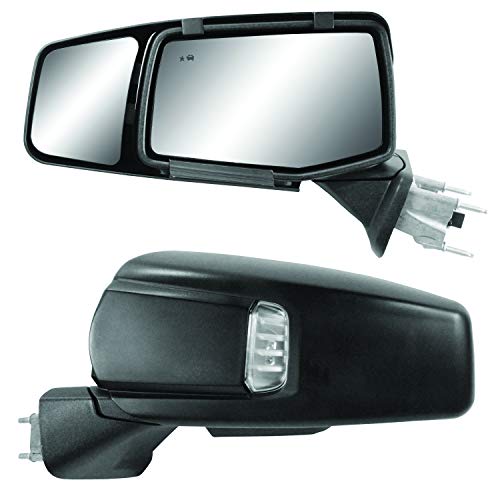
Easy Clip-on Install - no tools or additional hardware required
How to Back Up a Trailer With a Toyota Tundra: Step by Step
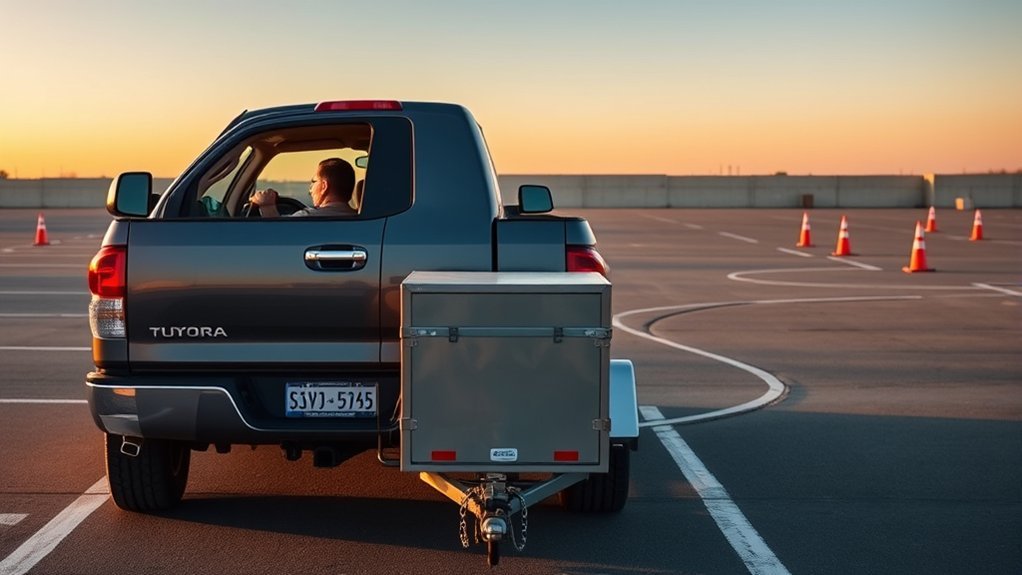
- Pull past the target. Drive forward until the trailer axle is slightly beyond the entrance to the space. Leave room for the front of your Tundra to swing.
- Pause and check the area again. Confirm that the path remains clear and that your spotter is in a safe, visible position.
- Select reverse and release the brake gently. Let the truck move at idle or walking speed. Avoid using heavy throttle.
- Hold the bottom of the steering wheel. Move your hand toward the direction you want the rear of the trailer to travel.
- Start with a very small input. Watch the trailer in both mirrors as it begins rotating toward the target.
- Straighten the steering wheel early. Once the trailer has the needed angle, reduce the steering input so the angle does not keep increasing.
- Countersteer to follow the trailer. Turn the truck so it follows behind the trailer and gradually straightens the combination.
- Pause whenever visibility is incomplete. Set the parking brake, get out, and inspect the trailer’s position and clearance.
- Pull forward when the approach is poor. Straighten the truck and trailer, move ahead, and begin again from a better angle.
- Finish slowly. Stop at the chosen reference point, apply the parking brake, keep the service brake applied as needed, and place wheel chocks before disconnecting or working around the trailer.
Pro Tip: Pulling forward is not a failed attempt. A short reset is usually faster and safer than trying to rescue a poor angle while continuing backward.
Understand How Trailer Steering Works
The rear of your truck and the trailer initially move in opposite directions when you turn the steering wheel during reverse travel. That can feel confusing until you use the bottom-of-wheel method.
Place one hand at the six-o’clock position. Move that hand left when you want the trailer to move left. Move it right when you want the trailer to move right. Because your hand is at the bottom, moving it left turns the steering wheel clockwise, and moving it right turns the wheel counterclockwise.
The first steering input starts the trailer’s turn. You must then reduce that input and countersteer as the trailer reaches the desired angle. Failing to straighten soon enough causes the angle between the truck and trailer to increase rapidly.
How Trailer Length Changes Its Response
A short trailer generally reacts quickly to steering changes, so use especially small inputs. A longer trailer often responds more slowly, giving you more time to observe the movement. Neither type should be rushed.
Do not stare at only one mirror. Alternate between both sides so you can detect whether the trailer is drifting and whether the truck’s front end is approaching an obstacle.
Use a Spotter Safely
A spotter can see low obstacles and blind areas that may be hidden from the driver. Agree on simple signals before moving and avoid changing the system midway through the maneuver.
- Stop: Both hands raised with palms facing the driver.
- Move toward the driver’s side or passenger side: A clear pointing motion toward the required direction.
- Continue straight: Hands directing the truck slowly backward.
- Distance remaining: Hands showing the approximate space between the trailer and stopping point.
Keep the spotter on the driver’s side when practical, where you can see them through the window or mirror. The spotter must never stand directly behind the trailer, between the truck and trailer, or where the truck’s front end may swing.
If you lose sight of the spotter, stop. Do not assume the spotter moved to a safe location.
[Amazon Products Picked for You]

FITMENT: 2015 2014 2013 2012 2011 2010 2009 2008 15 14 13 12 11 10 09 08 Titan Pro-4X Model ; 2015 - 2011 Titan SL SV Model ; 2010 2009 2008 2007 2006 2005 2004 Titan LE SE Model

Expand Your View, Drive Safer - Eliminate blind spots instantly and increase visibility during lane changes, merging, and parking for a safer driving experience.

[Vehicle Fitment]: This A-Premium passenger side mirror glass is compatible with Dodge Ram 1500/2500/3500 2005-2008 --- It fits the model with Power Trailer Towing Mirror
Use Tundra Camera and Mirror Features When Equipped

Recent Toyota Tundras may offer several towing-view features, but availability depends on the model year, grade, package, and installed equipment. Check the owner’s manual and your truck’s equipment list before relying on a particular function.
[Amazon Products Picked for You]

Easy Clip-on Install - no tools or additional hardware required

100FT Wireless Range: - This wireless backup camera system built-in with strong and stable WiFi signals, which could boast up to 100ft digital range(in open area); Recommend to use at vehicles under 60ft, perfect for Truck, Camper, RV, Trailers, Fifth Wheels, Travel Trailers, Fifth Wheels etc; Easily attach to SUV, Pickup Truck, Travel Trailer, Horse Trailer, RV Camper, Semi Truck, Tractor or Farm Equipment, for monitoring or vehicle reversing

4K Screen & 4 1080P Backup Cameras: With the 10.36 inch 4K ultra HD 4-split touch screen & 4 pcs of 1080P Full HD camera, you can get sharper, cleaner and more vivid view on road to get the ultimate travel pleasure
Panoramic View Monitor and Hitch Views
Toyota describes an available Panoramic View Monitor that can provide a top-down view, a truck-bed view, a rear split view beside the trailer, and a hitch view for connecting. These views can help you judge nearby objects, but they may distort distance and do not show every hazard.
Wireless Trailer Camera System
An available Toyota Wireless Trailer Camera System uses a camera mounted at the rear of the trailer to provide an additional rearward view. It is optional equipment rather than a standard built-in feature on every Tundra. When fitted, confirm that the camera is charged, mounted securely, paired correctly, and displaying a clear image before moving.
Tow Mirrors and Reference Points
Available power-extending tow mirrors can improve your view along the trailer’s sides. Adjust the mirrors before reversing and establish reference points, such as a painted line, cone, fence post, or edge of the parking pad.
Note: Camera systems are visual aids, not replacements for mirrors, a spotter, or getting out to look. If a display freezes, turns black, or shows an unreliable view, stop and use direct checks. You can also check your VIN for open recalls through the NHTSA recall lookup.
Make Small Corrections and Avoid Jackknifing
Small steering movements give you time to see how the trailer responds. Large or rapid inputs can make the trailer rotate faster than you can correct it.
Watch the angle between the truck and trailer. If the angle continues tightening after you straighten the steering wheel, countersteer so the truck begins following the trailer. If the angle becomes sharp or you are unsure which correction to make, stop.
The cleanest correction is often to stop, pull forward, straighten the combination, and try again.
How to Recover From a Developing Jackknife
- Stop reversing before the truck and trailer approach contact.
- Shift into drive.
- Turn the truck in the direction that opens the angle between the truck and trailer.
- Pull forward until the combination is nearly straight.
- Reposition the truck and begin the backing approach again.
Do not attempt to force the trailer straight by accelerating backward. More speed reduces your time to react and can worsen the angle.
Common Trailer Backing Mistakes and How to Fix Them
| Mistake | What Happens | Better Approach |
|---|---|---|
| Reversing too quickly | The trailer changes direction before you can evaluate the angle. | Use idle or walking speed and pause often. |
| Making a large steering input | The trailer rotates sharply and may begin jackknifing. | Use a small input, observe, and then correct. |
| Watching only one mirror | You may miss an obstacle or drift on the opposite side. | Scan both mirrors and the truck’s front swing area. |
| Depending entirely on a camera | Blind areas, dirt, glare, distortion, or a display fault can hide a hazard. | Combine the camera with mirrors, a spotter, and direct checks. |
| Trying to save a bad approach | The angle becomes harder to control and clearance decreases. | Pull forward, straighten, and reset. |
| Ignoring the truck’s front end | The front of the Tundra may swing into another vehicle, post, or wall. | Leave front-swing clearance and scan it throughout the turn. |
Special Precautions for Slopes, Ramps, and Tight Spaces
Backing on a slope or boat ramp adds gravity, reduced traction, and limited stopping space. Use a spotter when practical, avoid sudden throttle or brake inputs, and keep people clear of the downhill side of the combination.
Before leaving the driver’s seat, apply the parking brake and follow the truck and trailer manufacturers’ parking instructions. Chock the trailer wheels before disconnecting. Do not rely on the transmission’s Park position alone to hold a loaded combination on a grade.
In a narrow campsite, alley, or storage area, inspect overhead clearance as carefully as ground clearance. Air conditioners, vents, awnings, roof racks, tree limbs, and building eaves may be outside the camera’s view.
Practice Trailer Backing in an Open Area
Choose an empty, level area where trailer practice is permitted. Set cones to represent the entrance and back of a parking space. Begin with a wide space before making the course narrower.
- Practice backing straight while keeping equal trailer visibility in both mirrors.
- Make one small steering input and watch how quickly the trailer reacts.
- Straighten and countersteer until the truck follows the trailer.
- Practice stopping, pulling forward, and resetting without rushing.
- Repeat from both the driver’s side and passenger side.
Driver-side backing is generally easier because you can look through the driver’s window as well as the mirror. Passenger-side backing places more of the trailer on your blind side, so use extra pauses and direct checks.
Frequently Asked Questions
How do beginners reverse with a trailer?
Start in a large, empty area. Hold the bottom of the steering wheel and move your hand toward the direction you want the trailer to travel. Reverse slowly, straighten the steering early, and pull forward whenever the angle becomes difficult to control.
Does the Toyota Tundra have trailer backup assist?
Tundra towing technology varies by model year, grade, package, and installed options. Recent models may offer features such as a Panoramic View Monitor, hitch view, rear split view, tow mirrors, and a Wireless Trailer Camera System. Do not assume your truck has Straight Path Assist. Check the owner’s manual and equipment list for your exact Tundra.
Which way should I move the steering wheel when backing a trailer?
Hold the wheel at the bottom and move your hand toward the direction you want the trailer to go. Move your hand left for trailer-left movement and right for trailer-right movement. Make a small input, then straighten and countersteer as the trailer reaches the desired angle.
How should I back up a trailer for the first time?
Practice on level ground in an open area with cones and an experienced spotter. Begin by backing straight, then practice gentle turns. Keep the speed extremely low, pause to inspect your position, and use pull-forward resets whenever needed.
What should I do if the trailer starts to jackknife?
Stop reversing immediately. Shift into drive and pull forward while steering to open the angle between the truck and trailer. Continue until the combination is nearly straight, reposition the truck, and restart the approach.
Can I back up a trailer without a spotter?
You can back without a spotter when conditions allow, but you must stop and get out whenever you cannot verify clearance. Use both mirrors and available camera views, move slowly, and repeat direct inspections as often as necessary.
How do I use the Tundra rear step?
Deploy the rear step fully before placing weight on it, keep three points of contact when climbing, and stow it securely before driving. Its design and operating method may vary, so follow the instructions and load limit in the owner’s manual for your exact Tundra.
Conclusion
Successful trailer backing depends more on patience and a repeatable process than on technology. Inspect the connection and path, approach the space with enough room, use the bottom-of-wheel method, and make small corrections at walking speed.
Your Tundra’s available mirrors and camera views can improve visibility, but they cannot replace direct checks or a well-positioned spotter. When the angle becomes poor, stop and pull forward. Each controlled reset helps you complete the maneuver with less risk to the truck, trailer, people, and nearby property.
Sources
- Toyota USA Newsroom: 2025 Toyota Tundra — supports the descriptions and availability limits for the Panoramic View Monitor, hitch view, rear split view, Wireless Trailer Camera System, and tow mirrors.
- Toyota USA Newsroom: 2026 Toyota Tundra — supports current towing-package and model-year equipment context.
- Toyota Manuals and Warranties — provides model-specific owner’s manuals and Toyota Wireless Camera System information.
- National Highway Traffic Safety Administration Recall Lookup — provides VIN-based searches for unrepaired vehicle recalls.