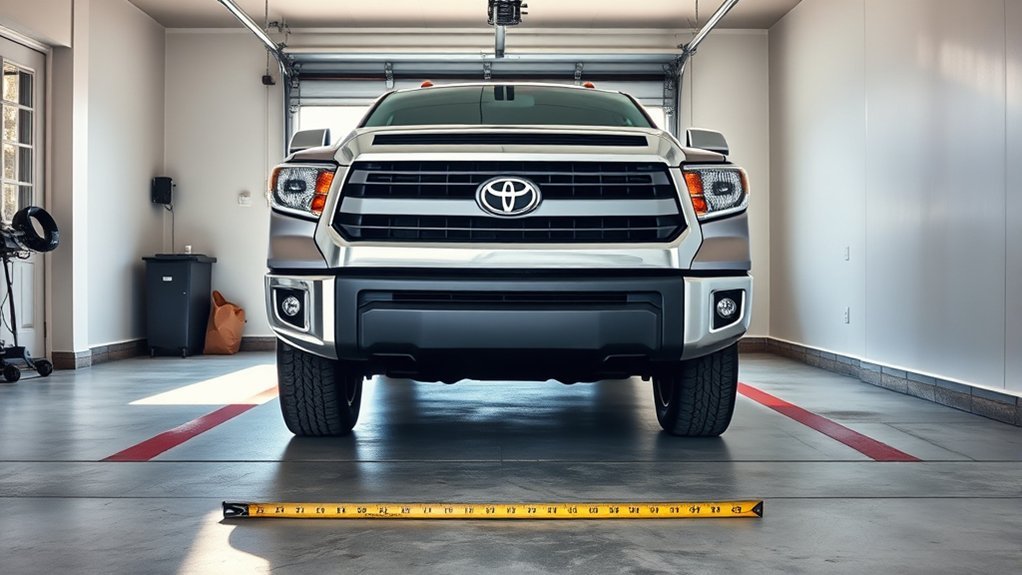
A Toyota Tundra can fit in many residential garages, but the answer depends on its model year, cab, bed, mirrors, tires, and accessories. The garage door may also be narrower or lower than the room behind it, so checking only the garage’s advertised size can lead to expensive scrapes or a truck that technically fits but is difficult to use.
For reliable planning, measure your actual Tundra and the finished garage opening. Then account for room to open the driver’s door, walk around the truck, close the garage door, and reach any shelves or equipment.
Quick Answer
For a stock current-generation Toyota Tundra, plan on a garage at least 24 feet deep, with 26 feet preferred for the longest configuration. A 10-foot-wide door and 8-foot height offer comfortable access. Measure your exact truck, mirrors, accessories, and finished opening because cab, bed, trim, and modifications change the fit.
Key Takeaways
- Current-generation Tundras are roughly 19 to 21 feet long, depending on the cab and bed.
- A 24-foot garage is workable for shorter configurations, while about 26 feet is better for a long-bed truck.
- A 10-foot-wide door is preferable because mirrors and door trim make a 9-foot opening tight.
- An 8-foot-high door provides a useful margin for most stock trucks; lifted trucks may need more.
- Measure the actual truck and finished opening instead of relying only on brochure dimensions.
At a Glance
| Time Required | 15 to 30 minutes |
| Difficulty | Easy |
| Tools Needed | Tape measure, painter’s tape, notepad, and preferably a helper |
| Cost | Usually $0 if you already own a tape measure |
Understanding the Dimensions of a Toyota Tundra
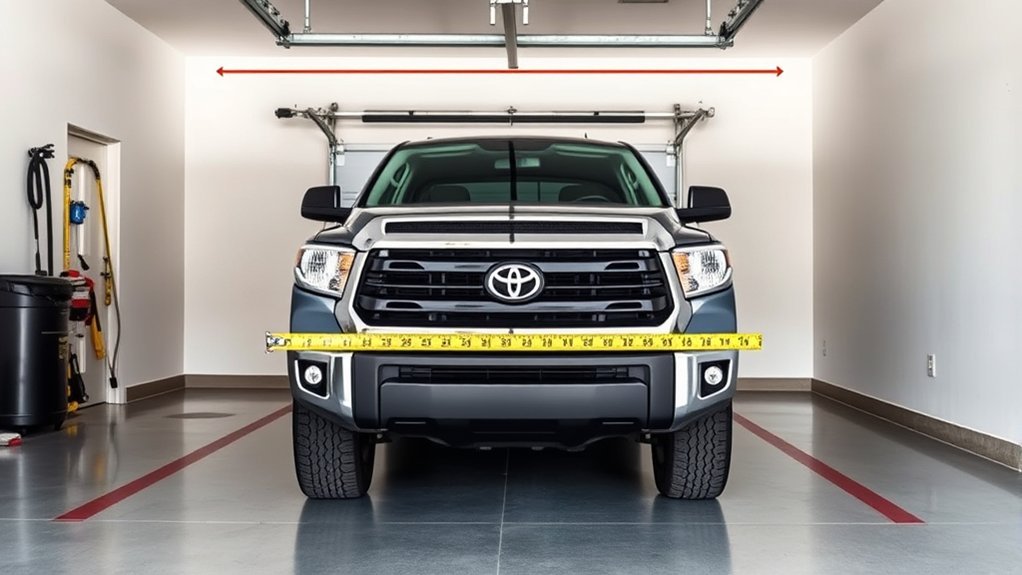
Your Tundra’s length is the first number to confirm. Toyota offers the current truck with 5.5-, 6.5-, and 8.1-foot beds, and the cab and bed combination changes the truck’s overall length.
The following figures are useful planning estimates for the current generation. Equipment and specifications can vary by model year, grade, drivetrain, tires, and installed accessories, so confirm your truck’s exact dimensions before making structural changes.
| Cab and Bed | Approximate Length | Length in Feet |
|---|---|---|
| Double Cab with 6.5-ft. bed | 228.9 inches | About 19 ft. 1 in. |
| CrewMax with 5.5-ft. bed | 233.6 inches | About 19 ft. 6 in. |
| CrewMax with 6.5-ft. bed | 245.6 inches | About 20 ft. 6 in. |
| Double Cab with 8.1-ft. bed | 252.5 inches | About 21 ft. 1 in. |
Many stock current-generation configurations are approximately 80.2 inches wide without mirrors and around 78 to 79 inches tall. The mirrors extend beyond the body, and available tow mirrors can require considerably more room.
The truck’s brochure width is not the same as the clearance required at the garage door. Measure the mirrors, jambs, trim, weather seals, and any hardware projecting into the opening.
What Size Garage Do You Need for a Toyota Tundra?
No single garage size fits every Tundra configuration. You need to consider the interior bay, the finished door opening, the truck’s mirrors, and how much usable space you want after parking.
| Garage Measurement | Tight or Basic Fit | Preferred Target |
|---|---|---|
| Interior depth | 24 feet for shorter configurations | 26 feet for long-bed trucks or easier access |
| Interior bay width | 10 feet, with limited door-opening room | 11 to 12 feet |
| Door-opening width | 9 feet may work with careful alignment and folded mirrors | 10 feet |
| Door-opening height | 7 feet may clear an unmodified truck after measurement | 8 feet for a stock truck; more for modifications |
Minimum Garage Dimensions Required
A 24-foot-deep garage measures 288 inches. Subtracting the truck’s length shows how much total space remains in front of and behind it.
- 228.9-inch truck: About 59.1 inches remain, or roughly 29.5 inches at each end if centered.
- 233.6-inch truck: About 54.4 inches remain, or roughly 27.2 inches at each end.
- 245.6-inch truck: About 42.4 inches remain, or roughly 21.2 inches at each end.
- 252.5-inch truck: About 35.5 inches remain, or roughly 17.8 inches at each end.
This means a 24-foot garage can physically hold the longest current-generation configuration, but access around it will be limited. A 26-foot depth provides about 59.5 inches of total extra space around a 252.5-inch truck.
Width also needs careful calculation. If the truck body is about 80.2 inches wide, a 10-foot interior bay leaves approximately 39.8 inches total, or 19.9 inches per side. A 12-foot bay leaves approximately 31.9 inches per side.
Pro Tip: Mark the truck’s full footprint on the garage floor with painter’s tape. Include the mirrors and open the driver’s door within the outline to see whether the space will be usable, not merely large enough to contain the truck.
Clearance Considerations for Parking
Measure the narrowest point of the finished garage-door opening from jamb to jamb. Do not use the door panel’s advertised width if trim, tracks, weather stripping, masonry, or framing reduces the usable opening.
You can calculate approximate side clearance with this formula:
(Finished opening width − actual truck width) ÷ 2 = clearance per side
A 9-foot opening is 108 inches wide. Subtracting an 80.2-inch body leaves about 13.9 inches on each side before accounting for mirrors. A 10-foot opening leaves about 19.9 inches on each side.
For height, measure from the driveway surface at the threshold to the lowest part of the open door, bottom seal, opener arm, or other obstruction. Then measure the truck at its highest fixed point.
Warning: Do not attempt a close-clearance entry based only on published vehicle height. A lift kit, larger tires, roof rack, rooftop tent, antenna, snow buildup, driveway slope, or hanging door seal can reduce the available margin. Leave at least three inches of verified static overhead clearance, with more preferred.
Key Clearance Requirements for Parking Your Tundra
Use the following targets as practical planning guidance rather than building-code requirements:
- Driver’s side: About 30 to 36 inches is comfortable for regularly entering and exiting.
- Passenger side: Approximately 18 to 24 inches may work if passenger access is occasional.
- Front and rear: Keep at least 18 inches at the tighter end when possible. About 24 to 36 inches is more useful for walking, loading, or accessing storage.
- Overhead: Maintain at least three measured inches above the truck’s highest point. More clearance reduces risk.
- Door opening: Include mirrors, jambs, seals, handles, tracks, and wall projections in your calculations.
Also inspect the transition between the driveway and garage floor. A steep approach can temporarily change the truck’s angle as the front and rear wheels cross the threshold, reducing roof or bumper clearance.
Maneuvering Your Tundra: Tips for Tight Spaces
A repeatable parking routine is safer than trying to judge a narrow opening differently each day. Clear stored items away from the path and use fixed visual references that guide the truck to the same position.
Optimal Parking Techniques
- Approach straight: Center the truck before reaching the opening instead of making a sharp correction at the threshold.
- Move at idle speed: Avoid sudden throttle or brake inputs in a confined space.
- Use a spotter: Ask the helper to remain visible in a mirror and agree on simple stop signals before moving.
- Mark the stopping point: Use a properly secured wheel stop, hanging ball, wall marker, or garage laser.
- Check the garage door: Confirm it is fully raised before entering or leaving.
Backing into the garage can make departure easier, but it may put the bed or rear bumper closer to stored items. Choose the direction that gives you the clearest sight lines and safest exit.
Use Folding Mirrors and Parking Assistance
The Toyota Tundra does not have a factory switch that retracts its bumpers. Depending on the grade and equipment, it may instead offer power-folding mirrors, a Panoramic View Monitor, Multi-Terrain Monitor views, or front and rear parking assistance.
Fold the mirrors before crossing a narrow opening when your truck supports that function. Camera views and sensors can help with alignment, but they should supplement direct observation rather than replace it.
Note: Camera images can distort distance, and parking sensors may not detect every shelf, pipe, mirror-height obstacle, or hanging object. Stop and inspect the area whenever the clearance is uncertain.
Use Diagonal Parking Only After Testing
Diagonal parking can help in an unusually shaped or side-access garage, but it is not automatically more space-efficient. Angling a long truck may bring a front corner, rear corner, or mirror closer to a wall while blocking walkways and storage.
Before using this method, outline the angled truck position with painter’s tape. Check every corner, the swing of each door, the garage-door path, and the room needed to straighten the truck during entry and exit.
Must-Have Garage Features for Parking Your Tundra
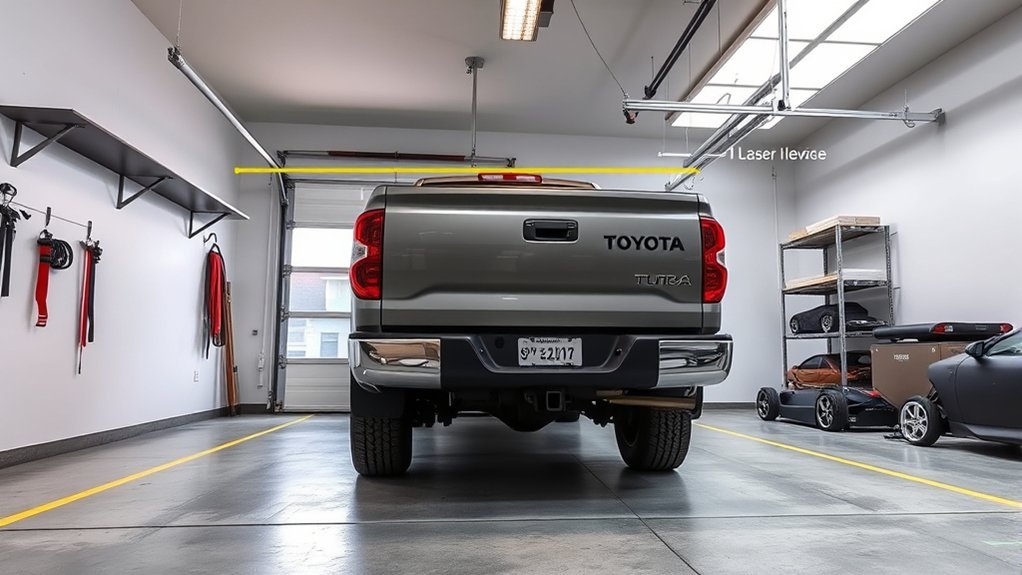
A Tundra-friendly garage needs more than an adequate floor area. The opening, lighting, storage, wall protection, and parking guidance all affect daily usability.
- Wide finished opening: A 10-foot door provides a better margin than a 9-foot opening.
- Useful door height: An 8-foot opening suits most unmodified trucks, while lifted trucks may need 9 feet or more.
- Bright lighting: Position lights so mirrors, walls, shelves, and floor markings remain visible at night.
- Wall protection: Add padded guards where a door edge could contact a wall or cabinet.
- Consistent parking aid: Use a wheel stop, laser, hanging marker, or floor line.
- Shallow or elevated storage: Keep cabinets and tools outside the truck’s mirror and door-swing zones.
- Safe garage-door system: Keep sensors unobstructed and test the opener’s reversal function.
The U.S. Consumer Product Safety Commission advises homeowners to maintain automatic reversal protection and test the door’s reverse function. Never bypass the photoelectric sensors to gain storage or parking space.
Organizing Your Garage Efficiently for Your Tundra
Start by removing floor-level clutter from the entire parking path. A small box, snow shovel, bicycle wheel, or extension cord can force you off the intended centerline.
- Move storage upward: Use wall-mounted shelves above door-handle height where they will not interfere with mirrors or passengers.
- Protect usable side space: Avoid deep cabinets beside the driver’s door.
- Keep the front wall simple: Do not place fragile equipment where a stopping error could damage it.
- Mark permanent boundaries: Add floor tape showing the tire path and safe stopping zone.
- Review seasonal changes: Account for winter tires, roof accessories, snow equipment, and items stored during colder months.
Vertical storage helps, but do not hang ladders, kayaks, bicycles, or tools where they can fall onto the truck or reduce overhead clearance.
Future-Proofing Your Garage for Bigger Vehicles
If you are building or enlarging a garage, design for the longest and tallest vehicle you may reasonably own rather than the shortest truck in your current driveway. Extra depth and door width are difficult to add after framing, roofing, and exterior finishes are complete.
| Feature | Future-Friendly Target | Why It Helps |
|---|---|---|
| Interior Bay Width | 12 feet or more | Improves door access and allows shallow storage |
| Interior Depth | 26 feet | Fits long-bed configurations with usable end clearance |
| Garage Door Width | 10 feet | Provides a better margin for mirrors and alignment |
| Garage Door Height | 8 feet stock; 9 feet for expected modifications | Allows for larger tires, lifts, racks, or rooftop equipment |
| Electrical and Lighting | Bright side lighting and accessible outlets | Improves parking visibility and supports tools or charging equipment |
Ask a qualified designer, contractor, or garage-door professional to verify structural framing, tracks, spring systems, headroom, local codes, and opener compatibility before changing an opening.
Related Guides
Frequently Asked Questions
Can a Toyota Tundra fit in a standard garage?
Some Tundras fit in a standard residential garage, but many garages are too short, narrow, or low for comfortable use. A 24-foot depth may work for shorter configurations, while the longest current truck is easier to accommodate in a garage closer to 26 feet deep. Always measure the finished door opening and your actual truck.
How much overhead clearance should a Tundra have?
Leave at least three inches of verified static clearance above the truck’s highest point, with more preferred. Measure the lowest part of the fully open door, bottom seal, opener arm, and tracks. Lift kits, larger tires, racks, antennas, rooftop tents, snow, and driveway slope can reduce the margin.
Does the Tundra model year affect the garage size you need?
Yes. Tundra dimensions and available cab or bed combinations have changed between generations. Trim, drivetrain, tires, mirrors, suspension, and accessories can also change the truck’s height or width. Check the specification for your exact model year and measure the physical vehicle.
How deep should a garage be for a full-size truck?
A 24-foot depth is a practical starting point for many full-size trucks. A 26-foot garage is better for long-bed configurations, walking space, storage access, and safer front-to-rear clearance. Compare the garage depth with the exact bumper-to-bumper length of the truck.
Is a 9-foot-wide garage door enough for a Tundra?
A 9-foot opening may work for a stock Tundra when the truck is carefully centered and the mirrors are folded. However, it offers a narrow margin. A 10-foot-wide opening is more forgiving, especially for tow mirrors, wider accessories, or an angled approach.
Conclusion
A Toyota Tundra needs more garage space than its bumper-to-bumper dimensions alone suggest. For most stock current-generation trucks, a 24-foot-deep garage with a 10-foot-wide and 8-foot-high door is a useful planning baseline. Choose approximately 26 feet of depth for the longest configuration or when you want comfortable access around the truck.
Before parking or changing the garage, measure the exact truck, mirrors, finished opening, interior obstructions, and overhead hardware. That final fit check is more reliable than any general dimension and can prevent damage to the Tundra, garage door, walls, and stored equipment.
Sources
- Toyota: 2026 Tundra — current lineup, available bed lengths, mirrors, cameras, and vehicle features
- Toyota USA Newsroom: 2026 Toyota Tundra — current equipment and parking-assistance information
- Toyota Manuals and Warranties — model-year-specific owner documentation
- U.S. Consumer Product Safety Commission: Garage Door Safety Alert — reversal testing, sensor, inspection, and maintenance guidance
- 16 CFR Part 1211 — federal safety standard for automatic residential garage-door operators
