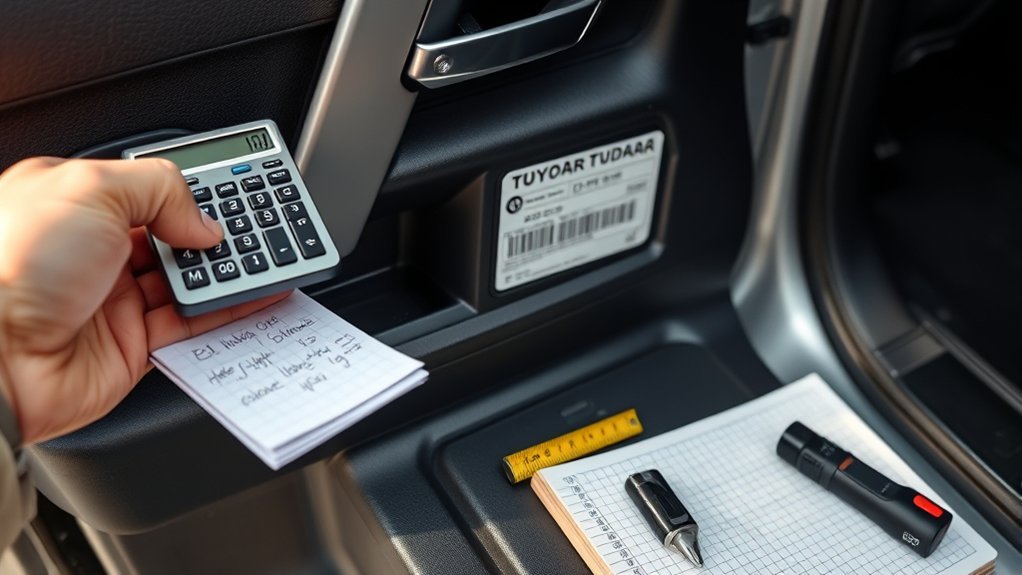
Your Toyota Tundra’s advertised towing number is only a starting point. The safe limit for your truck depends on its model year, drivetrain, cab, bed, powertrain, factory equipment, passengers, cargo, hitch hardware, and the trailer’s loaded weight. You need the correct Toyota rating plus several weight checks before you tow.
Quick Answer
Your Tundra’s door labels do not directly list one towing-capacity number. Use the truck’s exact model year, drivetrain, cab, bed, powertrain, and equipment to find Toyota’s trailer weight rating in the correct owner’s manual. Then confirm payload, axle, hitch, and GCWR limits using the truck’s actual loaded weight.
Key Takeaways
- The driver-door labels show ratings such as GVWR, GAWR, VIN, tire information, and occupant-and-cargo limits, not a universal towing-capacity figure.
- Find Toyota’s trailer weight rating for your exact model year and configuration in the correct owner’s manual or official specification data.
- Calculate your trip-specific limit by checking loaded truck weight, GCWR, payload, tongue weight, axle ratings, and hitch-component ratings.
- Use the lowest applicable limit. A hitch upgrade or weight-distributing hitch does not raise Toyota’s GVWR, GAWR, GCWR, or factory trailer rating.
At a Glance
| Time Required | 15 to 30 minutes, plus time for a public-scale visit |
| Difficulty | Easy to moderate |
| Tools Needed | Owner’s manual, door-label information, calculator, trailer specifications, and preferably a scale ticket |
| Cost | Free for the paperwork check; public scales may charge a small fee |
Why You Should Care About Your Tundra’s Towing Capacity

Staying within every weight rating helps you protect braking, steering, tires, axles, suspension, and drivetrain components. It also reduces the chance of trailer sway, poor handling, overheating, or excessive stopping distance.
As of July 2026, Toyota lists up to 12,000 pounds of maximum towing and up to 1,850 pounds of maximum payload for the 2026 Tundra. Those numbers are lineup maximums. Your truck may have lower limits because its configuration and equipment differ.
Warning: Never use a lineup maximum as your truck’s guaranteed rating. The correct limit is the lowest rating that applies to your specific truck, hitch system, loaded trailer, axle weights, and combined weight.
What the Door Labels and Owner’s Manual Tell You
Your Tundra may have more than one label near the driver’s door. The certification label normally identifies the VIN and lists the gross vehicle weight rating (GVWR) and gross axle weight ratings (GAWR). A separate tire-and-loading label states the maximum combined weight of occupants and cargo for that individual truck.
These labels help you check payload and axle limits, but they do not usually state one complete trailer weight rating. Use your model year and exact configuration to open the correct manual through Toyota’s Manuals and Warranties portal. Search the manual for “trailer towing,” “trailer weight rating,” “GCWR,” and “vehicle identification.”
Note: Do not rely on page numbers from another model year. Toyota can move towing tables and instructions when it revises a manual.
Distinguishing Between Payload and Towing Capacity
Towing capacity and payload measure different loads. You must stay within both limits at the same time. Trailer tongue weight presses on the truck, so it uses part of your available payload and can affect the rear axle load.
| Term | What It Means | How You Use It |
|---|---|---|
| Trailer weight rating | Toyota’s maximum permitted loaded trailer weight for a specific configuration and required equipment. | Treat it as a ceiling, not a target. |
| GVWR | Maximum loaded weight of the truck itself. | Compare it with the truck’s actual loaded weight. |
| GAWR | Maximum load allowed on the front or rear axle. | Check axle-group weights on a scale ticket. |
| GCWR | Maximum loaded weight of the truck and trailer combination. | Subtract the actual loaded truck weight to find the combination-based trailer allowance. |
| Payload | Weight carried by the truck, including people, cargo, added equipment, hitch hardware, and trailer tongue weight. | Subtract every carried item from the occupant-and-cargo limit. |
| Tongue weight | The downward load the trailer places on the hitch. | Count it against payload and verify rear-axle load. |
Understanding Payload Capacity
Start with the occupant-and-cargo limit printed on your truck’s tire-and-loading label. Subtract the weight of the driver, passengers, bed cargo, accessories added after manufacture, hitch equipment, and expected trailer tongue weight.
Remaining payload = door-label occupant-and-cargo limit − people − cargo − added equipment − hitch hardware.
Clarifying Towing-Capacity Limits
Toyota’s trailer weight rating remains the first ceiling. Your usable limit can be lower when the truck carries more people or cargo, when tongue weight consumes available payload, when an axle approaches its GAWR, or when a hitch component has a lower rating.
How to Calculate Your Tundra’s Usable Towing Limit
You do not calculate the factory tow rating from the door sticker alone. You look up Toyota’s rating, then calculate how much of that rating remains available for your loaded trip.
Step 1: Identify Your Exact Truck
Record the model year, VIN, cab style, bed length, drivetrain, powertrain, trim, axle information if listed, and factory towing equipment. A model code can help you match a manual table, but use every configuration detail the manual requests.
Step 2: Find Toyota’s Trailer Weight Rating and GCWR
Open the owner’s manual for your exact model year. Find the row that matches your configuration. Record the trailer weight rating, GCWR, hitch requirements, trailer-brake requirements, and any tongue-weight or load-distribution instructions.
Step 3: Calculate the GCWR-Based Allowance
Load the truck as you plan to travel, including people, cargo, accessories, and hitch equipment. Weigh the truck without the trailer attached.
GCWR-based trailer allowance = Toyota GCWR − actual loaded truck weight.
This result does not override Toyota’s trailer weight rating. It only shows how your truck’s real load affects the combined-weight limit.
Step 4: Check Payload, Tongue Weight, and Axle Limits
Confirm that the expected tongue weight fits within your remaining payload. After hitching the loaded trailer, use a public scale or an approved weighing method to check the truck’s front and rear axle weights. Neither axle may exceed its GAWR, and the truck may not exceed its GVWR.
Step 5: Use the Lowest Applicable Limit
Your final usable trailer limit is the lowest of these constraints:
- Toyota’s trailer weight rating for your exact configuration
- GCWR minus the truck’s actual loaded weight
- Payload available for tongue weight and hitch hardware
- Front and rear GAWR limits
- The receiver, ball mount, hitch ball, coupler, and other component ratings
- The trailer’s own GVWR, tire ratings, and axle ratings
Worked Example
Assume a hypothetical Tundra has a 10,500-pound Toyota trailer rating and a 17,500-pound GCWR. The loaded truck weighs 6,800 pounds, so the GCWR-based allowance is 10,700 pounds. If payload and expected tongue weight limit the trailer to 8,750 pounds, and the hitch is rated for 10,000 pounds, the usable ceiling is 8,750 pounds. You must still confirm axle loads and the trailer’s ratings.
Pro Tip: Weigh the truck and trailer in normal travel condition. Empty-trailer or “dry” weights often exclude cargo, water, batteries, propane, accessories, and other items you add later.
Factors That Affect Your Tundra’s Towing Capacity

Your Tundra’s published rating can change with cab style, bed length, wheelbase, two-wheel drive or four-wheel drive, gas or hybrid powertrain, trim, axle setup, factory towing equipment, wheels, tires, and optional features. Extra equipment can also reduce available payload because it adds weight to the truck.
Passengers, coolers, tools, bed cargo, a tonneau cover, a bed rack, running boards, and hitch hardware all use payload. Trailer tongue weight adds another load to the truck and often becomes the practical limit before the advertised maximum trailer weight does.
A weight-distributing hitch can move some load among the truck’s axles and the trailer axles when Toyota and the hitch manufacturer allow it. It does not erase weight or raise the truck’s GVWR, GAWR, GCWR, payload label, or factory trailer rating.
Avoid These Common Towing Capacity Calculation Errors
- Using 12,000 pounds for every Tundra: That figure is a lineup maximum for certain configurations, not a universal rating.
- Treating the door sticker as a tow-rating label: Use it for GVWR, GAWR, VIN, tires, and payload-related information, then use the correct manual for the trailer rating.
- Using curb weight instead of loaded weight: People, cargo, accessories, and hitch hardware reduce the trailer allowance under GCWR.
- Ignoring tongue weight: It counts against payload and can overload the rear axle even when trailer weight stays below the published maximum.
- Trusting dry trailer weight: Base your decision on the trailer’s expected loaded weight and verify it when possible.
- Assuming upgrades increase the certified rating: Suspension aids, larger tires, or a stronger receiver do not automatically change Toyota’s ratings.
- Checking only total weight: You must also stay within front GAWR, rear GAWR, hitch ratings, and trailer ratings.
How to Verify the Result With a VIN and Scale
A VIN helps identify the truck’s model year and encoded equipment. The NHTSA VIN Decoder can confirm information reported by the manufacturer, but it may not provide a complete, certified towing-capacity result. Use Toyota’s manual portal, your original build information, or a Toyota dealer when the configuration remains unclear.
For the most useful scale check, load the truck and trailer as you plan to travel. Obtain truck-axle and trailer-axle weights, then compare them with GVWR, front GAWR, rear GAWR, GCWR, Toyota’s trailer rating, and the trailer’s own ratings. Follow the scale operator’s directions and your owner’s manual.
Tundra Towing Safety Checklist

- Match the owner’s manual table to your exact truck configuration.
- Check the tire-and-loading label before adding passengers, cargo, and tongue weight.
- Confirm the receiver, ball mount, hitch ball, coupler, safety chains, and electrical connector ratings.
- Use trailer brakes and a brake controller when Toyota, the trailer manufacturer, or local law requires them.
- Load the trailer according to Toyota and trailer-manufacturer instructions.
- Check tire pressure and tire load ratings on both the truck and trailer.
- Verify lights, brakes, breakaway equipment, mirrors, and safety-chain attachment before departure.
- Recheck the load after adding water, fuel, batteries, propane, cargo, or accessories.
Related Guides
Frequently Asked Questions
How can I tell towing capacity from the door sticker?
You usually cannot read the complete towing capacity directly from the sticker. Use the label for VIN, GVWR, GAWR, tire information, and occupant-and-cargo limits. Then match your exact configuration to the towing table and instructions in the correct Toyota owner’s manual.
How do I know how much my Tundra can tow?
Find Toyota’s trailer weight rating for your exact truck. Next, calculate GCWR minus the actual loaded truck weight. Check payload, tongue weight, axle loads, hitch ratings, and trailer ratings. The lowest applicable number is your usable ceiling.
Can I look up Tundra towing capacity by VIN?
A VIN can help identify the model year and configuration, but a general VIN decoder may not return the exact trailer rating. Use the VIN with Toyota’s owner portal or ask a Toyota dealer to confirm the original configuration, then verify the rating in Toyota’s towing data.
How do I calculate towing capacity from a VIN plate?
You cannot derive Toyota’s factory trailer rating from the VIN plate alone. Use the VIN and configuration to find Toyota’s rating. You can then calculate the GCWR-based allowance by subtracting the actual loaded truck weight from GCWR.
Does tongue weight count against payload?
Yes. Tongue weight presses on the truck through the hitch, so it uses available payload and affects axle loads. Include the hitch hardware itself when calculating the truck’s carried weight.
Does a weight-distributing hitch increase towing capacity?
No. It can redistribute part of the hitch load when correctly selected and adjusted, but it does not increase Toyota’s GVWR, GAWR, GCWR, payload limit, or factory trailer weight rating.
Sources
- Toyota: 2026 Tundra — current lineup maximum towing and payload figures.
- Toyota Manuals and Warranties — model-year owner’s manuals and vehicle-specific guidance.
- NHTSA VIN Decoder — manufacturer-reported VIN information and vehicle identification.
- 49 CFR 567.4 — federal certification-label location and required GVWR, GAWR, and VIN information.
- 49 CFR 571.3 — federal definitions for curb weight, GVWR, GAWR, and GCWR.
- SAE J2807 — performance requirements used to determine tow-vehicle GCWR and trailer weight rating.
Conclusion
To find your Toyota Tundra’s towing capacity, first identify Toyota’s trailer rating for your exact model year and configuration. Then check the real trip load against payload, GVWR, GAWR, GCWR, hitch ratings, and trailer ratings. Use the lowest limit, verify loaded weights when possible, and leave a sensible safety margin instead of planning at the absolute maximum.