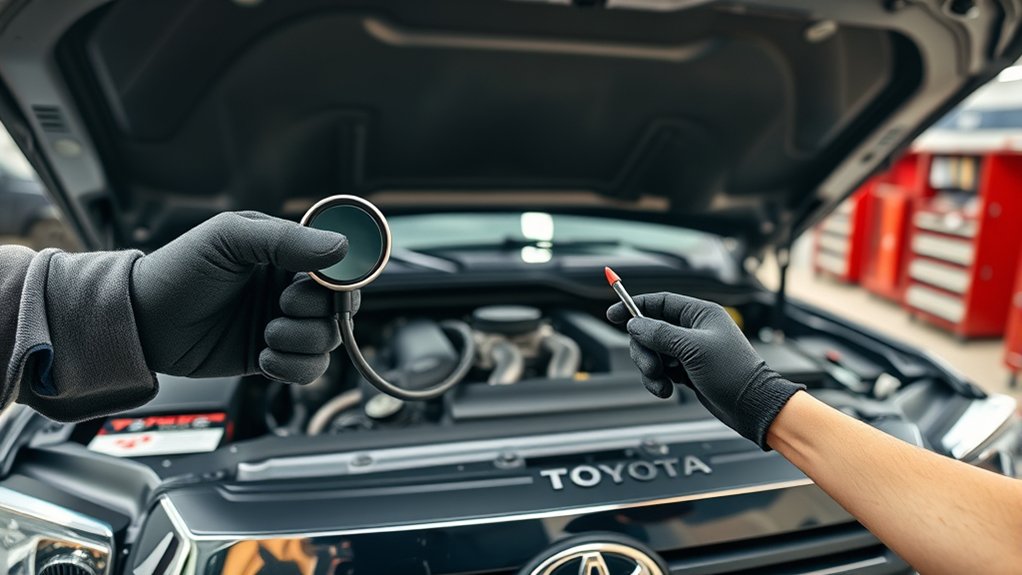
A knocking sound from your Toyota Tundra can range from a normal fuel-injector tick to serious crankshaft-bearing damage. The sound alone cannot identify the cause. Note when it happens, check the oil level and warning lights, and avoid driving if the engine runs rough, loses power, overheats, stalls, or produces a loud, deep knock.
Last updated: July 12, 2026
Quick Answer
Toyota Tundra engine knocking can come from combustion ping, low or incorrect oil, valvetrain or timing noise, an exhaust leak, an accessory problem, or worn crankshaft bearings. Stop driving if the knock is loud, oil pressure is low, the engine runs rough, or power drops. Check your VIN for recalls before further diagnosis.
Key Takeaways
- A light tick, metallic ping, deep knock, and single clunk usually point to different systems.
- Do not keep driving with low oil pressure, a flashing check-engine light, overheating, rough running, stalling, or power loss.
- Use the fuel grade and oil specification listed for your exact model year and engine.
- Certain 2022–2024 non-hybrid Tundras have been included in VIN-specific engine recall campaigns.
- A compression test checks cylinder sealing. It does not confirm rod-bearing or main-bearing wear.
At a Glance
| Time Required | About 10–15 minutes for basic safety checks |
| Difficulty | Easy for observation and fluid checks; advanced for internal diagnosis |
| Tools Needed | Gloves, flashlight, clean towel, phone, and an optional OBD-II scanner |
| Cost | Basic checks may cost nothing; professional diagnosis varies. Recall repairs are free for eligible VINs. |
Warning: Shut off the engine and arrange towing if the oil-pressure warning stays on, the check-engine light flashes, the engine overheats, the truck stalls or loses power, or a deep knock quickly becomes louder. Continuing to drive can turn a repairable problem into complete engine failure.
First, Decide Whether the Engine Is Safe to Run
Do not rev the engine repeatedly to identify the noise. Extra speed and load can worsen a lubrication, bearing, timing, or overheating problem.
Turn the engine off immediately when you notice any of these conditions:
- A red oil-pressure warning or an oil-pressure message
- A flashing check-engine light
- Severe shaking, repeated misfires, or rough running
- Sudden power loss, stalling, or difficulty restarting
- An overheating warning or rising coolant temperature
- A loud, deep knock that follows engine speed
- Visible oil loss or no oil showing on the dipstick
If none of these warnings are present, you may perform a brief visual and fluid inspection. Keep the truck parked, avoid heavy throttle, and do not crawl under a running vehicle.
Common Causes of Engine Knocking in Toyota Tundra
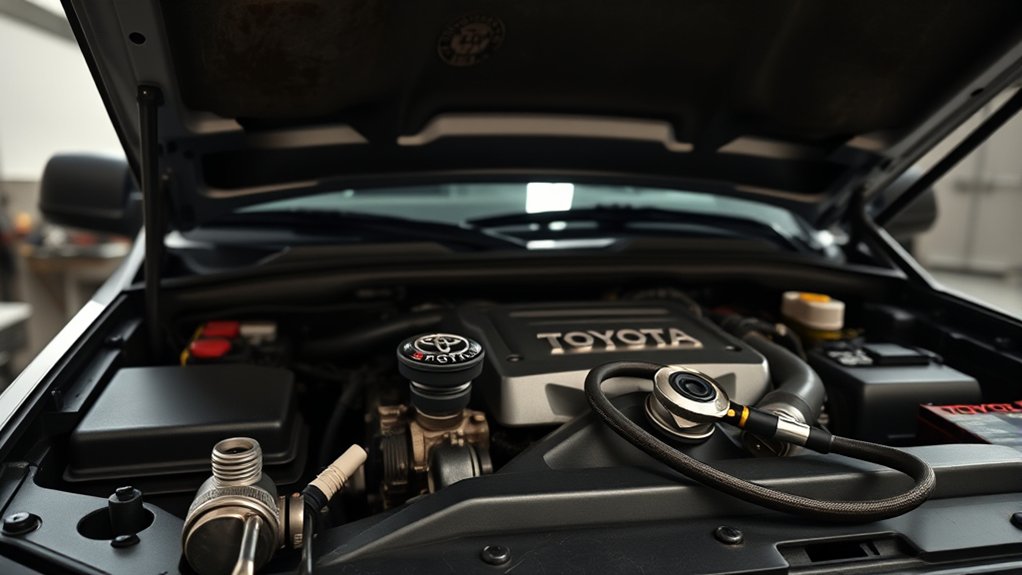
Several parts can create a knocking, ticking, rattling, or clunking sound in a Toyota Tundra. The location, tone, engine temperature, and operating condition provide better clues than volume alone.
| Sound or Pattern | Possible Area | Best Next Step |
|---|---|---|
| Metallic ping under acceleration, towing, or climbing | Combustion knock, incorrect fuel, overheating, or mixture problem | Reduce load, verify fuel requirements, and scan for codes |
| Deep rhythmic knock that rises with RPM or load | Connecting-rod or main-bearing damage | Shut off the engine and arrange professional diagnosis |
| Light, even tick from the top of the engine | Fuel injectors, high-pressure fuel equipment, or valvetrain | Compare cold and warm operation and inspect if the sound is new |
| Brief rattle during a cold start | Oil drain-back, timing components, or valvetrain | Check oil level and arrange inspection if it persists or worsens |
| Tick that is louder when cold and fades as the engine warms | Exhaust-manifold or gasket leak | Inspect for soot marks and have the exhaust checked |
| Single clunk when shifting into Drive or Reverse | Engine mount, flexplate, transmission mount, or driveline movement | Inspect mounts and driveline components |
Low Oil Level or Lubrication Problems
Low oil level, incorrect oil, restricted oil flow, or low oil pressure can prevent bearings and valvetrain parts from receiving enough lubrication. This may produce ticking, rattling, or knocking.
Park on level ground, shut off the engine, and wait several minutes. Remove the dipstick, wipe it clean, reinsert it fully, and check the level again. If no oil appears on the dipstick or the oil-pressure warning is on, do not restart the engine.
Use only the oil viscosity and specification listed on the oil cap or in the manual for your exact model year and engine. Toyota provides model-specific manuals through its Manuals and Warranties portal.
Normal Ticking Versus Abnormal Knocking
Fuel injectors and high-pressure fuel-system parts can make a light, regular ticking sound. A normal tick is usually even, changes smoothly with engine speed, and is not accompanied by rough running, warning lights, metal in the oil, or power loss.
Have the truck inspected when a sound is new, suddenly louder, irregular, accompanied by vibration, or different from another similar Tundra. Do not assume every tick is harmless based only on its location.
Exhaust, Accessory, and Driveline Noises
An exhaust leak can sound like valvetrain ticking, especially during a cold start. A loose heat shield, belt tensioner, pulley, fan component, flexplate, engine mount, or driveline joint can also create a noise that appears to come from the engine.
A technician may briefly isolate belt-driven accessories or use listening equipment to locate the source. Do not place your hands, clothing, or tools near moving belts or fans.
How Fuel Quality Influences Engine Knocking
Fuel-related knock normally sounds like a metallic ping during acceleration or heavy engine load. It differs from the deeper, rhythmic sound associated with major bearing clearance.
Octane Rating Importance
Octane rating measures gasoline’s resistance to premature detonation, often called knocking or pinging. It does not measure how clean the fuel is, how much energy it contains, or how uniformly it burns.
Use the octane grade required or recommended in the manual for your exact Tundra. The U.S. Department of Energy and Environmental Protection Agency advise drivers to follow the vehicle manufacturer’s requirement rather than automatically choosing the highest grade available.
If the pinging began immediately after refueling, avoid towing, hard acceleration, and high engine load. Refuel with fresh gasoline that meets the manual’s requirement when practical. Persistent knocking still needs diagnosis because premium fuel will not repair worn bearings, low oil pressure, a failed sensor, or a mechanical timing problem.
Note: If you suspect diesel, water, or another contaminant entered the tank, do not keep running the engine. Contact a repair facility or towing service before attempting to dilute or drain the fuel.
Fuel Injector Functionality
Fuel injectors deliver measured amounts of fuel to each cylinder. A restricted, leaking, or electrically faulty injector can contribute to a lean condition, rich condition, misfire, rough idle, or uneven combustion.
Injector clicking by itself does not prove the injector is defective. A technician may review misfire counts, fuel-trim data, fuel pressure, injector operation, and cylinder-balance results before replacing parts.
Oxygen Sensor Impact
Oxygen and air-fuel-ratio sensors help the engine computer adjust fuel delivery. A faulty sensor or wiring problem may contribute to an incorrect mixture and usually stores a diagnostic code or produces abnormal live data.
Do not replace an oxygen sensor based only on a knocking sound. Vacuum leaks, fuel-pressure problems, contaminated airflow sensors, injector faults, exhaust leaks, or wiring issues can produce similar symptoms.
What Is Rod Knock and Why Does It Matter?
Rod knock occurs when excessive clearance develops between a connecting-rod bearing and its crankshaft journal. Each change in piston direction can allow the rod assembly to strike against the oil-cushioned journal surface, creating a deep metallic knock.
A deep knock that becomes stronger with engine speed or load should be treated as possible bearing damage until a qualified technician rules it out.
Possible warning signs include:
- A deep knock from the lower portion of the engine
- A noise that becomes stronger under acceleration or load
- Low oil pressure or an oil-pressure warning
- Metallic material in the drained oil or oil filter
- Rough running, stalling, or loss of power
- A sudden change after an oil-loss or overheating event
Continuing to operate an engine with bearing damage can score the crankshaft, damage a connecting rod, puncture the engine block, or cause the engine to seize.
The Role of Timing and Sensors in Engine Knock
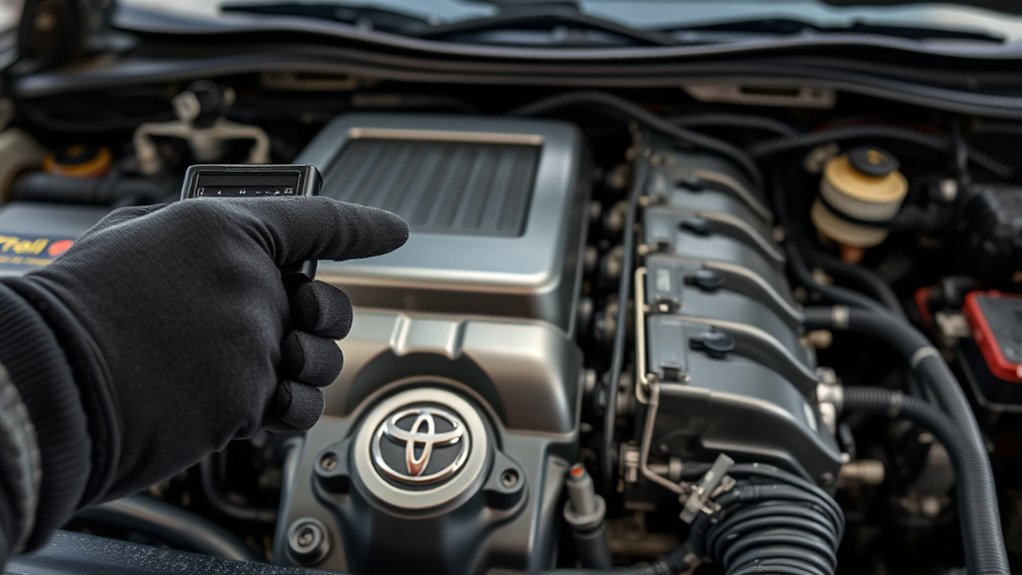
The engine control module uses data from several sensors to manage ignition timing, fuel delivery, boost, emissions, and engine protection. A knock sensor detects vibration within a calibrated frequency range, allowing the computer to respond to possible combustion knock.
A failed knock sensor does not normally create a mechanical bearing knock. However, a sensor, circuit, or control problem can reduce the computer’s ability to respond correctly to abnormal combustion. Diagnostic codes and live data should be checked before replacing the sensor.
Timing-chain, guide, actuator, or tensioner problems may cause rattling or timing-related performance symptoms. The sound often comes from the front or upper portion of the engine and may be most noticeable during startup. These problems must be diagnosed by engine family rather than assumed to affect every Tundra generation.
Incorrect ignition timing, overheating, excessive deposits, mixture problems, or fuel below the required octane can contribute to combustion knock. None of these conditions should be diagnosed from sound alone.
Signs of Worn Bearings: What to Look For
Worn connecting-rod or main bearings can produce a deep, repeating knock. The noise often follows engine speed and may become more noticeable when the engine is placed under load.
Supporting signs can include:
- Low measured oil pressure
- An oil-pressure warning
- Metallic debris in the oil or filter
- A sudden increase in vibration
- Loss of power or rough running
- Knocking after severe oil loss or overheating
A compression test measures how well each cylinder seals through the piston rings and valves. It may help diagnose a misfire or internal cylinder problem, but it does not confirm worn rod or main bearings.
Bearing diagnosis may require a mechanical oil-pressure test, inspection of drained oil and the oil filter, laboratory oil analysis, sound localization, removal of the oil pan, or engine disassembly.
Identifying Symptoms of Engine Knocking
Write down the exact conditions that produce the noise. This information can shorten diagnostic time and help a technician reproduce the problem.
- Cold or warm: Does the noise occur only after an overnight start, only when hot, or at every temperature?
- Idle or load: Is it present while parked, during acceleration, while towing, or when climbing a hill?
- Engine speed: Does the rhythm increase directly with RPM?
- Gear selection: Does it begin when shifting into Drive or Reverse?
- Recent events: Did it begin after refueling, an oil change, overheating, towing, or a warning light?
- Location: Does it seem strongest at the top, front, bottom, exhaust side, or transmission bellhousing?
A noise that appears when shifting from Park to Drive may come from a mount, flexplate, torque-converter area, or driveline component because the powertrain changes direction under load. It does not automatically indicate an internal timing fault.
Pro Tip: From a safe position, record a short video that captures the dashboard, engine temperature, RPM, and sound. Do not stand in front of the truck, reach near moving parts, or record while driving.
Check Your Tundra for Current Engine Recalls
Toyota has announced multiple VIN-specific recalls involving machining debris in certain Tundra engines. The debris can damage a main bearing and may lead to engine knocking, rough running, a no-start condition, stalling, or loss of motive power.
Toyota’s May 30, 2024 announcement covered certain model-year 2022–2023 Tundra and Lexus LX conventional-gas vehicles. Toyota later updated that campaign to provide a replacement engine at no cost for involved vehicles.
On May 20, 2026, Toyota announced another recall involving approximately 44,000 U.S. model-year 2024 Tundra non-hybrid vehicles. Toyota said the remaining debris could damage the number-one main bearing. The announcement also referenced related May 2024 and November 2025 campaigns.
Model year alone does not confirm that your truck is included. Check your 17-digit VIN through the official Toyota recall lookup and the NHTSA recall lookup. Recall status and remedy availability can change, so use the lookup tools even if you checked previously.
Warning: Contact a Toyota dealer promptly if your VIN is involved and the truck develops knocking, rough running, a no-start condition, stalling, or power loss. Do not continue driving a truck that may lose motive power.
Safe Checks You Can Perform Before Visiting a Mechanic
- Park safely. Stop on level ground, set the parking brake, switch off accessories, and shut down the engine.
- Check warning lights. Note the oil-pressure, temperature, charging, and check-engine indicators before turning the ignition off.
- Check the oil level. Wait several minutes, then use the dipstick procedure in the owner’s manual. Do not overfill the engine.
- Look for leaks. Check beneath the truck and around the oil filter, drain plug, oil cap, and visible hoses. Do not crawl under an unsupported vehicle.
- Save diagnostic codes. Use an OBD-II scanner if available. Record stored, pending, and permanent codes plus freeze-frame data. Do not clear them before diagnosis.
- Check recall status. Enter the VIN on both Toyota and NHTSA recall sites.
- Document the pattern. Record whether the sound occurs cold, hot, at idle, under load, or after refueling or service.
Do not pour in an unapproved additive, flush, or thicker oil to hide the noise. These products can alter lubrication, complicate diagnosis, and fail to address the damaged part.
When to Consult a Mechanic About Engine Noise?
Arrange a professional inspection whenever the noise is new, persistent, becoming louder, or accompanied by a warning light or performance change. Internal engine damage can progress quickly once bearing material, oil pressure, or lubrication has deteriorated.
Persistent Noise After Inspection
Seek professional help when the basic checks do not identify a loose shield, low oil level, incorrect fuel event, or another obvious cause. Do not continue replacing sensors or ignition parts based only on the sound.
A mechanic should inspect the truck promptly when:
- The knock follows RPM or becomes stronger under load.
- The oil level was low or the oil-pressure warning appeared.
- The engine has misfire, timing, fuel-pressure, or knock-sensor codes.
- The noise remains after the engine warms.
- The truck is included in an open engine recall.
- Metal is visible in the oil or filter.
Changes in Performance Symptoms
| Symptom | Recommended Action |
|---|---|
| Oil-pressure warning with knocking | Shut off the engine and tow the truck |
| Flashing check-engine light or severe shaking | Stop driving to prevent engine and catalytic-converter damage |
| Loss of power, stalling, or no-start condition | Arrange towing and check the VIN for recalls |
| Light ping only during heavy acceleration | Reduce load, verify fuel requirements, and schedule diagnosis if it returns |
| New tick or rattle without warning lights | Document the pattern and arrange an inspection before heavy use or towing |
How a Mechanic Diagnoses a Tundra Knocking Noise
A complete diagnosis may include several tests rather than one part replacement. The exact process depends on the engine, model year, codes, noise location, and recall status.
A technician may:
- Confirm the sound during cold, warm, idle, and loaded operation
- Check technical campaigns and recalls by VIN
- Scan trouble codes, freeze-frame data, fuel trims, misfire counts, and timing data
- Measure oil pressure with a mechanical gauge
- Inspect the drained oil and cut open the oil filter to look for bearing material
- Check fuel pressure, injector performance, and ignition operation
- Inspect the timing system, exhaust manifolds, mounts, flexplate, and accessories
- Use a mechanic’s stethoscope or electronic listening equipment to locate the noise
- Perform compression or leak-down testing when cylinder sealing is in question
- Remove the oil pan or disassemble the engine when bearing damage is suspected
Compression and leak-down tests can identify cylinder-sealing problems, but normal readings do not rule out rod-bearing or main-bearing damage.
Preventative Maintenance Tips to Avoid Engine Knocking
Maintenance cannot prevent every manufacturing defect, but it can reduce lubrication, overheating, ignition, and fuel-related problems.
- Use the oil viscosity, quality standard, filter, and change interval specified for your exact Tundra.
- Check the oil level regularly and more often during towing, long trips, or heavy use.
- Investigate oil consumption, leaks, low pressure, or unusual oil condition promptly.
- Use gasoline that meets the octane and ethanol requirements in the manual.
- Replace spark plugs, filters, and other service items according to the maintenance schedule.
- Address overheating, coolant loss, misfire codes, and fuel-system faults early.
- Check Toyota and NHTSA recall databases periodically, especially before buying a used Tundra.
- Keep service receipts and document when a new sound first appears.
Avoid using thicker oil, octane booster, engine flushes, or noise-reducing additives unless the applicable Toyota instructions or a qualified technician specifically approves them.
Frequently Asked Questions
Why is my Toyota Tundra engine knocking?
Possible causes include combustion ping, low oil level, low oil pressure, incorrect oil, valvetrain or timing noise, an exhaust leak, an accessory problem, a flexplate or mount issue, or damaged rod or main bearings. Certain VINs may also be covered by a machining-debris engine recall.
What model years of Toyota Tundra have engine recalls?
Toyota has announced VIN-specific engine campaigns involving certain 2022–2023 conventional-gas Tundras and additional 2024 non-hybrid Tundras. Toyota also referenced a related November 2025 campaign. Not every truck from those years is affected, so check the VIN through Toyota and NHTSA.
What is the most common cause of engine knock?
No single cause applies to every noise described as a knock. A metallic ping under load suggests combustion knock, while a deep rhythmic knock may indicate bearing damage. A light top-end tick may come from injectors, valvetrain parts, or an exhaust leak.
Can a knocking Tundra engine be saved?
Sometimes. A fuel, exhaust, sensor, accessory, or lubrication problem may be repairable without replacing the engine. Severe bearing damage may require crankshaft work, a rebuilt engine, or replacement. Stopping the engine early gives you the best chance of limiting damage.
Can low oil cause a knocking sound?
Yes. Low oil level or low oil pressure can reduce lubrication to bearings, timing parts, and valvetrain components. If the oil-pressure warning appears or no oil shows on the dipstick, shut off the engine and do not restart it until the cause is addressed.
Will premium gasoline stop a Tundra from knocking?
It may reduce combustion ping if fuel below the required octane caused the problem. It will not repair a damaged bearing, low oil pressure, timing fault, exhaust leak, or defective mechanical part. Use the grade listed in your manual and diagnose any persistent noise.
Is ticking from a Tundra engine normal?
A light, even injector or high-pressure-fuel-system tick may be normal. Inspection is appropriate when the sound is new, irregular, much louder than before, or accompanied by warning lights, rough running, metal in the oil, stalling, or power loss.
Conclusion
A knocking Toyota Tundra needs a condition-based diagnosis rather than a guess. Check the warning lights, oil level, operating pattern, diagnostic codes, and VIN recall status first. Shut the engine off when the noise is deep or severe, oil pressure is low, the engine runs rough, or the truck loses power.
Fuel-related ping, injector noise, exhaust leaks, mounts, and accessories may have manageable repairs. Bearing damage and recall-related engine problems require prompt professional attention. Avoid heavy driving, towing, additives, or unapproved oil changes until you know what is causing the sound.
Sources
- Toyota Recalls Certain 2024 Toyota Tundra Vehicles — May 20, 2026 recall, symptoms, affected vehicle type, and remedy-status information.
- Toyota Recalls Certain Model Year 2022–2023 Toyota Tundra and Lexus LX Vehicles — machining-debris risk and engine-replacement remedy.
- Toyota Safety Recall and Service Campaign Lookup — VIN and license-plate recall checking.
- National Highway Traffic Safety Administration Recall Lookup — official U.S. VIN recall search.
- Toyota Manuals and Warranties — model-specific fuel, oil, warning-light, and maintenance instructions.
- FuelEconomy.gov: Selecting the Right Octane Fuel — government guidance explaining octane and manufacturer fuel requirements.
