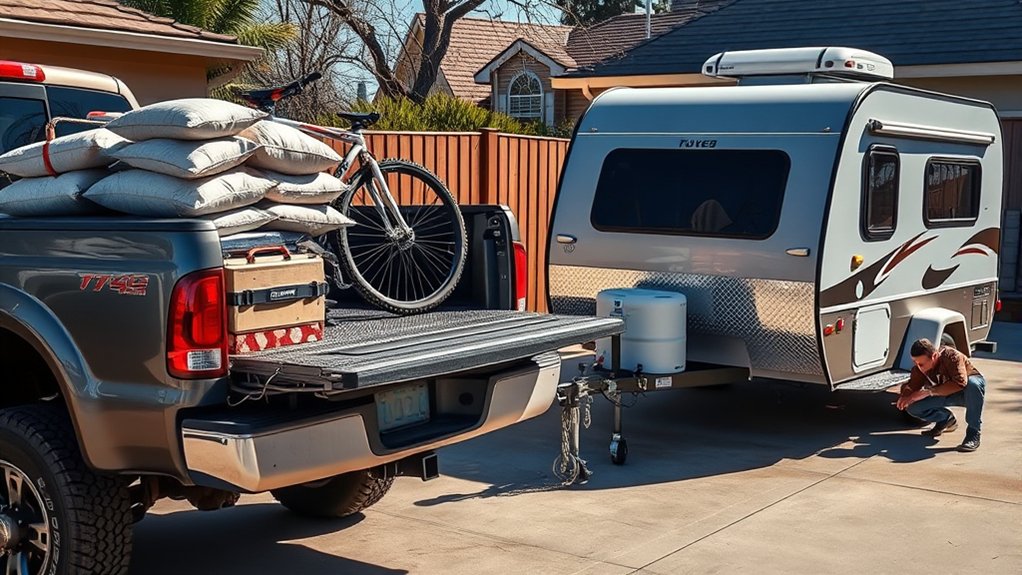
Payload vs. towing capacity: payload is the weight your truck carries, while towing capacity is the maximum loaded trailer weight the manufacturer allows it to pull. When towing, tongue or kingpin weight becomes part of the truck’s load, so a trailer can be under the tow rating while the truck is already over payload or a rear-axle limit. Check payload, GVWR, GAWR, GCWR, tire, hitch, and trailer ratings for your exact vehicle; the first limit reached controls.
Last updated: September 19, 2026 — verified against current Ford and Chevrolet towing guidance, NHTSA tire-label guidance, and SAE J2807_202411.
Quick Answer
Payload capacity is the weight your truck can carry, including passengers, cargo, accessories, hitch hardware, and trailer tongue or kingpin weight. Towing capacity is the manufacturer-rated maximum loaded trailer weight it can pull. You must stay within both limits, plus GVWR, GCWR, GAWR, tire, trailer, and hitch ratings. The lowest applicable limit controls.
Key Takeaways
- Payload includes people, cargo, aftermarket accessories, and the portion of trailer weight pressing on the truck.
- Towing capacity applies to the trailer’s total loaded weight, not its empty or advertised dry weight.
- Tongue weight counts against payload, GVWR, rear GAWR, and the hitch rating, but it should not be subtracted twice from trailer weight.
- A trailer can be below the published tow rating and still overload the truck’s payload, rear axle, tires, or hitch.
- The safe limit is the lowest of the truck, trailer, axle, tire, hitch, and combination ratings that apply to your setup.
At a Glance
| Time Required | 10–20 minutes to check labels and calculate; longer if you visit a public scale |
| Difficulty | Easy to moderate |
| Tools Needed | Owner’s manual, vehicle labels, calculator, and preferably a certified public scale |
| Cost | Free for label checks; public-scale fees vary by location |
Warning: Advertised maximum payload and towing figures may apply only to a specific cab, engine, axle ratio, drivetrain, wheelbase, and equipment package. Use the ratings for your exact vehicle and never exceed a vehicle, axle, tire, hitch, or trailer limit.
What Is Payload Capacity and Why It Matters?
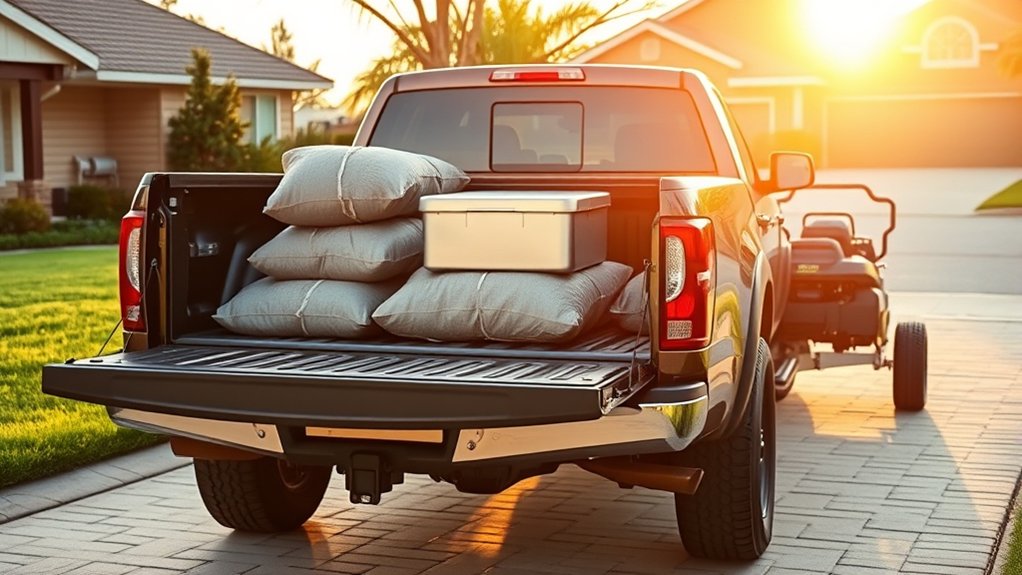
Payload capacity is the maximum combined weight that can be added to the truck itself. It includes the driver, passengers, cargo in the cab or bed, installed accessories, tools, a bed cap or tonneau cover, and trailer tongue or kingpin weight.
For vehicles sold in the United States, the Tire and Loading Information label normally states that the combined weight of occupants and cargo should never exceed a vehicle-specific number. Federal labeling requirements describe this as the vehicle capacity weight. You can review the applicable wording in 49 CFR 571.110.
A common theoretical formula is:
Payload capacity = GVWR − curb weight
GVWR, or Gross Vehicle Weight Rating, is the maximum permitted weight of the loaded truck. Curb weight is the truck’s weight with standard equipment and operating fluids but without occupants or cargo. In practice, the payload number on the vehicle’s Tire and Loading Information label is usually the more useful starting point because it is tied to that completed vehicle.
Aftermarket accessories installed later still use payload. For example, if added equipment weighs 100 pounds in total, available capacity for passengers, bed cargo, hitch hardware, and trailer tongue weight drops by the same 100 pounds.
Note: Bulk materials can vary greatly in weight. Firewood changes with species and moisture, while soil, gravel, and sand become much heavier when wet. Use volume estimates only for planning and weigh the loaded truck before relying on them.
What Is Towing Capacity?
Towing capacity is the maximum loaded trailer weight that the manufacturer permits a properly equipped vehicle to pull. Loaded trailer weight includes the trailer, cargo, water, fuel, batteries, propane, tools, accessories, and any other items carried on or inside it.
Towing capacity is not determined by engine power alone. The manufacturer considers the powertrain, cooling system, frame, suspension, brakes, axle ratio, tires, wheelbase, hitch equipment, and vehicle configuration. SAE J2807_202411 establishes minimum performance criteria at GCWR and a methodology for determining trailer-weight ratings for eligible vehicles up to 14,000 pounds GVWR. Manufacturers may use J2807, but the vehicle-specific owner’s manual or towing guide remains the controlling source.
| Rating or weight | What it means | Where to find it |
|---|---|---|
| GVW | The truck’s actual weight at a given time | Public scale |
| GVWR | Maximum permitted loaded truck weight | Certification label or owner’s manual |
| GAWR | Maximum weight permitted on each axle | Certification label or owner’s manual |
| GCW | Actual combined weight of the loaded truck and loaded trailer | Public scale |
| GCWR | Maximum permitted combined truck-and-trailer weight | Owner’s manual, towing guide, or VIN-specific tool |
| Maximum loaded trailer weight | The manufacturer’s trailer-weight limit for the vehicle configuration | Owner’s manual, towing guide, VIN tool, or trailering label |
You can estimate the remaining combination allowance with this formula:
Remaining combination allowance = GCWR − actual loaded tow-vehicle weight before coupling the trailer
This result is not automatically your safe towing capacity. The loaded trailer must also stay below the manufacturer’s maximum trailer rating, and the connected setup must remain within payload, GVWR, front and rear GAWR, tire, receiver, ball mount, hitch-ball, and tongue-weight limits.
Your usable towing limit is not necessarily the largest number in the brochure. It is the lowest applicable limit in the complete truck, hitch, and trailer system.
Understanding the Key Differences Between Payload and Towing Capacity
Payload and towing capacity work together, but they measure different loads. A truck may have enough published trailer capacity for a camper yet run out of payload because passengers, bed cargo, and tongue weight consume the truck’s carrying capacity.
| Question | Payload capacity | Towing capacity |
|---|---|---|
| What is measured? | Weight carried by the truck | Total loaded trailer weight |
| What counts? | People, cargo, accessories, tongue or pin weight | Trailer, cargo, fluids, batteries, propane, and equipment |
| Primary related ratings | GVWR and GAWR | Maximum trailer rating and GCWR |
| Best source | Tire and Loading Information label | Owner’s manual, towing guide, or VIN-specific tool |
How Can Payload Limit Towing Before the Tow Rating?
A trailer can remain below the truck’s maximum trailer rating and still overload the tow vehicle. The reason is that occupants, bed cargo, accessories, hitch hardware, and trailer tongue or pin weight all consume the truck’s carrying capacity and can also load the rear axle.
For planning only, you can estimate a payload-based trailer ceiling from the payload left for hitch load. If 900 pounds of payload remains for tongue weight and the trailer is designed to carry 12% of its loaded weight on the tongue, 900 ÷ 0.12 = about 7,500 pounds. That is not a new tow rating. The trailer must still remain within the manufacturer’s maximum trailer weight, GCWR, GVWR, GAWR, tire, receiver, and hitch-component limits.
Definition of Payload Capacity
Payload capacity is the maximum combined weight of occupants and cargo the truck is designed to carry. For towing calculations, cargo includes the downward load transferred through the hitch. Factory options may already be reflected in the door-label payload, while aftermarket equipment installed later must be deducted from the remaining capacity.
The most practical formula is:
Remaining payload = door-label payload − occupants − cargo − added accessories − hitch hardware − trailer tongue or pin weight
Definition of Towing Capacity
Towing capacity is the maximum loaded trailer weight permitted for a properly configured vehicle. The exact rating can change with cab style, bed length, drivetrain, engine, axle ratio, towing package, wheelbase, and installed equipment.
A truck advertised with a 7,000-pound towing capacity may pull a trailer weighing up to 7,000 pounds when loaded only if every other limit is also satisfied. The truck and trailer together will weigh more than 7,000 pounds, so their combined actual weight must separately remain below GCWR.
Ratings That Can Limit Your Setup
- Payload: Limits occupants, cargo, accessories, and hitch load carried by the truck.
- GVWR: Limits the truck’s total actual weight when loaded and connected.
- GAWR: Limits the weight supported by each axle; rear GAWR is often important while towing.
- GCWR: Limits the total actual weight of the truck and trailer combination.
- Maximum loaded trailer weight: Limits the trailer itself.
- Hitch-component ratings: The receiver, ball mount, hitch ball, coupler, and weight-distribution equipment each have limits.
- Tire ratings: Each tire must have enough load capacity at the manufacturer-recommended cold pressure.
- Trailer ratings: The trailer’s GVWR and axle ratings must not be exceeded.
Calculating Your Truck’s Payload Capacity Made Easy
Start with the payload figure on the Tire and Loading Information label, usually found on the driver-side door edge or B-pillar. NHTSA explains where to locate this label in its TireWise safety guidance.
- Record the door-label payload. Look for the statement giving the maximum combined weight of occupants and cargo.
- Add all occupant weight. Include the driver and every passenger.
- Add cargo, accessories, and hitch hardware. Count tools, luggage, bed cargo, coolers, caps, steps, winches, tool boxes, ball mounts, weight-distribution hardware, and other added equipment.
- Add tongue or kingpin weight. Use the trailer’s actual loaded hitch weight, not an empty estimate.
- Subtract the total from the listed payload. A positive result is your remaining payload margin.
- Verify on a scale. Confirm that actual GVW and each axle weight remain below their ratings.
If you weigh the truck loaded for travel but before coupling the trailer, you can also calculate remaining GVWR margin = GVWR − actual loaded truck weight. This checks how much vehicle-weight margin remains before hitch load is applied; it does not replace the door-label payload, GAWR, tire, receiver, or hitch-component checks.
| Example payload budget | Weight |
|---|---|
| Door-label payload capacity | 1,800 lb |
| Driver and passengers | −400 lb |
| Tools, luggage, and bed cargo | −300 lb |
| Aftermarket accessories | −100 lb |
| Loaded trailer tongue weight | −780 lb |
| Remaining payload | 220 lb |
In this example, the truck remains within its payload limit, but you must still verify GVWR, rear GAWR, tire capacity, hitch limits, maximum trailer weight, and GCWR.
Pro Tip: Keep a written payload budget for regular trips. It makes it easier to see how an extra passenger, generator, tool box, full water tank, or heavier trailer changes your available margin.
Determine Your Truck’s Towing Capacity
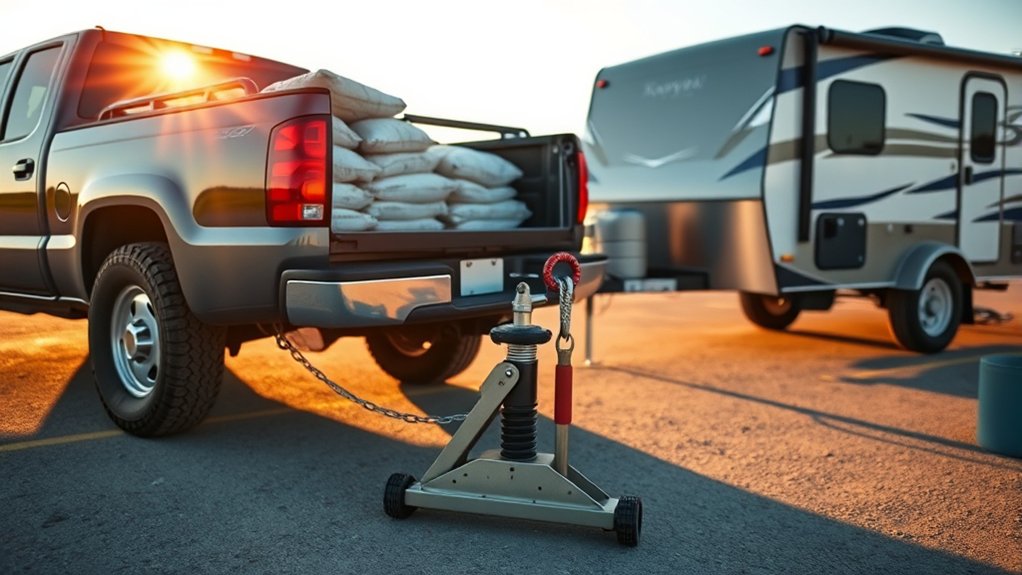
To determine what your truck can tow, collect the rating for your exact vehicle, calculate the trailer’s actual loaded weight, and compare the result with all related limits. Do not rely only on a model-line advertisement or a generic online chart. For a separate step-by-step walkthrough, see how to calculate towing capacity; for the rating distinction, see towing capacity vs. GCWR.
Check Owner’s Manual
Start with the towing section of the owner’s manual and the manufacturer’s current towing guide or VIN-specific calculator. Ford, for example, directs owners to its towing guide or VIN-based calculator for maximum loaded trailer weight rather than treating a basic subtraction formula as the final rating. See the manufacturer’s definitions and tools at Ford Towing.
Confirm all of the following:
- Maximum loaded trailer weight for the exact configuration
- GCWR
- Required towing or cooling package
- Maximum conventional tongue weight or fifth-wheel/gooseneck pin weight
- Receiver and weight-distribution requirements
- Trailer-brake requirements stated by the manufacturer
- GVWR and front and rear GAWR
The certification and Tire and Loading labels in the driver-door area normally provide GVWR, GAWR, tire information, and occupant-and-cargo capacity. They do not universally provide the vehicle’s complete towing rating.
Calculate Gross Combined Weight
GCW is the actual weight of the loaded truck and loaded trailer together. GCWR is the maximum allowed combined weight. The measured GCW must remain at or below the GCWR.
For planning, use:
Combination-based trailer allowance = GCWR − actual loaded tow-vehicle weight before coupling
Suppose a truck has a 15,000-pound GCWR and weighs 5,900 pounds when loaded with its passengers, cargo, fuel, and accessories but before the trailer is connected. Its combination-based allowance is 9,100 pounds. If the manufacturer’s maximum loaded trailer rating is 8,500 pounds, the lower 8,500-pound rating controls before considering payload, axle, tire, and hitch limits.
Do not subtract tongue weight from the trailer rating a second time. Tongue weight remains part of the trailer’s total loaded weight, while the downward force it places on the truck also uses payload and affects GVW and axle loads.
For conventional trailers, manufacturer guidance commonly calls for about 10–15% of loaded trailer weight on the tongue. Fifth-wheel and gooseneck pin weight is commonly higher. Some trailer designs use different targets, so follow the trailer and tow-vehicle manuals. Chevrolet’s 2026 guidance explains these ranges in its Trailering Guide.
Verify the Weights at a Public Scale
A public scale is the most reliable way to check a loaded setup. Load the truck and trailer exactly as they will travel, including passengers, pets, food, tools, water, propane, batteries, and recreational equipment.
- Weigh the loaded truck without the trailer. Record the front axle, rear axle, and total truck weight.
- Connect the loaded trailer and weigh the full combination. Record the front axle, rear axle, trailer axle group, and total combined weight.
- Compare the truck’s scale weight with GVWR.
- Compare each truck axle with its GAWR.
- Compare total GCW with GCWR.
- Compare the trailer’s actual loaded weight with its GVWR and the truck’s maximum loaded trailer rating.
- Verify the hitch and tire ratings. No component may be overloaded.
The combined scale weight minus the loaded truck’s uncoupled weight gives the trailer’s approximate total loaded weight, provided the truck’s cargo and fuel have not changed between weighings. Use an appropriate tongue-weight scale or a manufacturer-approved weighing method when you need a direct hitch-weight measurement.
Debunking Common Misconceptions About Payload and Towing Capacities
Payload and towing advertisements are easy to misunderstand. These are the most common mistakes to avoid:
- “Every half-ton truck has similar payload.” The traditional half-ton label is a market class, not a literal or uniform payload figure. Door-label payload can vary widely among trucks in the same model line.
- “The advertised maximum applies to every trim.” Maximum figures often require a specific cab, drivetrain, axle ratio, engine, wheelbase, and towing package.
- “Dry trailer weight is the towing weight.” Dry or unloaded vehicle weight normally excludes some or all cargo, water, dealer-installed equipment, batteries, and personal gear.
- “Tongue weight only matters to the trailer.” Tongue or pin weight is supported by the tow vehicle and uses payload while affecting GVW and axle loads.
- “A weight-distribution hitch increases towing capacity.” A correctly specified system redistributes hitch load and may be required to use a manufacturer-published weight-distributing rating, but it does not create a rating above the limits published for the vehicle, receiver, hitch components, tires, axles, or trailer.
- “Air springs increase payload.” Suspension aids may change ride height or feel, but they do not change the manufacturer’s certified weight ratings. Air Lift states that adding air springs does not change GVWR, GCWR, or GAWR.
- “Engine power is the only towing limit.” Cooling, braking, handling, axle, tire, frame, and hitch limits also matter.
Note: A weight-distribution hitch must be compatible with the truck, receiver, and trailer. Follow the adjustment and front-axle load-restoration instructions supplied by the tow-vehicle and hitch manufacturers.
What Happens If You Exceed Your Capacity Limits?
Exceeding payload, axle, tire, hitch, trailer, or combination limits can reduce steering control and stability while placing additional stress on the suspension, brakes, tires, wheel bearings, cooling system, and drivetrain.
An overloaded rear axle can lighten the front axle and affect steering or braking response. Excess trailer or tongue weight can contribute to poor balance, sway, overheating, excessive brake wear, tire failure, or component damage. The exact result depends on how much the setup is overloaded, where the weight is placed, road and weather conditions, speed, and the condition of the equipment.
Weight-limit, licensing, trailer-brake, and towing-equipment laws vary by jurisdiction. Overloading may also affect enforcement, insurance, warranty, or liability questions after an incident. Check the laws that apply where you operate and treat the manufacturer’s ratings as hard limits rather than targets.
Warning: Do not continue a trip when a scale ticket shows that GVWR, GCWR, GAWR, trailer GVWR, tire capacity, or a hitch-component rating has been exceeded. Reduce or redistribute the load, or use equipment rated for the job.
Real-World Examples of Payload and Towing
These examples show why payload and towing capacity must be checked together.
Example 1: Tools and Materials Without a Trailer
A truck has a 1,700-pound door-label payload. The driver and two passengers weigh 500 pounds, an installed bed cap weighs 180 pounds, and the tools and materials weigh 850 pounds. The total added load is 1,530 pounds, leaving 170 pounds of payload. The driver must still confirm GVWR, axle loads, and tire capacity.
Example 2: A 6,500-Pound Travel Trailer
A travel trailer weighs 6,500 pounds when fully loaded. At 12% tongue weight, about 780 pounds presses on the truck. That 780 pounds counts against payload along with every passenger, bed item, and accessory. A truck can therefore have enough advertised towing capacity but not enough remaining payload or rear-axle capacity for the trailer.
Example 3: A Fifth-Wheel Trailer
A 12,000-pound loaded fifth-wheel with 20% pin weight places about 2,400 pounds in the truck bed. Even when the truck’s published trailer rating is above 12,000 pounds, payload, rear GAWR, tire capacity, or the fifth-wheel hitch rating may become the controlling limit.
Example 4: Sand, Firewood, or Landscaping Material
Loose materials can gain substantial weight from moisture, and volume estimates may be inaccurate. Start with a conservative supplier estimate, keep the load low and evenly distributed, and verify the truck’s actual front axle, rear axle, and total weight at a scale.
Tips for Safe Hauling and Towing Practices
Safe towing begins before the vehicle moves. Check the complete system rather than focusing only on the truck’s advertised tow number.
Brakes deserve the same attention as the hitch and the tires. A loaded descent heats the pads far more than everyday driving does, so worn or under-specified friction material becomes a real limit on what you can safely pull. On a Super Duty that means fitting tow-rated F-250 brake pads rather than standard replacements.
| Pre-trip item | What to verify |
|---|---|
| Weights | Payload, GVW, axle weights, trailer weight, tongue or pin weight, and GCW are within their ratings. |
| Load placement | Cargo is balanced side to side, secured against movement, and positioned to maintain the trailer manufacturer’s hitch-weight target. |
| Hitch | Receiver, ball mount, ball, coupler, safety chains, breakaway cable, and weight-distribution equipment are correctly rated and connected. |
| Tires | Truck and trailer tires are undamaged, correctly load-rated, and inflated to the proper cold pressures. |
| Brakes and lights | Trailer brakes, brake controller, running lights, turn signals, and brake lights operate correctly. |
| Mirrors and clearance | Mirrors provide a legal view, the trailer is level, and there is enough cab, bed, tailgate, and turning clearance. |
| Driving plan | Speed, following distance, route, grades, weather, fuel stops, and parking areas suit the combination. |
Check tire pressure when the tires are cold, allow more following distance, brake earlier, and reduce speed for curves, crosswinds, rough pavement, and downhill grades. Recheck the hitch, cargo securement, tires, and wheel condition after the first part of the trip and at regular stops.
Frequently Asked Questions
What is the difference between payload and towing capacity?
Payload is the weight carried by the truck, including passengers, cargo, accessories, and trailer tongue or pin weight. Towing capacity is the maximum total loaded trailer weight the properly equipped truck is rated to pull.
What is an example of payload capacity?
If a truck’s door label lists 1,800 pounds of payload, the combined weight of its people, bed cargo, installed accessories, and trailer hitch load must remain at or below 1,800 pounds. GVWR and axle ratings must also be respected.
Does tongue weight affect payload capacity?
Yes. Tongue weight presses down on the tow vehicle, so it uses payload and contributes to GVW and axle loads. It must also remain within the receiver, ball mount, hitch ball, and vehicle tongue-weight ratings.
What does a 4,000-pound payload mean?
It means the truck can carry up to 4,000 pounds of combined occupants and cargo under the rating assumptions. The load must still be distributed so that GVWR, each GAWR, tire ratings, and any other vehicle limits are not exceeded.
Is dry trailer weight the same as loaded trailer weight?
No. Dry or unloaded weight normally excludes at least some cargo, fluids, batteries, propane, dealer-installed equipment, and personal belongings. Towing calculations should use the trailer’s actual ready-to-travel weight.
Does a weight-distribution hitch increase towing or payload capacity?
No. A correctly adjusted system redistributes hitch load. It may be required to use a manufacturer-published weight-distributing rating, but it does not create capacity above the published vehicle, receiver, hitch-component, axle, tire, trailer, GVWR, GCWR, or payload limits.
Which towing limit matters most?
Every applicable limit matters. The usable limit is whichever one is reached first, which may be payload, rear GAWR, maximum trailer weight, GCWR, tire capacity, tongue-weight capacity, or a hitch-component rating.
Does payload capacity include the driver?
Yes. The driver and every passenger count against the vehicle’s occupant-and-cargo capacity, along with cargo, added accessories, hitch hardware, and trailer tongue or pin weight.
Can a truck be under its towing capacity and still be overloaded?
Yes. A trailer can be below the truck’s maximum trailer rating while tongue or pin weight pushes the truck over payload, GVWR, rear GAWR, tire capacity, or a hitch-component limit.
Where do I find my truck’s payload and towing capacity?
Start with the Tire and Loading Information label near the driver’s door for the occupant-and-cargo limit. Use the certification label for GVWR and GAWR, then check the owner’s manual, official towing guide, trailering label, or VIN-specific manufacturer tool for maximum loaded trailer weight and GCWR.
Can airbags or helper springs increase payload capacity?
No. Suspension aids can reduce sag or change how the truck feels under load, but installing them does not change the manufacturer’s payload, GVWR, GAWR, GCWR, tire, hitch, or trailer ratings.
Conclusion
Payload capacity tells you how much weight the truck itself can carry, while towing capacity tells you how much loaded trailer it can pull. A safe setup must satisfy both limits along with GVWR, GCWR, GAWR, tire, trailer, and hitch ratings.
Before hauling or towing, check the labels and manufacturer guide for your exact vehicle, build a complete payload budget, use the trailer’s actual loaded weight, and verify the finished combination at a public scale. When two ratings produce different limits, follow the lower one.
Sources
- Ford Towing — definitions of payload, towing capacity, GVWR, GCWR, GAWR, tongue weight, and rating locations
- 2026 Ford RV & Trailer Towing Guide — weight limits, actual GVW and GCW, tongue load, axle limits, and hitch guidance
- 2026 Chevrolet Trailering Guide — GCWR, maximum trailer ratings, loaded weighing, and tongue or pin-weight guidance
- NHTSA TireWise — Tire and Loading Information label location, cold tire pressure, tire inspection, and load-related safety
- 49 CFR 571.110 — federal occupant-and-cargo capacity labeling requirements
- SAE J2807_202411 — performance criteria for tow-vehicle GCWR and trailer-weight ratings
- Air Lift Air Suspension FAQs — confirms air springs do not change GVWR, GCWR, or GAWR