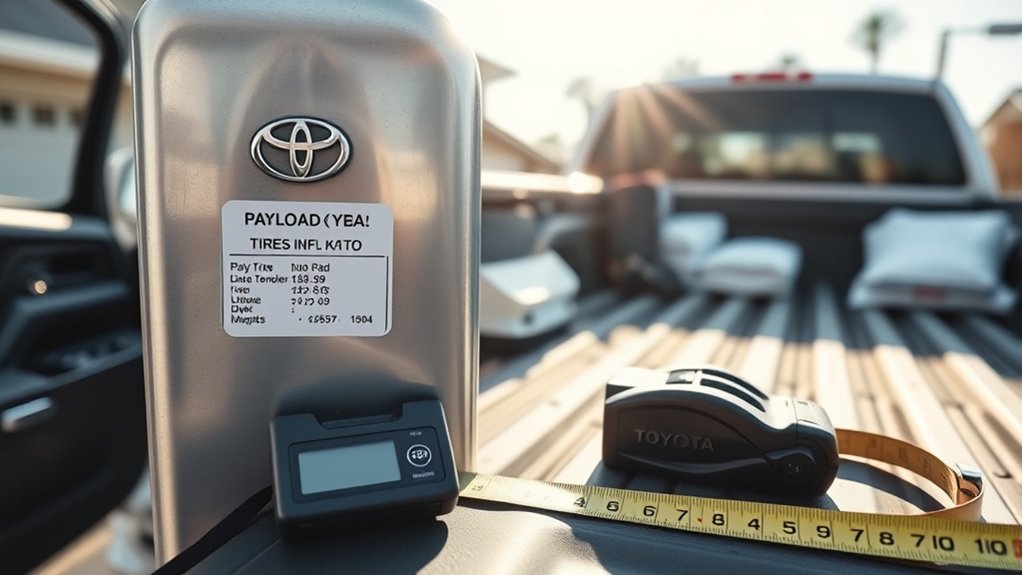
Your Toyota Tundra’s payload capacity is the total weight the truck can safely carry in and on the vehicle. That includes the driver, passengers, cargo, accessories, hitch equipment, and the trailer’s tongue weight. The most useful number is not a generic maximum from an advertisement. It is the vehicle-specific limit printed on your truck’s driver-side Tire and Loading Information label.
Last updated: July 11, 2026
Quick Answer
Find the Tire and Loading Information label on the driver-side door jamb. Use its “combined weight of occupants and cargo” limit as your starting payload number. Subtract passengers, cargo, aftermarket accessories, hitch hardware, and trailer tongue weight. Also stay below the truck’s GVWR, front and rear GAWR, GCWR, and towing limits.
Key Takeaways
- Your door-jamb label gives the safest vehicle-specific starting point for payload calculations.
- Passengers, bed cargo, accessories, hitch equipment, and trailer tongue weight all use payload capacity.
- A lineup maximum applies only to one qualifying configuration, not every Tundra with that model year.
- A certified scale helps confirm actual axle and vehicle weights, but it does not replace the manufacturer’s ratings.
- Payload capacity and towing capacity are related, but they are not the same limit.
At a Glance
| Time Required | 10 to 20 minutes, plus optional scale time |
| Difficulty | Easy |
| Tools Needed | Door labels, owner’s manual, calculator, and an optional certified vehicle scale |
| Cost | Free unless the scale charges a weighing fee |
Key Metrics for Understanding Your Tundra’s Payload Capacity
Start with the ratings assigned to your exact truck. Cab style, bed length, drivetrain, engine, trim, factory equipment, and installed options can change the final payload figure.
The main numbers work together:
- Payload capacity: The combined weight your truck can carry, including people and cargo.
- GVWR: Gross Vehicle Weight Rating, or the maximum permitted weight of the loaded truck.
- GAWR: Gross Axle Weight Rating for the front or rear axle. You must stay below both axle limits.
- GCWR: Gross Combined Weight Rating for the loaded truck and loaded trailer together.
- Tongue weight: The downward force the trailer applies to the hitch. It counts against truck payload.
- Curb weight: A manufacturer-defined vehicle weight used for specifications. Your truck’s actual scale weight may differ after accessories, fuel, occupants, and cargo are added.
Payload is often described with this basic formula:
Payload capacity = GVWR minus the truck’s rated curb weight. For day-to-day loading, use the vehicle-specific door label and subtract everything you add to the truck.
Why Your Tundra’s Payload Sticker Matters
Open the driver’s door and look for the Tire and Loading Information label. It normally states that the combined weight of occupants and cargo should never exceed a listed amount. That number is tailored to the truck as built and is more useful than a model-wide maximum.
The National Highway Traffic Safety Administration also directs owners to the driver-side Tire and Loading Information label for vehicle-specific tire and loading information.
Do not confuse this label with the certification label. The certification label usually lists GVWR and front and rear GAWR. You need both labels when checking a heavily loaded truck or trailer setup.
Warning: Do not use a sales-page maximum as the limit for your truck. Overloading can affect braking, steering, tire loading, suspension travel, and vehicle stability.
Understanding Curb Weight, GVWR, and Payload
These terms sound similar, but each answers a different question. Understanding the difference helps you avoid double-counting or missing weight.
Curb Weight Definition
Curb weight is the truck’s specified weight in a standard operating condition. The exact definition can depend on the manufacturer’s published specifications. It does not represent your truck’s current weight after you add accessories, tools, passengers, cargo, or hitch equipment.
Use curb weight for general comparisons and the basic GVWR-minus-curb-weight formula. Use a certified scale when you need the truck’s actual weight in its present configuration.
Why GVWR and GAWR Both Matter
GVWR is the maximum allowed weight of the loaded truck. It includes the vehicle, occupants, cargo, accessories, hitch equipment, and trailer tongue weight pressing on the truck.
Staying under GVWR is not enough by itself. A truck can be under GVWR while exceeding the rear GAWR because too much weight is concentrated behind the cab. Check total vehicle weight and each axle weight.
Calculating Available Payload
Use the payload number printed on the Tire and Loading Information label. Then subtract every item that adds weight to the truck:
- Driver and passengers
- Bed cargo and in-cab cargo
- Toolboxes, bed covers, racks, steps, skid plates, and other added accessories
- Fifth-wheel, gooseneck, or receiver-hitch hardware
- Weight-distribution hitch components
- Trailer tongue or pin weight
For example, assume your door label allows 1,450 pounds of combined occupants and cargo. If people weigh 450 pounds, accessories and hitch hardware weigh 150 pounds, and cargo weighs 300 pounds, you have about 550 pounds left for additional load or trailer tongue weight.
Real-World Toyota Tundra Payload Examples
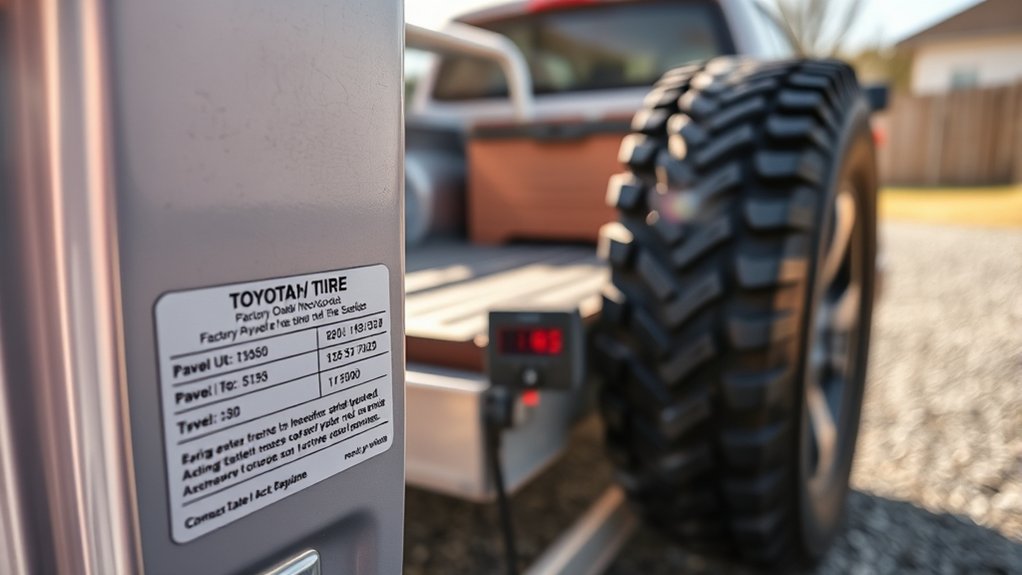
Tundra payload varies widely because Toyota sells different cab, bed, drivetrain, powertrain, and equipment combinations. Toyota announced a maximum payload of up to 1,940 pounds for the redesigned 2022 Tundra lineup. As of July 2026, Toyota’s current U.S. page lists a maximum payload of 1,850 pounds for the 2026 Tundra.
Those are lineup maximums. They do not mean every 2022 Tundra carries 1,940 pounds or every 2026 Tundra carries 1,850 pounds. Higher trims, four-wheel drive, hybrid hardware, larger cabs, longer beds, and extra equipment can increase vehicle weight and reduce available payload.
| Reference | Published Maximum | How to Use It |
|---|---|---|
| 2022 Tundra lineup | Up to 1,940 lb | General lineup reference only |
| 2026 Tundra lineup | Up to 1,850 lb | Current lineup reference only |
| Your truck’s door label | Vehicle-specific | Use this for your loading calculation |
How to Calculate Your Tundra’s Payload Accurately
- Read the Tire and Loading Information label. Record the maximum combined weight of occupants and cargo.
- List every occupant. Include the driver and all passengers.
- List cargo and installed accessories. Include items in the cab, bed, roof rack, toolbox, and hitch area.
- Add trailer-imposed weight. Include actual tongue or pin weight and the hitch equipment carried by the truck.
- Subtract the total from the door-label payload figure. A positive result is your remaining payload margin.
- Check the other ratings. Confirm that loaded truck weight, axle weights, combined weight, trailer weight, and hitch ratings stay within their limits.
- Use a certified scale for a loaded setup. Weigh the truck and trailer as configured for travel, not empty.
Pro Tip: Keep a simple weight worksheet in your glove box. Record passenger weight, permanent accessories, hitch hardware, common cargo, and the latest certified scale results.
How Trim Levels and Options Affect Payload
Every feature that adds vehicle weight can reduce payload. Four-wheel-drive hardware, larger wheels, hybrid components, premium seating, panoramic roofs, skid plates, power steps, and longer cabs or beds can all change the final rating.
Factory options should already be reflected in the vehicle-specific label. Dealer-installed and aftermarket equipment may not be. Subtract the weight of items added after the truck left the factory unless updated documentation clearly accounts for them.
For model-year instructions, towing procedures, and rating details, use Toyota’s official Tundra owner’s manual portal and select the manual for your exact year.
Common Misconceptions About Tundra Payload Ratings
Actual Weights Do Not Replace Ratings
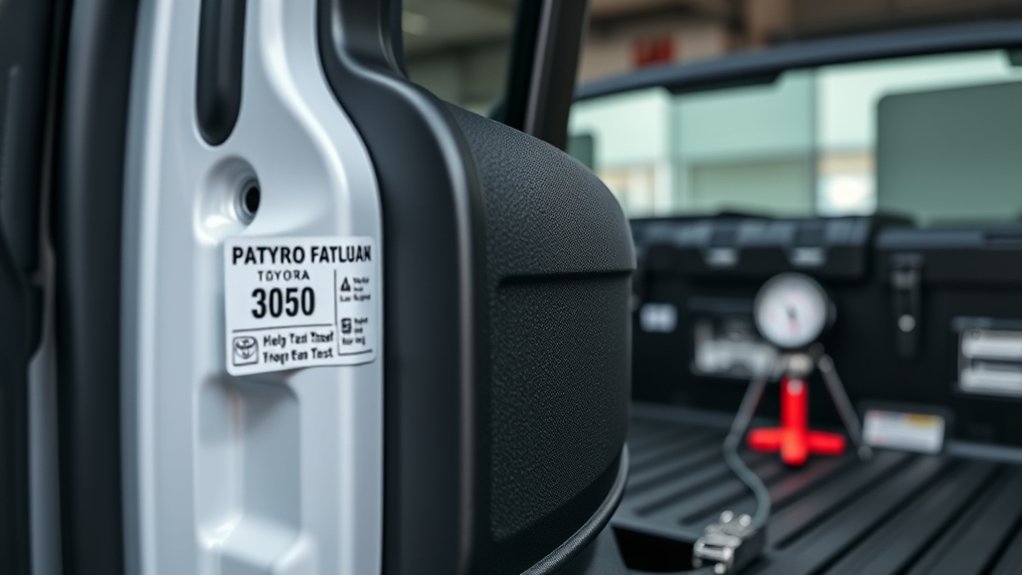
A certified scale tells you what the truck and axles weigh at that moment. The door labels tell you the maximum ratings you must stay below. Use both sets of numbers together.
If a scale shows your loaded truck weighs less than GVWR, the difference is your remaining GVWR margin at that moment. You still need to verify front GAWR, rear GAWR, GCWR, trailer rating, tire limits, and hitch limits.
What Changes Available Payload
- Passengers: Every occupant uses part of the payload allowance.
- Accessories: Toolboxes, racks, steps, bed covers, bumpers, and skid plates add weight.
- Trailer setup: Tongue weight, pin weight, and hitch hardware sit on the truck.
- Load placement: Cargo placed far rearward can overload the rear axle before total GVWR is reached.
- Configuration: Cab, bed, drivetrain, engine, trim, and factory options change the vehicle-specific rating.
Note: A weight-distribution hitch can change how load is shared across axles, but it does not make tongue weight disappear or increase the truck’s GVWR.
Tips for Safe Towing With Your Tundra
Towing can use payload faster than expected because the truck carries people, gear, hitch equipment, and the trailer’s downward hitch load at the same time.
- Use the towing chart and instructions for your exact model year and configuration.
- Measure the loaded trailer, not only its empty or “dry” weight.
- Measure actual tongue or pin weight and include it in the payload calculation.
- Check GVWR, front GAWR, rear GAWR, GCWR, trailer weight, tire ratings, and hitch ratings.
- Distribute and secure cargo so it cannot shift during braking or cornering.
- Set tire pressures to the vehicle manufacturer’s specification when the tires are cold.
- Reweigh after adding major accessories, changing trailers, or changing the way you load.
Payload Checks Before You Drive
Use this final check before hauling a heavy load or towing:
| Check | Where to Find It | What to Confirm |
|---|---|---|
| Occupants and cargo limit | Tire and Loading Information label | People and cargo stay below the listed limit |
| GVWR and GAWR | Certification label | Truck and both axles remain within ratings |
| Towing and combined limits | Owner’s manual and Toyota towing data | Trailer and combined weights remain within limits |
| Actual loaded weights | Certified scale ticket | Measured vehicle and axle weights match the plan |
Making Informed Decisions Based on Payload Data
Use a simple hierarchy when numbers conflict. Start with the labels on your exact truck, then use the owner’s manual and model-specific towing information. Use a certified scale to measure the loaded setup. Do not rely on a generic internet table, a different trim, or another truck brand.
Leave a reasonable margin when possible. Loads can change during a trip as passengers, water, fuel, tools, and supplies are added or moved.
Frequently Asked Questions
How do you read the payload on a Tundra door sticker?
Find the Tire and Loading Information label on the driver-side door area. Record the maximum combined weight of occupants and cargo. Subtract the driver, passengers, cargo, added accessories, hitch equipment, and trailer tongue or pin weight.
Can you find towing capacity on the door sticker?
Not usually as one complete trailer-weight number. The labels provide payload, GVWR, and axle ratings. Use the owner’s manual and Toyota’s model-specific towing information to find trailer and combined-weight limits for your exact configuration.
What is the payload capacity of a Toyota Tundra?
It depends on model year and configuration. Toyota listed up to 1,940 pounds for the 2022 lineup and up to 1,850 pounds for the 2026 lineup. Your exact limit is the combined occupant-and-cargo figure on your truck’s door label.
Does trailer tongue weight count as payload?
Yes. Tongue or pin weight presses down on the truck and uses part of its payload allowance. Hitch hardware and weight-distribution equipment carried by the truck also add to the load.
Conclusion
Your Toyota Tundra’s safe payload is not one universal number. Read the vehicle-specific door label, subtract everything added to the truck, and confirm the loaded setup against GVWR, axle ratings, combined-weight limits, towing limits, tire ratings, and hitch ratings. A certified scale provides the clearest real-world check before a demanding trip.
Sources
- Toyota 2026 Tundra specifications — current maximum payload and towing figures.
- Toyota 2022 Tundra launch information — 2022 lineup maximum payload and towing figures.
- Toyota Tundra manuals and warranties — model-year owner guidance and towing instructions.
- NHTSA TireWise — driver-side Tire and Loading Information label guidance.

