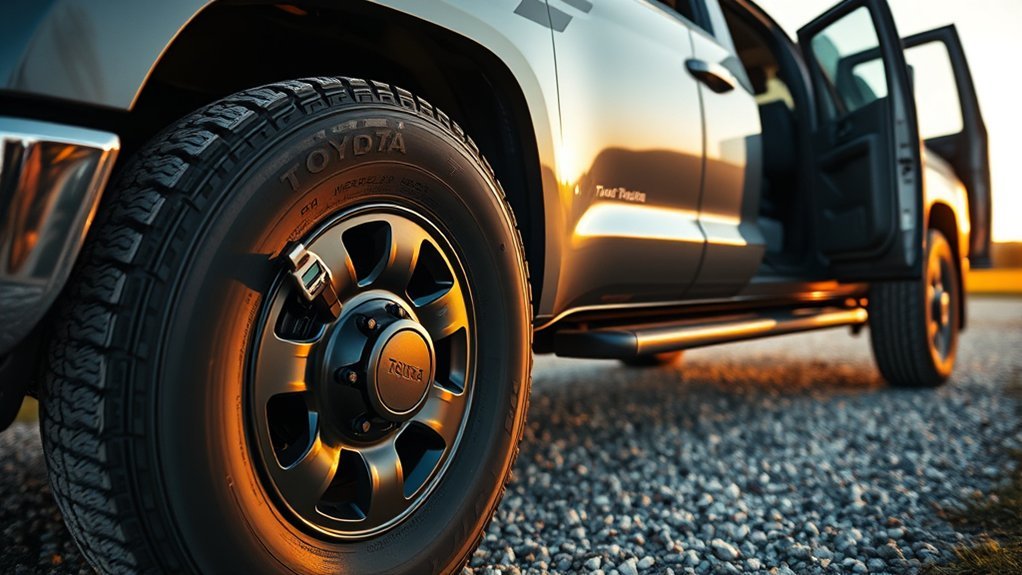
The correct Toyota Tundra tire pressure is not one universal number. It varies by model year, trim, original tire specification, and whether the truck still has its factory-size tires. Start with the cold-pressure values on the tire-and-loading information label inside the driver’s door opening, then use the owner’s manual or an approved tire load table when the tires have been changed.
Quick Answer
Inflate original-equipment Toyota Tundra tires to the cold PSI printed on the driver-door tire placard. Do not use the tire sidewall’s maximum pressure as your target. If you installed a different size or changed from P-metric to LT-metric tires, have the required pressure calculated from an approved load-and-inflation table.
Key Takeaways
- Use the PSI on your truck’s tire placard for factory-size tires; pressures from another Tundra may not apply to yours.
- Check all tires cold at least once a month and before towing, carrying a heavy load, or taking a long trip.
- Load Range E does not automatically mean 50, 55, 60, or 80 PSI. The correct pressure depends on the tire size and required load capacity.
- Do not exceed the tire’s maximum pressure, the wheel’s pressure rating, GVWR, GAWR, payload limit, or towing limits.
- TPMS is a warning system, not a substitute for checking pressure with an accurate gauge.
At a Glance
| Time Required | 5–10 minutes |
| Difficulty | Easy for factory-size tires; professional guidance recommended after changing tire size or construction |
| Tools Needed | Accurate pressure gauge, air compressor or inflator, valve-cap tool if needed, and the truck’s tire placard |
| Cost | Usually free at home with existing tools; approximately $10–$30 for a quality gauge |
How to Find the Correct Toyota Tundra Tire Pressure

Open the driver’s door and look for the Tire and Loading Information label on the door pillar or door opening. It lists the original tire size and the recommended cold tire inflation pressure for the front and rear tires. Some configurations use the same pressure at both axles, while others specify different front and rear values.
For factory-size tires with the correct load index and service description, the placard is the primary reference. The National Highway Traffic Safety Administration also advises drivers to use the vehicle manufacturer’s recommended cold pressure rather than the maximum number printed on the tire.
Warning: The “MAX PRESS” value molded into a tire’s sidewall is a limit associated with that tire’s rated load. It is not the normal pressure recommendation for your Tundra. Never exceed the tire or wheel manufacturer’s maximum pressure.
Which Pressure Source Should You Follow?
| Tire setup | Pressure guidance |
|---|---|
| Original tire size and specification | Use the cold front and rear PSI on the truck’s tire placard. |
| Same-size replacement with an equal or higher load index | Start with the placard unless Toyota or the tire manufacturer provides a different documented requirement. |
| Different tire size | Use an approved load-and-inflation table to preserve or exceed the original tire’s load capacity at placard pressure. |
| P-metric to LT-metric conversion | Do not reuse the P-metric placard PSI blindly. Calculate the LT pressure required to carry the equivalent load. |
| Towing or maximum payload | Follow Toyota’s loaded-operation instructions. For modified tire setups, use actual axle loads and the tire manufacturer’s load table. |
Toyota Tundra pressure specifications have changed across generations and configurations. Many older second-generation trucks with factory P-metric tires use placard figures such as 30 PSI at the front and 33 PSI at the rear, but that does not make 30/33 correct for every Tundra. Newer trucks, optional wheel packages, market-specific models, and specialty configurations can use different values. Check the label on the individual truck instead of copying a figure from another owner.
Why Correct Tire Pressure Matters
Air pressure allows a tire to support the truck’s weight and maintain its intended shape while accelerating, cornering, and braking. A tire that does not have enough pressure for its load flexes excessively and generates heat. Continued underinflated operation can damage the tire internally even when the tread still looks usable.
Excessive pressure can reduce ride comfort and alter the tire’s contact with the road. Pressure above the tire or wheel limit can also create a serious failure risk. Proper cold inflation supports predictable handling, braking, tread wear, load capacity, and fuel efficiency.
You cannot reliably judge tire pressure by appearance. A radial truck tire may look normal while being significantly underinflated, so use a gauge.
The tire placard, GVWR label, and owner’s manual work together but describe different limits:
- Placard pressure: The cold PSI Toyota specifies for the listed original tire configuration.
- Payload capacity: The maximum combined weight of occupants and cargo allowed for that truck as equipped.
- GVWR: The maximum permitted weight of the loaded truck.
- GAWR: The maximum permitted weight on an individual axle.
- Tire load capacity: The load one tire can support at a specified pressure under the applicable standard.
Installing higher-load tires does not raise the Tundra’s payload, GVWR, GAWR, hitch rating, or towing capacity. The truck remains limited by its original vehicle ratings.
How to Check and Maintain Tundra Tire Pressure
- Park long enough for the tires to cool. Check them before driving, after the truck has been parked for at least three hours, or after it has traveled less than about one mile at moderate speed.
- Read the placard. Note the required front and rear cold pressures. Do not assume all four tires use the same value.
- Remove the valve cap. Inspect the valve for dirt, corrosion, cracking, or obvious leakage.
- Measure with a reliable gauge. Press the gauge firmly onto the valve stem until air no longer escapes around the connection.
- Add or release air as needed. Bring each tire to its specified cold pressure.
- Recheck the reading. Compressor gauges can vary, so confirm the final pressure with your handheld gauge.
- Replace the valve cap. A sealing cap helps keep moisture and debris away from the valve core.
- Check the spare. Spare-tire pressure is often different from the road-tire pressure and may not be monitored by TPMS.
Pro Tip: Keep one gauge in the truck and compare it with a known-accurate shop gauge occasionally. Use a gauge with a range high enough for your tires; a 60-PSI gauge may not be suitable for high-pressure LT tires or the spare.
[Amazon Products Picked for You]

Enhanced Visibility in Low Light: Features a green backlit LCD screen and integrated flashlight, allowing for clear reading of tire pressure even in dark or dimly light conditions.

1. LONG ZINC ALLOY DUAL HEAD DESIGN : Straight foot air chuck are deisghed for inner wheels or difficult reached valve as well as the 30°reverse chuck are for outer wheels.A good choice for testing your tire pressure also a great father's day gift

PROCESS LEVEL ACCURACY: Each ETENWOLF’s digital tire pressure gauge is calibrated manually to ANSI B40.7 Grade 2A(plus-minus 1 PSI).Presta valve adapter not included, if used for bicycles, it must be purchased separately
How Often Should You Check Tundra Tire Pressure?
Check all tires at least once a month and before long trips, towing, carrying a heavy load, or sustained high-speed travel. The U.S. Tire Manufacturers Association’s tire-care guide recommends regular cold-pressure checks even when a vehicle has TPMS.
If one tire repeatedly loses more pressure than the others, do not keep topping it up indefinitely. A puncture, leaking valve core, damaged wheel, bead leak, or prior underinflation damage may require professional inspection.
How Temperature Affects Tire Pressure
Pressure changes as air temperature changes. A common real-world estimate is a change of roughly 1–2 PSI for every 10°F change in temperature. A cold snap may therefore trigger the warning light even when no puncture is present.
Adjust the tires back to the placard pressure while they are cold. Do not intentionally leave them low in winter, and do not overinflate them in anticipation of future cold weather.
Note: Tire pressure normally rises while driving because the tires warm up. Do not bleed air from a hot tire simply because the reading is higher than the cold placard value. Recheck and adjust it after the tire has cooled.
Factory PSI Versus Replacement-Tire PSI
The size molded on the tire is only part of the pressure calculation. The tire’s construction, load index, load range, and applicable load standard also matter. Two tires with similar dimensions can require different pressures to carry the same load.
[Amazon Products Picked for You]
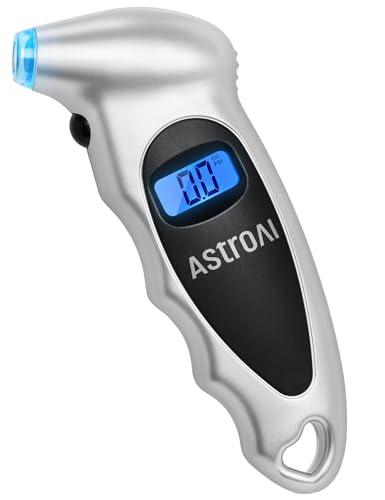
Accurate, Dependable Readings: Factory‑calibrated to ±1 PSI, so you can confidently match your vehicle’s recommended PSI (check the door jamb sticker). Ideal for monthly checks and road trips — consistent results every time, cold or warm.

RUGGED DESIGN: The stainless steel components prevent rust and corrosion while the precision-crafted nozzle seamlessly seals onto the valve stems for highly accurate readings (±2% span). We also provide 4 valve stem caps for convenient replacement.

HIGH ACCURACY: Every ETENWOLF's pencil tire gauge is calibrated to ANSI B40.1 Grade B, it is accurate to 2% of span in the middle 50% of range and 3% of span in the lower and upper 25% of range. Each ETENWOLF pencil tire pressure gauge is manually calibrated and has its unique calibration number printed on the pencil
Factory P-Metric and Metric Tires
When the truck still uses the original size, type, and an appropriate load index, use the tire placard. A second-generation Tundra placard may show 30 PSI front and 33 PSI rear, while another Tundra may show a different value. The label on your truck resolves the question.
Switching From P-Metric to LT-Metric Tires
An LT tire generally needs more pressure than a similarly sized P-metric tire to carry an equivalent load. That does not mean every LT275/65R18 should be set to 55 PSI at the front and 60 PSI at the rear, or that every Load Range E tire needs at least 50 PSI.
The correct conversion process is:
- Record the original tire size, load index, and front and rear placard pressures.
- Determine the load capacity the original tire provides at each placard pressure under the applicable load standard.
- Find the replacement LT tire in the manufacturer’s load-and-inflation table.
- Select a cold pressure that provides at least the required equivalent load capacity.
- Confirm that the pressure does not exceed the replacement tire’s limit or the wheel’s pressure rating.
- Verify clearance, speed rating, load index, and Toyota’s replacement-tire restrictions.
Toyo Tires’ light-truck replacement bulletin explains why an LT-metric tire can be underinflated for its load even when it contains the same PSI used in the original P-metric tire. Its load-and-inflation guide provides the table-based procedure for optional sizes.
Warning: Do not rely on a chalk test, visual sidewall bulge, internet poll, or the tire’s load-range letter as the only basis for highway pressure. These methods do not prove that the tire can carry the required load at the selected PSI.
What Load Range E Means
Load Range E identifies a category of LT-tire construction and load-pressure capability. It does not instruct you to run the tire at its maximum pressure during normal driving. An E-rated tire may require a higher pressure than the original P-metric tire, but its operating PSI must still be matched to the load it needs to carry.
Running an LT tire far below the pressure required for its load can create excessive flex and heat. Running it unnecessarily high can produce a harsh ride and may reduce traction or impact compliance. Use the applicable table rather than assuming that more pressure is always better.
Tundra Tire Pressure for Towing and Heavy Loads
Towing adds load to the truck through the trailer’s tongue weight. Passengers, bed cargo, a weight-distributing hitch, accessories, and the hitch assembly itself also use the Tundra’s available payload. The trailer’s full weight is not placed on the truck’s rear tires, so total trailer weight cannot be converted directly into a PSI recommendation.
Before towing:
- Read the truck’s payload label, GVWR, front and rear GAWR, hitch limits, and towing instructions.
- Calculate the weight of occupants, cargo, accessories, hitch hardware, and trailer tongue weight carried by the truck.
- Confirm that the loaded truck remains within payload, GVWR, and both axle ratings.
- Use the placard pressure unless Toyota specifies a different loaded pressure.
- If the tire size or construction has changed, verify the loaded tire capacity with the replacement manufacturer’s load table.
- When operating close to the limits, weigh the fully loaded truck and trailer at a public scale, including separate front- and rear-axle readings.
Actual axle weight is more useful than a general statement such as “add five PSI” or “run at least 50 PSI.” Each tire on an axle must have enough capacity for its share of the load, and no pressure increase can make it safe to exceed an axle, wheel, tire, hitch, or vehicle rating.
Warning: Underinflation and overloading can produce excessive heat and internal tire damage. If the required load cannot be supported without exceeding a tire or wheel limit, reduce the load or install a properly rated tire-and-wheel combination.
[Amazon Products Picked for You]

PRO ACCURACY - mechanic recommended, performance tested, & calibrated accurate to professional ANSI 2A standards - with dual pressure sensors certified to ±0.50% FS (0.50 PSI), offering reliable readings up to 100 PSI w/ precise readout resolution of 0.10 PSI - so you can now maintain your tires with a shop-grade mechanic trusted tool
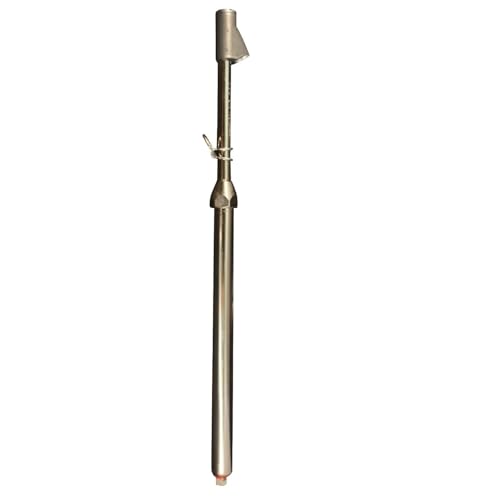
Milton precision engineered service gages provide accurate, long life trouble free performance

PROCESS LEVEL ACCURACY: This heavy duty tire pressure gauge is calibrated manually to ANSI B40.1 Grade A (±1% of span)
Should You Increase Pressure Before Towing?
Do not automatically add pressure simply because a trailer is attached. For original tires, follow the placard and any loaded-operation instructions in the Toyota owner’s manual. For replacement tires, an increase may be necessary if a documented load-table calculation requires it.
Increasing pressure does not increase the truck’s legal payload or towing capacity. It only changes how much load the tire can support within the tire’s rated range.
What About Airing Down Off Road?
Lower pressure can enlarge the contact patch on sand, loose dirt, or rocky trails, but the safe amount depends on tire construction, wheel design, vehicle load, speed, and terrain. Excessive airing down can unseat a bead, damage a sidewall, or allow the wheel to strike an obstacle.
Drive slowly while aired down and reinflate to the correct road pressure before returning to sustained pavement or highway speeds. Off-road pressure is temporary and should not replace the placard or calculated highway setting.
What to Do When the Tire Pressure Light Comes On
A steady tire-pressure warning means at least one monitored tire may be significantly underinflated. TPMS can alert you to a problem, but it may not illuminate until pressure is well below the placard value. Toyota advises owners to check pressure regularly with a gauge instead of relying only on the monitor.
- Reduce speed and avoid abrupt steering or braking. Pull over in a safe location when practical.
- Inspect the tires. Look for a visibly low tire, embedded object, cut, sidewall bulge, tread separation, or damaged wheel.
- Measure each tire with a gauge. Use the placard values. If the tires are warm, add enough air to avoid operating significantly below the cold recommendation, then recheck them cold.
- Inflate the low tire. Do not exceed the tire or wheel limit.
- Watch for rapid loss. If pressure falls again, the tire needs professional inspection. Do not continue driving on a severely underinflated or damaged tire.
Why the Light May Stay On After Inflation
The light may not clear immediately. Depending on model year, the system may need a short drive before it recognizes the corrected pressure. Some Tundras also have a pressure-setting or initialization function in the multi-information display.
Do not initialize or “set” the TPMS while the tires are incorrectly inflated. Doing so may teach the system an unsuitable reference pressure. Follow the procedure in the manual for your exact model year through the Toyota Tundra owner’s-manual portal.
If the warning flashes for about a minute before remaining illuminated, or if it persists despite correct pressure, the system may have a sensor, registration, communication, or control-system fault. A tire shop or Toyota service department can test the sensors and confirm whether relearning or registration is required.
Common Tundra Tire Pressure Mistakes
- Using the maximum sidewall pressure as the normal target.
- Copying a PSI value from a different year, trim, wheel package, or tire size.
- Assuming every Load Range E tire should be set to 50, 60, or 80 PSI.
- Adding a fixed five PSI for towing without checking loads and published instructions.
- Bleeding air from warm tires to reach the cold placard value.
- Ignoring the spare tire because it is not shown on the TPMS display.
- Initializing TPMS before setting the tires to the correct cold pressures.
- Believing that higher-capacity tires increase GVWR, GAWR, payload, or towing capacity.
- Continuing to drive on a tire that repeatedly loses pressure.
Frequently Asked Questions
What PSI should Toyota Tundra tires be at?
Use the cold front and rear pressures on the tire-and-loading label inside your Tundra’s driver-door opening. Some older configurations use 30 PSI front and 33 PSI rear, but other years and tire packages use different values. The individual truck’s placard is the correct reference for factory-size tires.
What is the 5 PSI rule for tires?
There is no universal five-PSI rule for setting Toyota Tundra tire pressure. Do not automatically add five PSI for towing, winter, or replacement tires. Follow the placard for original tires or use an approved load-and-inflation table when the tire size or construction has changed.
Is 35 PSI too much when the placard says 32 PSI?
Thirty-five PSI may still be below the tire’s maximum, but it is higher than the vehicle manufacturer’s 32-PSI recommendation. For an original-size tire, return it to 32 PSI cold unless the owner’s manual or a qualified tire professional has provided a documented alternative for that setup and load.
Is 40 PSI good for a Toyota Tundra?
Forty PSI is correct only when it matches the truck’s placard or a valid replacement-tire load calculation. It may be too high for one Tundra and too low for an LT tire carrying a heavy load on another. Tire size alone is not enough to decide.
What pressure should Load Range E tires use on a Tundra?
Load Range E does not have one universal operating pressure. Determine how much load the original tire supported at the placard PSI, then use the E-rated replacement tire’s load-and-inflation table to find the pressure that provides at least equivalent capacity without exceeding the tire or wheel limit.
Should I increase my Tundra’s tire pressure when towing?
Not automatically. Follow Toyota’s placard and towing instructions for original tires. An increase may be appropriate for a replacement-tire setup when a load table and actual loaded axle weights show that more pressure is needed. Never exceed the tire, wheel, axle, or vehicle limits.
Why is the TPMS light still on after I added air?
One tire may still be low, the spare may be monitored on some configurations, the system may need a short drive, or the truck may require a model-specific initialization procedure. A flashing light followed by a steady light can indicate a malfunction. Recheck all tires cold and consult the manual before resetting the system.
Conclusion
The safest Toyota Tundra tire-pressure recommendation is the one printed on your truck’s tire placard for its original tire configuration. Check the tires cold every month and before towing or long trips, and do not substitute the tire sidewall maximum for Toyota’s recommended PSI.
When tire size or construction changes, especially when converting from P-metric to LT-metric tires, use an approved load-and-inflation table rather than a fixed internet recommendation. Confirm the tire and wheel limits, preserve the original load capacity, and keep the loaded truck within its payload, GVWR, GAWR, hitch, and towing ratings.
Sources
- National Highway Traffic Safety Administration — TireWise — cold inflation pressure, tire placards, pressure checks, and tire-safety guidance.
- U.S. Tire Manufacturers Association — Care and Service of Passenger and Light Truck Tires — monthly checks, cold-tire definition, temperature effects, loading, and TPMS limitations.
- Toyo Tires — Application of Load and Inflation Tables — optional-size and replacement-tire pressure calculations.
- Toyo Tires — Replacing Tires on Light Trucks — P-metric-to-LT-metric load equivalency and inflation requirements.
- Toyota — Tundra Owner’s Manual — model-specific tire-pressure, TPMS, loading, and initialization instructions.
