
Choosing a trailer ball for your Toyota Tundra starts with the trailer, not the truck. The ball must match the size stamped on the trailer coupler, fit the ball mount correctly and carry a sufficient weight rating. You must also keep the loaded truck and trailer within every applicable Toyota, hitch and trailer limit.
Quick Answer
A Toyota Tundra does not have one universal trailer ball size. Use the diameter stamped on the trailer coupler—commonly 2 inches or 2-5/16 inches—then verify the exact ball’s weight rating, shank fit and installation requirements. Never choose a hitch ball by trailer weight or truck model alone.
Key Takeaways
- Read the required ball diameter from the trailer coupler; do not guess from the trailer type or Tundra model.
- Ball diameter and towing capacity are separate specifications. Check the rating stamped on the exact ball.
- The lowest-rated component in the truck, receiver, ball mount, ball, coupler or trailer sets the usable limit.
- Confirm the ball shank fits the mount hole and tighten it to the equipment manufacturer’s specified torque.
- Set the trailer approximately level and check the latch, chains, wiring, brakes and breakaway system before driving.
At a Glance
| Time Required | About 10–20 minutes to inspect and select the equipment; longer if a ball or mount must be installed |
| Difficulty | Beginner for identification; intermediate or professional installation may be appropriate for high-torque fasteners |
| Tools Needed | Tape measure, coupler and equipment labels, weight information, suitable wrenches and the specified torque wrench if changing the ball |
| Cost | No cost to inspect an existing setup; replacement cost varies by rating and whether you need only a ball or a complete ball mount |
Understanding Trailer Ball Sizes for Towing

A trailer ball and coupler form a ball-and-socket connection that lets the truck and trailer move independently over turns and uneven roads. For that connection to work correctly, the nominal ball diameter must be exactly the size specified by the coupler.
The three common conventional-trailer ball sizes in North America are 1-7/8 inches, 2 inches and 2-5/16 inches. A Toyota Tundra is often used with a 2-inch or 2-5/16-inch ball because those sizes appear on many utility, boat, equipment and travel trailers. However, the Tundra itself does not select the size.
Look for a marking such as “2 IN BALL” or “2-5/16 BALL” on the top, side or latch area of the trailer coupler. If the marking is unreadable, check the trailer manual or contact the coupler or trailer manufacturer before towing.
| Ball Diameter | Common Applications | What to Verify |
|---|---|---|
| 1-7/8 inches | Many small utility, personal-watercraft and light recreational trailers | Coupler marking, exact ball rating and shank dimensions |
| 2 inches | Many utility, boat, cargo and smaller camper trailers | Do not assume all 2-inch balls have the same capacity |
| 2-5/16 inches | Many larger conventional, equipment and gooseneck trailers | Confirm the individual rating; the larger diameter does not guarantee a particular capacity |
The coupler marking determines the required ball diameter. The stamp or documentation for the exact hitch ball determines its weight rating.
Ball Size and Weight Rating Are Different
A common mistake is treating “2-inch” as one capacity class and “2-5/16-inch” as another. In reality, manufacturers offer balls of the same diameter with different shank sizes, materials and ratings.
For example, one 2-inch ball may be intended for a relatively light trailer while another 2-inch ball with a larger shank may have a much higher rating. The same variation exists among 2-5/16-inch balls. Read the rating stamped on the ball or listed in its manufacturer documentation.
The ball’s rating must be high enough for the trailer’s actual loaded weight. If you do not know the loaded weight, use the trailer’s GVWR as the equipment-selection limit unless the equipment manufacturer specifies another approved method.
Warning: Never place a 2-inch coupler over a 1-7/8-inch ball or a 2-5/16-inch coupler over a 2-inch ball. The latch may appear to close, but the undersized ball can allow the trailer to separate from the truck.
Comparing 2-Inch vs. 2-5/16-Inch Trailer Balls: Which Is Right for You?
The correct choice is the ball that matches your trailer coupler and meets every related fit and rating requirement. Do not choose a 2-5/16-inch ball merely because your Tundra can tow a heavy trailer, and do not choose a 2-inch ball merely because the trailer seems small.
[Amazon Products Picked for You]
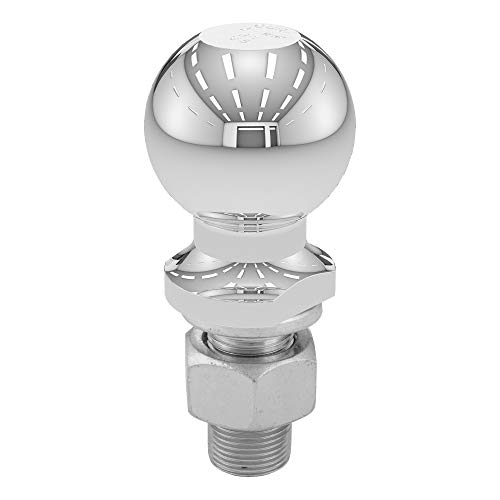
RELIABLE STRENGTH. This trailer hitch ball is rated to tow up to 7,500 pounds gross trailer weight. It is constructed from hot-forged steel for reliable towing strength and confidence on the road ahead
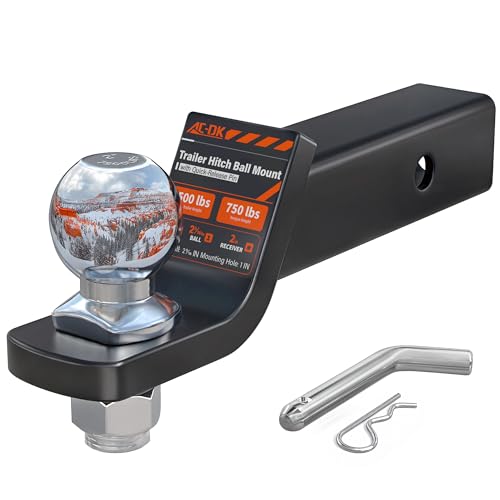
Heavy-Duty Trailer Hitch Ball Mount: Rated to tow up to 7,500 lbs GTW and 750 lbs tongue weight, this durable hitch mount is suitable for trucks, SUVs, RVs, trailers, campers, ATVs/UTVs, and boats. Designed to fit all vehicles equipped with a standard 2-inch hitch receiver
Coupler Compatibility
Begin with the nominal diameter stamped on the coupler. A 2-inch coupler requires a 2-inch ball. A 2-5/16-inch coupler requires a 2-5/16-inch ball. The coupler should lower fully onto the ball, and its latch must close and lock without excessive force.
After latching, raise the trailer jack slightly. The rear of the truck should begin to rise with the trailer tongue. If the coupler lifts off the ball, stop and correct the connection before moving the vehicle.
Weight Capacity Considerations
Check the rating of each part in the towing path:
- Toyota Tundra: Verify the trailer-weight, payload, axle and combined-weight limits for the exact model year, cab, bed, drivetrain, powertrain and equipment configuration.
- Receiver hitch: Read its conventional and, where applicable, weight-distributing ratings.
- Ball mount: Check both gross trailer weight and tongue-weight ratings.
- Hitch ball: Verify the rating stamped on the ball or provided by its manufacturer.
- Coupler: Confirm its ball size and load rating.
- Trailer: Do not exceed its GVWR, axle ratings, tire ratings or cargo limits.
The usable capacity is no greater than the lowest-rated component. Installing a higher-rated ball does not increase the Tundra’s towing capacity, receiver rating or payload capacity.
Tundra Towing and Payload Limits
The 2026 Toyota Tundra is advertised with a maximum towing capacity of up to 12,000 pounds, but that figure applies only to qualifying configurations. Other Tundra configurations have lower limits.
Use the Toyota manuals and warranties portal, your owner’s manual, the certification labels on the truck and Toyota’s model-specific towing data to verify your actual limits.
Remember that trailer tongue weight becomes part of the truck’s load. Passengers, cargo, aftermarket accessories, the ball mount and tongue weight all consume payload. A trailer may be within the advertised towing limit while still causing the truck to exceed its payload, rear-axle or GVWR limit.
Tongue Weight and Stability
For many conventional trailers, general guidance places tongue weight at approximately 10–15% of loaded trailer weight. The exact approved range and maximum must come from the Toyota, hitch and trailer instructions.
Too little tongue weight can contribute to sway. Too much can overload the truck’s receiver, rear axle, suspension or payload capacity. Weigh the trailer in its travel-ready condition, including water, fuel, batteries, equipment and cargo.
Pro Tip: Do not base your setup only on a trailer’s published dry weight or empty tongue weight. Verify the trailer after it is loaded as it will be used.
How to Select the Right Trailer Ball for Your Tundra
Use the following process whenever you connect a different trailer or replace part of the towing setup.
1. Read the Trailer Coupler Size
Clean the coupler and locate its stamped ball diameter. Common markings include 1-7/8, 2 and 2-5/16 inches. Do not estimate the opening with a tape measure when a manufacturer marking or trailer manual is available.
2. Determine the Loaded Trailer Weight
Use a public vehicle scale, a suitable trailer scale or reliable manufacturer data for the trailer in its loaded condition. Confirm that the trailer remains within its GVWR and axle and tire ratings.
Also identify the expected tongue weight. Include that load when checking the Tundra’s payload, GVWR and rear GAWR.
3. Check the Tundra’s Configuration-Specific Rating
Find the towing information for the exact truck rather than relying on the highest number advertised for the Tundra range. Confirm:
- Maximum conventional trailer weight
- Maximum tongue weight
- GVWR and front and rear GAWR
- GCWR
- Available payload after passengers, cargo and accessories
- Any requirement or restriction involving a weight-distributing hitch
4. Check Every Component Rating
Inspect the receiver, ball mount, hitch ball, pin, coupler and safety chains. Use the lowest listed rating as the maximum for the setup. Replace any component whose label is missing, unreadable or insufficient for the planned load.
5. Match the Ball Shank to the Ball Mount
The threaded shank passes through the ball-mount hole. Confirm all of the following:
- The shank diameter is approved for the mount hole.
- The usable threaded length is sufficient for the mount thickness, washer and nut.
- The ball seat rests fully and flat against the mount.
- The washer and nut are installed in the manufacturer’s required orientation.
- The nut is tightened to the exact torque specified by the hitch-ball or mount manufacturer.
Do not drill, grind or enlarge a ball-mount hole unless the equipment manufacturer explicitly approves that modification.
Note: Hitch-ball nuts often require more torque than an ordinary household torque wrench can provide. Use suitable equipment or have a qualified hitch installer complete the work.
6. Select the Correct Rise or Drop
Park the unloaded truck and level trailer on flat ground. Measure from the ground to the top inside edge of the receiver opening, then measure from the ground to the bottom of the trailer coupler.
- If the coupler is lower than the receiver, you generally need a drop.
- If the coupler is higher than the receiver, you generally need a rise.
Select a rated mount that positions the loaded trailer approximately level. A severely nose-high or nose-low trailer can affect axle loading, ground clearance and handling.
7. Couple and Test the Connection
- Place the coupler directly over the ball and lower it fully.
- Close the coupler latch and install its safety pin or lock.
- Raise the jack enough to confirm the coupler remains attached.
- Retract and secure the jack.
- Cross the safety chains under the tongue and attach them to the designated receiver points.
- Connect the electrical plug and breakaway cable where applicable.
- Check running lights, brake lights, turn signals and trailer brakes.
- Walk around the trailer and verify tires, cargo securement, doors and stabilizers.
Why You Need to Match Your Hitch With Your Ball Size
Matching the ball to the coupler is only one part of compatibility. The receiver, ball mount, hitch ball and trailer coupler must function as one rated system.
A correctly sized ball can still be unsafe if the ball mount, receiver, shank, coupler or truck is underrated for the load.
Before towing, verify these four forms of compatibility:
- Diameter compatibility: The ball diameter exactly matches the coupler marking.
- Mechanical compatibility: The shank, mount hole, washer and nut fit correctly and are installed to specification.
- Weight compatibility: Every part is rated for the loaded trailer and tongue weight.
- Geometry compatibility: The mount provides the correct rise or drop so the trailer tows approximately level.
If the connection rattles excessively, the coupler will not close, the latch feels loose or the trailer does not sit correctly, do not force the parts together. Inspect the equipment for the wrong size, wear, damage or incorrect adjustment.
[Amazon Products Picked for You]

TRAILER HITCH BALL MOUNT: Each adjustable trailer hitch includes one anti-theft steel lock, one 2" tow ball, two pins and clips.
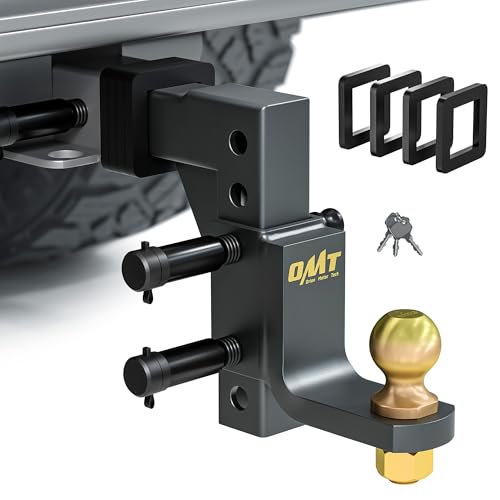
No More Hitch Sizing Stress: Orion Motor Tech's trailer hitch ball mount comes with a standard 2 in. receiver, 2 in. ball, 9-1/2 in. drop, and 8-1/4 in. rise for secure towing. Tow everything from fishing boats to RVs, campers, and utility trailers

DURABLE & VERSATILE – Get ready for the ultimate towing experience with our Adjustable Trailer Hitch! With a strong, durable, and versatile design, you'll be able to tow just about anything, up to 20,000lbs GVWR, and take advantage of a 6-inch drop for easy hitching with its unique channel-style shank
Safety Considerations When Towing With a Trailer Ball
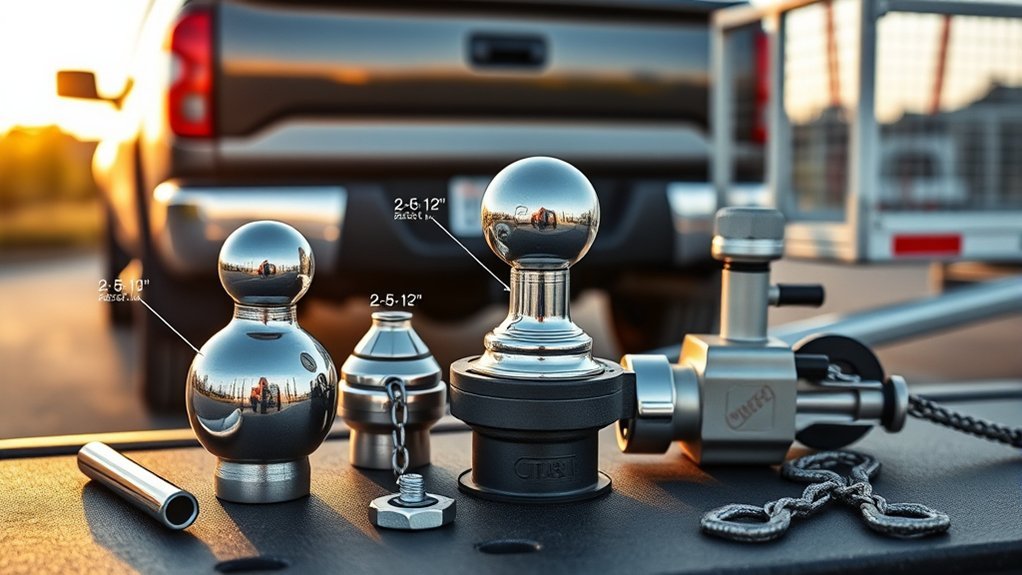
A properly selected hitch ball cannot compensate for damaged equipment, poor trailer loading or an overloaded truck. Inspect the complete setup before every trip and again after the first few miles following a new installation or major loading change.
Pre-Departure Towing Checklist
- The coupler is fully seated, latched and secured with its pin or lock.
- The ball diameter matches the coupler marking.
- The ball, mount, receiver and coupler ratings are sufficient.
- The ball nut and mounting hardware are secure.
- The hitch pin and retaining clip are installed.
- Safety chains are crossed under the tongue with enough slack for turns but do not drag.
- The breakaway cable is attached independently from the safety chains where required.
- The electrical connector is secure and all lights work.
- Trailer brakes and the brake controller operate correctly where fitted.
- The trailer jack is fully raised and secured.
- The trailer is approximately level.
- Tires are correctly inflated and free from visible damage.
- Cargo is secured and distributed to produce appropriate tongue weight.
- The truck and trailer remain within all weight ratings.
The Nissan Towing Guide provides useful general manufacturer guidance on matching hitch-ball size, shank fit, tongue load and crossed safety chains. Your Toyota and trailer-specific instructions still take priority for your combination.
When a Weight-Distributing Hitch May Be Needed
A weight-distributing hitch uses spring bars to transfer part of the tongue load among the tow vehicle and trailer axles. It does not reduce the trailer’s actual weight or create extra payload.
Use one only when it is approved by Toyota, the receiver, the trailer and the hitch manufacturer. Some surge-brake trailers and certain frame designs have compatibility restrictions. Follow the adjustment procedure for the exact system instead of applying a generic setting.
Common Trailer Ball and Coupler Problems
The coupler will not lower onto the ball: Confirm the ball diameter, open the latch fully, align the truck and trailer and inspect the coupler for corrosion or damage.
The latch closes but the coupler lifts off: Stop immediately. The ball may be undersized, the coupler may be worn or the latch may need manufacturer-approved adjustment or repair.
The connection clunks: Inspect the coupler fit, ball wear, receiver play, hitch pin, mount and cargo loading. Do not assume all movement is normal.
The trailer sits nose-high or nose-low: Select a mount with a different rise or drop and recheck the trailer after loading.
The trailer sways: Reduce speed gradually without abrupt steering, then inspect tongue weight, cargo distribution, tire condition, speed and the complete hitch setup before continuing.
Warning: Do not tow if the coupler does not latch securely, a rating is unknown, a component is cracked or bent, the ball is badly worn, safety chains cannot be attached correctly or the combination exceeds a weight limit.
Three Questions to Answer Before Towing With Your Tundra
- What ball size does the trailer require? Read the marking on the coupler. The answer may be 1-7/8 inches, 2 inches, 2-5/16 inches or another coupling type.
- What does the trailer weigh when loaded? Include cargo, fluids, batteries and equipment, then verify tongue weight and all truck and trailer limits.
- What is the lowest-rated component? Compare the Tundra, receiver, ball mount, hitch ball, coupler and trailer ratings. The lowest one controls.
Answering these questions is more reliable than choosing a ball from a general statement about “medium-duty” or “heavy-duty” towing.
Frequently Asked Questions
What is the difference between a 2-inch and a 2-5/16-inch trailer ball?
The difference is the nominal diameter and the couplers they fit. A 2-inch coupler requires a 2-inch ball, while a 2-5/16-inch coupler requires a 2-5/16-inch ball. Capacity depends on the rating of the exact ball and shank, not diameter alone.
Can I use a 2-inch ball with a 2-5/16-inch trailer coupler?
No. The undersized ball may allow the coupler to separate even if the latch appears to close. Use the exact diameter stamped on the coupler.
What trailers commonly use a 2-5/16-inch ball?
Many larger travel, equipment, car-hauler and gooseneck trailers use a 2-5/16-inch ball. Trailer type is not conclusive, so always verify the coupler marking.
Why are there several different trailer ball sizes?
Different trailers use couplers designed for different ball diameters, equipment dimensions and applications. Standardized sizes make it possible to select a compatible connection, but each component still has its own weight rating.
How do I know which ball size my Toyota Tundra needs?
Inspect the trailer coupler. The truck does not prescribe one universal diameter. After identifying the coupler size, verify the ball rating, shank fit, ball-mount rating and your Tundra’s configuration-specific limits.
Can any 2-5/16-inch ball tow 12,000 pounds?
No. Read the exact ball’s rating. You must also verify the receiver, ball mount, coupler, trailer and Tundra ratings. A Tundra’s advertised maximum does not increase the rating of any hitch component.
Is a gooseneck ball the same as a fifth-wheel hitch?
No. A gooseneck trailer couples to a ball mounted in the truck bed, commonly a 2-5/16-inch ball. A fifth-wheel trailer normally uses a kingpin and fifth-wheel plate rather than a conventional hitch ball.
Sources
- Toyota — 2026 Tundra — current maximum towing and payload information, with configuration-dependent limitations
- Toyota Manuals and Warranties — model-specific owner’s manuals and vehicle guidance
- Nissan Towing Guide — general manufacturer guidance for hitch-ball size, ratings, shank fit, tongue load and safety chains
- SAE J684 — trailer couplings, hitches and safety-chain standard
- SAE J2807 — performance requirements used to determine tow-vehicle trailer-weight ratings
Conclusion
The correct Toyota Tundra trailer ball is the one that matches the trailer coupler, fits the ball mount and carries an adequate stamped rating. A 2-inch ball is not automatically limited to one weight, and a 2-5/16-inch ball is not automatically approved for every heavy trailer.
Check the loaded trailer weight, Tundra configuration, payload, receiver, mount, ball, coupler and trailer ratings. Install the ball to the manufacturer’s specifications, set the trailer approximately level and complete the full connection checklist before driving.
