Brake fade in a Toyota Tundra can develop when towing places more heat into the truck and trailer braking systems than they can safely dissipate. Long descents, excessive speed, an overloaded combination, poorly adjusted trailer brakes, worn components, or hydraulic problems can all contribute. Preventing fade starts with correct loading, functioning trailer brakes, a properly adjusted controller, and disciplined downhill driving.
Quick Answer
To prevent Toyota Tundra brake fade while towing, slow down before a descent, use Tow/Haul mode and a lower gear when equipped, avoid riding the brake pedal, and confirm that the trailer brakes share the stopping work. Stop safely if braking weakens, the pedal changes, or you smell overheated brakes.
Last updated: September 11, 2026 — rechecked against Toyota’s current Tundra information, Toyota model-year owner guidance, FMCSA speed-and-load guidance, and federal brake-fluid requirements.
How this guide was checked: This is a safety-focused synthesis of manufacturer and government guidance. It does not claim hands-on brake testing across every Tundra generation, trailer type, or brake package.
Key Takeaways
- Brake fade is primarily a heat-management problem, but a soft or sinking pedal can also indicate a hydraulic fault that needs immediate attention.
- Trailer brakes must be functional, correctly adjusted, and legally compliant; one universal trailer-weight threshold does not apply everywhere.
- Enter descents slowly, select an appropriate lower gear, and use controlled brake applications instead of continuously resting your foot on the pedal.
- Restore worn or faulty factory components before buying aftermarket pads, rotors, lines, or other upgrades.
- Do not try to correct a soft pedal by braking aggressively or deliberately activating ABS.
Brake-Fade Decision Guide
| Before a descent | Verify the loaded truck and trailer remain within their ratings, confirm the trailer brakes respond, check controller gain, and choose an appropriate Tow/Haul mode or lower gear before the grade. |
| Firm pedal, weak braking | Possible friction fade. Reduce speed, use an appropriate lower gear, avoid continuous pedal pressure, and stop at the first safe location if braking strength is falling. |
| Soft or sinking pedal | Treat this as a possible hydraulic or fluid-overheating fault. Slow the combination, stop safely, and do not continue towing if normal pedal feel does not return. |
| Continue towing? | Only after the brakes cool, normal braking and pedal feel return, and there is no leak, smoke, persistent warning, severe pulling, or continuing wheel overheating. If you are unsure, have the system inspected before towing again. |
What Is Toyota Tundra Brake Fade When Towing?
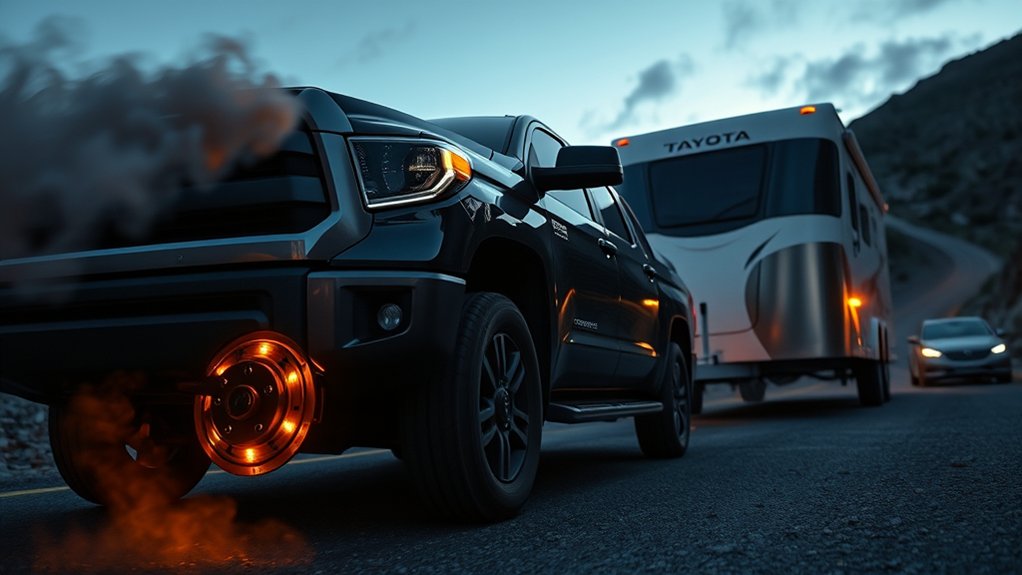
When you tow a heavy trailer, the brakes must convert the moving energy of both the truck and trailer into heat. A longer or steeper descent, a higher starting speed, and a heavier combination all increase the amount of heat the braking system must absorb and release.
Brake fade means braking effectiveness drops as heat builds. It can appear in more than one way:
- Friction fade: The pedal may still feel firm, but the truck does not slow as strongly because the pads or trailer brake linings have moved outside their effective temperature range.
- Fluid fade: The pedal may feel soft, spongy, or unusually long if excessive heat causes vapor to form in the hydraulic system.
- Mechanical or hydraulic failure: A sinking pedal, visible leak, severe pulling, warning light, grinding noise, or braking loss that does not recover may indicate a fault rather than temporary fade.
Warning: If the Tundra becomes difficult to slow, the pedal turns soft or begins sinking, you see smoke, or the truck pulls sharply during braking, reduce speed without abrupt steering, select a lower gear, and pull over at the first safe location. Do not continue towing until the cause has been identified if normal braking does not return.
Functioning trailer brakes are a critical part of the system because they allow the trailer to help slow its own mass. Do not assume that connecting a seven-pin plug means the brakes are operating correctly. The controller, wiring, magnets or hydraulic actuator, brake adjustment, battery, and breakaway system must all be in working order.
What Causes Brake Fade in a Toyota Tundra While Towing?
Brake fade is not unique to the Toyota Tundra. It can affect any tow vehicle when heat production exceeds the braking system’s capacity. The most common towing-related causes and contributing conditions include the following:
| Cause or condition | Why it matters |
|---|---|
| Excessive speed before a descent | The brakes must absorb more energy, causing temperatures to rise quickly. |
| Continuous light pedal pressure | Riding the brakes generates heat continuously and leaves little opportunity for cooling. |
| Trailer brakes that are absent, weak, or misadjusted | The Tundra’s brakes must perform too much of the combination’s stopping work. |
| Exceeding a weight rating | Excess trailer, tongue, cargo, axle, or combined weight increases braking demand and may reduce stability. |
| Worn, glazed, contaminated, or incorrect friction material | The pads or trailer linings may produce less friction or perform poorly at towing temperatures. |
| Dragging brake components | A sticking caliper, seized slide, parking-brake problem, or tight trailer bearing can generate heat before the driver applies the brakes. |
| Hydraulic fluid or system problems | Incorrect, contaminated, overheated, or leaking fluid can cause abnormal pedal travel and reduced hydraulic force. |
| Poor route or speed planning | Entering a grade too fast may force repeated heavy brake applications with little cooling time. |
What Are the Signs Your Tundra or Trailer Brakes Are Overheating?
Recognizing the symptom helps you decide whether you may be experiencing heat-related fade or a separate fault:
- Firm pedal but weak deceleration: Possible friction fade at the truck or trailer brakes.
- Soft or spongy pedal: Possible fluid overheating, air, hose expansion, leakage, or another hydraulic problem.
- Pedal or steering-wheel pulsation: Possible rotor thickness variation, runout, uneven deposits, hub problems, improper wheel torque, or ABS operation. Pulsation alone does not prove that the rotors must be replaced.
- Burning odor: Friction material, a dragging brake, overheated bearing grease, or another hot component may be involved.
- Smoke from a wheel: Stop as soon as it is safe. Do not touch the wheel, rotor, drum, or caliper.
- Pulling to one side: One brake may be applying differently from the others, or a tire or suspension problem may be affecting control.
- Trailer pushing the truck: Trailer-brake output may be too low, disconnected, misadjusted, or unable to handle the load.
Note: Brake odor after a demanding descent does not prove the system is undamaged. Glazed pads, heat-checked rotors, damaged seals, overheated trailer bearings, and cooked lubricant may remain after the components cool.
How Do You Prevent Toyota Tundra Brake Fade When Towing?
Prevention begins before the trailer is connected. Use the exact Toyota owner’s manual for your model year because towing limits, controller functions, approved brake fluid, drive modes, and operating instructions can differ between generations and trims.
Verify the truck and trailer weights
Do not rely only on a trailer’s advertised empty weight. Cargo, water, propane, batteries, accessories, passengers, and equipment can add substantial mass. Confirm that the loaded combination remains within the Tundra’s trailer rating, payload rating, axle ratings, gross vehicle weight rating, and gross combined weight rating.
Tongue weight and cargo in the bed also consume payload. A trailer may be below the maximum tow rating while still causing the truck to exceed its payload or rear-axle rating. For a vehicle-specific loading workflow, see Toyota Tundra payload capacity explained.
Inspect the Tundra’s brakes
- Check pad thickness, rotor condition, caliper operation, hoses, lines, and visible fluid level.
- Investigate uneven pad wear, pulling, grinding, leakage, warning lights, or unusual pedal travel before towing.
- Make sure the tires are correctly inflated for the load and that wheel fasteners have been tightened to the specified torque.
- Use only the brake-fluid type specified for the truck. Federal brake-fluid requirements instruct users to follow the vehicle manufacturer’s recommendation and keep fluid clean and dry because contamination can contribute to brake failure or costly repairs.
Inspect the trailer braking system
- Confirm that every braked axle is operating and adjusted correctly.
- Inspect wiring, connectors, grounds, magnets, hydraulic actuators, drums or rotors, linings, bearings, and the breakaway battery.
- Test the breakaway system according to the trailer manufacturer’s procedure.
- Verify that trailer brakes meet the laws where you tow. Requirements vary by jurisdiction and trailer configuration.
Calibrate the brake controller
If your Tundra has an Integrated Trailer Brake Controller, follow the procedure for its model year rather than copying another driver’s gain number. Trailer type, load, brake condition, road surface, weather, and controller design all affect the correct setting. For control locations, menu differences, and troubleshooting, see the dedicated Toyota Tundra trailer brake controller guide.
- Load the trailer as it will be used, confirm its brakes are in good working condition, and make the proper electrical connection.
- Select the correct trailer-brake type when your Tundra provides that setting, then confirm that the truck recognizes the trailer and shows no controller fault.
- Use a dry, level, traffic-free test area. Toyota’s documented procedure for recent factory controllers uses approximately 20–25 mph for the gain test.
- Use 5.0 as the documented starting gain where specified by your model-year Toyota manual, then fully apply the manual trailer-brake control.
- Adjust gain up or down in the controller’s available steps until trailer braking is strong and smooth without wheel lock-up. If your model-year manual gives different instructions, follow that manual.
- Perform normal controlled stops and recheck the setting if the trailer pushes the truck, grabs, or brakes too aggressively.
Pro Tip: Recheck controller gain after a major cargo change, brake service, prolonged storage, or a change in road conditions. The setting that worked for an empty trailer may be inadequate or too aggressive when it is fully loaded.
How Do You Control Speed on a Long Downhill Grade?
The safest descent begins before the road points sharply downhill. A loaded trailer requires more distance and greater caution than an unloaded truck, and FMCSA speed-and-load guidance reinforces the need to reduce speed for the load and conditions.
- Slow down before the grade. Do not wait until gravity has already accelerated the combination.
- Select Tow/Haul mode if equipped and appropriate. Current Tundra configurations may include selectable Tow/Haul modes, but operation varies by model year and trim. See Toyota Tundra Tow/Haul mode for the model-specific role of this setting.
- Select a lower transmission range. Use the model-year manual’s instructions and avoid an engine-speed range that could damage the powertrain.
- Leave a much larger following gap. This reduces the need for abrupt braking.
- Use controlled brake applications. Reduce speed decisively, then release enough pressure to let the brakes cool when road and traffic conditions allow. Do not continuously rest your foot on the pedal.
- Monitor the trailer. Watch for pushing, sway, controller warnings, smoke, odor, or changes in pedal feel.
- Use pullouts early. If speed control is becoming difficult, stop at a safe location before the brakes become severely overheated.
The best time to control downhill speed is before the brakes become hot—not after braking performance has already started to fall.
What to Do if Brake Fade Starts While Towing
- Stay calm and keep the combination straight. Avoid abrupt steering or an unnecessary lane change.
- Release the accelerator. Turn off cruise control if it is active.
- Select a lower gear or range carefully. Use Tow/Haul mode if equipped and appropriate, but do not select a range that would over-rev the engine.
- Apply the brakes with firm, controlled pressure. Do not pump an ABS-equipped brake pedal as a routine response, and do not deliberately attempt to trigger ABS.
- Use the trailer controller’s manual lever only as permitted by your model-year instructions. The manual control applies the trailer brakes without the Tundra’s service brakes. Excessive input can lock trailer wheels, and the control should not be used to continuously drag trailer brakes down a grade.
- Move to a safe stopping location. Use an escape ramp if one is available and you cannot control speed normally.
- Allow the brakes to cool naturally. Do not pour water on hot rotors or drums because sudden cooling can damage components.
- Inspect before continuing. Arrange professional help if the pedal remains soft, braking remains weak, a warning light stays on, a component leaks, or any wheel continues smoking or overheating.
Do not resume towing just because the brakes have cooled. Continue only if normal braking strength and pedal feel return and there is no fluid leak, smoke, persistent warning, severe pulling, or continuing wheel overheating. If the cause is unclear, have the truck and trailer braking systems inspected before towing again.
When Can Brake Upgrades Help With Towing Brake Fade?
Upgrades may help a Tundra that tows frequently, but they should follow a complete inspection. No pad, rotor, line, or controller can make an overloaded trailer or defective braking system safe.
Restore the factory braking system to full working condition before changing its design or friction materials.
- Application-specific brake pads: Choose OEM-equivalent or reputable severe-duty pads approved for your exact Tundra configuration. Do not assume every ceramic pad has better towing performance; compounds differ in friction, noise, dust, cold response, and temperature range.
- Quality rotors with adequate thermal capacity: Correct dimensions, metallurgy, ventilation, mass, and installation matter. Plain vented or approved slotted rotors may both be suitable depending on the application. Drilled or slotted surfaces alone do not guarantee cooler brakes.
- Correct brake fluid: Use only the specification in the owner’s manual. Do not substitute a different type merely because it advertises a higher boiling point, and never mix incompatible fluids.
- Brake hoses and lines: Replacing damaged or expanding hoses is important. Properly engineered braided lines may produce a firmer pedal, but they do not increase rotor heat capacity or correct fading pads.
- Trailer brakes and controller: Properly sized trailer brakes, sound wiring, correct adjustment, and a compatible controller usually provide more towing benefit than asking the truck brakes to absorb the trailer’s energy.
- Tires and wheels: Changes in tire diameter, wheel mass, or load rating can affect braking feel and component clearance. Verify compatibility before modifying the truck.
After any pad or rotor replacement, follow the component manufacturer’s bedding procedure. Improper bedding can leave uneven transfer material and create vibration that is sometimes incorrectly described as a “warped rotor.”
Why Owner-Reported Brake-Fade Fixes Still Need Diagnosis
Owner reports can suggest patterns, but they do not prove the cause of a braking symptom. A change that appears to help one truck may not address another truck’s actual fault. Diagnose trailer-brake gain, caliper operation, friction material, hydraulic condition, loading, and descent technique before buying parts.
Recommendations also differ across Tundra generations. Older trucks, current twin-turbo models, different wheel packages, and trucks with or without a factory controller do not necessarily use the same components or operating procedures. Toyota’s current Tundra information lists an Integrated Trailer Brake Controller and selectable Tow/Haul modes on specified configurations, but owners should verify the equipment installed on their own truck.
Do not use aggressive braking or intentional ABS activation as a treatment for a soft pedal. If hard braking appears to change the pedal, the system still requires inspection for fluid, air, leakage, hose, caliper, booster, master-cylinder, or ABS hydraulic-unit problems.
Related Guides
Frequently Asked Questions
What is the main cause of brake fade?
The main cause is excessive heat from sustained or repeated braking. While towing, excess speed, a long descent, heavy loading, weak trailer brakes, worn friction material, or dragging components can make temperatures rise faster than the brakes can cool.
Can towing damage a Tundra’s brakes?
Towing within the truck’s ratings should not automatically damage the brakes, but excessive heat, overloading, poor controller adjustment, dragging components, or repeated hard descents can accelerate pad and rotor wear or damage seals, fluid, and friction surfaces.
What does brake fade feel like in a Toyota Tundra?
Friction fade often feels like a firm pedal with weaker-than-normal deceleration as brake temperature rises. A soft, spongy, or sinking pedal can point instead to overheated fluid, air, leakage, or another hydraulic fault. Treat any sudden change in braking strength or pedal feel as a reason to slow down and stop safely.
How do you set the Tundra trailer brake controller?
Follow the instructions for the truck’s model year and trailer-brake type. Toyota’s documented procedure for recent factory controllers uses a dry, level, traffic-free test area at about 20–25 mph and a 5.0 starting gain where specified. Apply the manual trailer-brake control, then adjust until braking is strong without wheel lock-up. Recheck the setting when load, road, weather, or brake condition changes.
What should I do if the brake pedal becomes soft while towing?
Reduce speed, select a lower gear, and stop at the first safe location. A soft or sinking pedal can indicate overheated fluid, air, leakage, or another hydraulic problem. Do not continue towing if the normal pedal feel does not return or if you see fluid, smoke, or a warning light.
Do drilled or slotted rotors prevent brake fade?
Not by themselves. Brake temperature depends on the complete system, including rotor mass and ventilation, pad compound, caliper condition, speed, load, trailer braking, and driving technique. Use only components approved for the truck and towing application.
Does Tow/Haul mode replace trailer brakes?
No. Tow/Haul mode can change transmission behavior and help the truck manage a load, but it does not replace required trailer brakes, correct controller gain, proper loading, or regular brake maintenance.
Can I keep towing after brake fade cools down?
Cooling can restore temporary braking performance, but it does not prove the system is undamaged. Do not continue if braking remains weak, the pedal feels abnormal, a warning stays on, fluid is leaking, a wheel keeps overheating, or smoke returns. If the cause is uncertain, have the truck and trailer brakes inspected before towing again.
Does engine braking help prevent brake fade while towing?
Yes. Entering a descent slowly and using an appropriate lower transmission range can let the powertrain help control speed, reducing how much heat the service brakes must absorb. Use Tow/Haul mode when equipped and appropriate, and follow the model-year manual so engine speed stays within the permitted range.
Conclusion
Preventing brake fade in a Toyota Tundra is less about buying one “high-performance” part and more about managing the complete towing system. Verify the truck’s ratings, keep both truck and trailer brakes in good condition, calibrate the controller, slow down before descents, and use an appropriate lower gear. If braking performance or pedal feel changes, stop safely and correct the cause before continuing.
Sources
- Toyota Manuals and Warranties — model-year-specific operating, towing, brake-fluid, and controller instructions
- Toyota Tundra Official Vehicle Page — current Tundra towing capacity, equipment, Integrated Trailer Brake Controller, and Tow/Haul availability
- Federal Motor Carrier Safety Administration: Driving Too Fast for Conditions — loaded-trailer speed, stopping-distance, and safe-driving considerations
- 49 CFR 571.116 — Motor Vehicle Brake Fluids — brake-fluid performance, boiling-point, contamination, compatibility, and labeling requirements