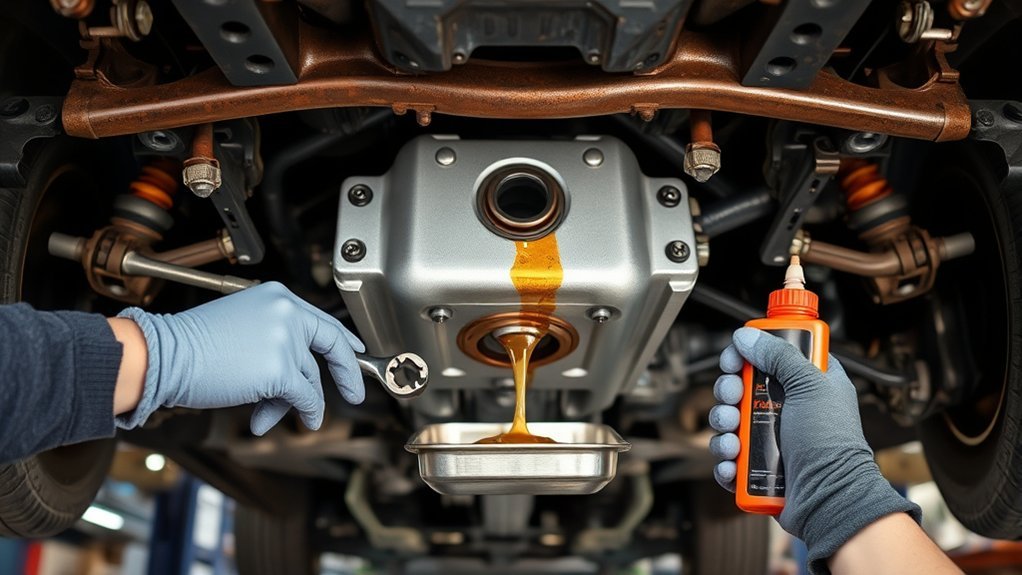
Toyota Tundra transfer case fluid is model-year dependent. Verified U.S.-market examples show a 2012 Tundra 4WD using 75W-90 gear oil at a 1.2-qt reference capacity, 2014 and 2021 trucks using Toyota Genuine Transfer Gear Oil LF SAE 75W at 1.6 qt, and the 2026 Tundra using Toyota Genuine ATF WS at 2.17 qt. Always confirm the exact Toyota specification, capacity, sealing hardware, and plug torque for your truck before service.
Last updated: September 22, 2026 — fluid examples and the current maintenance schedule were rechecked against model-year Toyota owner/service information and Toyota’s 2026 maintenance guidance.
Quick Answer
Do not choose Tundra transfer case fluid from a 75W or 75W-90 label alone. Toyota changed the specified fluid across model years, and the current 2026 4WD specification is Toyota Genuine ATF WS with a 2.17-qt (2.05-L) reference capacity. For 2026 normal use, Toyota schedules transfer-case oil inspections at 30,000-mile intervals through 150,000 miles; the listed dirt/dust and towing, car-top-carrier, or heavy-load conditions call for replacement at those checkpoints.
Key Takeaways
- Fluid type and capacity can change by model year: older Tundras may use gear oil, while the 2026 4WD specification uses Toyota Genuine ATF WS.
- A viscosity grade by itself does not confirm that an aftermarket fluid meets Toyota’s requirements.
- For the 2026 Tundra, normal use calls for transfer-case oil inspection every 30,000 miles through 150,000 miles; listed special-use conditions call for replacement at those same checkpoints.
- Grinding, whining, leaks, difficult 4WD engagement, or abnormal metal debris require diagnosis; fresh fluid cannot repair mechanical damage.
- Always loosen the fill plug before the drain plug, support the truck safely, and recycle the used oil.
Note: This guide applies to four-wheel-drive Toyota Tundra models equipped with a transfer case. A conventional two-wheel-drive Tundra does not have the same transfer-case service requirement.
At a Glance
| Time Required | Varies by model, access, and experience; confirm the fluid, seals, tools, and torque data before starting |
| Difficulty | Beginner to intermediate; accurate identification, safe lifting, and torque-wrench use are required |
| Tools Needed | Model-specific plug tool, torque wrench, drain pan, fluid pump, wheel chocks, rated ramps or jack stands, gloves, eye protection, and shop towels |
| Cost | Varies by model, approved fluid, required quantity, replacement gaskets, local pricing, and whether tools are already available |
What Transfer Case Fluid Does a Toyota Tundra Use?

The correct fluid depends on the model year. The verified examples below show why one “Tundra transfer case oil” recommendation is unsafe across every generation.
| U.S.-Market Example | Toyota-Listed Transfer Fluid | Reference Capacity |
|---|---|---|
| 2012 Tundra 4WD | Gear oil, API GL-4 or GL-5, SAE 75W-90 | 1.2 qt (1.12 L) |
| 2014 and 2021 Tundra 4WD | Toyota Genuine Transfer Gear Oil LF or equivalent, SAE 75W | 1.6 qt (1.5 L) |
| 2026 Tundra 4WD | Toyota Genuine ATF WS or Toyota-approved equivalent of matching quality | 2.17 qt (2.05 L) |
These are model-year examples, not universal generation rules. If your year is not shown, do not interpolate between rows. Match the truck to its exact Toyota documentation before buying fluid.
Start with the Toyota Manuals and Warranties portal. Select the correct model year and review the owner’s manual, warranty and maintenance guide, and any applicable supplements. For repair-level procedures and current torque specifications, Toyota also provides the subscription-based Toyota Technical Information System.
How this guide was checked: Current maintenance guidance was rechecked against Toyota’s 2026 Tundra maintenance schedule. Earlier owner-manual examples were used only to show how fluid type and capacity changed over time. Torque values and sealing hardware remain model-specific because they can vary by application.
[Amazon Products Picked for You]

Tested and approved by Toyota

Genuine OEM Product: Toyota factory-engineered Transfer Gear Oil LF 75W specifically formulated and tested to meet Toyota's strict standards

The information below is per-pack only
Information to Verify Before Buying Fluid
| Item | Why It Matters |
|---|---|
| Exact fluid name or Toyota specification | Confirms the required viscosity and additive performance for the applicable transfer case. |
| Model year and drivetrain | Prevents instructions for another Tundra generation or a 2WD truck from being applied incorrectly. |
| Refill capacity and level-check method | Helps prevent underfilling or overfilling. |
| Fill- and drain-plug torque | Reduces the risk of leakage, stripped threads, or a damaged housing. |
| Gasket or sealing-washer part number | Ensures the correct sealing hardware is installed rather than reusing an unsuitable washer. |
| Maintenance category | Determines whether normal or special-operating-condition service applies. |
If an aftermarket product is being considered, its technical data must explicitly support the complete specification required for that transfer case. Similar viscosity, the words “full synthetic,” or a generic gear-oil description are not enough by themselves.
The viscosity grade is only one part of a transfer-case fluid specification. The additive system, material compatibility, and application approval matter too.
Why Oil Viscosity and Fluid Specification Matter
Viscosity describes a fluid’s resistance to flow. The cold-temperature portion of a multigrade label affects how the oil moves when temperatures are low, while the second number relates to its viscosity at higher test temperatures. A higher viscosity index generally means the fluid’s viscosity changes less as temperature changes.
However, choosing the thickest available oil does not automatically provide better protection. A fluid that is too thick, too thin, or chemically incompatible can affect lubrication, drag, cold operation, shifting behavior, seals, or internal components.
The safest approach is straightforward:
- Find the exact Toyota specification for the truck.
- Confirm that the product documentation identifies compatibility with that specification or application.
- Use the prescribed quantity or level-setting method.
- Do not substitute differential oil, transmission fluid, or a generic gear oil merely because it appears similar.
Synthetic vs. Conventional Oil: Which Is Best?
The words “synthetic” and “conventional” describe aspects of an oil’s formulation, but they do not decide whether that oil is correct for a Toyota Tundra transfer case. The controlling factor is whether the complete product meets the specification required for the particular unit.
A properly formulated synthetic product may offer strong low-temperature flow, oxidation resistance, and temperature stability. Those advantages do not make every synthetic gear oil interchangeable. Likewise, a product should not be rejected solely because its marketing language differs if it is the approved Toyota fluid or is documented as meeting the required specification.
[Amazon Products Picked for You]

Meets the challenging demands of different all-wheel and four-wheel drive vehicles with multi-powered axles


Please see Product Description regarding the California Proposition 65 Warning
Benefits of Using the Correct Fluid
- Reliable lubrication: The correct viscosity and additive system maintain the intended protective film.
- Material compatibility: Approved fluid is selected for the unit’s seals, bearings, gears, chains, and other internal parts.
- Predictable cold operation: Correct fluid flows as intended during low-temperature starts.
- Service documentation: A receipt and product data sheet help show that maintenance was performed with an appropriate product.
Aftermarket Fluid and Warranty Considerations
Using an aftermarket product does not automatically void a vehicle warranty in the United States. The Federal Trade Commission’s warranty guidance says warranty coverage cannot be denied merely because aftermarket parts were used; the manufacturer or dealer must show that the aftermarket part caused the damage before denying coverage for that damage. For fluid service, keep the receipt, photograph the label, retain the technical data sheet, and record the date and mileage.
Note: Do not rely on an online compatibility selector alone. Compare the bottle label and current product data sheet with the exact Toyota requirement for the truck.
How Often Should Toyota Tundra Transfer Case Fluid Be Changed?
There is no single replacement interval that safely applies to every Tundra. For the 2026 U.S.-market Tundra, Toyota’s normal maintenance chart lists transfer-case oil inspection at 30,000, 60,000, 90,000, 120,000, and 150,000 miles. Under the listed special operating conditions—primarily dirt or dusty-road use, or towing, car-top-carrier use, or heavy vehicle loading—the same 30,000-mile checkpoints call for transfer-case oil replacement.
Use the 2026 Toyota Tundra Warranty & Maintenance Guide for the current example, and use the guide for your exact model year before applying that schedule to an older truck. For a deeper interval-by-condition breakdown, see the Toyota Tundra transfer case service interval guide.
| Operating Situation | Recommended Approach |
|---|---|
| 2026 normal road use | Inspect transfer-case oil at 30,000-mile intervals through 150,000 miles. Older model years must be checked separately. |
| 2026 towing, car-top-carrier use, or heavy vehicle loading | Replace transfer-case oil at the 30,000-mile checkpoints in Toyota’s special-operating-condition schedule. |
| 2026 primarily dirt or dusty-road use | Replace transfer-case oil at the 30,000-mile checkpoints and inspect for leakage, contamination, and damaged seals or breathers. |
| Water crossing or suspected water entry | Inspect promptly rather than waiting for the next scheduled service. |
| Leak, repair, or accidental use of the wrong fluid | Correct the cause and service the unit using the Toyota procedure; professional inspection may be necessary. |
Do not turn the 2026 schedule into a universal rule for every Tundra. Toyota maintenance guides are model-year specific, and contamination, leakage, water entry, or repair work can require service before the next scheduled checkpoint.
What Are the Signs a Tundra Transfer Case Needs Inspection?
Symptoms can justify an inspection, but they do not prove that old fluid is the sole cause. Look at fluid level, leakage, contamination, service history, 4WD operation, and mechanical condition together.
Leaks or a Low Fluid Level
Look for wetness or oily residue around the fill and drain plugs, case seams, output seals, actuator area, and nearby underbody components. A damp surface may be residue from an earlier service, while a fresh drip or recurring wet area indicates an active leak.
Do not repeatedly top up a leaking transfer case without repairing the source. Low fluid can reduce lubrication, and the escaping oil may contaminate other components or the ground.
Unusual Noises or 4WD Engagement Problems
Whining, grinding, clunking, binding, vibration, or difficulty engaging or disengaging four-wheel drive deserves prompt diagnosis. Possible causes include:
- Low, incorrect, or contaminated fluid
- Worn bearings, gears, or chain components
- An actuator, sensor, or electrical fault
- Driveshaft, universal-joint, differential, or tire-related problems
- Internal damage following water entry or impact
Stop driving and arrange an inspection if the noise is severe, engagement is unpredictable, the case becomes abnormally hot, fluid is pouring out, or metal pieces are found. Replacing fluid cannot repair a damaged gear, bearing, chain, or actuator.
Fluid Contamination
Fluid appearance varies by product, so color alone should not determine whether it is usable. More concerning findings include:
- A milky or emulsified appearance that suggests water contamination
- Metallic glitter distributed through the oil
- Visible flakes, slivers, or chunks
- Heavy sludge or gritty debris
- A strong burnt odor combined with overheating or operating problems
- Evidence that an incorrect product was added
A light paste on a magnetic drain plug can develop as very small wear particles collect over time. Large fragments, sharp flakes, or a sudden increase in debris are not normal findings and should be evaluated before the truck is returned to service.
How to Check Transfer Case Fluid Level and Condition
A fluid check should not require draining the entire transfer case. The exact checking method varies, so review the model-year procedure first.
- Verify the specification and procedure. Confirm the correct fill/check plug, fluid level method, gasket, and plug torque.
- Park on a level surface. An angled vehicle can produce a false level reading.
- Secure the truck. Apply the parking brake, chock the wheels, and use rated ramps or jack stands if additional access is required.
- Allow the components to cool. The exhaust, transfer case, and fluid can cause burns after driving.
- Clean around the plug. Remove dirt before opening the case so contamination does not fall inside.
- Remove the specified fill or level plug. Use the correct tool and avoid rounding the plug.
- Check the level as Toyota directs. Many housings use the lower edge of the fill opening as the reference, but do not assume this applies without checking the procedure.
- Inspect a small sample. Note water, unusual debris, heavy sludge, burnt odor, or an obviously incorrect fluid.
- Correct the cause of any low level. Find and repair leakage rather than treating a top-up as a permanent fix.
- Install the correct gasket and torque the plug. Do not guess or overtighten it.
Warning: Never work beneath a truck supported only by a hydraulic or emergency jack. Use wheel chocks and appropriately rated ramps or jack stands on a stable surface. Wear eye protection and gloves, and avoid contact with hot exhaust parts or hot fluid.
Benefits of Correct Transfer Case Maintenance
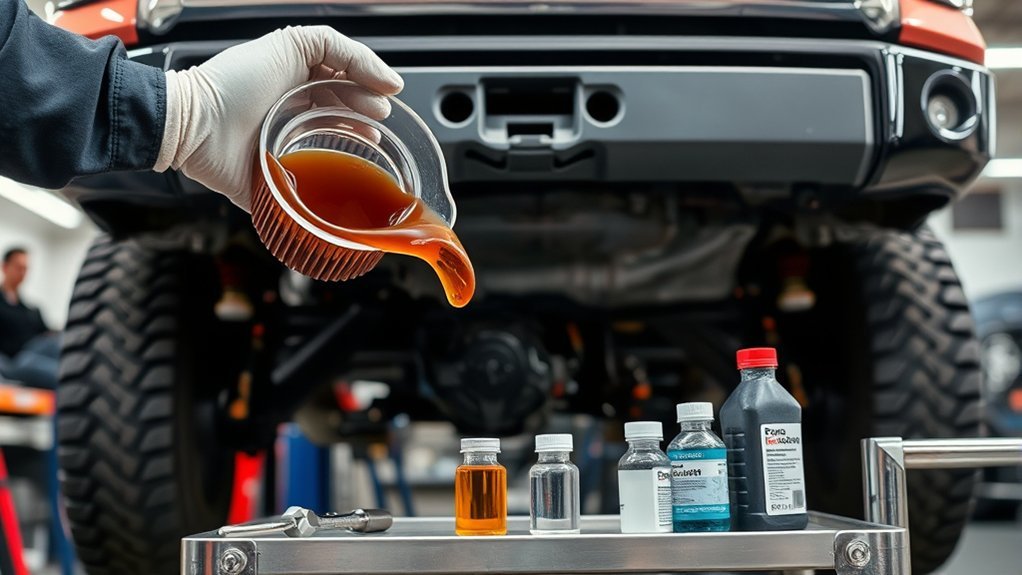
Inspection and timely service help preserve the lubrication the unit was designed to receive. The practical benefits include:
- Finding leakage before the level becomes dangerously low
- Removing worn or contaminated fluid when replacement is required
- Discovering water, sludge, or abnormal metal debris early
- Maintaining documented service records
- Reducing the chance that a minor seal or plug problem becomes a larger repair
Fluid service is preventive maintenance, not a cure for existing internal damage. If shifting, engagement, noise, vibration, or overheating problems continue after the correct level and fluid have been verified, the transfer case and surrounding driveline need further diagnosis.
How to Change Toyota Tundra Transfer Case Fluid
The following sequence explains the general process. The Toyota procedure for the truck’s exact model year takes priority over generic instructions.
[Amazon Products Picked for You]

6Qt Genuine 00289-ATFWS

DIRECT FILL FOR BMW, JEEP, RAM TRUCKS, DODGE, MERCEDES BENZ & MORE — Covers all 75W-85 GL-5 applications for differentials and hypoid gear limited slip systems. Its a direct replacement for BMW G5 Hypoid 75W85, SAF-EH MOD LV, Stellantis MS-A0450 (Mopar LL Hypoid, P/N 68083381AC), Ford WSS-M2C942-A and XY-75W85-QL.

Complete 18-Piece Kit — Includes 3 pcs 90430-24003, 9 pcs 12157-10010, and 6 pcs 90430-A0003/90430-18008 crush washers for transfer case and differential service.
Tools and Supplies
- The exact approved fluid in sufficient quantity
- Correct new sealing washers or gaskets
- Socket, hex, or other plug tool specified for the truck
- Calibrated torque wrench covering the required range
- Fluid-transfer pump or suitable filling device
- Drain pan with enough capacity
- Wheel chocks and rated ramps or jack stands
- Eye protection and fluid-resistant gloves
- Shop towels and spill-absorbent material
- A clean, leak-proof container for transporting used oil
Preparation and Safety
Confirm the fluid, quantity, gasket, plug location, and torque values before raising the truck or opening the transfer case. Inspect the containers to ensure the seals are intact and that no transmission, differential, or engine oil was purchased by mistake.
A short drive may help suspend contaminants and improve drainage, but the case and exhaust must be allowed to cool to a safe working temperature. Do not open a dangerously hot unit.
Pro Tip: Loosen the fill plug before removing the drain plug. If the fill plug is seized, damaged, or inaccessible, you can stop without leaving the transfer case empty.
Step-by-Step Process
- Position the truck on a level surface. Chock the wheels and create safe access with rated equipment if needed. The truck should remain level for an accurate final fluid level.
- Remove only the necessary shields. Keep track of each fastener and its location. Skid-plate hardware varies by year and configuration.
- Identify the fill and drain plugs. Do not confuse transfer-case plugs with transmission or differential plugs.
- Clean the area. Brush or wipe away mud and grit before opening either plug.
- Loosen the fill plug first. Confirm that it can be removed and that the correct fluid and filling equipment are ready.
- Position the drain pan. Account for the direction and distance of the initial oil stream.
- Remove the drain plug. Allow the fluid to drain until it slows to an occasional drip.
- Inspect the old oil and plug. Look for water, metallic glitter, flakes, chunks, excessive sludge, or evidence of the wrong fluid. Clean a magnetic plug with a lint-free material without leaving fibers or debris behind.
- Install the drain plug. Fit the specified new gasket or sealing washer and tighten the plug to the exact Toyota torque specification.
- Refill the transfer case. Pump in the approved fluid using the specified capacity and level-setting procedure. Do not assume that every case is filled correctly merely when oil first reaches the opening.
- Install the fill plug. Use the correct new seal and tighten it to specification.
- Clean the housing. Removing spilled oil makes a new leak easier to detect.
- Reinstall shields and fasteners. Use the correct positions and torque values.
- Check operation. Follow the owner’s manual when testing 4WD modes. Do not engage modes on a surface or at a speed prohibited by the manual.
- Inspect for leakage. Check around both plugs and the disturbed areas after operation and again after the next drive.
- Document the service. Record the date, mileage, fluid brand and specification, quantity, gasket part numbers, and any debris or leakage found.
Common Service Mistakes to Avoid
- Draining the unit before confirming the fill plug can be removed
- Using a product based only on viscosity or online forum recommendations
- Confusing transfer-case oil with front- or rear-differential oil
- Working under a vehicle supported only by a jack
- Reusing a sealing washer when Toyota specifies replacement
- Guessing the plug torque or tightening until the housing threads are damaged
- Filling the case while the truck is noticeably tilted
- Ignoring a leak and repeatedly topping up the unit
- Assuming a fluid change will repair grinding, binding, or actuator problems
- Flushing the case with solvents or unapproved chemicals
- Returning the truck to service after finding water or large metal pieces without diagnosis
Common Mistakes When Choosing Transfer Case Fluid
| Mistake | Possible Consequence | Better Practice |
|---|---|---|
| Buying any oil marked 75W or 75W-90 | The viscosity may look similar while the additive system or application compatibility is wrong. | Match the complete Toyota specification for the exact model year. |
| Assuming every synthetic oil is interchangeable | An unsuitable formulation can produce poor operation or component damage. | Review current product documentation and application approval. |
| Using differential oil because it is already available | The transfer case and differential may have different fluid requirements. | Treat each component as a separate service item. |
| Choosing solely by brand reputation | A reputable brand can still sell a product that is wrong for this application. | Choose by verified specification first and brand second. |
| Buying only the estimated capacity | Spillage, container sizes, or a different unit may leave too little fluid to finish the job. | Verify capacity and have enough approved fluid available before draining. |
What If the Transfer Case Fluid Is Contaminated?
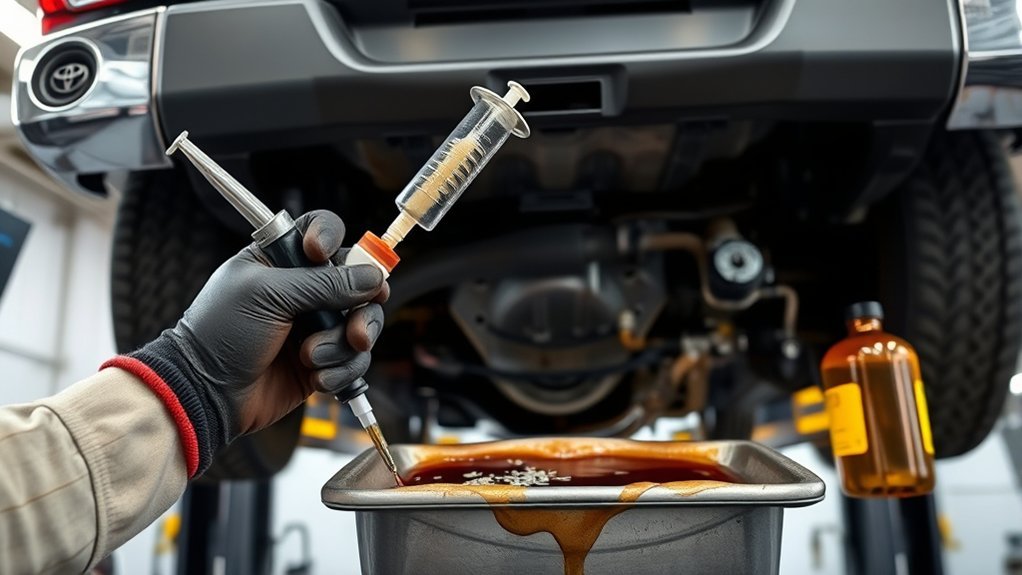
The correct response depends on what is found and how the contamination entered the case.
Milky Fluid or Suspected Water Entry
Milky or emulsified oil can indicate water contamination. Inspect the seals, vent or breather, plugs, and case for an entry point. If the truck was driven through deep water, do not assume one drain-and-refill has removed all moisture. A technician may need to inspect the unit and determine the appropriate corrective procedure.
Fine Metallic Paste
A small amount of fine paste on a magnetic drain plug may reflect gradual wear. Photograph it, clean the plug, inspect the drained oil, and compare the finding with earlier services when records are available.
Metal Flakes, Slivers, or Chunks
Visible pieces can indicate abnormal internal wear or damage. Do not treat them as proof that fresh oil alone will solve the problem. Limit operation and have the transfer case diagnosed.
Burnt Odor or Darkened Fluid
Odor and color should be considered alongside operating temperature, service history, fluid level, debris, and symptoms. Investigate overheating, an incorrect fluid, low level, heavy loading, or internal friction rather than relying on appearance alone.
The Wrong Fluid Was Added
Do not continue driving merely to see whether symptoms develop. Record exactly what was added and how much, then consult the applicable Toyota service information or a qualified technician. The correct response may depend on the product used, the amount, whether the truck was operated, and the transfer-case design.
Dispose of Used Fluid Correctly
Transfer-case and gear oils should not be poured onto the ground, into a drain, or placed loose in household trash. Store the used fluid in a clean, leak-proof container and take it to an authorized used-oil collection or recycling location. The U.S. Environmental Protection Agency’s used-oil guidance provides handling and recycling information. Follow provincial, state, and local requirements where you live.
Frequently Asked Questions
What fluid goes in a Toyota Tundra transfer case?
It depends on model year. Verified examples include SAE 75W-90 gear oil in a 2012 Tundra, Toyota Genuine Transfer Gear Oil LF SAE 75W in 2014 and 2021 trucks, and Toyota Genuine ATF WS in the 2026 Tundra. Use the exact Toyota owner or service information for your year rather than choosing by viscosity alone.
Does a 2026 Toyota Tundra use gear oil or ATF in the transfer case?
The 2026 U.S.-market Tundra 4WD specification lists Toyota Genuine ATF WS, or a Toyota-approved equivalent of matching quality, with a 2.17-qt (2.05-L) reference capacity. Do not substitute an older Tundra’s 75W or 75W-90 gear-oil recommendation.
How often should Toyota Tundra transfer case fluid be changed?
For a 2026 U.S.-market Tundra, Toyota lists transfer-case oil inspection at 30,000, 60,000, 90,000, 120,000, and 150,000 miles under normal use. Under the listed dirt/dust and towing, car-top-carrier, or heavy-load conditions, those 30,000-mile checkpoints call for replacement. Older model years must follow their own maintenance guide.
Can I use 75W-90 in my Tundra transfer case?
Only when Toyota’s documentation for your exact model year specifies or approves it. A 2012 Tundra example uses SAE 75W-90, while 2014 and 2021 examples use SAE 75W Transfer Gear Oil LF and the 2026 truck uses ATF WS. Matching one viscosity label is not proof of compatibility.
What are the symptoms of low transfer case fluid?
Possible signs include visible leakage, abnormal noise, heat, or operating problems, but these symptoms are not unique to a low fluid level. Many units do not provide a dedicated low-fluid warning. Check the level using the correct model-year procedure and repair any leak instead of repeatedly topping it up.
Is transfer case fluid the same as differential oil?
Not necessarily. The transfer case, front differential, and rear differential are separate components and may require different fluids, capacities, seals, and service intervals. Verify each specification independently; see the Toyota Tundra differential fluid guide for the axle-side requirements.
How much transfer case fluid does a Toyota Tundra need?
Capacity varies by model year. Verified examples are 1.2 qt (1.12 L) for a 2012 Tundra 4WD, 1.6 qt (1.5 L) for 2014 and 2021 examples, and 2.17 qt (2.05 L) for the 2026 Tundra. Treat those as reference capacities and follow Toyota’s level-setting procedure for the exact truck.
Conclusion
Correct Toyota Tundra transfer case maintenance begins with the model year. A 2012, 2014/2021, and 2026 Tundra can call for different transfer fluids and capacities, so verify the fluid specification, capacity, sealing hardware, torque values, and service interval before opening the case. Inspect leaks and unusual symptoms instead of assuming that every noise calls for a fluid change, and obtain professional diagnosis when water, large metal debris, severe noise, overheating, or unreliable 4WD operation is present.
When replacement is due, support the truck safely, loosen the fill plug first, use the approved fluid and new seals, torque the plugs correctly, check for leaks, record the service, and recycle the used oil responsibly.
Sources
- Toyota Manuals and Warranties — vehicle-specific owner’s manuals, maintenance guides, and warranty documents
- Toyota Technical Information System — model-specific repair procedures, technical information, and torque specifications
- 2026 Toyota Tundra Warranty & Maintenance Guide — current normal-use inspections and special-operating-condition transfer-case service
- 2021 Toyota Tundra Warranty & Maintenance Guide — earlier model-year maintenance schedule for comparison
- Federal Trade Commission: Auto Warranties and Auto Service Contracts — aftermarket parts, maintenance records, and warranty considerations
- U.S. Environmental Protection Agency: Managing, Reusing, and Recycling Used Oil — safe handling and recycling of used gear oil
