Last Updated: September 22, 2026
The correct Toyota Tundra differential fluid depends on the truck’s model year, drivetrain, axle, and the component you’re servicing. For many U.S.-market 2007-and-newer Tundras, Toyota specifies 75W-85 GL-5 differential gear oil, while many 2000–2006 trucks use different front, standard-rear, and limited-slip-rear viscosity requirements. Confirm the exact Toyota specification, capacity, fill procedure, and plug torque for your vehicle before buying fluid or loosening a plug.
Quick Answer
For U.S.-market 2007–2021 Tundras, Toyota manuals specify Toyota Genuine Differential Gear Oil LT 75W-85 GL-5 or an equivalent for the front and rear differentials. Toyota service information for the redesigned 2022-and-newer Tundra also uses 75W-85 GL-5, but capacities and axle configurations changed. Many 2000–2006 Tundras use different viscosities. The transfer case is a separate component and may require Toyota Genuine Transfer Gear Oil LF, SAE 75W. Check the exact Toyota manual for your model year and configuration before buying fluid.
Key Takeaways
- Choose differential fluid by model year, axle, and Toyota specification, not by brand name alone.
- Do not apply a 75W-85 rule to every Tundra: many 2000–2006 trucks use different front and rear viscosities.
- Do not assume the differentials and transfer case use the same fluid.
- The AUTO LSD button on later trucks is a traction-control function and does not automatically mean the axle needs limited-slip friction modifier.
- Capacity, fill level, plug type, washer, and torque values can differ by engine, axle, cab, bed, drivetrain, locker, and generation.
- Toyota often lists differential inspection under normal service and adds replacement intervals for specific operating conditions such as regular towing or heavy loading.
At a Glance
| Time Required | About 45–90 minutes for one differential or 1–3 hours for multiple driveline components |
| Difficulty | Intermediate; safe lifting and accurate torque work are required |
| Tools Needed | Wheel chocks, rated lifting equipment if needed, correct sockets or hex bits, torque wrench, drain pan, fluid pump, gloves, eye protection, and new sealing washers |
| Cost | Varies by model year, fluid specification, required quantity, washers, and whether you service one or several components |
Understanding Differential Fluid Types for Toyota Tundra
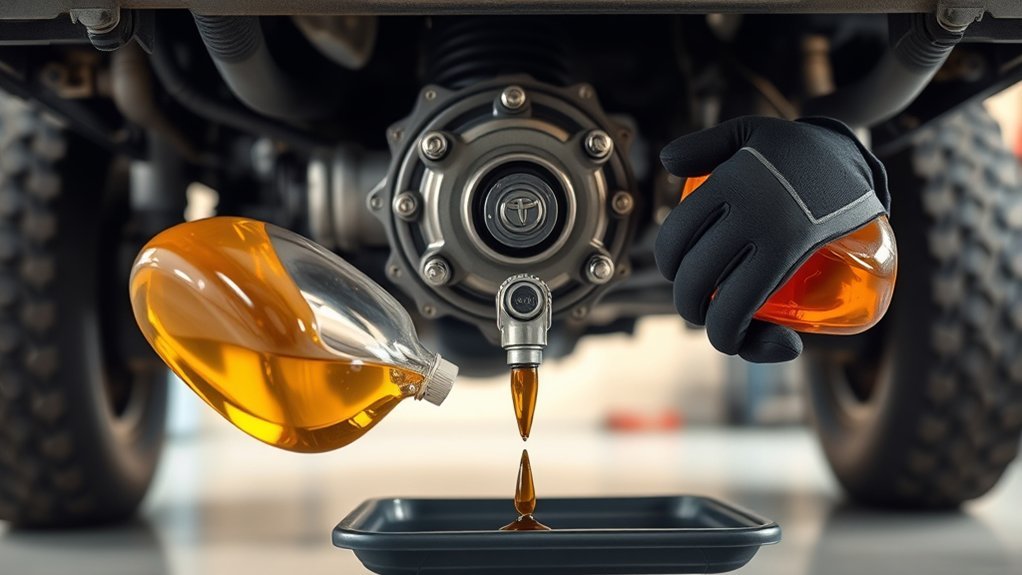
Your Tundra has a rear differential. Four-wheel-drive models also have a front differential and a separate transfer case. These components do different jobs, and they do not always use the same lubricant.
The safest selection method is to open the Toyota manuals and warranties portal, select the correct year and model, and check the maintenance-data or vehicle-specifications section. Use the manual for the exact truck rather than a store catalog or a fluid chart that combines multiple generations.
| Vehicle or Component | Documented Example | What You Should Do |
| 2000–2006 Tundra | Do not use one universal viscosity. A 2005 manual, for example, lists SAE 75W-90 for the front, synthetic SAE 75W-140 for the standard rear, and temperature-dependent grades for the mechanical limited-slip rear. | Verify the exact year, front/rear axle, and whether the rear differential is standard or mechanical limited-slip. |
| 2007–2021 Tundra front and rear differentials | Toyota Genuine Differential Gear Oil LT 75W-85 GL-5 or equivalent | Match both SAE 75W-85 and API GL-5; capacity varies by configuration. |
| 2022-and-newer redesigned Tundra | Toyota service information continues to specify Differential Gear Oil LT 75W-85 GL-5 or equivalent | Do not reuse second-generation capacity figures; front/rear quantities vary with the newer axle and locker configuration. |
| 2015 Tundra transfer case | Toyota Genuine Transfer Gear Oil LF or equivalent, SAE 75W | Do not substitute differential oil merely because both products are labeled gear oil. |
Differential Oil and Transfer-Case Oil Are Not the Same Requirement
Differential oil protects the ring gear, pinion, bearings, and related axle parts. Transfer-case oil lubricates the mechanism that distributes power between the front and rear driveline on a four-wheel-drive truck.
Even when two fluids look similar, their viscosity and additive requirements may differ. Never pour a differential product into the transfer case unless Toyota documentation for your exact model explicitly approves it. The owner’s manual or repair information for that model year is the deciding source.
What AUTO LSD Means on a Tundra
Some later Tundras have an AUTO LSD button or indicator. In Toyota’s documented system, AUTO LSD uses traction control to manage engine output and apply braking when a rear wheel spins. The label does not by itself prove that the axle contains clutch packs or requires a separate friction modifier. This should not be confused with the mechanical limited-slip rear differentials used on some earlier Tundras, which can have different lubricant requirements.
Note: Only add a limited-slip friction modifier when Toyota’s documentation or the axle manufacturer specifically requires one. Adding an unnecessary modifier can change friction behavior without solving a mechanical problem.
How to Change Differential Fluid in Your Tundra
A differential-fluid change is manageable for an experienced DIY owner, but the truck must remain stable and level. You also need the correct fill and drain tools, replacement washers, specified fluid, and accurate torque data for your model. Toyota service procedures for later Tundras set the final oil level close to the lower edge of the filler opening, but you should use the procedure for your exact axle rather than assuming one universal level.
Warning: Never work beneath a vehicle supported only by a jack. Chock the wheels, use equipment rated for the truck’s weight, support it at Toyota-approved points, wear eye protection and oil-resistant gloves, and let excessively hot components cool before touching them.
Loosen the fill plug before removing the drain plug. This confirms that you can refill the housing before the old oil is released.
- Confirm the specification. Check the model year, drivetrain, axle, fluid viscosity, API or Toyota specification, reference capacity, washer type, and plug torque.
- Position the truck safely. Park on a firm, level surface. If lifting is necessary, keep the vehicle level so the fill opening gives an accurate fluid level.
- Warm the oil slightly. A brief drive can help the old oil drain, but avoid working on a housing or exhaust component that is too hot to touch safely.
- Clean around both plugs. Remove dirt before opening the housing so contamination does not fall inside.
- Loosen the fill plug first. Stop if the plug is seized, rounded, or inaccessible. Do not drain the housing until you have a reliable refill path.
- Place a drain pan and remove the drain plug. Keep front differential, rear differential, and transfer-case fluids separate if you plan to compare their condition.
- Inspect the old fluid and magnetic plug. A thin paste of very fine metallic material may occur during service. Chips, flakes, sharp fragments, heavy glitter, or broken pieces need professional investigation.
- Install a new sealing washer. Clean the plug and sealing surface. Start the plug by hand to avoid cross-threading, then tighten it to the model-specific value.
- Pump in the correct fluid. Toyota service information for later Tundras specifies a final oil level 0–5 mm (0–0.197 in.) below the lower lip of the filler opening while the truck is level. Follow the exact procedure for your model because earlier axles and service instructions can differ.
- Install the fill plug with a new washer. Tighten it to the correct model-specific torque rather than relying on a universal online number.
- Clean and inspect. Remove spilled fluid, drive briefly, then recheck both plugs and the housing for seepage.
- Recycle the used oil. Store it in a clean, sealed container and take it to an approved automotive-fluid collection or recycling location.
Pro Tip: Confirm that every fill plug loosens before beginning a multi-component service. A seized transfer-case or differential fill plug can otherwise leave you with an empty component that cannot be refilled.
Which Differential Fluid Should You Use in a Toyota Tundra?
The best differential fluid is the product that matches Toyota’s required viscosity and performance specification for your model. A familiar brand, synthetic label, limited-slip additive, or high-mileage claim cannot correct a specification mismatch.
How to Compare OEM and Aftermarket Gear Oil
Start with the complete Toyota requirement: viscosity, API or Toyota performance category, axle type, and any limited-slip requirement. Then compare the current product data sheet. Brand reputation, a synthetic label, or a “severe service” claim cannot make the wrong viscosity correct.
- Toyota Genuine Differential Gear Oil: The most direct match when the manual names the Toyota product and grade.
- Aftermarket SAE 75W-85 GL-5: A candidate for a Tundra that requires 75W-85 GL-5 only when the manufacturer states that the product meets the full requirement for the intended axle.
- Mobil 1 Synthetic Gear Lubricant LS 75W-90: Mobil currently lists this product as SAE 75W-90 and API GL-5, including limited-slip applications. That does not make it an exact viscosity match for a Tundra that requires 75W-85.
- Other viscosities: Use 75W-90, 75W-140, 80W-90, or another grade only when Toyota documentation for the exact truck and differential calls for or approves that grade.
Mileage alone does not change Toyota’s required viscosity. A high-mileage truck still needs the fluid specification for its actual axle unless Toyota service information says otherwise.
Fluid Specifications and Types
A product must satisfy every important part of the requirement:
- Viscosity: Examples include SAE 75W, 75W-85, 75W-90, 80W-90, and 75W-140. These grades are not automatically interchangeable.
- Performance category: Many Tundra differentials require an API GL-5 product, but you should confirm the manual.
- Component: A product approved for a differential is not necessarily approved for a transfer case or transmission.
- Limited-slip compatibility: Relevant only when the actual axle design requires it.
- Toyota equivalency: The product should state that it meets the required quality and specification, not merely that it is recommended for trucks.
For example, the official 2015 Tundra Owner’s Manual lists Toyota Genuine Differential Gear Oil LT 75W-85 GL-5 or equivalent for the differentials. Its transfer-case specification is listed separately.
How to Use Owner Reports Without Overriding the Manual
Owner reports can help with practical details such as bottle packaging, pump access, plug removal, local availability, and whether a service procedure is awkward on a specific configuration. They cannot override Toyota’s fluid specification or prove that a different viscosity provides better protection.
Before following an owner report, confirm that the truck has the same model year, drivetrain, axle type, locker or limited-slip equipment, and component being serviced. This is especially important when comparing first-generation trucks with 2007-and-newer models.
A change in noise after service does not prove that one brand is superior. Noise can also come from incorrect fluid level, bearing wear, tire patterns, driveshaft joints, damaged gears, or another driveline problem.
Dealer Recommendations: What Should You Consider?
When a dealership recommendation conflicts with the owner’s manual, ask for the exact Toyota service publication, technical information, or superseded part reference supporting the recommendation. A clear written specification is more useful than a verbal statement that a shop “uses this in every Tundra.”
Use the specification for your model year and component as the starting point. Treat dealership and community advice as supporting information, not a substitute for Toyota documentation.
A dealership may recommend a newer service product that Toyota considers an approved replacement for an older fluid. Ask the advisor to identify the replacement part number and confirm that it covers your VIN.
Be cautious when a recommendation depends only on mileage, climate, or towing but changes the required viscosity without supporting documentation. Driving conditions can shorten an inspection or replacement interval, but they do not automatically authorize a different fluid grade.
Signs Your Differential Fluid Needs Changing
Scheduled inspection remains important even when the truck drives normally. You should also investigate fluid condition or the differential when you notice any of these signs:
- Leakage around the housing or plugs: A wet area may indicate a damaged washer, loose plug, seal leak, vent problem, or housing issue.
- Whining that changes with road speed: This may involve bearings, gear contact, fluid level, or wear and should not be diagnosed from sound alone.
- Grinding or clunking: Stop driving aggressively and arrange an inspection, especially when the noise is new or severe.
- Burnt odor: Overheating, low fluid, overloading, or internal wear may be involved.
- Milky or cloudy fluid: This commonly suggests water contamination and needs prompt attention.
- Metal flakes or fragments: Large or sharp debris is more concerning than a light paste on a magnetic drain plug.
- Recent water crossing: Toyota warns that water can enter driveline components and reduce the lubricant’s protective qualities.
- Heavy towing or loading: Severe service may trigger earlier replacement under the Toyota maintenance schedule.
Warning: Do not keep driving a truck with a rapidly worsening whine, grinding, repeated clunks, a major leak, or visible metal fragments in the oil. Low lubrication or internal damage can lead to loss of driveline function and a much larger repair.
DIY Maintenance Tips for Differential Fluids
Good preparation prevents most DIY problems. Confirm the fluid and hardware before raising the truck, and do not begin until you have a safe method to loosen, drain, refill, and torque every component you plan to service.
Essential Tools Required
- Wheel chocks
- Floor jack and rated jack stands or suitable ramps, when lifting is required
- The correct socket, hex bit, or specialty tool for each plug
- Calibrated torque wrench covering the required range
- Drain pan with enough capacity
- Fluid-transfer pump or flexible bottle hose
- Replacement Toyota-spec sealing washers
- Brake cleaner or another suitable exterior cleaning product
- Shop towels and absorbent material
- Eye protection and oil-resistant gloves
- Sealed container for transporting used oil
A 10 mm hex bit, 12 mm tool, or 24 mm socket may fit certain Tundras or specific components, but those sizes should not be treated as universal. Check your plugs before purchasing tools.
Step-by-Step Procedure Guide
Start with Toyota’s fluid specification and reference capacity, but use the fill-level procedure as the final guide when the manual instructs you to fill to the opening. Do not force the entire listed reference quantity into a housing that has already reached the specified level.
Keep the truck level, loosen the fill plug, drain the fluid, inspect the magnetic plug, replace both sealing washers, and tighten each plug to the correct repair-manual torque. Pump in the specified fluid slowly to reduce trapped air and spills.
After installing the fill plug, wipe the housing clean. Drive the truck long enough to circulate the oil, park on a clean surface, and inspect for fresh seepage. Recheck any plug that appears wet, but do not repeatedly overtighten it to stop a leak. A damaged washer, sealing surface, plug, or thread may need repair.
Common DIY Problems and What to Do
- The fill plug will not loosen: Stop before draining. Use the correct six-point or hex tool, penetrating oil where appropriate, and professional help if the plug begins to round.
- The plug threads look damaged: Do not force the plug. Cross-threading can damage the housing and create a persistent leak.
- More fluid went in than expected: Confirm that the truck is level and that you are using the correct opening and procedure.
- Less fluid went in than the listed capacity: Some old oil may remain, or the truck may not be level. Follow the manual’s level procedure rather than forcing additional fluid.
- The new fluid immediately becomes milky: Investigate water entry, vents, seals, and recent water exposure.
- The housing leaks after service: Inspect the washer, plug torque, threads, sealing surface, axle seals, pinion seal, and cover or housing joints.
Synthetic vs. Conventional Differential Oils: Which Is Best?
Synthetic gear oils can provide strong low-temperature flow, oxidation resistance, shear stability, and high-temperature performance. These qualities may be useful for towing, hauling, off-road use, or temperature extremes, but a synthetic label does not by itself extend Toyota’s scheduled inspection or replacement interval.
Conventional gear oil can also protect a differential properly when it meets Toyota’s viscosity and performance requirements and is changed at the appropriate interval. Base-oil type should come after specification compatibility, not before it.
- Choose synthetic when: It exactly matches the required specification and you value its temperature or oxidation characteristics.
- Choose conventional when: Toyota permits it, it matches the required specification, and the truck’s service conditions do not justify a more expensive product.
- Avoid either type when: The viscosity, GL category, component approval, or limited-slip requirements do not match your vehicle.
Mobil 1 Synthetic Gear Lubricant LS 75W-90, for example, is documented as an API GL-5 synthetic product for applications that allow that grade. Its quality does not make 75W-90 an automatic substitute for a Toyota requirement calling for 75W-85.
A Better Way to Compare Tundra Differential Fluids
Compare gear oils by specification first and shopping details second. A product that works in a 2005 two-wheel-drive truck may not match a 2019 four-wheel-drive truck or a redesigned 2022-and-newer model. Even trucks from the same generation can have different reference capacities because of engine, cab, bed, drivetrain, locker, or axle differences.
This order prevents a common mistake: choosing a familiar brand or a widely recommended viscosity before checking what Toyota requires for the actual differential.
The most reliable product comparison follows this order:
- Match the exact Toyota viscosity.
- Match the required API or Toyota performance specification.
- Confirm that the product is intended for the correct component.
- Verify limited-slip requirements only when the axle actually has them.
- Compare synthetic versus conventional construction.
- Then compare availability, packaging, and cost.
How Often Should You Change Tundra Differential Fluid?
Toyota maintenance schedules distinguish routine inspection from replacement under special operating conditions. In the 2025 Tundra maintenance guide, front and rear differential oil are inspection items at 15,000-mile checkpoints under normal service. When the truck is driven primarily while towing, using a car-top carrier, or under heavy vehicle loading, Toyota adds front-differential replacement at 15,000-mile intervals and rear-differential replacement at 30,000-mile intervals.
This means “change every differential at 30,000 miles” is not Toyota’s universal normal-service rule. The interval depends on model year, component, and operating condition. Use the maintenance guide for your exact truck and distinguish Inspect from Replace.
Consider earlier inspection after:
- Frequent towing or heavy payload use
- Repeated off-road driving
- Water crossings or flooding
- Operating in deep mud, dust, or severe temperature conditions
- A differential leak or repair
- New noise, overheating, or contaminated fluid
Capacity and Torque Values Vary by Configuration
The 2015 Tundra manual demonstrates why one universal quantity is unsafe. It lists a 2.2-quart reference capacity for the front differential on four-wheel-drive models. Rear reference capacities range from 3.8 to 4.9 quarts depending on the engine, cab, bed, and drivetrain configuration. Its transfer-case reference capacity is 1.6 quarts.
The redesigned 2022-and-newer Tundra uses different axle capacities, and rear capacity can vary with locking-differential and powertrain configuration. Do not copy second-generation quantities to a newer truck. Toyota can change housings, plugs, washers, fluid specifications, and service procedures between generations.
Note: An owner’s manual may list reference capacity without publishing the service torque for every plug. Use Toyota repair information for torque values rather than an unsourced universal number.
Frequently Asked Questions
Can I use 75W-140 instead of 75W-90?
Do not substitute 75W-140 unless Toyota documentation for your model or a documented service instruction approves it. The thicker hot-viscosity grade may change drag, lubrication flow, operating temperature, and cold-weather behavior. Severe use alone does not automatically authorize the change.
What kind of differential fluid does a 2019 Toyota Tundra take?
Toyota documentation for this Tundra generation specifies Toyota Genuine Differential Gear Oil LT 75W-85 GL-5 or an equivalent for the differentials. Confirm the exact 2019 owner’s manual for your VIN before purchasing fluid, and check the transfer-case specification separately.
What kind of oil does a Toyota differential take?
Toyota differential specifications vary by vehicle and model year. Many Tundras use a GL-5 gear oil, but the required viscosity may be 75W-85, 75W-90, or another grade. Use the maintenance-data section of the owner’s manual rather than a Toyota-wide rule.
What kind of gear oil does a 2015 Toyota Tundra take?
The official 2015 Tundra owner’s manual specifies Toyota Genuine Differential Gear Oil LT 75W-85 GL-5 or an equivalent for the front and rear differentials. It separately specifies Toyota Genuine Transfer Gear Oil LF or equivalent, SAE 75W, for the transfer case.
Can I use 75W-90 when Toyota specifies 75W-85?
Use 75W-85 unless Toyota or authoritative service information approves 75W-90 as an equivalent for your VIN. Both products may meet API GL-5, but GL-5 compliance does not make their viscosity grades identical.
Does a Tundra with AUTO LSD need limited-slip additive?
Not because of the AUTO LSD label alone. Toyota’s AUTO LSD system can use engine and brake control to limit wheelspin. Add a friction modifier only when the actual axle and Toyota specification require it.
How often should I change Toyota Tundra differential fluid?
Use the maintenance guide for your exact model year. On the 2025 Tundra, Toyota lists front and rear differential inspection at 15,000-mile checkpoints under normal service. For trucks driven primarily while towing, using a car-top carrier, or under heavy vehicle loading, Toyota adds front-differential replacement at 15,000-mile intervals and rear-differential replacement at 30,000-mile intervals.
Sources
- Toyota Manuals and Warranties — official model-year and VIN-based owner-document lookup
- 2015 Toyota Tundra Owner’s Manual — differential viscosity, GL-5 specification, reference capacities, transfer-case fluid, and AUTO LSD operation
- 2019 Toyota Tundra Warranty and Maintenance Guide — inspection and severe-service maintenance requirements
- 2024 Toyota Tundra Warranty and Maintenance Guide — normal and special-operating-condition schedules
- 2025 Toyota Tundra Warranty and Maintenance Guide — current inspection and special-operating-condition replacement intervals used in this guide
- Mobil 1 Synthetic Gear Lubricant LS 75W-90 Product Data Sheet — API GL-5 rating, viscosity, and limited-slip product information
- U.S. Environmental Protection Agency Used-Oil Guidance — proper handling and recycling of used automotive oil
Conclusion
The right Toyota Tundra differential fluid is the oil that matches the specification for your exact year, axle, and drivetrain. Toyota documentation commonly specifies 75W-85 GL-5 on 2007-and-newer trucks, while many 2000–2006 models use different front and rear viscosities. The transfer case is a separate component and may require a different fluid.
Check the Toyota manual before buying oil, use model-specific capacity and torque information, replace sealing washers, and keep the truck safely supported and level during service. If you find a major leak, metal fragments, milky oil, damaged threads, or worsening driveline noise, have the differential inspected before further driving.
