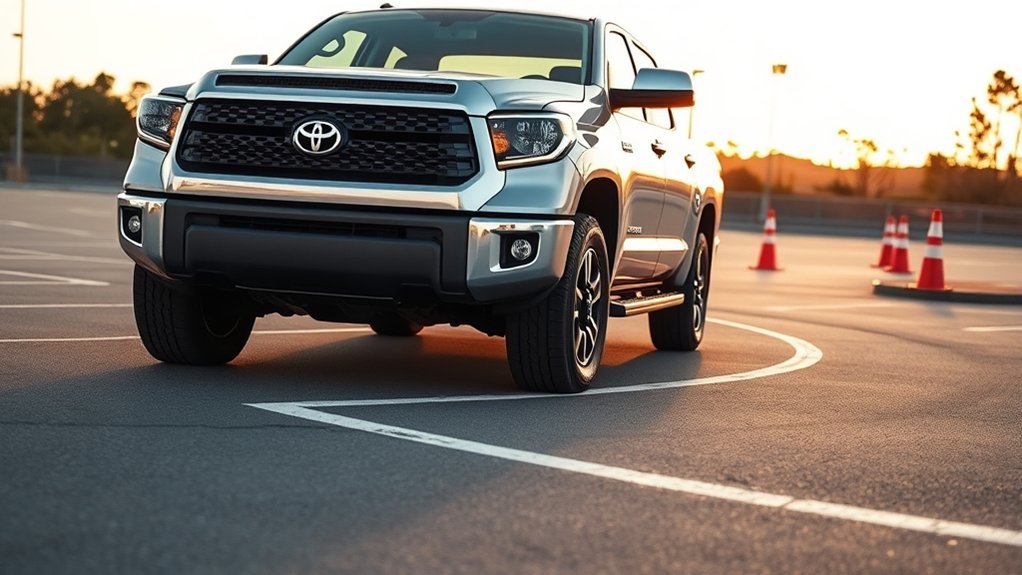
The Toyota Tundra is a full-size pickup, so it needs considerably more room to turn than a compact truck or car. Its exact turning circle depends on the model year, wheelbase, cab and bed combination, tires, wheels, suspension, and how the measurement was taken. Understanding those details makes the published number much more useful when you are comparing trucks or planning for a narrow driveway, garage, parking lot, or jobsite.
Quick Answer
A current Toyota Tundra generally needs roughly 49 feet, or about 15 metres, of curb-to-curb space to complete its tightest circle. The exact turning diameter varies by configuration. When a specification is called a “turning radius,” confirm whether it actually lists the full diameter; the mathematical radius would be about half that number.
Key Takeaways
- There is no single turning-radius number for every Tundra because cab, bed, wheelbase, tires, and measurement method differ.
- Published vehicle specifications usually show the full curb-to-curb turning diameter, even when people casually call it the turning radius.
- A longer-wheelbase or long-bed configuration normally requires more maneuvering room than a shorter configuration.
- A lift by itself does not determine the turning circle; tire size, width, wheel offset, steering stops, alignment, and rubbing clearance matter more.
- Use slow speeds, early setup, mirrors, cameras, reverse-in parking, and a spotter when space is limited.
Toyota Tundra Turning Diameter by Generation
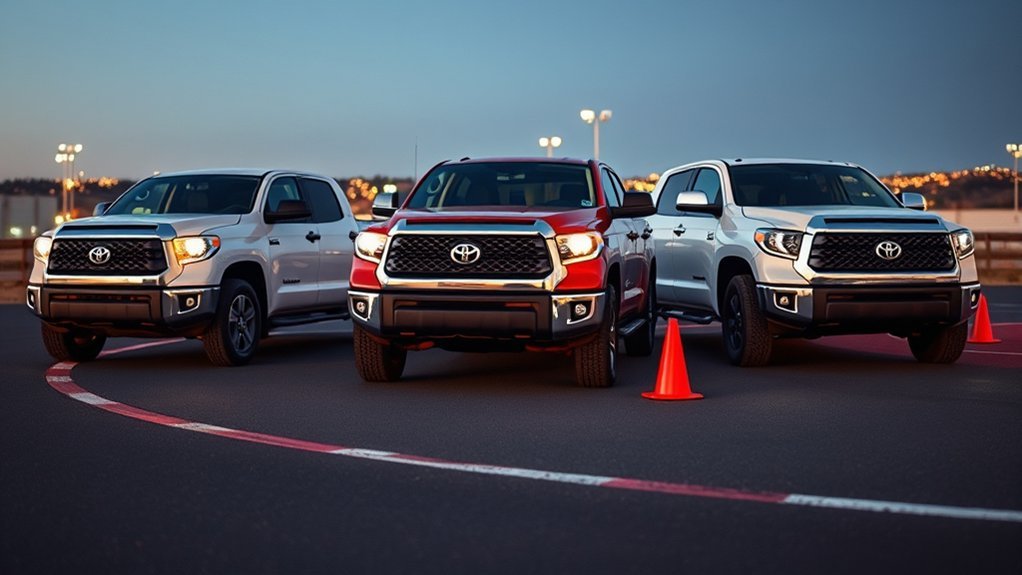
The Tundra’s maneuverability cannot be ranked accurately by model year alone. Toyota has offered different cabs, beds, wheelbases, drivetrains, tires, and suspension packages within the same year. Two Tundras with the same badge may therefore feel different in a parking lot.
| Tundra generation | What affects maneuverability | What to verify |
|---|---|---|
| 2000–2006 First generation |
Regular Cab, Access Cab, and Double Cab versions have different overall lengths and wheelbases. The Double Cab is not directly comparable with a shorter first-generation configuration. | Exact cab, wheelbase, tire size, suspension condition, and whether the specification is curb-to-curb or wall-to-wall. |
| 2007–2021 Second generation |
Toyota offered Regular Cab, Double Cab, and CrewMax trucks with several bed lengths and wheelbases during this generation. Long-bed trucks generally need more space than shorter configurations. | Do not assume that a 2011, 2017, or 2020 truck has one universal turning figure. Match the complete configuration before comparing specifications. |
| 2022–present Third generation |
Current Double Cab and CrewMax configurations remain large full-size trucks. A representative turning circle is roughly 49 feet, or about 15 metres, but the precise figure remains configuration-dependent. | Consult the current Toyota Tundra product hub and its downloadable product-information sheet for the exact model being considered. |
Note: Do not compare a modified truck with a factory specification unless you know the tire diameter, tire width, wheel width, wheel offset, spacers, steering-stop setup, alignment, and suspension components. Any of these can change usable steering clearance.
Turning Radius vs. Turning Diameter
The terms are often mixed together in vehicle listings:
- Turning diameter: The full width of the smallest circle the truck can complete.
- Turning radius: Mathematically, half of that diameter.
- Curb-to-curb: Measures the tire path between low curbs and normally produces the smaller published figure.
- Wall-to-wall: Accounts for the body and bumper sweep between tall obstacles, so it requires more space.
A listed 49-foot turning circle is normally the full diameter. Its mathematical radius is approximately 24.5 feet, but the truck’s body still needs additional clearance around walls, posts, vehicles, and landscaping.
This distinction matters in a garage or driveway. A truck may keep its tires clear of a curb while the front bumper, rear corner, tow mirror, running board, or trailer still swings into an obstacle.
What Determines a Tundra’s Turning Circle?
[Amazon Products Picked for You]

UPGRADED 4K UHD CLARITY - Experience stunning detail with the front camera's upgrade to 4K UHD (2160p) resolution, paired with a 1080p rear camera. The extra-large 12" display provides 1.5 times the viewing area of a standard mirror, significantly reducing blind spots for enhanced safety.
Universal Fit for Most Vehicles: Compatible with cars, trucks, SUVs, RVs, vans, pickups, campers, and trailers. Works with most aftermarket monitors, navigation systems, or reverse display screens (RCA video input required)

[10M(33ft) Color Night Vision & 50% Faster Decision] Drive safely at midnight using this high-performance rear view camera for truck with 10M(33ft) Full-Color Night Vision. The night vision works great, delivering clear picture quality even in complete darkness. Upgraded sensors allow 50% faster identification of colored obstacles versus grainy B&W images. Essential for Trucks and RVs in dark garage parking and night backing.
Wheelbase, Cab, and Bed Length
Wheelbase is the distance between the front and rear axles. With a similar steering angle, a longer wheelbase usually creates a larger turning circle. That is why a long-bed Double Cab should not be compared casually with a short-bed CrewMax or an older short-wheelbase truck.
Cab and bed choices also change the body’s front and rear sweep. Even when two trucks have similar tire-path measurements, the longer truck may need more wall-to-wall clearance.
Steering Angle and Factory Components
The maximum angle of the front wheels is a major part of the turning-circle calculation. Suspension arms, steering knuckles, steering stops, wheels, tires, brake hoses, and inner-fender clearance all limit how far the wheels can turn safely.
Toyota notes that the current Tundra uses a rigid front crossmember for the steering system, while available camera and parking-assistance features can help drivers see nearby obstacles. Equipment varies by grade and package, so check the exact truck rather than assuming every Tundra has the same aids. See Toyota’s current-generation Tundra overview for feature details.
How Lift Kits and Wheel Sizes Impact Turning

A suspension lift does not automatically change the truck’s geometric turning circle. The result depends on the parts installed with it and whether the front wheels can still reach their original steering angle without rubbing or contacting another component.
- Larger-diameter tires: Can contact the inner fender, body mount, mud flap, bumper liner, or suspension at full lock.
- Wider tires: Increase the chance of contact on the inside or outside of the wheel well.
- More negative wheel offset: Pushes the tire outward, changing its swept path and increasing stress on some steering and suspension components.
- Wheel spacers: Alter the scrub radius and clearance and must be evaluated as part of the complete fitment.
- Aftermarket control arms or knuckles: May change alignment range or clearance.
- Steering stops: May be added or adjusted to prevent rubbing, but limiting steering angle increases the turning circle.
- Poor alignment: Can reduce predictable handling and accelerate tire wear even when no rubbing is obvious.
Warning: Do not remove, grind, or alter steering stops simply to gain more steering angle. The stops may be protecting the tire, brake hose, steering linkage, suspension, or body from contact. Have a qualified suspension or alignment shop inspect full-lock clearance on both sides.
After changing tires, wheels, or suspension, check clearance while the suspension is loaded—not only while the truck is raised on a lift. Turn from lock to lock, move slowly in both directions, inspect for polished or freshly rubbed areas, and obtain an alignment. Follow NHTSA tire-safety guidance and use tires with the correct load capacity for the truck.
[Amazon Products Picked for You]

Increase Vehicle Stability: Give your vehicle a wider track width and increased stability with Rough Country's 0.25-inch wheel spacers.

Vehicle Compatible: 1999-2006 Silverado 1500 2WD, 1999-2006 Sierra 1500 2WD, 2007 Classic Silverado 1500 2WD, 2007 Classic Sierra 1500 2WD. Does NOT Fit Extended Cab Models
【Compatible】2004-2020 F150 2WD/4WD 3" Front and 2" Rear Leveling Lift Kit *Note: Due to the different geometric shapes of the factory suspension, there are different lifting heights (only rear height) in different years: 2004-2008 F150 4WD has 2'' stock block, it will not lift; 2009-2020 F150 4WD has 1.5'' stock block, it will provide additional 0.5'' lift; 2004-2020 2WD don't have stock block, it will provide additional 2'' lift
How to Measure Your Tundra’s Turning Diameter
Measuring your own truck is useful when it has aftermarket parts or when a published specification does not identify the exact configuration. Use a large, level, empty private lot with permission.
At a Glance
| Time Required | About 10–15 minutes |
| Difficulty | Easy, with a second person recommended |
| Tools Needed | Tape measure or measuring wheel, chalk or removable markers, cones, and a spotter |
| Cost | $0 if you already have measuring tools; typically under $25 otherwise |
- Prepare the truck. Remove any trailer, check tire pressures against the driver-door label, secure cargo, and confirm that no tire is visibly damaged.
- Clear the area. Keep pedestrians, animals, vehicles, curbs, posts, and loose objects well outside the expected circle.
- Choose the measurement. For curb-to-curb, track the outer edge of the outside front tire. For wall-to-wall, track the outermost body point as it sweeps around.
- Set the steering. While moving at walking speed, turn the wheel smoothly to full lock. Do not force it beyond the stop or hold excessive pressure against the stop.
- Complete a circle. Drive one slow, steady circle while a spotter marks the widest opposite points of the tire path.
- Measure the diameter. Measure straight across the widest part of the marked circle through its approximate center.
- Repeat in the other direction. A meaningful left-to-right difference may indicate uneven tire clearance, alignment trouble, modification interference, or a steering problem.
Warning: Never perform this test on a public street, crowded parking lot, steep surface, or loose terrain. Do not measure with a trailer attached. Use a spotter and stop immediately if a tire rubs or the steering binds.
How to Maneuver Your Tundra in Tight Spaces
A large turning diameter does not mean the Tundra is impossible to place accurately. It means the driver must plan the path sooner and account for parts of the truck that do not follow the front tires exactly.
Set Up Early and Use the Full Space
Approach a tight turn from the outside of the available lane when it is safe and legal. Begin the turn later than you would in a small car. This widens the front-wheel path and helps the rear wheel clear the inside corner.
Watch Front Swing and Rear Off-Tracking
The rear wheels follow a tighter path than the front wheels. This is called off-tracking and can pull the inside rear tire toward curbs, posts, landscaping, or parked vehicles. At the same time, the outside front bumper and fender swing outward.
Check both sides rather than staring only at the inside mirror. Tow mirrors, running boards, wheel flares, and long bed corners also need clearance.
Reverse Into Parking Spaces
Backing into a space often gives you more control because the front of the truck can swing through the wider driving aisle while the rear wheels act as a predictable pivot point. It also provides better visibility when leaving the space.
Use mirrors and available Toyota camera views, but continue checking the actual surroundings. Cameras can distort distance and may not display every low, narrow, moving, or dirty-lens-obscured object.
Use a Three-Point Turn When Needed
Trying to force a one-motion U-turn can place the tires against a curb or the front corner into an obstacle. A controlled three-point turn is usually safer than using every inch of the truck’s maximum steering angle.
Pro Tip: When test-driving a Tundra, visit the places that matter to you: your garage entrance, workplace parking structure, fuel station, school pickup lane, boat ramp, or drive-through. A specification cannot show every combination of slope, curb, post, overhang, and traffic.
How a Trailer Changes the Maneuver
A trailer does not simply follow the truck’s turning circle. Its wheels track inside the truck’s path, while the trailer’s rear may swing outward. The sharper the turn and the longer the distance from the hitch to the trailer axle, the greater the difference can become.
- Allow additional inside clearance for trailer wheels.
- Watch the truck’s rear corner and the trailer’s front corner to avoid a jackknife.
- Use a spotter where visibility is restricted.
- Make small steering corrections while reversing.
- Stop and walk around the combination when clearance is uncertain.
Do not use the truck’s unloaded curb-to-curb figure to decide whether a truck-and-trailer combination can turn safely within a site.
[Amazon Products Picked for You]

Package Information - 2pcs extension mirrors for towing trailer; Suitable for most large vehicles such as SUV, trailers, Jeep, RVs, trucks and more.

Complete rear and side visibility system: View rear and both side angles on one 7.2" HD screen to cover blind spots while towing, as an rv backup camera system and rv wireless camera system. It Ideal for backing into tight campsites, lining up with hookups, and maneuvering into a garage or storage spot where mirrors alone cannot show both corners. Use full screen while driving, then switch to split views for precision backing and tight turns

Fits Most Standard Mirrors - Compatible with most standard side mirrors on pickups, SUVs, and RVs; NOT suitable for vertical-style mirrors or mirrors exceeding 16 inches in perimeter.
When the Turning Circle Feels Worse Than Normal
A large full-size-truck turning circle is normal. A sudden change, scraping noise, steering bind, uneven left/right angle, or heavy steering may not be.
Check Tire Pressure
Underinflated front tires increase steering effort and sidewall flex. Set cold tire pressure according to the truck’s driver-door label rather than the maximum pressure molded into the tire sidewall.
Look for Tire Rubbing
Inspect the inner fender liners, mud flaps, body mounts, control arms, sway bar, brake hoses, and tire sidewalls for polished areas, cuts, scuffs, or fresh rubber marks. Check with the wheels turned both ways and the suspension carrying the truck’s weight.
Verify Wheel and Tire Fitment
If the problem started after a tire, wheel, spacer, leveling kit, or lift installation, compare the new dimensions with the previous setup. Ask the installer to document the wheel offset, tire dimensions, alignment, clearance, and any steering-stop adjustment.
Schedule an Inspection
Have the steering and suspension inspected if the wheel will not turn smoothly, does not return normally, feels loose, produces clunks, or reaches a different angle on each side. Do not assume the symptom is simply part of owning a large truck.
How to Compare Tundra Models on a Test Drive
Use the same route and maneuvers for every truck so the comparison is meaningful:
- Record the model year, cab, bed length, drivetrain, trim, tire size, and whether the suspension is stock.
- Make a legal U-turn in a wide, low-traffic location.
- Enter and exit a standard parking space in both directions.
- Reverse into a space using mirrors first and cameras second.
- Check front-bumper swing near a visible marker without approaching dangerously close.
- Listen for tire rubbing and steering or suspension noises.
- Confirm that the steering angle feels similar in both directions.
- Test the truck in your own driveway or garage when the seller permits it.
For a used Tundra, check the VIN through the Toyota recall lookup and NHTSA recall database. Review service records and obtain a pre-purchase inspection rather than rejecting or selecting a truck solely because of its model year.
Frequently Asked Questions
What is the turning radius of a Toyota Tundra?
A current Tundra typically needs roughly 49 feet, or about 15 metres, for its full curb-to-curb turning diameter, although the exact figure depends on configuration. If you are using “radius” mathematically, that would be about half the published diameter. Always verify the exact cab, bed, wheelbase, and specification method.
What is the most common problem with a Toyota Tundra?
There is no single problem that applies to every Tundra generation and configuration. A wide turning circle is a normal full-size-truck characteristic, not proof of a defect. For a specific truck, check its VIN for open recalls, review its maintenance history, and have a qualified technician inspect it before purchase.
What is considered a good turning radius?
There is no universal good number because a compact car, midsize truck, full-size pickup, and long-bed work truck serve different purposes. Compare the Tundra with trucks of similar wheelbase and size, then test it in the driveway, parking structure, garage, or jobsite where you will use it.
What is a bad year for the Toyota Tundra?
A model year should not be labelled bad solely because of turning diameter or online anecdotes. Reliability also varies with configuration, maintenance, mileage, use, modifications, climate, and recall completion. Evaluate the individual truck with a VIN recall check, service-history review, diagnostic scan, road test, and independent inspection.
Does a lift kit make a Tundra’s turning radius worse?
Not automatically. The lift height alone is only one factor. Larger or wider tires, wheel offset, spacers, suspension geometry, rubbing clearance, alignment, and steering-stop changes determine whether the truck can retain its factory steering angle. If steering angle must be limited to prevent contact, the turning circle becomes larger.
Can the Toyota Tundra’s turning circle be reduced?
There is no simple safe adjustment that turns a Tundra into a short-wheelbase vehicle. Restoring factory-size tires, correcting an unsuitable wheel offset, repairing worn components, removing interference, or correcting alignment may recover lost steering angle on a modified or damaged truck. Do not alter steering stops or suspension parts without professional engineering and clearance checks.
Conclusion
The Toyota Tundra’s turning circle is best understood as a configuration-specific measurement rather than a score assigned to an entire model year. A current truck generally needs about 49 feet of curb-to-curb space, while longer wheelbases, body overhangs, trailers, and some aftermarket wheel or tire setups require additional room.
Before buying or modifying a Tundra, verify the exact specification, inspect full-lock clearance, and test the truck in the spaces that matter to you. In daily driving, slow speed, an early setup, careful mirror and camera use, reverse-in parking, and an occasional three-point turn are safer than trying to force a full-size pickup through a space designed for a smaller vehicle.
Sources
- Toyota USA Newsroom — 2026 Toyota Tundra — current model information and official downloadable product specifications.
- Toyota — 2026 Tundra Product Information — official configuration and specification reference.
- Toyota USA Newsroom — 2025 Tundra Overview — steering, suspension, camera, parking-assistance, and model information.
- Toyota Owners — Warranty and Owner’s Manuals — model-year-specific operating and safety instructions.
- National Highway Traffic Safety Administration — Tires — tire selection, pressure, inspection, and safety guidance.
- National Highway Traffic Safety Administration — Recall Lookup — VIN-specific safety-recall information.
