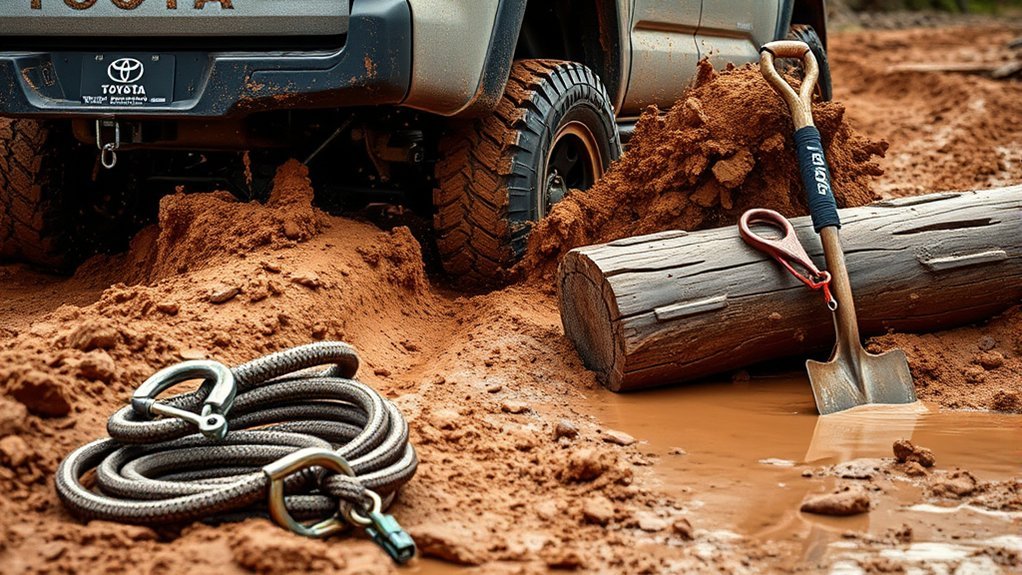
Driving a Toyota Tacoma through mud safely starts with reading the terrain before you commit. On a part-time 4WD Tacoma, 4H is generally the practical starting range for moderate loose mud where you still need controlled momentum, while 4L is better for very slow movement, deep ruts, steep terrain, technical obstacles, or recovery. Exact controls vary by model year and trim, so use the operating procedure in your Tacoma’s owner’s manual rather than treating one setting as universal.
Last updated: September 11, 2026 — substantively reviewed against current Toyota Tacoma off-road-system guidance, NHTSA tire-safety guidance, and recovery-safety guidance. This guide is source-based and does not claim first-hand vehicle testing.
Quick Answer
Inspect the route first, then use smooth throttle, controlled momentum, and small steering inputs. For moderate loose mud, 4H is usually the starting range on a part-time 4WD Tacoma; use 4L when you need low-speed control, greater torque multiplication, or a careful recovery. Do not rely on a universal tire pressure. Stop spinning the tires when forward progress ends, use only suitable recovery points, and restore proper road pressure before normal-speed pavement driving.
Key Takeaways
- Check the route, weather, trail rules, tires, recovery points, and escape options before entering mud.
- Use 4H for loose terrain that still permits controlled trail-speed movement; use 4L when slow control, steep terrain, deep resistance, or recovery requires it.
- No single off-road tire pressure is safe for every Tacoma, tire, wheel, load, speed, and trail.
- Multi-Terrain Select, A-TRAC, Auto LSD, Crawl Control, and rear-locker operation vary by Tacoma generation and equipment.
- Smooth throttle usually creates more useful traction than high RPM and uncontrolled wheelspin.
- Attach recovery equipment only to suitable recovery points and keep everyone outside the recovery zone.
- Wash and inspect the brakes, wheels, underbody, cooling system, tires, and fluids after driving through heavy mud or water.
At a Glance
| Time Required | No fixed time. Inspect until you have confirmed the route, exit, vehicle condition, and recovery plan. |
| Difficulty | Varies by terrain. Moderate mud requires preparation and judgment; deep mud, water crossings, steep terrain, and dynamic recoveries may require additional training or professional help. |
| Typical 4WD Choice | 4H for moderate loose mud with continued movement; 4L for slow, deep, steep, technical, or recovery situations. Follow the procedure for your model year. |
| Tools Needed | Accurate tire gauge, air compressor, shovel, traction boards, gloves, communication device, and correctly rated recovery gear. |
| Cost | Varies according to the recovery and tire equipment you already own. Do not substitute unrated hardware to reduce cost. |
Warning: Mud driving and vehicle recovery can cause rollover, drowning, tire failure, drivetrain damage, or serious injury. Never enter water or mud when you cannot determine its depth, base, exit, and current. Use only legal routes and recovery equipment that is suitable for the vehicle and attachment points.
Choose a Mud-Driving Strategy Before You Enter
Make the drive-mode decision before the tires are already spinning. Mud depth alone does not determine the right setup. Consider the firmness of the base, slope, water, available clearance, required vehicle speed, and whether you have a safe exit.
| Condition | Starting Strategy | Stop or Reassess When |
|---|---|---|
| Moderate mud with a visible, firm base | Use 4H on an applicable part-time 4WD Tacoma, smooth throttle, and controlled momentum. | Wheel speed rises without matching forward movement. |
| Deep ruts, steep grade, or slow technical obstacle | Use 4L when the model-specific manual calls for low-range control; select the appropriate terrain aid if equipped. | The truck becomes grounded, slides sideways, or loses a safe exit. |
| Standing water, moving water, or unknown bottom | Do not enter until depth, bottom, current, exit, and vehicle limitations are confirmed. | Conditions cannot be confirmed safely — turn around. |
| Tires spinning with no forward progress | Release the accelerator, secure the truck, inspect for grounding, dig, and use traction boards or a planned recovery. | One or two controlled self-recovery attempts fail. |
[Amazon Products Picked for You]

EXTREME STRENGTH & HEAVY-DUTY BUILD: This complete recovery kit is built for the toughest jobs. It features two 1/2" soft shackles crafted from 12-strand UHMWPE rope with a massive 56,000 lbs breaking strength. Paired with a solid 7075 aerospace-grade aluminum recovery ring, this system provides unmatched strength and reliability when you need it most

Premium Material: This recovery ring winch is made of 7075 aluminum alloy for superior strength and durability. It is stronger, corrosion-resistant and less prone to rust than traditional grip blocks, ensuring a longer service time for a wide range of off-road gear and winch lines

Feel the Strength of 30,000 lbs: Gear up with our recovery kit! With durable 3 in x 30 ft and 3 in x 8 in polyester straps, you can anchor your vehicle securely and tackle any breakdowns with ease. Say goodbye to worries during heavy-duty operations – this strap is all about endurance and exceptional durability!
Prepare Your Tacoma Before Entering Mud
Walk or carefully inspect an uncertain section before driving into it, provided you can do so without entering deep water or unstable ground. Look for ruts, buried rocks, stumps, steep side slopes, water flow, and a firm exit. Mud that appears shallow may cover a washed-out base or a hole deep enough to flood mechanical or electrical components.
Check whether the route is open to motorized traffic and whether wet-weather closures apply. Stay on the designated route rather than driving around a mud hole. Going around often widens the trail, damages vegetation, and creates new drainage problems. The responsible choice may be to turn around and return when the trail is dry.
- Inspect the tires: Check tread, sidewalls, valve stems, and visible damage.
- Secure the load: Loose cargo changes vehicle balance and can become dangerous during a sudden stop or recovery.
- Identify recovery points: Know which points are approved or engineered for the recovery method before you need them.
- Check clearances: Confirm that skid plates, steps, exhaust components, and aftermarket parts are secure.
- Carry communication: Do not depend on cellular service in a remote area.
- Avoid traveling alone: A second prepared vehicle can help, but only when both drivers understand safe recovery procedures.
[Amazon Products Picked for You]

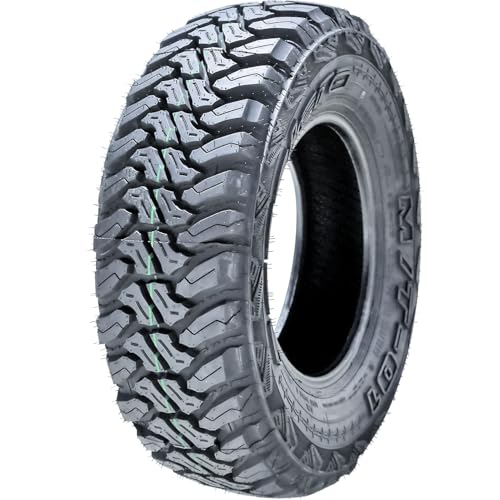
Product Overview: The Forceum M/T 08 Plus are 165/80R13 94/93Q D 8 Ply Rated Mud Terrain Tires Manufactured For Light Trucks

Product Overview: The Kanati Mud Hog M/T are 275/60R20 123/120Q E 10 Ply Rated Mud Terrain Tires Manufactured For Light Trucks
How to Adjust Your Tires for Optimal Performance in Mud

Lower tire pressure can enlarge the tire’s footprint and help the tread conform to soft terrain. However, 20 PSI is not a universal target. The safe amount of deflation depends on tire construction, wheel size, vehicle weight, cargo, speed, trail surface, and the risk of unseating the bead.
Use an accurate gauge and make conservative adjustments. Watch for excessive sidewall bulge, poor steering response, the tire contacting the wheel or suspension, or signs that the bead may unseat. Very low pressure can damage a tire or wheel, especially during sharp turns or when a tire strikes a buried rock.
For an original or manufacturer-approved road tire configuration, use the cold inflation pressure on the vehicle’s tire placard or in the owner’s manual for normal road driving. The National Highway Traffic Safety Administration explains that the correct road pressure comes from the vehicle manufacturer rather than the maximum pressure shown on the tire itself. If you have materially changed tire size, construction, load range, wheels, or vehicle load, use verified load-and-inflation guidance appropriate to that setup. The Tacoma tire load-range guide explains why tire construction and load range also matter.
Pro Tip: Do not air down unless you have a working compressor, an accurate gauge, and enough time to restore road pressure before driving at normal speed.
Choose Suitable Tires
Mud-terrain tires usually clear sticky mud more effectively than highway tires because of their larger voids and aggressive tread blocks. A quality all-terrain tire may still work well on mixed-use trails and moderate mud while providing quieter and more predictable road behavior.
Inspect tread depth before the trip. A tire with packed or badly worn tread cannot develop useful grip even when the truck has advanced traction systems. Clear packed mud only after stopping in a secure location with the transmission in Park or in gear, the parking brake applied, and the engine switched off when appropriate.
Do not treat snow chains as a general mud-driving solution. Fit chains only when Toyota and the chain manufacturer approve them for your exact tire size and wheel-well clearance. Incorrect chains can damage tires, brake lines, suspension parts, or bodywork.
Which 4WD and Traction Settings Should You Use in Mud?
Start by identifying which drivetrain and off-road systems your Tacoma actually has. Controls and operating conditions differ by model year, trim, transmission, and drivetrain. Consult the Toyota owner’s manual portal for the exact shifting procedure, operating limits, warnings, and indicator lights for your truck. For a broader explanation of the ranges, see the Tacoma 4WD system guide.
Generation matters: Many MTS-equipped 2016–2023 Tacomas require 4L before Multi-Terrain Select can operate. Toyota’s current fourth-generation guidance says equipped 2024–2026 Tacomas can use Multi-Terrain Select in both 4WD High and 4WD Low, with terrain-specific control for conditions including mud. See the Tacoma Multi-Terrain Select guide for a deeper generation-by-generation explanation.
When Should You Use 4WD High in Mud?
On a part-time 4WD Tacoma, 4WD High is generally the practical starting range for loose or slippery terrain when you still need normal trail-speed flexibility. Toyota describes 4H as a high-range four-wheel-drive setting for surfaces that allow tire slip, such as off-road, icy, or snow-covered surfaces. In moderate mud, it lets you maintain useful momentum without the stronger gear reduction of 4WD Low.
Do not operate a part-time 4WD system on dry, high-traction pavement unless your model-specific manual allows it. Driveline binding can occur when the front and rear axles cannot relieve speed differences through tire slip.
When Should You Use 4WD Low in Mud?
Use 4WD Low when the situation calls for very slow movement, precise throttle control, greater torque multiplication, steep grades, deep resistance, technical obstacles, or a controlled recovery. Toyota describes 4L as the low-range setting for maximum power and traction during demanding off-road driving and hard pulling in conditions including mud.
4WD Low is not automatically the best choice for every muddy section. Some terrain still requires controlled momentum and enough wheel rotation to keep tread working. Select the range based on the obstacle, required speed, and your Tacoma’s manual rather than mud depth alone.
How Should You Use Tacoma Traction Systems?
Toyota’s 2026 Tacoma overview says equipped Multi-Terrain Select offers terrain-specific traction control for mud, dirt, and sand in both 4WD High and 4WD Low. Equipped trucks may also offer next-generation Crawl Control and an electronic locking rear differential. Older Tacoma generations use different combinations and operating rules for Multi-Terrain Select, A-TRAC, Auto LSD, Crawl Control, and the rear differential lock.
A rear locker can help when rear-wheel slip prevents progress, but do not treat it as a universal first step. Stop uncontrolled wheelspin and follow the activation conditions for your exact truck. If you need the model-specific sequence, see the Tacoma rear differential lock guide.
Note: Do not automatically disable traction or stability control. Select the intended factory terrain setting and change electronic aids only when your owner’s manual describes that action for the current situation.
Maintaining Momentum When Driving Through Mud
Controlled momentum helps your Tacoma continue through soft ground, but excessive speed reduces your ability to react to hidden obstacles. Enter only after you have identified the line, exit, and safest place to stop if the truck loses progress.
The goal is enough controlled motion to keep moving, not enough wheelspin to dig deeper or hide a loss of traction.
- Use smooth throttle: Feed in power progressively instead of stabbing the accelerator.
- Keep useful wheel speed: Avoid both uncontrolled spinning and engine lugging.
- Choose a steady line: Follow the firmest visible base and avoid abrupt direction changes.
- Watch forward progress: If wheel speed rises but vehicle speed does not, reduce throttle and reassess.
- Stop early: Continuing to spin after movement ends usually deepens the holes beneath the tires.
Very slow progress may be safer when you have 4WD Low, Crawl Control, traction boards, or a firm base beneath the surface. Faster momentum is not a substitute for evaluating the obstacle.
Effective Steering Techniques to Maintain Control in Mud
Keep the wheels as straight as practical when entering deep, soft mud. A sharply turned front tire creates more resistance and may act like a brake. Follow existing ruts only when they are shallow enough for your ground clearance and do not pull the vehicle toward a slope, bank, or hidden obstacle.
Small, deliberate left-right steering corrections may help the front tread find a firmer edge. Avoid aggressive steering-wheel sawing. Large or abrupt inputs increase drag and may cause the front or rear of the truck to slide unexpectedly.
| Action | Purpose | Limit |
|---|---|---|
| Keep the wheels mostly straight | Reduces rolling resistance | Steer around hazards when needed |
| Use small left-right inputs | May help the tread find firmer ground | Do not saw the wheel aggressively |
| Look toward the intended path | Supports smoother correction | Avoid fixation on a rut or obstacle |
| Use traction boards | Creates a portable gripping surface | Do not build a new route with rocks or vegetation |
[Amazon Products Picked for You]

PREMIUM OFF-ROAD RECOVERY SOLUTION: Rhino Traction Boards are designed for 4x4 vehicles, trucks, and SUVs, featuring UV Stable Material for durability and Included Retrieval Leashes for easy use in sand, mud, and snow. Perfect for any off-road adventure.

Jack Base Function: Designed with unique jack base in the center of the traction board is for emergency work, compatible with offroad jack.And a bunker recovery boards could be placed under it to provide a solid surface for lifting

Enhanced Double-Sided Traction Design: Both sides of the boards feature a diamond array construction and cross-shaped teeth to maximize friction and grip. This dual-side structure prevents wheel slippage and can also serve as a stable base for lifting or recovery on mud, sand, or snow
Avoid Hidden Water Hazards
A muddy puddle may be a water crossing rather than a simple traction problem. Do not enter when you cannot confirm the depth, bottom, current, exit angle, and safe limits for your Tacoma. Water can hide holes, washouts, sharp debris, or a soft base that will not support the truck. For a dedicated decision process, see the Tacoma water-crossing precautions.
Deep water may enter the engine intake or contaminate drivetrain components, bearings, brakes, or electrical connections. A raised air intake does not waterproof the rest of the vehicle. If the route involves moving water, floodwater, an unknown bottom, or an uncertain exit, turn around rather than treating it as an ordinary mud obstacle.
Essential Recovery Gear for Mud Driving
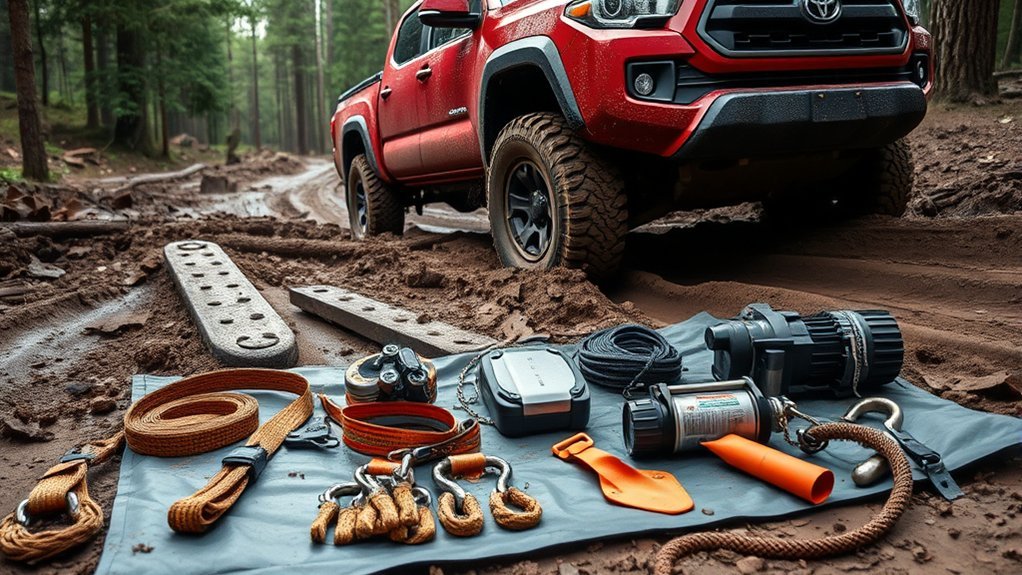
Carry equipment that matches your vehicle, recovery points, and skill level. A bag of random straps and hardware is not a safe recovery kit. Inspect every item for cuts, corrosion, deformation, heat damage, missing labels, or an unreadable rating before use.
Must-Have Recovery Tools
- Traction boards: Boards such as MaxTrax can give the tires a firm surface after you clear mud from in front of them.
- Long-handled shovel: Use it to clear mud from the tires, axles, differential, frame, and intended path.
- Air compressor and gauge: These allow controlled pressure adjustments and reinflation before road travel.
- Rated static strap: Use a strap designed for the intended towing or winching task, not for an uncontrolled kinetic pull.
- Kinetic recovery rope: Use only when the rope, both vehicles, recovery points, and operators are suitable for dynamic recovery.
- Rated shackles or connectors: Match them to compatible recovery points and the rest of the system.
- Gloves and eye protection: Protect your hands and eyes while handling muddy or damaged equipment.
- Recovery damper: Use one where appropriate, but do not treat it as a substitute for an exclusion zone.
- Communication equipment: Clear commands between drivers and spotters help prevent unexpected movement.
The ARB recovery-techniques guidance distinguishes between recovery points, straps, winches, dampers, shackles, and other equipment because each component has a specific job. A visible hook, tie-down, tow ball, or bracket should not be assumed suitable for every recovery method.
Safe Recovery Practices
Plan the recovery before connecting equipment. Agree on one person who will direct the operation, establish clear hand or radio signals, and remove passengers and bystanders from the area.
- Use suitable recovery points: Never attach a kinetic rope or winch line to a tow ball, bumper bracket, shipping tie-down, suspension component, or unknown hook.
- Match equipment ratings: The rope, strap, shackles, recovery points, and vehicles must be compatible with the intended recovery method.
- Keep a clear zone: Nobody should stand between the vehicles, beside a tensioned line, or in the likely path of failed equipment.
- Remove slack correctly: Static towing, winching, and kinetic recovery use different procedures.
- Inspect after every pull: Stop if a connector shifts, a recovery point bends, or the line shows damage.
- Use a high-lift jack cautiously: A high-lift jack requires compatible lifting points, stable footing, training, and strict control of the handle.
Soft shackles can reduce the amount of metal used in some recovery systems, but they do not eliminate stored energy or equipment-failure risk. Keep the recovery area clear regardless of connector material.
Post-Drive Maintenance Tips to Keep Your Truck in Shape
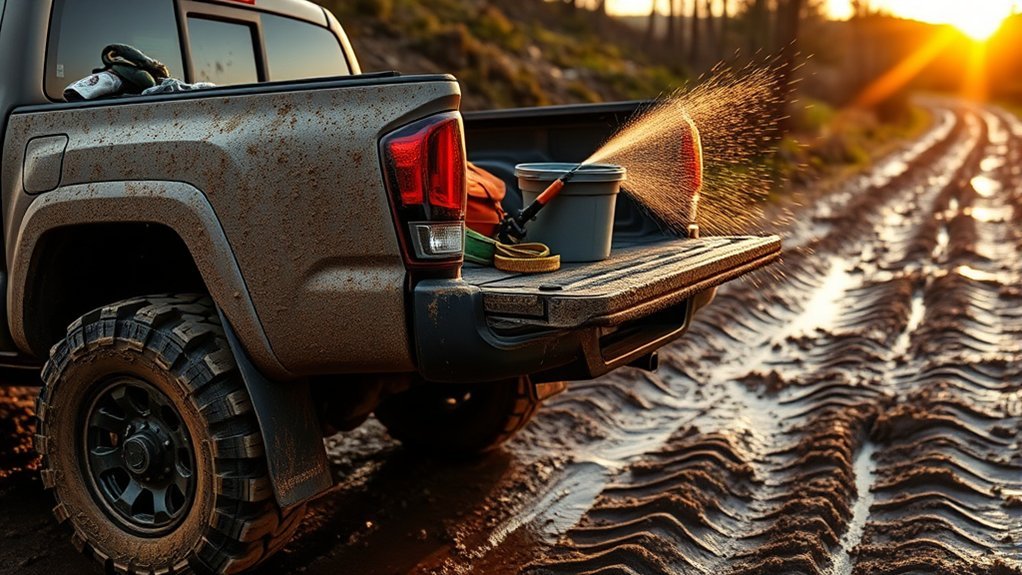
Remove mud soon after the trip because packed material holds moisture, hides damage, blocks airflow, and can unbalance a wheel. Let hot brakes and drivetrain parts cool before washing them. For a more detailed inspection sequence, use the Tacoma underbody inspection checklist.
- Wash the underbody: Rinse the frame, skid plates, suspension, wheel wells, crossmembers, hitch area, and recovery points.
- Clean the wheels and tires: Remove packed mud from both sides of each wheel and inspect the tread, bead, valve stem, and sidewall.
- Inspect the brakes: Look for trapped mud, stones, damaged hoses, unusual noise, pulling, vibration, or reduced braking response.
- Check the cooling system: Mud on the radiator, condenser, or intercooler can restrict airflow and contribute to high operating temperatures.
- Inspect the underbody: Check skid plates, exhaust parts, wiring, connectors, driveshafts, boots, and fluid leaks.
- Check fluids after deep water: Milky, cloudy, or unexpectedly high fluid may indicate water contamination. Have the relevant component inspected before continued use when contamination is suspected.
- Restore road pressure: Inflate the tires to the correct road specification for the vehicle/tire setup and confirm the pressure again when the tires are cold.
A steering-wheel or vehicle vibration that begins after heavy mud exposure may come from uneven mud packed inside a wheel. Stop and clean the wheels before highway driving. If vibration remains after the mud is removed, inspect the tires, wheels, steering, suspension, and other rotating components rather than assuming contamination is the only cause.
Handling Skids and Regaining Control in Mud
Stay calm and look toward the path you want the Tacoma to follow. Ease the accelerator rather than making a sudden throttle, steering, or brake input. Abrupt inputs can shift weight quickly and make a slide harder to control.
Use smooth steering to align the front tires with the intended path. If the truck begins to respond, reduce the steering angle instead of holding a large correction. Avoid adding strong throttle until the tires regain useful grip.
Electronic stability and traction systems may help manage wheel slip or a developing slide. Do not switch them off reflexively during a skid. Make planned off-road mode changes before entering an obstacle or after stopping safely, according to the owner’s manual.
Effective Recovery Techniques for Stuck Vehicles in Mud
If your Tacoma stops moving, release the accelerator before the tires dig deeper. Apply the brake, secure the vehicle, inspect the situation, and choose the lowest-risk recovery method.
- Confirm the truck is not grounded: Check whether the frame, differential, axle, skid plate, or suspension is resting on mud.
- Clear the path: Dig mud from in front of the tires and beneath any grounded component.
- Straighten the wheels: This reduces resistance during the first attempt.
- Select the correct factory setting: Use the drive range, terrain mode, differential function, or traction aid described in your manual.
- Place traction boards: Seat them firmly against the driven tires in the intended direction of travel.
- Use gentle throttle: Let the tires climb onto the boards without launching them behind the vehicle.
- Reassess after one or two attempts: Repeated wheelspin usually makes the recovery harder.
- Escalate carefully: Use a winch, static tow, or kinetic recovery only with compatible recovery points, correctly rated equipment, and operators who understand that recovery method.
Warning: Never use a trailer hitch ball as a recovery attachment. Do not place hands, feet, or tools beneath a tire while the driver applies power, and do not stand in front of or behind a traction board during an extraction.
Related Guides
Frequently Asked Questions
How do you get traction when a Toyota Tacoma is stuck in mud?
Stop excessive wheelspin, secure the truck, check whether the underbody is grounded, clear mud from the tires and intended path, straighten the wheels, and place traction boards firmly against the driven tires. Select the appropriate factory traction setting and apply gentle throttle. If self-recovery fails, use suitable recovery points and a correctly planned recovery method.
Should you use 4WD High or 4WD Low for mud?
Use 4WD High for loose or slippery terrain where you still need normal trail-speed flexibility and the surface allows tire slip. Use 4WD Low for very slow progress, deep resistance, technical terrain, steep grades, or controlled recovery. Mud depth alone does not determine the correct range, so follow your Tacoma’s manual and consider the required speed and control.
How do you drive through mud without getting stuck?
Inspect the route first, choose the firmest legal line, select the proper drive setting, and use smooth throttle with controlled momentum. Keep steering inputs small and stop when wheelspin increases without forward movement. Suitable tires, a planned exit, traction boards, a compressor, and compatible recovery gear improve your ability to deal with changing conditions.
Should you disable traction control in mud?
Not automatically. Tacoma traction systems differ by model year and may use TRAC, A-TRAC, Auto LSD, Multi-Terrain Select, Crawl Control, or other functions to manage wheelspin. Select the intended terrain setting and change traction- or stability-control settings only when the owner’s manual describes that action for the current situation.
What tire pressure should a Toyota Tacoma use in mud?
There is no universal mud PSI for every Tacoma. A safe off-road pressure depends on the tire, wheel, vehicle load, speed, terrain, and risk of bead or wheel damage. Make conservative adjustments with an accurate gauge, carry a compressor, and restore the correct road pressure before normal-speed pavement driving.
Can you use Multi-Terrain Select in 4WD High on a Tacoma?
It depends on the Tacoma generation. Toyota says equipped fourth-generation Tacomas can use Multi-Terrain Select in both 4WD High and 4WD Low. Many MTS-equipped 2016–2023 Tacomas require 4L. Check the manual for your exact model year before assuming the operating conditions are the same.
Conclusion
Safe Toyota Tacoma mud driving starts before the tires touch the mud. Inspect the route, confirm legal access, prepare the truck, and understand the controls fitted to your exact model. For moderate loose mud, 4H is generally the practical starting range on a part-time 4WD Tacoma; move to 4L when the terrain requires low-speed control, greater torque multiplication, or a careful recovery.
If progress stops, end the attempt before uncontrolled wheelspin digs the truck deeper. Clear the tires and underbody, use traction boards when appropriate, and connect recovery equipment only to suitable recovery points. After the trip, restore correct road tire pressure and inspect the brakes, wheels, cooling system, underbody, and fluids before returning to normal-speed driving.
Sources
- Toyota Manuals and Warranties – model-specific operating procedures, system limitations, tire information, and warnings.
- Toyota USA: 2026 Toyota Tacoma – current fourth-generation information about Multi-Terrain Select, Crawl Control, the electronic rear differential lock, and off-road equipment.
- National Highway Traffic Safety Administration TireWise – official tire-pressure, inspection, tread, and road-safety guidance.
- ARB Recovery Techniques and Equipment – recovery-point, strap, winch, damper, connector, and exclusion-zone safety guidance.
- Michelin Mud Driving Guidance – route assessment, controlled momentum, tire selection, steering, and stuck-vehicle guidance.
- Tread Lightly! – responsible motorized recreation and trail-stewardship principles.
