Your Toyota Tacoma’s tire pressure normally changes as outdoor temperature changes. A useful rule of thumb is about 1 PSI for every 10°F change: colder weather usually lowers the reading, while warmer weather and driving raise it. Check every tire when cold, inflate it to the pressure on your truck’s Tire and Loading Information label, and investigate any tire that loses noticeably more pressure than the others or keeps dropping after correction.
Quick Answer
Toyota Tacoma tire pressure commonly changes by about 1 PSI for each 10°F change in ambient temperature, although the exact change varies. AAA uses the same rule of thumb for seasonal pressure changes. Check the tires cold at least monthly and after major weather shifts. Inflate them to the driver-side door-jamb placard, not the maximum pressure molded into the tire sidewall.
Key Takeaways
- Use your Tacoma’s door-jamb placard for the correct cold PSI because pressure can differ by model year, tire size, axle, and configuration.
- Check all tires, including a full-size spare when applicable, at least once a month and before long trips, towing, or hauling.
- Measure pressure before driving or after the truck has been parked for at least three hours.
- Do not bleed air from a warm tire just because its reading is higher than the cold specification.
- Investigate repeated pressure loss, a steadily illuminated TPMS light, or a flashing TPMS light instead of repeatedly adding air.
At a Glance
| Time Required | About 5–10 minutes |
| Difficulty | Easy |
| Tools Needed | Accurate tire-pressure gauge, valve-cap storage spot, and an air source if adjustment is needed |
| Cost | No added cost if you already own a gauge and have access to an air pump |
Why Regular Tire Pressure Checks Are Essential
Correct pressure helps your Tacoma’s tires carry the intended load, respond predictably, and wear more evenly. Under-inflation increases tire flex and heat buildup. Excessive cold inflation can produce a harsher ride and make a tire less able to absorb some road impacts.
The National Highway Traffic Safety Administration recommends checking every tire at least monthly while cold. That schedule matters because a tire may lose air gradually without looking visibly low, and a Tire Pressure Monitoring System may not warn you until pressure is already significantly below the vehicle specification.
The placard inside the driver’s door is the pressure target. The number on the tire sidewall is not your Tacoma’s recommended operating pressure.
How Temperature Changes Impact Tire Pressure Levels
Air pressure changes with temperature. As the air inside a tire cools, its gauge pressure falls. As it warms, pressure rises. AAA uses a practical estimate of about 1 PSI for every 10°F change in temperature. Treat that as a rule of thumb rather than an exact formula because tire size, starting pressure, sunlight, driving heat, and the size of the temperature swing can change the result.
A Tacoma set correctly during a warm afternoon may therefore read lower the next cold morning. That does not automatically mean the tire has a puncture. However, a tire that loses more pressure than the others, continues dropping after adjustment, or needs frequent refilling may have a leak.
| Ambient Temperature Change | Approximate PSI Change | What It Means |
|---|---|---|
| 10°F colder | About 1 PSI lower | Recheck cold and restore the placard pressure if needed |
| 20°F colder | About 2 PSI lower | A previously marginal tire may trigger TPMS |
| 30°F colder | About 3 PSI lower | Check every tire instead of assuming the warning is only weather-related |
| 10°F warmer | About 1 PSI higher | Do not bleed normal temperature-related pressure from a tire that was correctly set cold |
Note: These values are estimates, not replacement specifications. Driving heats the tires and normally raises pressure. Compare a cold reading with the cold placard specification rather than trying to make a warm tire match that number.
How Can You Tell Temperature Change From a Tire Leak?
The pattern matters more than one isolated reading. A weather-related change usually affects several tires in the same direction. A leak is more suspicious when one tire behaves differently or pressure keeps falling after you correct it.
| What You See | More Likely Explanation | Next Step |
|---|---|---|
| Several tires drop similarly after a cold snap | Temperature change | Measure cold and adjust each tire to its placard value |
| One tire loses noticeably more than the others | Possible puncture, valve leak, bead leak, or wheel issue | Inspect the tire and have the cause checked if loss continues |
| Pressure falls again soon after being corrected | Possible ongoing leak | Do not rely on repeated top-offs; arrange an inspection |
| Sudden major loss, visible damage, bulge, or very low tire | Potential tire failure or significant leak | Stop driving when safe and inspect or obtain professional assistance |
What Happens If Your Tires Are Under-Inflated?
Under-inflated tires flex more as they roll. That extra movement creates heat, increases rolling resistance, and can accelerate shoulder wear. It may also reduce steering response and affect braking and handling, especially when the truck is heavily loaded or traveling at highway speed.
Fuel use can rise as well. The U.S. Department of Energy and EPA’s FuelEconomy.gov maintenance guidance estimates that under-inflated tires can reduce gas mileage by about 0.2% for each 1 PSI drop in the average pressure of all tires.
Warning: Do not keep driving on a visibly low tire, a tire with sidewall damage, or a tire that will not hold pressure. Stop in a safe location and inspect it or contact a qualified tire professional.
[Amazon Products Picked for You]

Enhanced Visibility in Low Light: Features a green backlit LCD screen and integrated flashlight, allowing for clear reading of tire pressure even in dark or dimly light conditions.

1. LONG ZINC ALLOY DUAL HEAD DESIGN : Straight foot air chuck are deisghed for inner wheels or difficult reached valve as well as the 30°reverse chuck are for outer wheels.A good choice for testing your tire pressure also a great father's day gift

PROCESS LEVEL ACCURACY: Each ETENWOLF’s digital tire pressure gauge is calibrated manually to ANSI B40.7 Grade 2A(plus-minus 1 PSI).Presta valve adapter not included, if used for bicycles, it must be purchased separately
How to Check Your Tacoma’s Tire Pressure Correctly
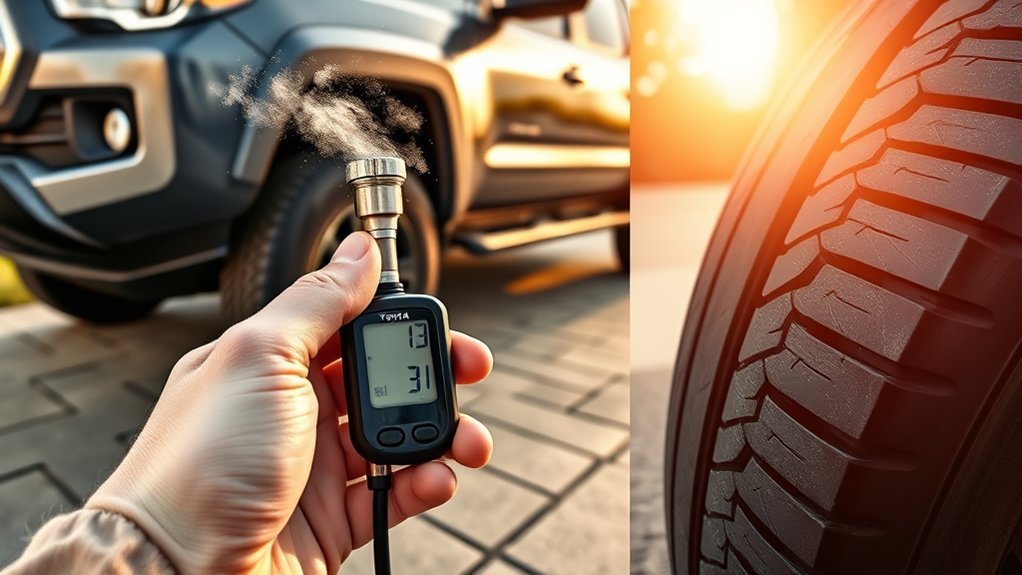
- Park and let the tires cool. Check before driving or after the Tacoma has been parked for at least three hours.
- Find the correct specification. Read the Tire and Loading Information label on the driver-side door edge or door jamb. Note whether front and rear pressures differ.
- Remove one valve cap. Keep it in a clean, secure place so dirt cannot enter the valve.
- Press the gauge squarely onto the valve stem. A brief hiss is normal, but reseat the gauge if air continues escaping.
- Compare the reading with the placard. Add air in short bursts if low. Release small amounts if the cold reading is high.
- Recheck after each adjustment. Stop when the gauge matches the specified cold pressure.
- Repeat for every tire. Reinstall the valve caps and check the spare if your Tacoma has one that requires routine inflation checks.
Pro Tip: Use the same dependable gauge each month. Small differences between gauges are common, so a consistent tool makes pressure trends easier to spot.
[Amazon Products Picked for You]
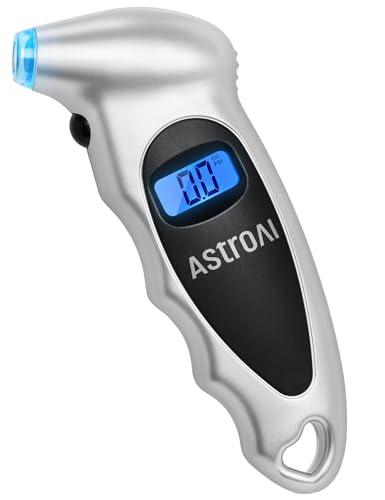
Accurate, Dependable Readings: Factory‑calibrated to ±1 PSI, so you can confidently match your vehicle’s recommended PSI (check the door jamb sticker). Ideal for monthly checks and road trips — consistent results every time, cold or warm.

TRUSTED BY OVER 3 MILLION USERS: Based in Garden Grove, California, AstroAI serves customers in more than 15 countries worldwide. Known for professional-grade accuracy and durable construction, this digital tire inflator with gauge is a trusted choice for drivers, mechanics, and DIYers who rely on dependable tools.

ACCURATE: Performance-tested and calibrated. Measures in pounds per square inch (PSI, 10-160, 2-lb. increments). Kilopascal readings also available per special order (kPa, 80-840, increments of 20)
Why Should You Check Tacoma Tire Pressure When Cold?
Toyota and federal tire guidance use a cold inflation pressure. A cold tire is generally one that has not been driven for at least three hours. Sunlight, hot pavement, towing, highway speed, and normal flexing can all increase a warm reading.
If you must add air while the tires are warm, do not bleed a tire down to make its warm reading equal the cold specification. Correct an obviously low tire enough to travel safely, then recheck and fine-tune the pressure once the tires are cold. Toyota specifically warns that pressure normally rises after driving and should not be reduced merely because of that heat-related increase.
Which Toyota Tacoma Tire Pressure Should You Use?
No single PSI applies to every Toyota Tacoma. Model year, original tire size, trim, axle loading, and factory configuration can affect the listed pressure. Toyota’s official 2024 Tacoma specifications alone contain factory applications using 30, 32, and 35 PSI cold inflation pressures, which shows why a universal Tacoma number is unreliable. Use the placard attached to your specific truck and confirm unusual configurations in the correct owner’s manual.
You can find the appropriate manual through Toyota’s official manuals and warranties portal.
[Amazon Products Picked for You]

HIGH ACCURACY: Every ETENWOLF's pencil tire gauge is calibrated to ANSI B40.1 Grade B, it is accurate to 2% of span in the middle 50% of range and 3% of span in the lower and upper 25% of range. Each ETENWOLF pencil tire pressure gauge is manually calibrated and has its unique calibration number printed on the pencil

RUGGED DESIGN: The stainless steel components prevent rust and corrosion while the precision-crafted nozzle seamlessly seals onto the valve stems for highly accurate readings (±2% span). We also provide 4 valve stem caps for convenient replacement.

PRO ACCURACY - mechanic recommended, performance tested, & calibrated accurate to professional ANSI 2A standards - with dual pressure sensors certified to ±0.50% FS (0.50 PSI), offering reliable readings up to 100 PSI w/ precise readout resolution of 0.10 PSI - so you can now maintain your tires with a shop-grade mechanic trusted tool
2016 Tacoma Pressure Specs
Do not rely on a generic claim that every 2016 Tacoma uses 29 PSI. Factory tire and trim combinations differ, so the correct cold pressure belongs to the specific truck and its original tire specification. Check the Tire and Loading Information label first, then use Toyota’s owner documentation when you need model-specific confirmation.
Variations by Tacoma Trim, Tires, and Load
TRD, SR, SR5, Limited, and other configurations may use different wheels or tires. Replacement tires must have suitable size and load capacity, but the sidewall’s maximum pressure still does not replace the vehicle placard. Ask a Toyota dealer or qualified tire professional for guidance when changing tire size or type, carrying unusual loads, installing specialty off-road tires, or using a slide-in camper.
Never inflate a tire beyond its stated limits. Do not raise pressure simply because a dealer, forum post, or previous owner used a higher number.
Should You Add Extra PSI to Tacoma Tires in Winter?
Do not add a blanket amount of extra pressure simply because it is winter. Instead, check the tires cold in the current outdoor conditions and restore them to the cold PSI shown on your Tacoma’s placard. If the temperature later falls substantially, recheck them because the gauge reading can fall again. Use different pressure only when Toyota or the applicable tire manufacturer provides configuration-specific guidance for your setup.
Consequences of Driving With Improper Tire Inflation
Both low and excessive pressure can create problems. Under-inflation promotes heat buildup, shoulder wear, slower steering response, and higher rolling resistance. Excessive cold pressure can make the ride harsher, increase sensitivity to road impacts, and contribute to center-focused wear in some conditions.
Pressure also works together with load, speed, alignment, tire condition, and road temperature. Correcting PSI cannot make a damaged, overloaded, aged, or badly worn tire safe. Inspect tread and sidewalls while you have the gauge in hand.
Year-Round Tire Pressure Tips
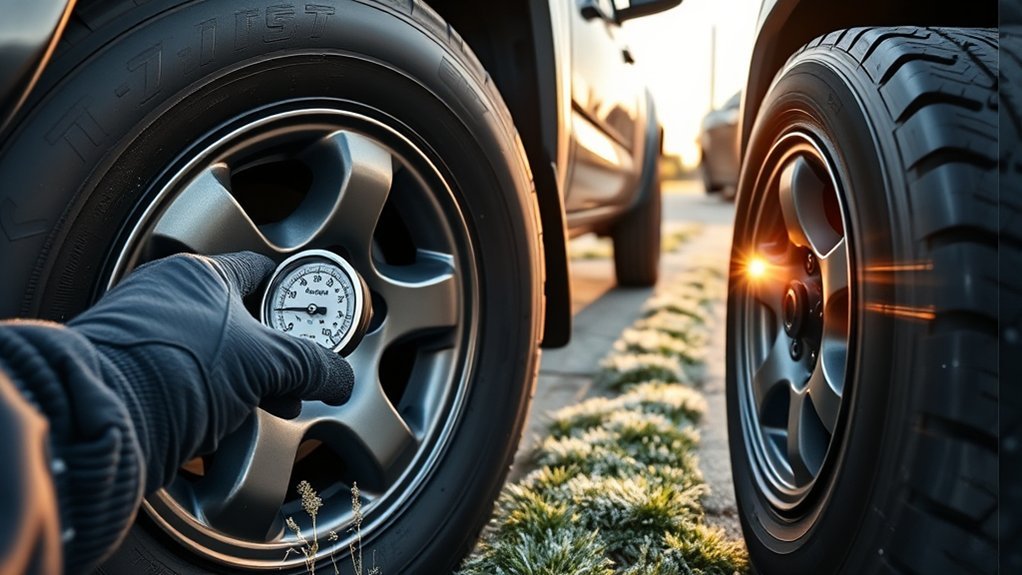
- Winter: Recheck after the first major cold snap and whenever the TPMS light appears on a cold morning.
- Spring and fall: Check after large day-to-night temperature swings.
- Summer: Set pressure cold. Do not bleed normal heat-related pressure from tires after highway driving.
- Before towing or hauling: Follow the truck’s placard, owner’s manual, payload limits, and towing guidance. Do not improvise a pressure increase.
- Before a long trip: Check pressure, tread, visible damage, valve stems, and the spare before loading the truck.
What Does a Tacoma TPMS Warning Mean in Cold Weather?
A TPMS light that appears on a cold morning and later turns off usually means one or more tires were close enough to the warning threshold for the overnight temperature drop to trigger the system. Check all tires with a gauge rather than assuming warmer daytime conditions solved the issue.
A solid low-pressure warning calls for a pressure check as soon as safely possible. Under federal TPMS rules, the system must provide a low-pressure warning by the regulatory threshold, which is based on pressure reaching 25% below the vehicle manufacturer’s recommended cold pressure or the applicable minimum in the standard, whichever is higher. A Tacoma may warn before that point, so TPMS should never be used as a substitute for routine gauge checks.
A warning that flashes for roughly one minute and then stays illuminated generally indicates a TPMS malfunction rather than ordinary low pressure. Federal Motor Vehicle Safety Standard No. 138 specifies the warning and malfunction behavior and reinforces that TPMS is a warning aid, not a pressure-setting tool.
How to Stay Informed About Tire Maintenance
Build tire checks into a simple routine instead of waiting for a warning light. Keep your gauge where you can reach it, record unusual losses, and consult the correct Toyota manual when tire or wheel equipment changes. You can also include tire inspection in your broader Toyota Tacoma maintenance routine.
| Action | When | Why It Matters |
|---|---|---|
| Check all cold tire pressures | At least monthly | Finds gradual loss before pressure becomes severely low |
| Recheck after major weather changes | After a sharp temperature rise or drop | Corrects temperature-related pressure changes |
| Inspect for leaks or damage | When one tire repeatedly loses air | Helps identify punctures, valve leaks, or wheel issues |
| Review the owner’s manual | After changing tires, wheels, or operating conditions | Keeps maintenance aligned with Toyota guidance |
Frequently Asked Questions
How much does tire PSI change with temperature?
A commonly used estimate is about 1 PSI for every 10°F change in temperature. Treat that as a rule of thumb, not an exact formula. Check with a gauge after major weather changes and adjust each cold tire to the Tacoma’s placard.
Should I add extra PSI to my Tacoma tires in winter?
Do not add a universal amount of extra winter pressure. Measure the tires cold in the current conditions and inflate them to the cold PSI on your Tacoma’s Tire and Loading Information label unless Toyota or the applicable tire manufacturer gives different configuration-specific guidance.
What is the 4 PSI rule?
The “4 PSI rule” is an informal method some drivers use to compare cold and hot pressure. It is not Toyota’s official inflation specification and should not replace the door-jamb placard. Driving conditions can produce more or less than a 4 PSI increase.
What is the 3% rule for tires?
The “3% rule” is not a recognized Toyota or NHTSA standard for setting Tacoma tire pressure. Avoid percentage shortcuts. Use the manufacturer’s cold PSI from the vehicle placard and investigate pressure that repeatedly changes beyond normal temperature effects.
What is the 5 PSI rule?
A warm tire may rise by several PSI during driving, but a fixed 5 PSI increase is not a universal target. Do not release air from a normally warmed tire to force that increase. Set pressure when cold and follow the placard.
Should I use the PSI printed on the tire sidewall?
No. The sidewall marking relates to the tire’s limits and load rating. Your Tacoma’s recommended cold pressure is on the Tire and Loading Information label inside the driver’s door area and in the owner’s manual.
Why does the TPMS light come on only during cold mornings?
One or more tires may be close to the warning threshold. Overnight cooling lowers the pressure enough to activate the light, then daytime warmth or driving raises it. Check and correct all tires cold rather than ignoring the warning.
Conclusion
Temperature can change your Tacoma’s tire-pressure reading even when no sudden air loss has occurred. Use roughly 1 PSI per 10°F only as an estimate, measure the tires cold, and always set pressure from your truck’s own placard. If one tire loses pressure faster than the others or continues dropping after adjustment, treat that as a possible leak rather than normal weather behavior. Check all four tires after major temperature changes and use TPMS as a warning system, not as your pressure gauge.
Sources
- NHTSA TireWise: Tire Safety Ratings and Awareness — monthly cold-pressure checks, placard guidance, TPMS limits, tread, and inflation safety.
- FuelEconomy.gov: Keeping Your Vehicle in Shape — fuel-economy effects of under-inflated tires and placard guidance.
- Toyota Owners: Manuals and Warranties — model-specific owner’s manuals and official Toyota maintenance information.
- 49 CFR 571.138: Tire Pressure Monitoring Systems — federal TPMS warning thresholds, malfunction behavior, and required owner guidance.
- AAA: Cold-Weather Tire Pressure Guidance — approximately 1 PSI of pressure change for each 10°F temperature drop.
