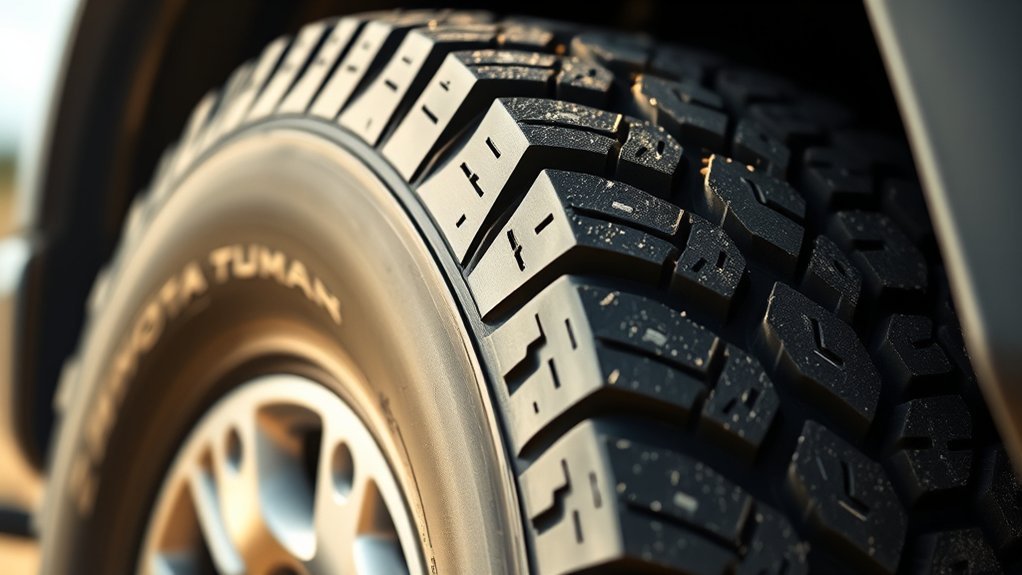
Your Toyota Tacoma’s correct tire rating depends on its model year, trim, wheel package, and original equipment specifications. Before buying tires, check the driver-side Tire and Loading Information label and your year-specific owner’s manual. Those sources identify the approved tire size and cold inflation pressure for your truck.
Quick Answer
Choose a tire that matches the Tacoma’s approved size and meets or exceeds the original tire’s load-carrying capacity and speed rating. Do not assume every Tacoma requires 109S. Confirm the complete service description on the original tire, door placard, owner’s manual, or Toyota-approved fitment data.
Key Takeaways
- Use your Tacoma’s door placard and year-specific manual instead of relying on a universal tire size or load index.
- Load index measures carrying capacity, while load range describes a tire’s construction and pressure capability.
- A 109 load index equals about 2,271 pounds per tire, but 109 is only an example unless your truck specifies it.
- A heavier LT or Load Range E tire does not increase the Tacoma’s GVWR, payload, axle rating, or towing limit.
- Use the vehicle manufacturer’s recommended cold pressure, not the maximum pressure printed on the tire sidewall.
Start With the Tacoma Tire Placard and Owner’s Manual

The safest starting point is the Tire and Loading Information label on the driver-side door edge or doorjamb. It normally lists the original front and rear tire sizes and the recommended cold inflation pressure. The certification label nearby also lists the truck’s gross vehicle weight rating and front and rear axle ratings.
The National Highway Traffic Safety Administration recommends choosing the original tire size or another size approved by the vehicle manufacturer. You can also select your Tacoma’s year and model through the Toyota manuals and warranties portal.
Warning: Do not select a replacement tire only because it fits the wheel. An incorrect load capacity, speed rating, inflation requirement, or overall diameter can affect handling, braking, clearance, and tire durability.
What to Record Before Shopping
- The complete original tire size, such as 245/70R17
- The load index and speed symbol, such as 110T
- Whether the tire is P-metric, metric, or LT-metric
- The recommended front and rear cold pressures
- The wheel diameter and approved wheel-width range
- The front and rear gross axle weight ratings
- Your normal passenger, cargo, towing, and off-road use
Do not rely on a tire size quoted for another Tacoma. Toyota has offered many cab, drivetrain, suspension, wheel, and tire combinations across different generations and trims. Even the 2026 Tacoma lineup includes different wheel and all-terrain tire packages.
Decode Tire Markings: What “109S” Means
A marking such as 265/70R17 109S combines the tire’s dimensions, construction, load index, and speed symbol. Each part describes a different requirement.
| Marking | Meaning |
|---|---|
| 265 | Nominal section width in millimeters |
| 70 | Sidewall height as a percentage of the tire width |
| R | Radial construction |
| 17 | Wheel diameter in inches |
| 109 | Load index, equal to about 2,271 pounds at the tire’s rated conditions |
| S | Speed rating, corresponding to 112 mph under controlled test conditions |
The load and speed codes form the tire’s service description. Match the original service description unless Toyota or a qualified tire professional confirms that another specification is appropriate.
Note: A speed rating does not recommend driving at that speed. It represents a laboratory-tested capability under specified load, pressure, temperature, and operating conditions.
How Load Index Relates to Tacoma Weight Limits
The load index is a standardized code for the maximum weight one tire can support at its rated conditions. A higher number represents a higher maximum load, but it does not automatically make a tire better for your truck.
Load Index Examples
The following values show how several common load indexes translate into capacity. Use the tire manufacturer’s load-index chart to confirm other values.
| Load Index | Kilograms per Tire | Approximate Pounds per Tire |
|---|---|---|
| 109 | 1,030 kg | 2,271 lb |
| 110 | 1,060 kg | 2,337 lb |
| 112 | 1,120 kg | 2,469 lb |
| 116 | 1,250 kg | 2,756 lb |
These figures do not mean that four tires with a combined capacity of 9,084 pounds allow a Tacoma to weigh 9,084 pounds. The vehicle’s GVWR, front GAWR, rear GAWR, suspension, brakes, wheels, and other components still control the truck’s legal and safe limits.
Match Tire Capacity by Axle
Check that the two tires on each axle provide enough capacity for that axle’s rating and actual loaded weight. For example, the combined capacity of the two rear tires must support the loaded rear axle without exceeding the tires’ rated conditions.
For the most accurate check, load the truck as you normally use it and weigh the front and rear axles separately at a certified vehicle scale. Include passengers, bed cargo, accessories, and trailer tongue weight.
GVWR already includes the truck’s allowable payload. Never add payload to GVWR when evaluating tire capacity.
Understanding Dual Load Indexes on LT Tires
Some LT tires use two load indexes, such as 121/118. The first number applies when the tire is used in a single-wheel position. The second applies when two tires share one side of an axle in a dual-wheel arrangement.
A Tacoma uses single rear wheels, so the first number normally applies. Do not add the two numbers together or use the lower dual-wheel value as the Tacoma’s single-tire capacity.
Choose the Correct Tire Type and Load Range
Load index, load range, and tire type are related, but they are not interchangeable. Understanding the difference helps you avoid buying a tire that is unnecessarily heavy or unable to support your truck correctly.
| Term | What It Describes |
|---|---|
| Load index | The tire’s maximum load at its rated conditions |
| SL | Standard Load passenger-type construction |
| XL | Extra Load passenger-type construction with greater pressure and load capability than a comparable SL tire |
| LT | A light-truck tire designation, not a load range by itself |
| Load Range C, D, or E | Construction and pressure categories commonly used with LT tires |
When SL or XL Tires May Make Sense
If your Tacoma originally uses a passenger-type or metric tire and you mainly drive on pavement with moderate loads, an approved SL or XL replacement may provide a lighter, smoother, and more efficient setup than a heavy LT tire.
The replacement must still meet the original load capacity, size, speed rating, and vehicle-manufacturer requirements. Do not assume that every passenger-type tire with the correct dimensions has enough capacity.
When LT Tires May Make Sense
An LT tire may suit frequent towing, heavy bed loads, rough roads, sharp rocks, or repeated off-road use. LT tires often provide stronger construction and a wider range of load and pressure capabilities.
However, an LT conversion can also increase tire weight, steering effort, rolling resistance, and ride firmness. A heavier tire may affect acceleration, braking response, fuel economy, and suspension feel.
Load Range C, D, or E
- Load Range C: Often offers a balance of reinforced construction and moderate weight for mixed road and trail use.
- Load Range D: Provides greater rated pressure and capacity in tire sizes where it is available.
- Load Range E: May suit high-load or severe-service use, but it is not automatically the best choice for every Tacoma.
Choose the lightest suitable construction that meets your truck’s required capacity and actual use. Installing a Load Range E tire does not raise Toyota’s payload, towing, GVWR, or axle ratings.
Pro Tip: Compare each tire’s actual weight, load index, approved wheel-width range, and required pressure. Two tires with the same load range can still feel and perform differently.
Pick the Right Speed Rating for Safety

The speed symbol represents the maximum speed capability demonstrated under controlled test conditions. It also reflects aspects of the tire’s heat resistance and construction, but it does not measure towing capacity or off-road durability.
Use the original speed rating as your baseline. Choose an equal or higher rating unless Toyota, the tire manufacturer, or a qualified installer approves a different specification for a specific application, such as certain winter or specialized off-road tires.
Common Speed-Rating Examples
The tire speed-rating chart explains how speed symbols translate into tested maximum speeds.
| Speed Symbol | Maximum Test Speed | Selection Guidance |
|---|---|---|
| S | 112 mph | Use only when it meets the truck’s original requirement or an approved replacement specification. |
| T | 118 mph | Common on many road-focused truck and SUV tires. |
| H | 130 mph | May use a construction and compound aimed at higher-speed road performance. |
A higher speed rating does not necessarily provide a softer ride, longer tread life, greater load capacity, or better off-road resistance. Evaluate the complete tire rather than choosing the highest letter available.
Towing and Load Needs
Towing adds tongue weight to the truck and often places more load on the rear axle. It can also increase heat buildup during long trips, especially when pressure is low or the truck is overloaded.
Before towing:
- Confirm the trailer and tongue weights.
- Subtract passengers, cargo, accessories, and tongue weight from the truck’s available payload.
- Stay below the truck’s GVWR and both axle ratings.
- Confirm that the tires and wheels can support the loaded axle weights.
- Set pressure according to Toyota guidance or a professionally calculated load-and-inflation requirement.
- Inspect the tires for damage, uneven wear, and abnormal heat.
Do not select V- or Z-rated tires merely because you tow. Their higher speed capability does not establish that they have the correct load capacity, tread design, sidewall construction, or pressure range for your Tacoma.
Use Ratings as Limits, Not Targets
Speed ratings assume properly maintained tires operating under defined conditions. Damage, underinflation, overloading, heat, age, repairs, and road hazards can reduce a tire’s safe capability.
Follow posted speed limits and reduce speed when towing, carrying a heavy load, driving in heat, or traveling on rough surfaces. The tire’s speed symbol never overrides road laws, trailer limits, or safe driving conditions.
Use the Correct Tire Pressure
Proper inflation is essential because a tire’s load capacity depends on pressure. Underinflation increases flex and heat, while excessive pressure can reduce ride comfort and change the tire’s contact with the road.
For an original-size and original-type replacement tire, begin with the recommended cold pressure on the vehicle placard. NHTSA defines a cold tire as one that has not been driven for at least three hours.
Warning: The pressure molded on the tire sidewall is a maximum rating for the tire. It is not automatically the correct operating pressure for your Tacoma.
If you change from a passenger-type tire to an LT tire, the placard pressure may not provide equivalent load support. Ask a qualified tire professional to calculate the correct cold pressure using the tire manufacturer’s load-and-inflation data.
Check all tires with an accurate gauge at least monthly, before long trips, and before towing. Include the spare when your Tacoma carries one.
Changing Tire Size or Construction
A different tire size can affect more than appearance. Overall diameter, width, wheel offset, and tire construction can influence clearance, gearing, speedometer readings, braking feel, steering, and electronic driver-assistance systems.
Before changing sizes, confirm:
- The tire fits the wheel’s diameter and approved width range.
- The load capacity meets the vehicle and axle requirements.
- The tire clears the body, suspension, brakes, and steering components through full travel.
- The overall diameter remains within an acceptable range.
- The spare tire remains compatible with the installed tires and drivetrain.
- The tire does not interfere with ABS, traction-control, stability-control, or safety-system operation.
- The wheels have adequate load capacity and the correct offset.
A lift kit or extra fender clearance does not confirm that a larger tire is safe. Added tire mass and leverage can affect braking, steering components, wheel bearings, suspension, and driveline performance.
Quick Checklist for Choosing Tacoma Tires
- Identify the exact truck. Record the model year, trim, drivetrain, cab, bed, and wheel package.
- Read the door placard. Note the original sizes and cold pressures.
- Check the original service description. Record the load index and speed symbol.
- Confirm the tire type. Determine whether the original tire is P-metric, metric, or LT-metric.
- Match the required capacity. Do not install a tire with inadequate load support.
- Check axle requirements. Consider GAWR and actual loaded axle weights.
- Choose construction for real use. Consider commuting, towing, cargo, terrain, and puncture exposure.
- Compare tradeoffs. Review tire weight, ride, noise, efficiency, wet grip, and tread design.
- Verify wheel and clearance compatibility. Do this before changing size or load range.
- Set the correct pressure. Use the placard or a professional load-and-inflation calculation.
- Replace tires as a compatible set. Avoid mixing incompatible sizes, constructions, or performance levels.
- Inspect and maintain them. Check pressure, tread, damage, rotation needs, balance, and alignment.
Frequently Asked Questions
How do I find my Tacoma’s required load index?
Check the complete service description on the original tire and review your year-specific Toyota manual or approved fitment information. The door placard identifies the original tire size and pressure, but it may not always print the load index separately. A Toyota dealer or qualified tire installer can confirm the original specification using the VIN.
What does 109S mean on a tire?
The number 109 is the load index and corresponds to approximately 2,271 pounds per tire at the tire’s rated conditions. The letter S is the speed symbol and corresponds to a maximum test speed of 112 mph. These codes describe tire capability, not the Tacoma’s payload or recommended driving speed.
Can I install a lower load index than the original tire?
Do not install a lower-capacity tire unless Toyota or a qualified tire professional has confirmed that the replacement still meets every vehicle requirement. Matching or exceeding the original load-carrying capacity is the safer general rule.
Is Load Range E better than Load Range D?
Not for every driver. Load Range E may provide greater pressure and load capability in a given size, but it may also weigh more and ride more firmly. Load Range D can be a better balance when it safely meets the truck’s capacity and use requirements.
How much weight can a Toyota Tacoma carry in its bed?
The available bed capacity depends on the truck’s vehicle-specific payload limit and everything else it carries. Passengers, accessories, tools, cargo, and trailer tongue weight all use payload. Read the payload label on your Tacoma and subtract those loads before deciding how much weight can go in the bed.
Does the Tacoma model year change the correct tire rating?
Yes. Tire size, load index, speed rating, wheel diameter, and original construction can change by model year, trim, drivetrain, and option package. Always verify the specification for the exact truck instead of copying a tire size from another Tacoma.
Conclusion
Choosing Tacoma tires starts with the truck, not a universal number. Match the approved size and original load-carrying capacity, use the correct speed rating, and select a tire construction that fits your actual driving, towing, and terrain.
Remember that a heavier tire cannot raise the Tacoma’s factory weight limits. Confirm axle capacity, wheel fitment, clearance, and inflation before changing size or moving to an LT tire. When the specifications are unclear, use your VIN and ask a Toyota dealer or qualified tire professional to verify the replacement.
Sources
- National Highway Traffic Safety Administration: TireWise — tire sizing, vehicle placards, cold pressure, inspection, and maintenance guidance
- Toyota Manuals and Warranties — year-specific Toyota owner’s manuals and vehicle documentation
- Goodyear Tire Load Index Guide — standardized load-index explanations and capacity references
- Goodyear Tire Speed Rating Guide — speed-symbol definitions and rating chart
- Toyota USA Newsroom: 2026 Tacoma — current model and wheel-package information
