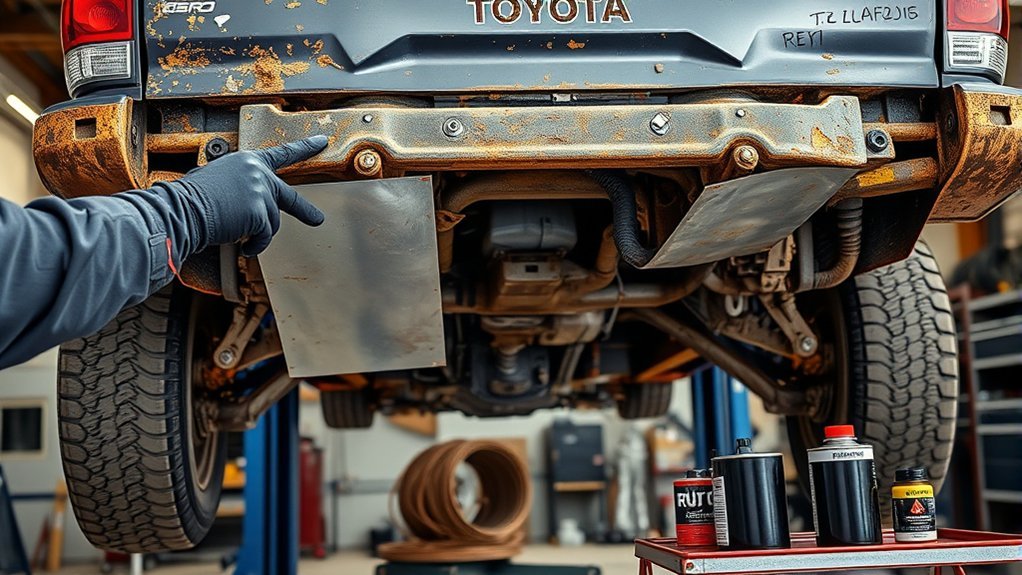
Rust on a Toyota Tacoma frame deserves prompt attention, but not every orange spot means the frame has failed. Light surface corrosion may be cleaned and protected at home. Deep scaling, holes, cracks, distorted mounts, or weakened steel require a qualified frame or collision-repair professional before you drive the truck again.
Quick Answer
Treat only light surface rust yourself. Clean the frame, remove loose corrosion, apply a compatible rust treatment, and seal the metal. Stop driving and arrange a professional inspection if you find perforation, deep scaling, cracks, deformation, or corrosion around suspension, steering, body, fuel-tank, or drivetrain mounts.
Key Takeaways
- Surface staining and light rust differ from scaling, section loss, cracking, and perforation.
- A coating can slow corrosion, but it cannot restore steel that has become thin or disappeared.
- Check your VIN through Toyota and NHTSA instead of assuming an old corrosion program still covers your truck.
- Structural welding and sectional frame repair require accurate assessment, alignment, preparation, and skilled installation.
- Inspect the frame and protective coating at least annually, especially after winters involving road salt or brine.
At a Glance
| Time Required | About 30–60 minutes for an initial inspection; several hours for minor surface preparation and coating |
| Difficulty | Moderate for surface treatment; professional level for structural evaluation, cutting, welding, or frame replacement |
| Tools Needed | Bright light, inspection mirror, wheel chocks, rated lifting equipment if needed, eye protection, respirator or suitable mask, gloves, wire brush or wheel, cleaner, rust treatment, and compatible topcoat |
| Cost | Relatively low for minor surface treatment; potentially high for structural welding or frame replacement. Obtain itemized local quotes. |
Last updated: July 13, 2026
Understanding Frame Rust and Its Impact on Your Toyota Tacoma

Your Tacoma’s frame carries loads from the cab, bed, suspension, steering, drivetrain, bumpers, and towing equipment. Rust becomes a safety concern when corrosion reduces the frame’s thickness, weakens a mounting point, creates a crack, or produces a hole.
Older Tacomas have been associated with several historical corrosion campaigns and support programs. Coverage was not identical for every year, location, or truck. Instead of relying on a broad model-year statement, enter your VIN in the Toyota safety recall and service campaign lookup. You should also check the NHTSA recall database.
Note: NHTSA explains that VIN results may not display recalls completed previously, some recalls more than 15 years old, or manufacturer customer-service campaigns. Contact Toyota with your VIN if you need help researching an older truck.
Moisture, road salt, brine, mud, damaged coatings, blocked drainage, and trapped debris can all accelerate corrosion. Boxed frame sections deserve special attention because rust may develop on an interior surface before the outer rail looks badly damaged.
A frame can look acceptable from one angle while corrosion develops inside a rail, above a crossmember, or around a mounting bracket.
How to Identify the Severity of Tacoma Frame Rust
Begin with a visual inspection in bright light. Photograph the frame before cleaning it so you can document stains, scaling, holes, damaged coatings, previous welds, and changes during future inspections.
Surface Rust Versus Structural Corrosion
| Condition | What It Looks Like | Recommended Action |
|---|---|---|
| Surface staining | Orange or brown discoloration with solid, smooth steel underneath | Clean, dry, treat, coat, and monitor |
| Light scaling | Thin flakes or rough texture without visible holes or distorted metal | Professional inspection is wise before coating, especially near mounts |
| Heavy scaling or section loss | Thick layers separating, swollen seams, deep pits, or visibly thin edges | Do not hide it with coating. Arrange a structural inspection. |
| Perforation or cracking | Holes, splits, torn brackets, displaced mounts, or frame deformation | Stop driving and have the truck transported for professional assessment |
Critical Areas to Inspect
- Front and rear suspension mounting points
- Steering-gear and control-arm mounting areas
- Engine, transmission, and cab mounts
- Rear spring hangers and shackles
- Crossmembers and their welded connections
- Fuel-tank supports and nearby frame sections
- Brake lines, fuel lines, and wiring attached to the frame
- Upper surfaces of frame rails that collect mud and salt
- Drain holes, boxed sections, seams, and reinforcement plates
- Previous welds, patches, collision damage, or altered frame sections
Warning: Do not rely on a casual hammer or screwdriver test to declare a frame safe. Stop driving if you see holes, cracks, displaced mounts, major deformation, or metal separating around a load-bearing attachment. Arrange towing or professional transport when roadworthiness is uncertain.
How to Treat Minor Surface Rust on a Toyota Tacoma Frame
The following process applies only to steel that remains solid and free from perforation, cracking, deformation, or serious section loss. A rust converter and paint can slow corrosion, but neither product replaces missing metal.
1. Prepare the Work Area Safely
Park on a firm, level surface, apply the parking brake, chock the wheels, and let the exhaust cool. If you must raise the truck, use correctly rated lifting equipment and support it securely. Never work beneath a vehicle held only by a hydraulic or factory emergency jack.
Wear eye protection, gloves, suitable respiratory protection, and clothing that covers your skin. Work with good ventilation. Keep sparks, grinding dust, and coatings away from fuel lines, the fuel tank, brake hoses, wiring, hot exhaust parts, and other flammable materials.
2. Clean and Dry the Frame
Remove packed mud, salt, oil, and loose debris. Use a cleaner that is compatible with the coating system you plan to apply. Rinse where appropriate and allow the steel, seams, and boxed sections to dry completely.
A coating applied over moisture, grease, or heavy scale may trap contamination or lose adhesion. Do not cover an area until you can see and evaluate the underlying metal.
3. Remove Loose Rust and Failed Coating
Use a hand wire brush, scraper, abrasive pad, or controlled wire wheel to remove loose rust and peeling coating. Avoid thinning sound metal or damaging nearby lines and components.
Media blasting can clean complex corrosion, but aggressive blasting may expose hidden damage and requires proper containment, equipment, and judgment. Leave extensive blasting to a qualified shop when the frame condition is uncertain.
4. Apply a Compatible Rust Treatment
Follow the product label and technical instructions. Rust-Oleum Automotive Rust Reformer, for example, is designed to bond with rusty metal and leave a protected, paintable surface.
Rust treatment works best on properly prepared surface corrosion. It does not rebuild thin steel, repair a crack, strengthen a damaged mount, or certify that the frame is roadworthy.
5. Seal Exposed Steel
Apply a compatible primer or topcoat as directed by the treatment manufacturer. Cover edges, seams, brackets, and cleaned areas evenly. Avoid coating brake friction surfaces, exhaust components, rubber parts, electrical connectors, labels, or drain openings unless the product is specifically approved for that use.
An internal-frame or cavity coating can reach boxed areas that an exterior brush cannot. Confirm compatibility with existing paint, undercoating, rubber, plastics, and wiring before application.
6. Inspect and Document the Area
After the coating cures, photograph the finished work and record the product, application date, and affected frame location. Reinspect the area after the next wet or salty season and compare it with your earlier photographs.
Pro Tip: Photograph both sides of each rail, the top of accessible sections, mounting brackets, and the inside of drain openings before applying an opaque coating. Good records help a technician distinguish old repairs from new corrosion.
When Professional Frame Repair Is Necessary
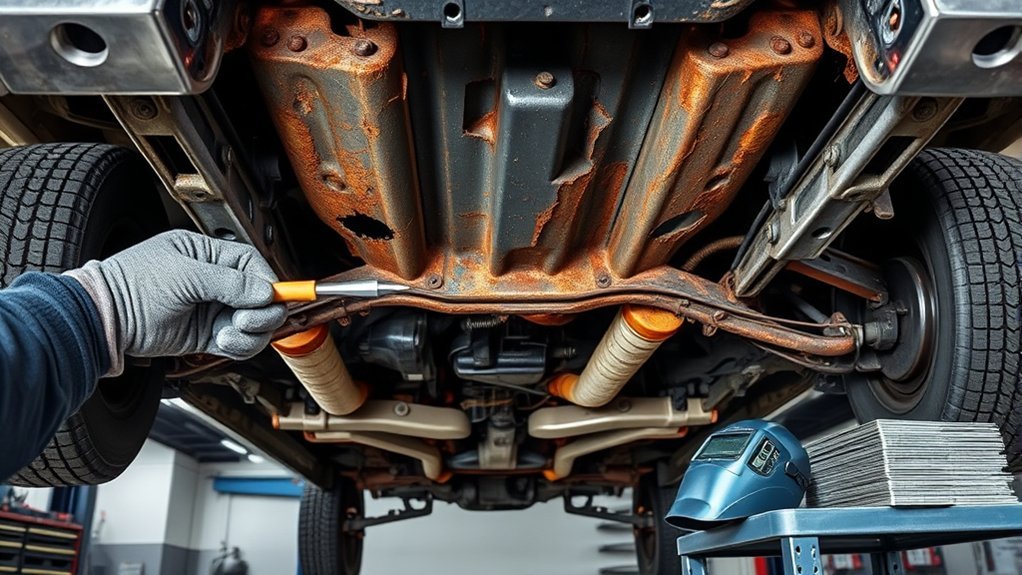
Professional assessment becomes necessary when corrosion affects more than the frame’s outer surface. A qualified technician should inspect the truck on a lift, determine how much sound steel remains, check frame dimensions, and examine nearby mounts, lines, brackets, and crossmembers.
Seek professional help when you find any of the following:
- A hole or split in a frame rail or crossmember
- Heavy scaling that separates in thick layers
- Visible thinning, crushed edges, or swollen seams
- Cracks extending from a hole, weld, bracket, or mounting point
- Corrosion around suspension, steering, drivetrain, cab, bed, or hitch mounts
- A leaning body, changing panel gaps, unusual alignment, or mount movement
- Previous patches with unknown materials or workmanship
- Damage close to brake lines, fuel lines, wiring, or the fuel tank
- Corrosion extending through several connected frame sections
Ask the shop to document the affected areas, remaining steel condition, proposed repair section, welding method, corrosion protection, alignment checks, warranty, and whether the finished truck must pass a state safety inspection.
How the Safe-T-Cap Repair System May Fit Into a Repair
Safe-T-Cap kits are preformed repair sections sold by Auto Rust Technicians for specific vehicle configurations, including several Tacoma cab and drivetrain combinations. The kits are intended for installation with welding and common body-repair equipment.
A kit may help a qualified installer replace or reinforce a known damaged section. However, the part must match the truck’s factory frame dimensions, and the rest of the frame must remain suitable for repair.
The Safe-T-Cap manufacturer warns that severe rust may exist in several areas and that installing one of its parts does not guarantee that a vehicle will be roadworthy. It also warns that modified or altered frames may not fit as designed.
Warning: Do not buy a frame section based only on a photograph of one rusty area. The installer must evaluate the full frame, confirm the correct kit, remove unsound steel, protect nearby systems, control alignment, complete sound welds, and inspect the finished repair.
Repair Costs Versus Replacement Costs
A reliable price cannot be estimated from the truck’s model year alone. Labor rates, cab style, drivetrain, rust location, fastener condition, parts availability, previous repairs, and the number of affected sections can change the total substantially.
Factors That Affect Sectional Repair
- How far corrosion extends beyond the visible opening
- Whether solid steel remains around the repair area
- Access to the inside, top, and back of the frame
- Removal of the bed, fuel tank, exhaust, lines, or suspension parts
- Fabrication or purchase of a vehicle-specific repair section
- Welding, frame measurement, refinishing, and cavity protection
- Repair of nearby brackets, mounts, crossmembers, and seized hardware
Factors That Affect Full Frame Replacement
- Availability and condition of a replacement frame
- Shipping and handling for a large structural part
- Labor to transfer the cab, bed, drivetrain, suspension, lines, wiring, and accessories
- Replacement of corroded fasteners, mounts, bushings, brake lines, and fuel-system parts
- Alignment, inspection, refinishing, and post-repair testing
| Option | May Make Sense When | Main Limitation |
|---|---|---|
| Surface treatment | Steel remains solid with no structural section loss | Cannot restore missing or weakened steel |
| Sectional repair | Damage is localized and sound attachment metal remains | A poor assessment or weld can leave hidden weakness |
| Frame replacement | Corrosion affects several connected areas but the truck otherwise justifies major work | High labor demand, parts availability, and possible additional component replacement |
| Retire or sell for parts | Repair exceeds the truck’s practical value or safe repair is not feasible | You lose the vehicle but avoid investing in an unsuitable structure |
Request at least two written estimates when practical. Each quote should identify the exact repair area, parts, labor, refinishing, alignment checks, additional components, warranty, and conditions that could change the price after disassembly.
How Undercoating Helps Protect a Tacoma Frame
Undercoating can reduce contact between exposed steel and corrosive moisture, salt, and debris. Its effectiveness depends on correct preparation, complete coverage, compatibility, and regular inspection.
Hard paint-like coatings can provide a durable finish on properly cleaned and prepared metal. However, a cracked or poorly bonded coating may hide corrosion or hold contamination against the steel. Soft oil- or wax-based products remain flexible and can creep into seams, but they collect dirt and require periodic renewal.
Do not apply a heavy coating over loose scale, wet metal, active perforation, or an area that has not been inspected. An opaque layer can make future evaluation harder without correcting the underlying damage.
How Often Should You Reapply Undercoating?

Inspect the frame and coating at least once a year. Check it more often after winter, off-road use, deep mud, coastal exposure, flooding, or work that scrapes the underside.
Reapplication intervals depend on the product. Fluid Film states that its automotive undercoating can provide up to a full year of protection, which supports annual renewal in many applications. Other coating systems may use different schedules.
Recommended Inspection and Reapplication Schedule
- After winter: Wash away salt and brine, then inspect seams, rails, crossmembers, and wheel-spray areas.
- Every six months in severe exposure: Check high-wear areas and touch up damaged coverage.
- At least annually: Perform a complete frame inspection before renewing a soft oil- or wax-based coating.
- After scraping or repairs: Restore corrosion protection as soon as the repaired surface is ready.
- According to the label: Follow the chosen product’s preparation, compatibility, cure, and renewal instructions.
Environmental Exposure Considerations
Trucks driven on salted roads usually need more frequent cleaning and inspection. Coastal air, wet soil, mud, and repeated launch-ramp use can also increase corrosion exposure.
Rinse the undercarriage when temperatures allow, but avoid forcing water into electrical connectors, damaged seals, or areas that cannot drain. Clear packed debris from ledges and openings so moisture can escape.
Application Methods and Compatibility
Clean and dry the frame before applying most hard coatings. Soft oil- and wax-based products may use different preparation requirements, so follow the product instructions.
Protect brake rotors, brake friction surfaces, tires, belts, hot exhaust components, oxygen sensors, and surfaces that the manufacturer excludes. Fluid Film also advises checking compatibility because it may soften some existing undercoatings and affect some non-oil-resistant rubber materials.
Common Lessons From Tacoma Frame Repairs
Owner reports can help you identify questions to ask, but they cannot prove that the same repair will work on your truck. Frame condition, climate, previous work, installer skill, and inspection standards vary widely.
| Common Experience | Useful Lesson | Question to Ask |
|---|---|---|
| A visible hole revealed wider hidden corrosion after cleaning | The visible opening may not show the full repair boundary | How will the shop confirm that it has reached sound steel? |
| A repair required removal of the bed, tank, lines, or suspension parts | Access and component removal can dominate labor | Which parts must be removed, replaced, or protected? |
| Rust returned near an untreated seam or boxed section | Exterior paint alone may not protect adjacent cavities | How will the shop protect seams and internal surfaces? |
| A well-documented repair helped during inspection or resale | Photographs, invoices, and specifications improve transparency | Will I receive before-and-after photos and a written warranty? |
Related Guides
Frequently Asked Questions
Can a Toyota Tacoma frame be repaired?
Yes, some Tacoma frames can be repaired when corrosion is localized and enough sound steel remains for a properly designed repair. A qualified technician must inspect the entire frame, confirm alignment, evaluate nearby mounts, and determine whether sectional repair or replacement is suitable.
Is a rusted Tacoma frame worth fixing?
It may be worth fixing when the damage is limited, the truck is otherwise sound, and a reputable shop can complete and document a safe repair. Compare itemized repair quotes with the truck’s condition, value, expected use, replacement cost, and the risk of finding additional corrosion.
Which Toyota Tacoma years can have frame-rust problems?
Corrosion depends on the individual truck’s history, location, storage, coating condition, and maintenance. Older Tacomas were included in several historical corrosion-related programs, but you should not assume coverage or condition from the model year alone. Check the VIN with Toyota and NHTSA, then inspect the actual frame.
Can a dealership sell a truck with a rusted frame?
Used-vehicle sales, inspections, warranties, and disclosures vary by state. Federal rules generally require a dealer to provide a Buyers Guide showing whether the vehicle includes a warranty or is sold as is. Review the guide, obtain an independent frame inspection, get promises in writing, and contact your state consumer-protection office when you need legal guidance.
Will rust converter or undercoating fix a weak frame?
No. Rust converter, paint, cavity coating, and undercoating can protect suitable metal after correct preparation, but they cannot replace lost steel or repair cracks, holes, damaged welds, or weakened mounting points.
Conclusion
You can often clean and protect light surface rust on a Toyota Tacoma frame, but structural corrosion requires a different response. Holes, cracks, deep scaling, distorted mounts, or widespread section loss call for professional assessment before further driving.
Check your VIN, document what you find, avoid hiding damage beneath a fresh coating, and compare written repair options carefully. Once the frame is confirmed sound, regular cleaning, annual inspection, and a compatible corrosion-protection system can help slow future deterioration.
Sources
- Toyota Safety Recalls and Service Campaigns — VIN-based Toyota recall and campaign lookup.
- National Highway Traffic Safety Administration Recall Lookup — recall searches, VIN-result limitations, and safety complaint information.
- Rust-Oleum Automotive Rust Reformer — manufacturer description and application information.
- Fluid Film Automotive Applications — undercoating characteristics, compatibility cautions, and renewal guidance.
- Auto Rust Technicians Safe-T-Cap Kits — kit applications, installation requirements, and roadworthiness disclaimer.
- Federal Trade Commission: Buying a Used Car From a Dealer — Buyers Guide, independent inspection, warranty, and state-law guidance.
