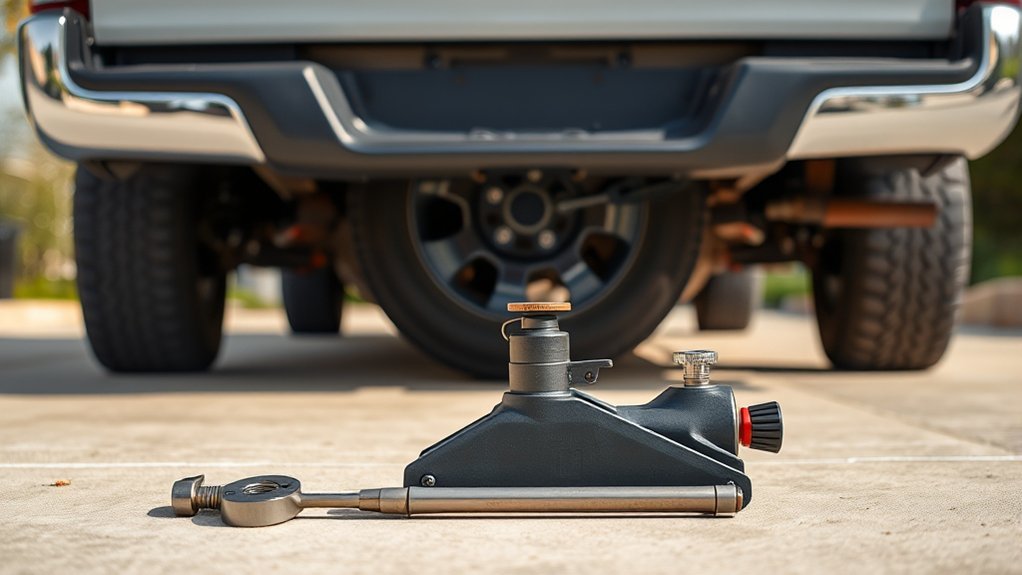
Your Toyota Tacoma needs a jack and lug tool that match its exact model year, wheels, ride height, and factory lifting points. A six-point 21 mm socket is a useful starting point for many Tacoma factory lug nuts, but test-fit it before relying on it. For a verified fourth-generation example, Toyota specifies 154 ft-lbf (209 N·m) for steel wheels and 97 ft-lbf (131 N·m) for aluminum wheels on the 2024 Tacoma; always check the manual for your exact model year and wheels. For regular garage work, a properly rated 3-ton floor jack is usually the most practical choice when its height, reach, and saddle fit the truck.
Last updated: September 19, 2026. This revision rechecked fourth-generation Tacoma wheel torque, OEM tool-kit variations, high-lift guidance, jack-safety standards, and spare-tire maintenance guidance.
Quick Answer
Start by test-fitting a six-point 21 mm socket on an original Tacoma lug nut, but verify the size for your model year and wheels. A 21 mm hex is not exactly the same as either 7/8 inch or 13/16 inch. Use the factory emergency jack for roadside wheel changes at Toyota-designated points and a quality 3-ton floor jack for regular garage work when its lift range and saddle fit your Tacoma.
Key Takeaways
- A lug nut’s hex size, thread specification, and tightening torque are three different measurements.
- A 21 mm six-point socket is a useful starting point for many Tacomas, but it must seat fully without rocking.
- A 21 mm hex equals about 0.827 inch; 13/16 inch is 20.6375 mm and 7/8 inch is 22.225 mm, so neither is an exact substitute.
- Toyota specifies different wheel-nut torque for steel and aluminum wheels on the 2024 Tacoma, so never copy one torque value across every Tacoma.
- A 3-ton floor jack offers useful capacity and stability for garage work, but minimum height, lift range, reach, and saddle fit matter as much as capacity.
- OEM jack and lug-tool part numbers can vary by cab, wheel, and equipment configuration; verify replacements by VIN.
- Use only the lift and support points shown in the owner’s or repair manual for your model year.
- Never work beneath a Tacoma supported only by a jack.
At a Glance
| Time Required | About 10 minutes to verify the tools; wheel-change time varies with conditions, equipment, and experience |
| Difficulty | Moderate; stop if the ground, traffic, weather, or equipment makes the job unsafe |
| Tools Needed | Correct six-point socket or factory lug wrench, rated jack, wheel chocks, jack stands for garage work, torque wrench, gloves, and warning lights or triangles |
| Cost | Varies by configuration and equipment; use the complete factory kit or rated equipment that matches your Tacoma’s weight, height, and lift points |
Warning: A jack lifts the truck but does not provide safe support for underbody work. Park on firm, level ground, chock the wheels, use the approved lifting points, and place rated jack stands at approved support locations before putting any part of your body beneath the vehicle. Call roadside assistance when you cannot work safely away from traffic.
Quick Answers: What Jack and Lug Sizes Does a Tacoma Use?

A six-point 21 mm socket is commonly used on many Toyota Tacoma factory lug nuts. However, it is not safe to assume that every Tacoma has the same hardware. Replacement lug nuts, wheel locks, aftermarket wheels, decorative caps, and generation changes can alter the required socket, key, thread specification, or torque value.
Push the socket fully over a clean lug nut before you need it. The correct socket should seat to the base of the hex with minimal movement. Do not use it if it rocks, stops partway down, or requires force to fit.
The jack also needs more than a suitable ton rating. Check its minimum height, maximum lift height, saddle shape, base size, condition, and ability to reach the approved point when a tire is completely flat.
Socket Size, Thread Size, and Torque Are Different
| Measurement | What It Describes | Why It Matters |
|---|---|---|
| Hex or socket size | The outside flats of the lug nut | Determines which wrench or socket fits |
| Thread size and pitch | The wheel stud diameter and distance between threads | Determines whether a replacement lug nut can thread onto the stud |
| Torque | The specified tightening force | Provides the intended wheel clamping force |
Do not use the thread size to choose a socket. Also, do not copy a torque number from another Tacoma generation or wheel type. Check the wheel-installation section of the manual for your exact truck and follow the wheel manufacturer’s instructions when aftermarket wheels are installed.
What Is the 2024 Tacoma Wheel-Nut Torque?
Toyota’s 2024 Tacoma owner’s manual specifies different tightening torque for factory steel and aluminum wheels. These values are a verified fourth-generation example, not a universal specification for every Tacoma ever built.
| 2024 Factory Wheel Type | Toyota-Specified Wheel-Nut Torque |
|---|---|
| Steel wheel | 154 ft-lbf (209 N·m, 21.3 kgf·m) |
| Aluminum wheel | 97 ft-lbf (131 N·m, 13.4 kgf·m) |
For another model year, replacement wheel, spacer, stud, or aftermarket lug nut, use the specification supplied for that exact setup instead of assuming the 2024 value applies.
Factory Jack: Type, Capacity, and Fit
Toyota supplies or specifies an emergency lifting system for changing a wheel on equipped Tacomas. The exact jack design, storage position, handle pieces, and tool layout can vary with the cab, generation, market, and equipment package.
The factory jack is intended for temporary roadside lifting at the designated locations. It is not a substitute for a wide, stable service jack and rated stands during brake, suspension, oil, drivetrain, or underbody work.
- Inspect the jack: Check for bent parts, damaged threads, corrosion, leaks, missing pins, or a hard-to-operate mechanism.
- Verify the label: Confirm that the load rating is legible and suitable for the intended lift.
- Locate every tool: Make sure the handle, extension pieces, lug wrench, wheel-lock key, and spare-tire tools are present.
- Practice safely: Learn how the handle assembles and where the lift points are before an emergency occurs.
- Check the spare: Check its cold pressure at least monthly and before long trips, and inspect its tread, age, and physical condition.
The Toyota Tacoma manuals page is the best starting point for identifying the equipment and procedures for a specific model year.
Tacoma Lug Wrench Sizes and Socket Types
Use the original factory lug wrench when it is complete, undamaged, and matched to the truck. For a replacement tool, a six-point metric socket provides better contact than a 12-point socket and is less likely to round a tight lug nut.
What Size Lug Socket Fits a Toyota Tacoma?
Start by checking whether a 21 mm six-point socket seats fully on your Tacoma’s lug nuts. For reference, 21 mm equals about 0.827 inch. A 13/16-inch socket is 20.6375 mm, while a 7/8-inch socket is 22.225 mm. Neither is exactly 21 mm, so do not label either one as an exact substitute.
Follow these checks:
- Clean dirt, decorative caps, and corrosion from the lug nut.
- Push the socket fully onto the hex by hand.
- Confirm that it does not rock noticeably from side to side.
- Repeat the test on every wheel because a previous owner may have mixed hardware.
- Check for a locking lug nut that requires a matching key.
Some capped lug nuts can swell or deform as they age. If the correct factory-sized socket no longer seats, replace the damaged lug nuts rather than hammering an unsuitable socket onto them for routine use.
Wrench End Types
You can choose among several tool styles:
- Factory L-handle wrench: Compact and easy to store, but it may provide limited leverage.
- Telescoping lug wrench: Provides more leverage and folds into a smaller space.
- Breaker bar with six-point socket: Useful for controlled removal of tight lug nuts.
- Impact-rated socket: Appropriate for an impact wrench, but final tightening should still follow the manual and use a torque wrench.
- Four-way wrench: Offers several sizes, but it takes more storage space.
Avoid thin, damaged, deeply worn, or poorly fitting sockets. Chrome hand-tool sockets should not be used on an impact wrench unless the manufacturer specifically rates them for impact use.
Adapter and Extension Options
An extension may be needed for recessed wheels, but extra length can reduce control and increase twisting. Use the shortest impact-rated extension that allows the socket to seat straight on the lug nut.
Do not stack multiple adapters unless the tool manufacturers approve the combination. Keep the socket, extension, breaker bar, and wheel-lock key together in a secured tool pouch so they cannot become projectiles in a crash.
Pro Tip: Test the complete wrench setup while the truck is parked at home. Make sure the handle clears the wheel, body, and ground and that you can loosen a properly torqued lug nut without standing on the wrench.
Spare Jack Assembly: Parts and VIN Verification
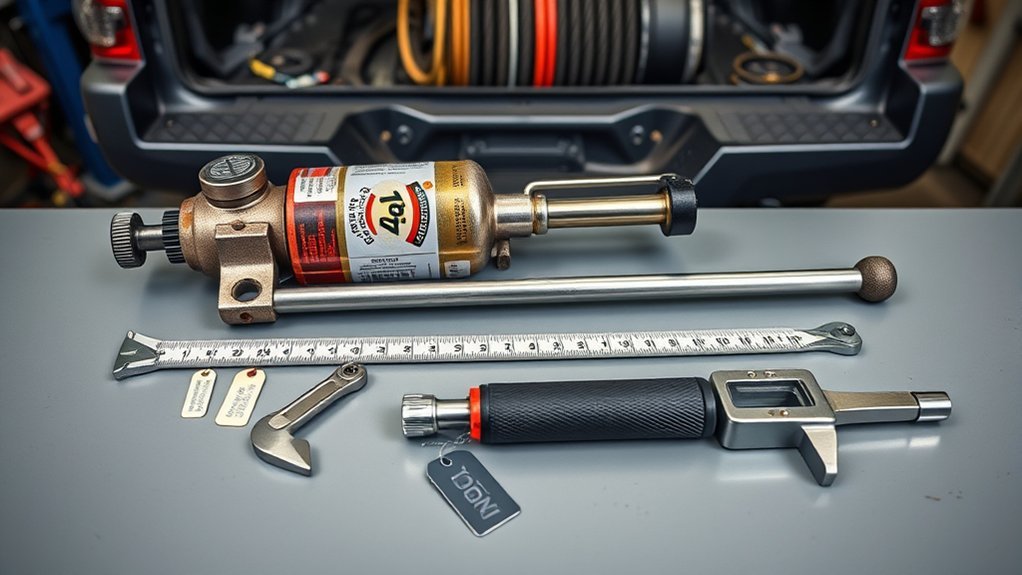
Replacement Toyota jack kits are not universal. Current Toyota-parts catalog listings show that even trucks from the same model year can use different tool numbers depending on cab, wheel, and equipment configuration. Treat the numbers below as catalog examples only and confirm the final application by VIN.
| Component | Catalog Examples | What to Verify |
|---|---|---|
| Jack assembly | 09111-AK010 appears in current Tacoma listings | VIN, generation, cab, jack type, collapsed height, and lift-point shape |
| Jack handle | 09115-0C030 appears in some Tacoma listings | Connection shape, length, number of sections, and storage fit |
| Lug wrench | 09150-0C040 and 09150-0C050 both appear in 2025 catalog listings for different configurations | Actual lug hex, wheel type, wheel clearance, cab/equipment configuration, and VIN |
| Extension section | 09114-0C040 appears in current Tacoma listings | End connections, total assembled length, and tool-kit application |
Confirm any Toyota service part through a VIN-based dealer or parts-catalog lookup. When buying a used kit, assemble it before purchase and make sure every section locks together correctly.
Portable Jacks That Fit Tacoma Lift Points and Flat-Tire Clearance
A portable jack must fit beneath the approved point when the tire is flat, not only when the truck is sitting at normal ride height. Measure the available height with the affected corner simulated as low as reasonably possible.
Bottle Jack Fitment
A bottle jack stores in a small space and can provide substantial lifting capacity. However, many bottle jacks have a tall minimum height and a small saddle or base. That combination may prevent safe positioning beneath a low axle or frame point after a tire loses all pressure.
Before buying one, verify:
- The rated capacity is sufficient for the load being lifted.
- The closed height fits below the approved point with a flat tire.
- The extension screw does not need to be overextended.
- The saddle contacts the lift point securely.
- The base remains flat and stable on the intended surface.
- The maximum height can raise the wheel far enough to install an inflated spare.
A hydraulic bottle jack should be stored upright when its manufacturer requires it. Inspect it for leakage and test it periodically. A mechanical jack avoids hydraulic fluid and seal concerns, but it still requires lubrication, inspection, and correct operation.
Floor Jack Portability
A compact floor jack offers a wide stance, controlled movement, and fast lifting on smooth, hard ground. A 3-ton model is a practical garage choice for many Tacoma owners because it provides useful capacity margin, but its dimensions remain critical.
Check the following:
- Minimum saddle height
- Maximum lift height
- Saddle diameter and shape
- Frame length and reach
- Jack weight and storage space
- Wheel size and ability to roll as the suspension moves
- Manufacturer instructions and inspection requirements
A floor jack needs to roll slightly while lifting. Do not use it on loose gravel, soft soil, or an uneven shoulder unless the manufacturer allows the setup and you have a stable, load-rated working surface.
Hi-Lift Clearance and Safety
A Hi-Lift-style farm jack is a specialized recovery, lifting, pulling, and clamping tool. It should not be treated as the default jack for an ordinary Tacoma wheel change.
Toyota states that the fourth-generation Tacoma has a high-lift jack point integrated into the rear frame end. That does not make every farm jack, nose, adapter, bumper, or slider compatible. Use only an attachment method approved for the vehicle and the specific jack.
The jack needs a compatible bumper, slider, wheel attachment, or recovery point that is specifically designed to accept its load. Factory body panels, rocker trim, unsupported seams, and ordinary bumpers may bend or allow the lifting nose to slip.
Use a Hi-Lift only when you have:
- A manufacturer-approved attachment point
- Training and practice with that exact setup
- A broad, stable base
- Enough vertical and side clearance
- A plan to secure the truck immediately after lifting
- No people within the handle’s travel or potential fall area
Keep your head and body out of the handle’s path. A loaded handle can move suddenly if the climbing mechanism changes position.
Recommended Jack Capacities: 2-Ton vs. 3-Ton vs. Bottle
A jack does not normally lift the entire truck at once, but its rating must still exceed the load placed on it. Capacity alone does not establish compatibility.
| Type | Typical Role | Main Limitation |
|---|---|---|
| 2-ton floor jack | May lift an approved Tacoma point when its rating and geometry are suitable | Less capacity margin and often less lift height than larger service jacks |
| 3-ton floor jack | Regular garage tire, brake, and maintenance preparation | Heavy and difficult to carry for roadside use |
| Bottle jack | Compact emergency or travel kit when its dimensions and saddle fit | Tall closed height and a smaller base or saddle |
| Factory emergency jack | Temporary wheel change at Toyota-designated points | Slow operation and unsuitable for supporting repair work |
| Hi-Lift-style jack | Specialized off-road recovery with compatible attachment points | High instability and injury risk when used incorrectly |
OSHA’s workplace jack rule requires a jack with sufficient capacity and requires a raised load to be secured after lifting. Although the rule governs workplaces, the same load-control principles are useful for home and roadside safety.
Essential Accessories: Adaptors, Bases, Handles, and Chocks
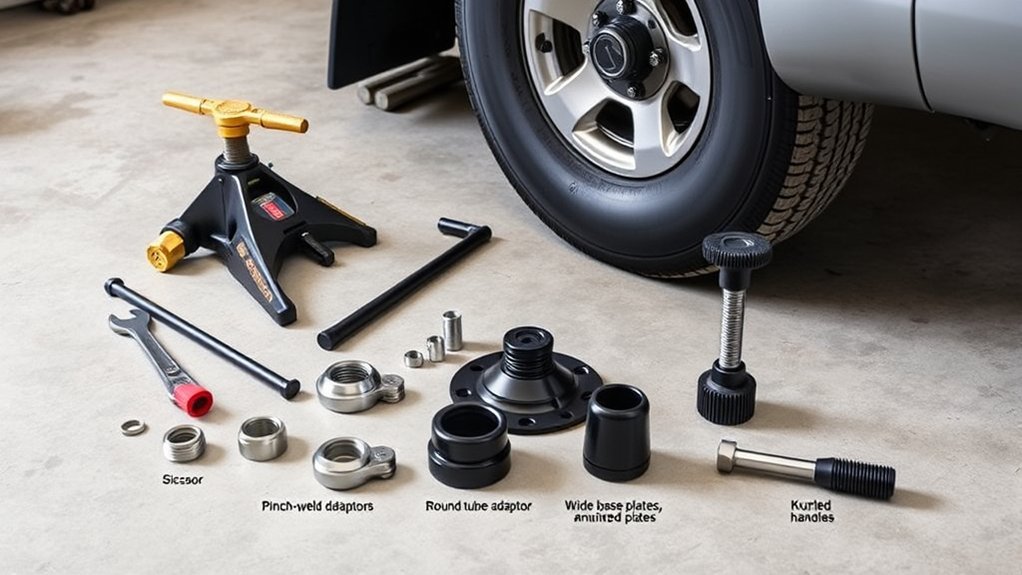
Accessories should improve contact and stability without changing the load path in an unapproved way. An adaptor must match both the jack saddle and the vehicle contact point.
Pinch-Weld Adaptor Uses
Do not assume that a Tacoma’s body seam is an approved lifting point. Use a pinch-weld adaptor only when the model-year manual, repair information, or accessory manufacturer identifies that exact seam as suitable for lifting.
A correct adaptor should:
- Fit the jack saddle securely
- Have a slot deep and wide enough for the intended contact point
- Keep the load centered
- Remain stable as the suspension moves
- Have a published load rating
- Show no cracking, bending, or severe wear
Tube or slider adaptors also require a structural rock slider or tube that its manufacturer approves for lifting. A cosmetic step bar is not automatically a jack point.
Handle and Base Options
A wide base plate can help keep a jack from sinking into a surface when the jack manufacturer permits that setup. Use a single solid plate with enough area and strength to spread the load, and keep it flat and centered beneath the jack.
Do not stack loose lumber, bricks, stones, pavers, or narrow scraps to create extra height. They can split, tilt, crush, or slide. Choose a jack with the correct lift range instead.
Other useful accessories include:
- Rated wheel chocks
- Reflective vest and warning triangles
- Work gloves and eye protection
- Flashlight or headlamp
- Torque wrench and correct socket
- Jack stands sized for the approved support points
- A secured bag for handle sections and wheel-lock keys
Safety Checklist: Lift Points, Jack Stands, and Roadside Setup
Stop and call for assistance when the truck is on a slope, soft shoulder, narrow roadway, blind corner, unstable ground, or any location where traffic cannot give you safe clearance.
- Move to safety: Pull as far from moving traffic as possible and turn on the hazard lights.
- Park securely: Select Park, or the manual-transmission position specified by your owner’s manual, set the parking brake, shut off the engine, and keep occupants away from traffic.
- Chock the wheels: Block the appropriate wheel or wheels as specified for the wheel-change procedure.
- Locate the approved point: Follow the diagram in the owner’s manual. Do not guess from a nearby frame bracket, skid plate, differential cover, seam, or suspension component.
- Loosen before lifting: Break each lug nut loose slightly while the tire remains on the ground.
- Position the jack: Center the saddle or factory jack head and make sure the base sits flat.
- Test contact: Raise the truck a small amount, pause, and check for shifting or tilting.
- Lift only as high as necessary: Raise the wheel enough to remove it and install the inflated spare.
- Use stands for repair work: Lower the vehicle onto rated stands at approved support locations before working around or beneath it.
- Keep people clear: No one should enter the truck, rock it, start it, or work beneath it while it is supported only by the jack.
For detailed model-year jack-point diagrams and lifting guidance, see Toyota Tacoma Jack Points: How to Lift It Safely.
The safest jack is not simply the one with the largest capacity. It must also fit beneath a flat-tire lift point, contact the truck correctly, remain stable on the surface, and provide enough controlled lift.
How to Change a Tacoma Wheel Safely
- Read the flat-tire section of your model-year Tacoma manual before beginning.
- Remove the spare, jack, handle, lug wrench, and wheel-lock key if equipped.
- Check that the spare is correctly inflated and usable.
- Remove any wheel cover as instructed by Toyota.
- Loosen the lug nuts slightly while the tire is still touching the ground.
- Position the jack at the exact point shown in the manual.
- Raise the truck only until the flat tire clears the ground enough to install the spare.
- Remove the lug nuts and wheel. Keep the lug nuts clean.
- Install the spare and start each lug nut by hand to prevent cross-threading.
- Snug the nuts gradually in the sequence shown in the owner’s manual.
- Lower the truck as directed so the tire is positioned for final tightening.
- Tighten the lug nuts in the specified sequence with a torque wrench set to the value listed for your exact model year and wheel. For the 2024 Tacoma, Toyota specifies 154 ft-lbf for steel wheels and 97 ft-lbf for aluminum wheels.
- Lower the truck fully, remove the jack, and perform any post-installation torque check required by your model-year manual.
- Store the flat tire and tools securely.
- Follow the speed, distance, pressure, and repair restrictions listed for the spare tire.
For the separate spare-hoist procedure, see How to Lower the Spare Tire on a Toyota Tacoma.
Note: Do not apply oil, grease, or anti-seize to the wheel studs, wheel bolts, or lug-nut seats unless Toyota or the wheel manufacturer specifically instructs you to do so. Lubrication can change the clamping force produced by a given torque setting.
Buying Guide: Choosing a Jack and Lug Tool
Ignore temporary discounts and choose equipment by fit, rating, construction, and intended use.
For the Factory Roadside Kit
- Buy a Toyota kit or replacement verified by VIN and configuration.
- Confirm that all handle and extension pieces are included.
- Check that the lug wrench fits the actual lug nuts.
- Make sure the jack contacts the approved lift point correctly.
- Verify that the assembled kit fits its intended storage location.
For Garage Maintenance
- Choose a floor jack with sufficient rated capacity.
- Confirm that it reaches the central or individual lift points specified for the task.
- Check maximum lift height for lifted Tacomas or oversized tires.
- Use jack stands with saddles that fit the approved support locations.
- Look for clear load labels, instructions, replacement parts, and manufacturer support.
- Consider equipment designed to the current ASME PASE-2024 safety standard for portable automotive service equipment.
For Lifted or Modified Tacomas
A suspension lift, body lift, larger tires, skid plates, aftermarket bumpers, or rock sliders can change the required jack height and access angle. Measure the modified truck instead of relying on stock specifications.
You may need:
- A taller service jack
- An approved saddle extension
- Taller rated jack stands
- A wheel-lift or axle-lift strategy specified by the equipment manufacturer
- A dedicated off-road recovery jack with engineered attachment points
Do not use an unapproved homemade extension between the jack and truck.
Verify Fit: Measure Clearances and Confirm Compatibility
Measure before ordering a replacement jack or tool:
- Record the model year and VIN: Use them for manual and parts searches.
- Identify the wheels: Note whether the truck has factory or aftermarket wheels and lug nuts.
- Measure the lug hex: Confirm with a properly fitting socket, not only a ruler.
- Find the lowest approved lift point: Estimate its height when the corresponding tire is flat.
- Check required lift: An inflated spare may need more clearance than the flat wheel.
- Measure the contact point: Compare its shape and width with the jack saddle or adaptor.
- Check the jack label: Verify capacity, operating range, and manufacturer instructions.
- Test the storage location: Secure all tools so they cannot move inside the cab or bed.
Perform a controlled test on firm, level ground before a long trip. You do not need to remove the wheel. Confirm only that the jack reaches the correct point, remains stable, and begins lifting without slipping or damaging nearby components.
Related Guides
Frequently Asked Questions
Do Toyota Tacomas have a jack?
Tacomas equipped with a spare-tire system normally include or specify an emergency jack and related tools. Equipment and storage can vary by model year, cab, market, and package. Check the storage diagram in your owner’s manual and confirm that every required handle section, wrench, and key is present.
Where should you place a jack under a Toyota Tacoma?
Place it only at the lifting point shown for your exact model year and the type of lift you are performing. Roadside wheel-change points may differ from service-jack or jack-stand locations. Do not guess based on a nearby frame bracket, skid plate, body seam, differential cover, or suspension component.
Where is the jack in a 2025 Toyota Tacoma?
The jack and tool storage arrangement depends on seating and cab configuration, so use the 2025 owner’s-manual diagram for the exact truck rather than assuming one compartment location. Confirm that the jack, tool bag, handle sections, lug wrench, and wheel-lock key if equipped are all present before a trip.
What size lug wrench does a Toyota Tacoma use?
A 21 mm six-point socket fits many Tacoma factory lug nuts, but test it on the actual truck. Aftermarket lug nuts, decorative caps, wheel locks, damaged caps, and generation changes may require another socket or key. The socket should seat fully with minimal movement.
Is a 2-ton jack enough for a Tacoma?
A properly rated 2-ton jack may lift an approved point on some Tacoma configurations, but capacity alone does not make it suitable. Check the load rating, minimum height, maximum lift, reach, saddle shape, condition, and manufacturer instructions. A 3-ton floor jack usually provides more useful capacity margin for regular garage work.
What is the Toyota Tacoma wheel-nut torque?
Torque depends on the model year and wheel. As a verified example, Toyota specifies 154 ft-lbf (209 N·m) for steel wheels and 97 ft-lbf (131 N·m) for aluminum wheels on the 2024 Tacoma. Do not apply those numbers to another Tacoma or aftermarket wheel without checking its manual or wheel instructions.
Can you use a 7/8-inch or 13/16-inch socket instead of 21 mm?
Neither size is exactly 21 mm. A 13/16-inch socket measures 20.6375 mm, while 7/8 inch measures 22.225 mm. Use the correctly fitting socket that seats fully on the actual lug nut without excessive movement or force.
Conclusion
A 21 mm six-point socket is a sensible tool to test on many Toyota Tacoma lug nuts, but it is not a universal guarantee. Neither 7/8 inch nor 13/16 inch is an exact 21 mm replacement. Verify the actual lug hardware, wheel-lock key, torque specification, factory-jack equipment, and lifting points for your exact model year and wheels.
For roadside use, keep a complete factory-compatible kit and inspect it before a long trip. Check the spare’s cold pressure at least monthly. For garage work, a well-built 3-ton floor jack and matching stands provide a practical setup when their height, saddle, reach, and support locations fit your Tacoma. Use a jack only for lifting, secure the truck before repair work, and call for assistance whenever traffic or ground conditions make a wheel change unsafe.
Sources
- Toyota 2025 Tacoma Manuals and Warranties – model-year manual access and vehicle-specific procedures
- Toyota 2024 Tacoma Manuals and Warranties – fourth-generation wheel torque and model-specific procedures
- Toyota USA Newsroom: 2025 Tacoma – fourth-generation chassis and integrated high-lift jack-point information
- 2025 Tacoma OEM Tool Catalog Example – configuration-dependent jack and lug-wrench catalog references
- OSHA 29 CFR 1910.244 – jack load ratings, foundations, load securing, inspection, and maintenance
- ASME PASE-2024 – current safety standard for portable automotive service equipment
- NHTSA TireWise – monthly tire-pressure checks, including the spare, and tire-maintenance guidance
