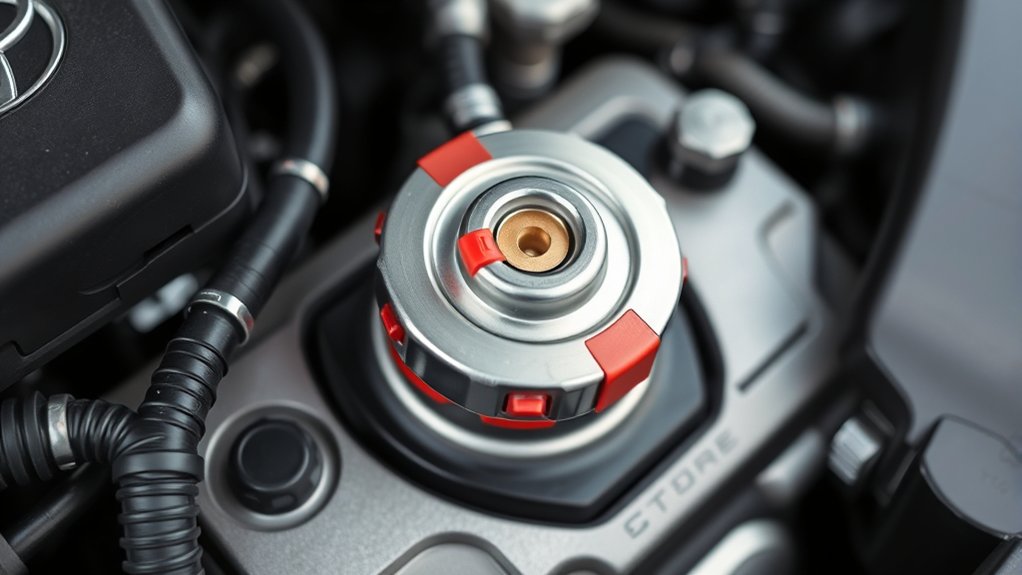
A discharged 12-volt battery can prevent a Toyota Camry from unlocking, cranking, or entering READY mode. The safe jump-start procedure depends on the model year and whether the Camry is conventional or hybrid. Confirm the illustrated connection points in your Toyota owner’s manual before attaching a clamp.
Quick Answer
Connect red to the Camry’s positive battery post or designated jump terminal, red to donor positive, black to donor negative, and black to the Camry’s specified ground point last. Start the donor, then start the Camry or confirm READY on a hybrid. Remove all four clamps in the exact reverse order.
Key Takeaways
- Do not assume every Camry has the same battery or jump-terminal location; check the manual for the exact model year and powertrain.
- The final connection is the black clamp on the discharged Camry’s designated ground point—not the donor battery.
- A Camry Hybrid has started when the READY indicator illuminates, even if its gasoline engine is not running.
- Jump-start only the 12-volt system. Never attach clamps to orange hybrid cables or high-voltage components.
- After a successful jump, arrange a proper battery and charging-system test instead of relying on voltage or an immediate restart alone.
At a Glance
| Time Required | About 10–20 minutes, depending on access and how discharged the battery is |
| Difficulty | Beginner, provided the correct positive terminal and ground point are clearly identified |
| Tools Needed | Safety glasses, insulated jumper cables and a 12-volt donor vehicle, or a compatible 12-volt jump pack |
| Cost | No added cost if suitable equipment is already available; otherwise the cost of a jump pack or roadside service varies |
Warning: Do not attempt a jump if the battery is cracked, leaking, swollen, frozen, smoking, or giving off a strong sulfur or rotten-egg odor. Keep flames, cigarettes, sparks, jewelry, and metal tools away from the battery. Wear eye protection and call roadside assistance whenever the correct terminals cannot be positively identified.
Steps to Jump-Start Your Toyota Camry
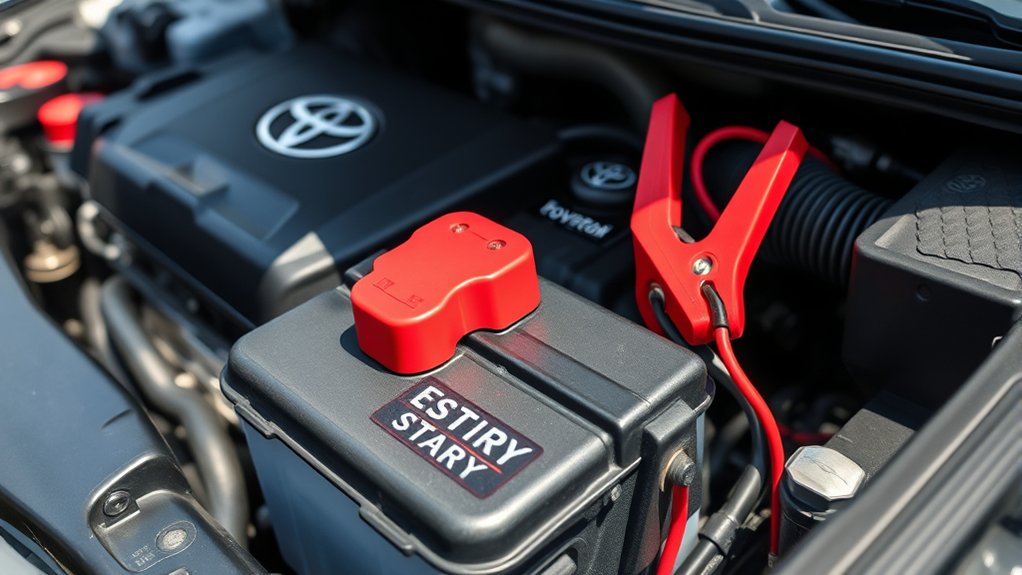
Before touching the cables, identify which arrangement your Camry uses:
- Conventional gasoline Camry: Many models use the positive terminal on the under-hood 12-volt battery and a separate ground point shown in the manual.
- Many newer Camry Hybrid models: The positive jump-start terminal is commonly beneath a small cover inside an under-hood fuse or relay box. The actual 12-volt battery may be mounted elsewhere.
- Some older Camry Hybrid models: Toyota manuals may direct the owner to a trunk-mounted 12-volt battery or another model-specific connection point.
The procedure below applies once the correct positive point and ground point have been confirmed:
- Park both vehicles on firm, level ground with enough room for the cables to reach without stretching. Do not let the vehicles touch.
- Shift both vehicles to Park, set both parking brakes, and switch off the ignition, lights, climate control, audio system, chargers, and other accessories.
- Inspect the battery, jump points, clamps, and cable insulation. Stop if anything is damaged, leaking, excessively corroded, or unusually hot.
- Connect the red clamp to the Camry’s positive battery terminal or designated positive jump terminal.
- Connect the other red clamp to the donor battery’s positive terminal.
- Connect the black clamp to the donor battery’s negative terminal.
- Connect the remaining black clamp to the solid, stationary ground point specified for the Camry. Keep it away from the battery, cooling fans, belts, and other moving parts.
- Start the donor vehicle. Follow the model-specific Toyota instructions; some manuals direct the donor engine to run at a slightly elevated speed for about five minutes before starting the Camry.
- Start a conventional Camry normally. For a Camry Hybrid, press the brake pedal and POWER switch, then verify that the READY indicator illuminates.
- Once the Camry has started or entered READY mode, remove the clamps in the exact reverse sequence.
Remember the four connections in order: Camry positive, donor positive, donor negative, Camry ground.
How to Access the Jump-Start Terminal
If the discharged battery prevents normal electronic unlocking, remove the mechanical key from the key fob and use it to unlock the driver’s door. The mechanical key is not required when the electronic locks still operate.
Pull the interior hood-release lever, release the secondary hood latch, and support the hood correctly. Consult the engine-compartment illustration in the owner’s manual before opening a fuse-box cover or attaching a clamp.
Conventional Camry Models
Locate the under-hood 12-volt battery. The positive terminal is marked with a plus sign and may be protected by a red or plastic cover. Do not assume that the battery’s negative post is the correct final connection point; use the separate ground location illustrated by Toyota.
Camry Hybrid Models
Many newer hybrids have an exclusive positive jump terminal under a small cover in the engine-compartment fuse box. Lift only the identified terminal cover. Do not probe other fuse-box studs, connectors, relays, or terminals.
Older hybrid arrangements can differ, including procedures that require trunk access. The high-voltage traction battery is not being jump-started. According to the National Highway Traffic Safety Administration, the jump procedure applies to the low-voltage 12-volt system, not the hybrid high-voltage battery.
Note: Never connect a jumper clamp to an orange cable, orange connector, traction-battery component, inverter housing terminal, or an unidentified fuse-box stud.
Get Your Car Ready for a Jump Start
Complete these checks before connecting either cable:
- Confirm that the donor vehicle or jump pack supplies the compatible 12-volt output required by the Camry.
- Read the donor vehicle’s manual before using it as a power source.
- Make sure both vehicles are in Park with the parking brakes applied.
- Keep the vehicles from touching each other.
- Turn off all electrical accessories in the Camry and donor vehicle.
- Remove loose jewelry and keep clothing, hands, clamps, and cables away from fans and drive belts.
- Verify the plus and minus markings instead of relying only on cable or cover colors.
- Keep the smart key outside the engine compartment and somewhere it cannot become locked inside the vehicle.
Lead-acid batteries can release flammable hydrogen and contain corrosive sulfuric acid. The Canadian Centre for Occupational Health and Safety recommends appropriate eye protection, careful handling, ventilation, and strict control of sparks and flames around automotive batteries.
Pro Tip: Photograph the owner’s-manual diagram or keep it open on your phone before beginning. The recommended ground can resemble an ordinary bolt, so the diagram is safer than guessing.
How to Connect Jumper Cables Safely
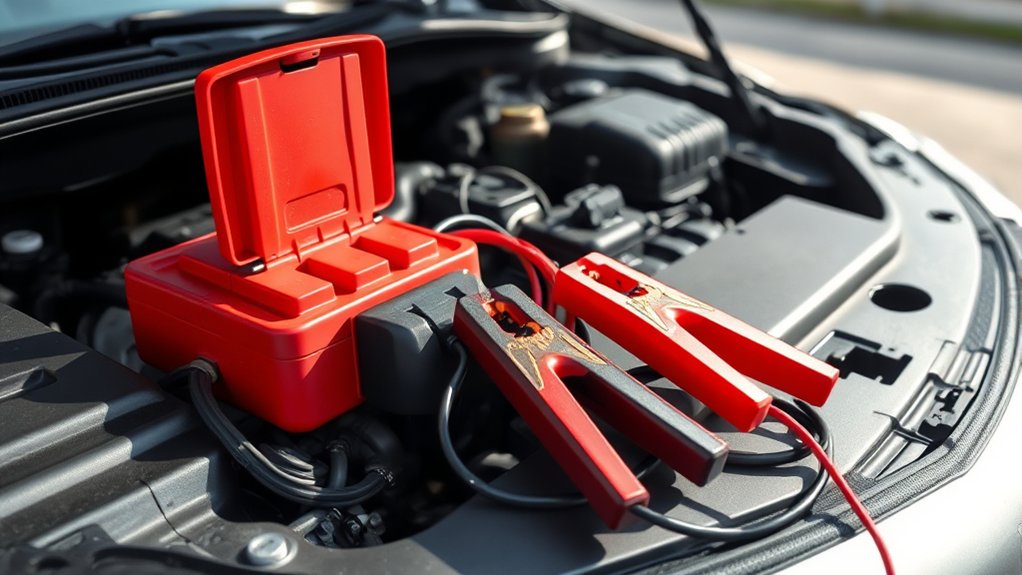
Using a Donor Vehicle and Jumper Cables
- Red to Camry positive: Attach one red clamp to the Camry’s marked positive battery terminal or exclusive jump-start terminal.
- Red to donor positive: Attach the other red clamp to the donor battery’s positive terminal.
- Black to donor negative: Attach one black clamp to the donor battery’s negative terminal.
- Black to Camry ground: Attach the final black clamp to the solid ground point specified in the Camry manual.
Make each connection firmly. Keep the unused clamps separated, and never allow the red and black clamps to touch while either end is connected.
Using a Portable Jump Pack
Read the jump pack’s instructions because activation and safety-lockout procedures differ among products. With the pack switched off, connect its red clamp to the Camry’s positive jump point and its black clamp to the specified Camry ground point. Activate the pack only as directed by its manufacturer, start the Camry, and then deactivate and disconnect the pack in the instructed order.
Do not bypass a reverse-polarity, temperature, or low-voltage warning displayed by the jump pack. Recheck the terminal markings and ground connection instead.
Steps to Start Your Toyota Camry After Jumping
Confirm Battery Status First
A discharged 12-volt battery is likely when the lights are dim, the starter cranks slowly, rapid clicking occurs, or the electronic locks and displays do not operate. These signs are not conclusive, however. Loose terminals, corroded connections, starter faults, blown fuses, or other electrical problems can produce similar symptoms.
Do not repeatedly crank a conventional Camry for long periods. If one or two brief attempts fail, stop and check the clamp contact, ground point, donor source, and owner’s-manual instructions.
Start a Conventional Camry
Start the donor vehicle and allow the connection time specified in the Camry manual. Then start the Camry normally. Do not race either engine or allow a cable to approach the cooling fans or belt while the engines are operating.
Start a Camry Hybrid
With the donor source connected, sit in the driver’s seat, press and hold the brake pedal, and press the POWER switch. Confirm that the READY indicator appears. The gasoline engine may remain off, which is normal. The vehicle can move whenever READY is illuminated, so leave the selector in Park and keep the parking brake applied.
If READY does not illuminate, switch the power off. Some Toyota hybrid procedures instruct the owner to open and close a door before trying again. Follow the exact recovery steps in the model-year manual rather than repeatedly pressing the POWER switch.
Reverse Connections Safely
Once the conventional engine is running or the hybrid READY indicator is on, remove the cables in the exact reverse order:
- Remove the black clamp from the Camry’s ground point.
- Remove the black clamp from the donor battery’s negative terminal.
- Remove the red clamp from the donor battery’s positive terminal.
- Remove the red clamp from the Camry’s positive terminal or jump-start terminal.
Keep the clamps from touching one another or any metal surface during removal.
Final Steps After a Jump Start
Close the positive terminal cover and reinstall the fuse-box or battery cover securely. If the hood uses a prop rod, support the hood, return the rod to its retaining clip, and then lower the hood gently until it latches.
Do not immediately switch the Camry off merely to test whether it will restart. A battery that was deeply discharged may not have recovered enough energy. Keep a conventional Camry running or a hybrid in READY while you move to a safe location and arrange a battery and charging-system inspection.
A jump start restores enough power to start the vehicle; it does not explain why the battery discharged. Common causes include an aging battery, lights or accessories left on, loose or corroded terminals, a conventional charging-system fault, or an electrical draw while the vehicle is parked.
Note: A single voltage reading is not a complete battery-health test. A battery may show plausible open-circuit voltage yet fail under starting load. Have it tested with suitable battery-testing equipment.
Troubleshooting a Failed Jump Start
| Symptom | What to Check |
|---|---|
| No lights or displays | Confirm that the donor source is charged, the clamps contact clean metal, polarity is correct, and the Camry’s battery connections are not loose. |
| Rapid clicking | Recheck all four clamp connections, especially the Camry ground. The cables or donor source may not be supplying enough current. |
| One solid click but no crank | A starter, relay, cable, terminal, or mechanical fault may be present. Stop repeated attempts and seek diagnosis. |
| Hybrid displays turn on but READY does not appear | Verify Park, press the brake firmly, power the vehicle off, follow the door-open-and-close recovery procedure in the manual if specified, and try once more. |
| Vehicle starts and then stalls or loses electrical power | The battery connection or charging system may be faulty. Move only if it is safe and arrange professional assistance. |
| Jump pack shows an error | Switch it off and check polarity, clamp contact, pack charge, temperature, and its manufacturer’s instructions. Do not override a safety warning. |
| Smoke, hot cables, melting insulation, or severe sparking | Stop immediately. Turn off the donor source if this can be done safely, move away from the battery, and call roadside assistance or emergency services if fire develops. |
A multimeter can help confirm that the battery is discharged, but resting voltage alone cannot determine whether the battery is serviceable. A meaningful diagnosis may require the battery to be charged and then tested under load or with a conductance tester.
Frequently Asked Questions
Where do jumper cables go on a Toyota Camry?
Connect red to the Camry’s marked positive battery terminal or exclusive positive jump terminal, red to donor positive, black to donor negative, and black to the Camry’s designated ground point last. Confirm the exact Camry terminal and ground locations in the model-year owner’s manual.
Is the Toyota Camry jump-start terminal always inside the fuse box?
No. Many newer Camry Hybrid models use an exclusive positive terminal in an under-hood fuse box, but conventional Camrys may use the positive post on the under-hood battery. Some older hybrid procedures use a trunk-mounted battery or another model-specific point.
How do I use jumper cables on a 2020 Toyota Camry?
First confirm whether the 2020 Camry is conventional or hybrid and use the connection-point illustration in its owner’s manual. Once identified, use the standard Toyota order: Camry positive, donor positive, donor negative, and Camry ground. A hybrid is successfully started when READY illuminates.
How do I open a Toyota Camry when its battery is dead?
Remove the mechanical key from the key fob and use it in the driver’s-door lock cylinder. Once inside, pull the hood-release lever. Mechanical lock details can vary, so consult the key and door-lock section of the owner’s manual.
Can I connect the black clamp to the Camry battery’s negative post?
Use the ground point illustrated by Toyota unless the owner’s manual explicitly directs otherwise. Making the final connection at the designated ground keeps the likely connection spark away from the discharged battery.
Why will my Camry not start even with a jump?
Possible causes include poor clamp contact, an uncharged or undersized jump source, loose battery terminals, a failed battery, a starter or fuse fault, a charging-system problem, or a hybrid-system condition. Stop if the cables heat up or the correct points cannot be identified.
Conclusion
Using a Toyota Camry jump-start terminal safely depends on identifying the correct model-specific positive point and ground before making any connection. Remember the order: Camry positive, donor positive, donor negative, and Camry ground. Remove the clamps in reverse, confirm READY on a hybrid, and have the battery and charging system tested if the discharge was unexplained or happens again.
Sources
- Toyota Canada Owner’s Manuals and Emergency Response Guides — model-year-specific Camry and Camry Hybrid instructions.
- Toyota Camry Hybrid Owner’s Manual — exclusive jump-terminal access, cable sequence, hybrid startup, and READY confirmation.
- Toyota Camry Owner’s Manual — conventional Camry battery connection points, cable order, and disconnection procedure.
- Toyota Camry Hybrid Owner’s Manual for an Earlier Generation — demonstrates that battery access and jump locations vary by generation.
- NHTSA Electric and Hybrid Vehicle Safety — explains that the high-voltage battery is not jump-started and the 12-volt system may be boosted according to the owner’s manual.
- Canadian Centre for Occupational Health and Safety: Lead-Acid Batteries — battery acid, hydrogen-gas, ventilation, eye-protection, and spark precautions.
