
A flat tire can turn a routine drive into a stressful roadside stop, but a careful process can keep the situation controlled. Before touching the jack, move your Toyota Camry to firm, level ground away from traffic, switch on the hazard lights, and use the owner’s manual for the exact equipment, lifting points, spare-tire limits, and wheel-nut torque for your model year.
Quick Answer
Park on firm, level ground away from traffic, activate the hazards, apply the parking brake, and secure the vehicle as the manual directs. Loosen the lug nuts before lifting at the approved jack point. Install the spare, hand-start the nuts, lower the car, and tighten them in a star pattern to the exact specification.
Key Takeaways
- Do not change a tire where traffic, soft ground, poor visibility, flooding, ice, or severe weather makes the work area unsafe.
- Use only the jack points, equipment, spare-tire restrictions, and wheel-nut torque listed for your exact Camry.
- Loosen the nuts while the tire is grounded, but remove them only after the vehicle is securely lifted.
- Start every lug nut by hand; keep the threads clean and dry unless Toyota specifically directs otherwise.
- Treat a compact spare or mobility-kit repair as temporary and arrange proper tire service promptly.
At a Glance
| Time Required | Often 20–30 minutes when the location is safe and the spare, tools, and lug nuts are usable |
| Difficulty | Beginner to intermediate; roadside conditions can make the job unsafe regardless of skill |
| Tools Needed | Compatible spare, factory jack and handle, lug wrench, owner’s manual, pressure gauge, wheel chocks, and torque wrench; a wheel-lock key may also be required |
| Cost | Usually no immediate parts cost when usable factory equipment is onboard; roadside assistance and tire repair or replacement may cost extra |
Last updated: July 13, 2026.
Check Your Camry’s Tire Equipment Before an Emergency
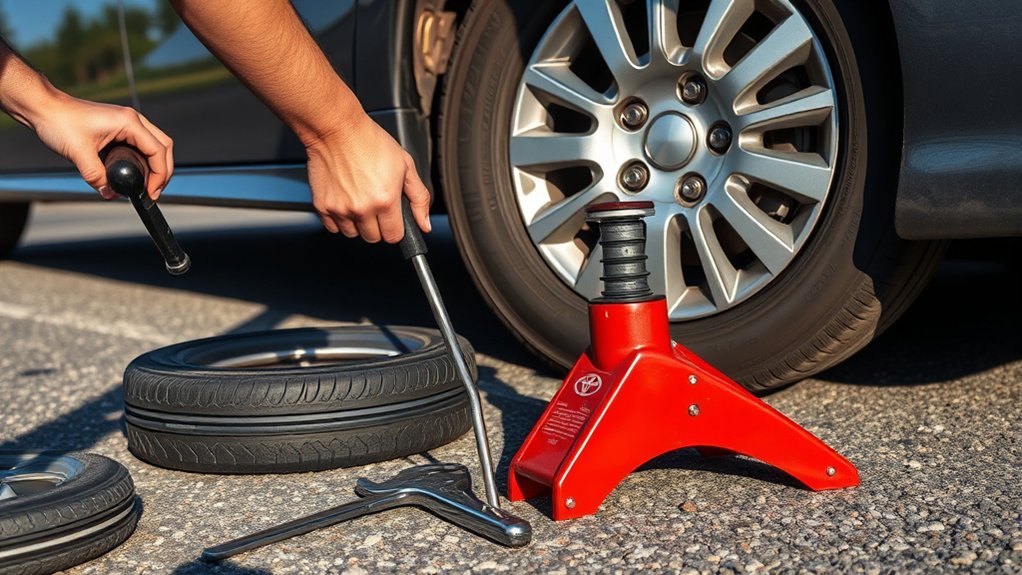
Knowing how to change a tire can keep a manageable roadside problem from becoming a long delay. The most important skill is not speed. It is knowing when the location is safe, where the approved jack point is, and when the situation requires professional help.
Camry equipment varies by model year, trim, wheel package, and market. Before an emergency, inspect the trunk and review the Toyota Camry manuals and warranties page for your vehicle. Confirm whether it has a spare wheel, factory jack, lug wrench, wheel-lock key, tire mobility kit, or another emergency tire system.
If the Tire Fails While You’re Driving
A rapid loss of tire pressure may cause pulling, vibration, noise, or heavy steering. The National Highway Traffic Safety Administration advises drivers to keep the vehicle balanced and controllable, avoid overreacting, release the accelerator gradually, and pull off the road only when it is safe.
- Hold the steering wheel firmly with both hands.
- Look where you want the vehicle to go and steer smoothly.
- Do not slam on the brakes or abruptly lift off the accelerator.
- Release the accelerator gradually and let the vehicle slow under control.
- Move to firm, level ground as far from traffic as reasonably possible.
- Stop, shift into Park, apply the parking brake, and activate the hazard lights.
Safety First: Prepare the Camry and Work Area
Park on firm, level pavement away from moving traffic. Switch off the vehicle, keep the hazards on, and remove the key or keep the smart key away from the car. Ask passengers to leave from the side away from traffic and wait in a protected location when doing so is safer than remaining in the vehicle.
Secure the vehicle exactly as the owner’s manual directs. If the manual calls for a wheel block or chock, place it in the specified position. When no more specific instruction is available, chocking the wheel diagonally opposite the flat can help resist movement on level ground; use chocks on both sides of that tire when possible.
Warning: Do not attempt the tire change on a narrow shoulder, slope, soft ground, ice, floodwater, loose gravel, or an area exposed to fast traffic. Never place any part of your body beneath a vehicle supported only by its emergency jack. Move to a safer location or call for assistance.
Roadside coverage may be available through insurance, an automobile club, a warranty, or an active Toyota plan. Toyota advises owners to confirm plan details and exclusions through the ToyotaCare and maintenance plans page rather than assuming coverage is active.
Collect the Tools and Identify the Spare System
Open the trunk and compare the available equipment with the diagram in your model-year manual. Do not assume that every Camry carries the same tools or even a spare tire.
Essential Tools
- Compatible spare wheel and tire: Confirm that it is intended for the vehicle and has no cracks, cuts, bulges, exposed cords, or obvious air loss.
- Factory jack and handle: Use them only at the approved lifting points and only as the manual describes.
- Lug wrench: Confirm that it fully fits the installed wheel nuts.
- Wheel-lock key: Some wheel sets use one locking nut that requires a matching adapter.
- Owner’s manual: Use its exact jack-point, spare-position, pressure, and torque instructions.
Helpful Roadside Items
- Two sturdy wheel chocks
- An accurate tire-pressure gauge
- A calibrated torque wrench and correct socket
- Work gloves, a flashlight, and a reflective vest
- A charged phone and emergency contact information
- A rain jacket or poncho
- A portable inflator approved for automotive tires
If Your Camry Has No Spare Tire
Some configurations may use a tire mobility kit instead of a spare. Follow that kit’s instructions exactly. Sealant and inflator kits generally cannot make every puncture safe to drive on, especially when the sidewall is torn, the wheel is damaged, the tire has separated from the rim, or the tire lost pressure after being driven flat. Call roadside assistance when the damage is outside the kit’s stated limits.
Pro Tip: Check the pressure of all road tires and the spare at least monthly when cold. NHTSA defines a cold tire as one that has not been driven for at least three hours. Use the vehicle label, spare label, or owner’s manual—not the maximum pressure molded on a regular tire’s sidewall.
How to Safely Lift Your Toyota Camry
Correct jack placement is essential. The factory manual identifies reinforced lifting points near the wheels. Do not place the jack beneath thin floor metal, plastic trim, suspension links, the engine, the battery enclosure, or another convenient-looking surface.
- Confirm that the transmission is in Park, the parking brake is applied, and the vehicle is secured as the manual directs.
- Remove the wheel cover if fitted, using the method shown in the manual to avoid damage.
- Fit the lug wrench fully onto each nut and loosen every nut about one-quarter turn counterclockwise. Do not remove them yet.
- Locate the exact jack point beside the flat tire using the manual’s illustration.
- Place the jack upright on firm, level pavement and engage its saddle securely with the designated point.
- Raise the vehicle slowly while watching for leaning, slipping, sinking, or movement.
- Stop lifting as soon as the flat tire clears the ground enough to be removed and the spare can be installed.
Note: Do not use a brick, loose stone, ordinary wood scrap, or another improvised object to compensate for soft or uneven ground. If the jack cannot sit securely on a suitable surface or begins to tilt or sink, lower the vehicle if it is safe to do so and stop.
Loosen and Tighten Camry Lug Nuts Correctly

Loosen the nuts while the tire still touches the ground because the vehicle’s weight helps keep the wheel from rotating. During installation, start each nut by hand before using a wrench. This reduces the chance of cross-threading a nut or damaging a wheel stud.
| Phase | Correct Method | Reason |
|---|---|---|
| Before lifting | Loosen each nut slightly without removing it | Keeps the wheel from spinning while force is applied |
| Initial installation | Start every nut by hand and snug them in a star pattern | Helps seat the wheel evenly and reduces cross-threading risk |
| Final tightening | Use a torque wrench in a star pattern at the manual-listed specification | Applies controlled, even clamping force |
Keep the wheel studs, nut seats, and threads free of dirt. Do not apply oil, grease, or anti-seize unless Toyota specifically requires it for that exact wheel and fastener system, because lubrication changes the relationship between torque and clamping force. Do not stand, jump, or bounce on the wrench, and do not guess torque from a general Toyota range.
Remove the Flat Tire Safely
Once the vehicle is stable and the flat tire is clear of the ground, remove the loosened nuts completely. Store them together in a clean, visible place so dirt does not enter the threads and no nut rolls toward traffic.
Raise the Camry only high enough to remove the damaged tire and install the spare. Extra lifting reduces stability without improving the repair.
- Support the wheel with both hands and pull it straight toward you.
- Keep fingers and feet away from pinch points between the wheel, hub, and ground.
- Place the damaged wheel flat in a safe location where it cannot roll.
- Inspect the studs, nuts, wheel seat, and visible hub area for obvious damage.
- Wipe away loose dirt that would prevent the spare from sitting flush; do not grind, hammer, or aggressively clean parts while the car is on the emergency jack.
If the wheel is seized to the hub, a stud is damaged, or a nut is rounded, stripped, or cross-threaded, do not use violent force while the car is supported by the roadside jack. Reinstall any removable nuts if possible, lower the vehicle carefully, and request professional help.
Install the Spare Tire and Secure the Wheel
Before installation, confirm that the spare is intended for your Camry, has no visible damage, and is inflated to the value on its label or in the owner’s manual. Also check whether the manual limits the spare to a particular axle or requires any wheel-position swap.
- Lift the spare with both hands and align its holes with the wheel studs.
- Slide the wheel straight onto the hub until it sits flush.
- Install every lug nut by hand with the specified side facing the wheel.
- Turn each nut several full rotations by hand. Stop if a nut binds or will not thread smoothly.
- Snug the nuts gradually in a star pattern.
- Lower the vehicle according to the manual’s sequence. Many procedures call for the tire to touch the ground enough to resist rotation before final tightening.
- Tighten the nuts in a star pattern with a calibrated torque wrench set to the exact Camry specification.
- Lower the vehicle fully, remove the jack, and verify the nuts once more in the same pattern.
Note: A temporary spare may have strict speed, distance, load, placement, and pressure limits. Follow the label on the spare and the instructions for your exact Camry. Do not rely on a universal speed or distance quoted for other vehicles.
What to Do After Changing a Camry Tire

Do not drive away immediately after lowering the car. Complete a final walk-around and confirm that the spare sits flush, the nuts are secure, and no tools remain beneath or beside the vehicle.
| Action | What to Do |
|---|---|
| Check pressure | Use a gauge and compare the reading with the spare label or owner’s manual. |
| Follow restrictions | Observe every speed, distance, load, and placement restriction for the installed spare. |
| Verify torque | Have the wheel nuts checked with a calibrated torque wrench promptly if final roadside torque could not be confirmed. |
| Watch for symptoms | Stop safely if you notice looseness, severe vibration, pulling, scraping, or unusual noise. |
| Arrange service | Have the damaged tire and wheel inspected promptly; repair or replace them only after a qualified technician evaluates the damage. |
| Stow equipment | Secure the flat tire, jack, wrench, wheel cover, and other tools so they cannot move inside the vehicle. |
The tire-pressure warning light may remain on until the system recognizes acceptable pressure, is reset as specified, or receives service. Some temporary spares may not be monitored in the same way as the regular tires. NHTSA stresses that TPMS is not a substitute for checking pressure with an accurate gauge.
Top Mistakes to Avoid When Changing a Camry Tire
- Working in an unsafe location: Passing traffic, a soft shoulder, a slope, or poor visibility can make a correct mechanical procedure dangerous.
- Skipping vehicle securement: The Camry can move as force is applied to the wrench or jack.
- Using the wrong jack point: Lifting beneath an unreinforced area can damage the car or allow the jack to slip.
- Removing the nuts before lifting: The wheel should remain retained until the vehicle is securely raised.
- Cross-threading or lubricating fasteners: Nuts should start smoothly by hand on clean threads, and lubricant should not be added unless Toyota directs it.
- Guessing wheel-nut torque: Body weight and general torque ranges do not replace the exact specification and a torque wrench.
- Treating the spare as permanent: A temporary spare or sealant repair may have strict operating limits and requires prompt follow-up service.
When to Call Roadside Assistance or a Tire Professional
Call for assistance instead of continuing when the environment, equipment, or vehicle condition prevents a controlled tire change. Professional help is appropriate when:
- The vehicle cannot be moved well away from traffic.
- The ground is sloped, soft, icy, flooded, loose, or unstable.
- The spare is flat, damaged, missing, or incompatible.
- The jack, handle, wrench, or wheel-lock key is missing.
- A lug nut is seized, rounded, cross-threaded, or stripped.
- The jack tilts, slips, sinks, or will not engage the approved lifting point.
- A wheel stud, hub, brake component, wheel, or tire appears damaged.
- The tire has sidewall damage, exposed cords, a large opening, or has separated from the rim.
- The vehicle vibrates, pulls, scrapes, or makes unusual noises after installation.
- You cannot confirm that the wheel is seated and the lug nuts are secure.
Do not attempt a plug, sealant repair, or reinflation when the product instructions or vehicle manual do not permit it. A roadside repair can hide internal damage caused by driving on an underinflated or flat tire, so the tire should still be inspected professionally.
Prepare Before Your Next Flat Tire
A few monthly checks can prevent common roadside surprises:
- Measure the cold pressure of all road tires and the spare.
- Inspect the spare for cracking, cuts, bulges, corrosion, and age.
- Confirm that the jack, handle, wrench, tow eye, and wheel-lock key are present.
- Practice locating the approved jack points without lifting the car.
- Keep the model-year manual accessible on your phone or in the glove compartment.
- Check the expiration date and condition of any tire-sealant or mobility-kit components.
- Store gloves, a flashlight, chocks, a gauge, and emergency contact information in the trunk.
- Know whether your roadside plan is active and how to request service.
Frequently Asked Questions
How do you change a flat tire step by step?
Park on firm, level ground away from traffic, activate the hazards, apply the parking brake, and secure the vehicle as the manual directs. Loosen the nuts slightly, lift at the approved jack point, remove the flat, install the spare, hand-start the nuts, lower the car in the specified sequence, and torque the nuts in a star pattern.
Where should you put the jack when changing a Toyota Camry tire?
Use only the reinforced jack point identified for the affected wheel in your exact Camry owner’s manual. Match the jack saddle to the factory illustration. Do not lift beneath ordinary floor metal, plastic trim, the engine, the battery enclosure, or an unapproved suspension component.
How do you put a spare tire on a Toyota Camry?
Align the spare with the wheel studs and slide it flush against the hub. Start every lug nut by hand, snug the nuts in a star pattern, lower the vehicle as directed, and finish tightening with a calibrated torque wrench at the model-specific specification.
How do you change a tire on a 2016 Toyota Camry?
The core safety sequence is similar, but use the jack placement, equipment instructions, spare restrictions, and wheel-nut torque listed for that year. Review the official 2016 Toyota Camry manuals and warranties page rather than relying on instructions for a newer model.
How fast can you drive a Toyota Camry with a compact spare?
Follow the maximum speed printed on the spare tire or wheel label and the limit stated in your exact owner’s manual. Compact-spare specifications vary. Drive only as far as necessary to obtain proper tire service and obey any distance, load, or wheel-position restriction.
Do all Toyota Camry models include a spare tire and jack?
No universal equipment assumption is safe. Model year, trim, market, and prior owner changes can affect what is onboard. Inspect the trunk before a trip and compare its contents with the equipment list in the model-year owner’s manual.
Should you loosen lug nuts before jacking up the Camry?
Yes. With the tire still on the ground, loosen each nut only enough to break it free—often about one-quarter turn. Do not remove the nuts until the vehicle is securely lifted at the approved jack point.
What should you do if a Camry lug nut will not come off?
Make sure the wrench is fully seated and that a wheel-lock key is not required. Do not jump on the wrench or use violent force beside traffic. A seized, rounded, or damaged nut is a reason to stop and call roadside assistance or a tire professional.
Conclusion
Changing a flat tire on a Toyota Camry is manageable when location safety comes first and the procedure follows the instructions for the exact vehicle. Secure the car, use only the approved jack point, raise it no higher than necessary, start the lug nuts by hand, and tighten them evenly to the specified torque.
Follow every temporary-spare or mobility-kit restriction and arrange proper tire service promptly. If the shoulder, weather, tools, jack, wheel, fasteners, or spare creates doubt, stop and request professional assistance. A delayed trip is safer than working beside traffic or driving on an incorrectly installed wheel.
Sources
- NHTSA Tire Safety and TireWise — supports blowout response, cold-pressure checks, spare inspection, tire aging, and TPMS limitations.
- Toyota 2026 Camry Manuals and Warranties — provides access to model-year owner instructions and specifications.
- Toyota 2016 Camry Manuals and Warranties — provides access to the model-year guidance referenced in the FAQ.
- ToyotaCare and Maintenance Plans — provides current plan and roadside-assistance information, subject to eligibility and exclusions.
