
Last updated: September 19, 2026. Procedures rechecked against Toyota Camry owner-manual guidance for older firm-brake HAC and newer automatic HAC operation.
Hill Start Assist Control (HAC) can reduce backward movement while you move your foot from the brake to the accelerator, but Toyota Camry operation varies by model year, powertrain, equipment, and market. On a recent U.S.-market Camry, HAC operates automatically when the required conditions are met and provides only a brief transition after you release the brake. Some older Camry Hybrid systems instead require an extra firm brake press before release, with a buzzer and flashing slip indicator confirming activation.
Quick Answer
Stop completely on the incline and keep the brake pedal firmly depressed. On a recent U.S.-market Camry, HAC operates automatically when the vehicle is stopped, the shift position is not P or N, the accelerator is not pressed, the parking brake is released, and the other manual conditions are satisfied. After you release the brake, the 2025 U.S. Camry manual specifies a maximum assistance period of about two seconds, so move smoothly to the accelerator. Some older Camry Hybrid models instead require you to press the brake farther until a buzzer sounds and the slip indicator flashes. Check your exact model-year and market owner’s manual before relying on either procedure.
Key Takeaways
- HAC provides only brief assistance while you transfer from the brake to the accelerator.
- Recent U.S. Camry manuals describe automatic HAC operation when the required conditions are met; they do not require the older activation beep.
- A beep and flashing slip indicator are part of some older Camry Hybrid procedures, not every Camry’s procedure.
- HAC is different from Brake Hold and cannot replace the parking brake.
- Do not assume your Camry has Downhill Assist Control; current Camry guidance instead describes transmission modes that can provide additional downhill engine braking.
At a Glance
| Time Required | A few seconds to use; 5–10 minutes to verify the procedure in the owner’s manual |
| Difficulty | Easy, once the correct model-year procedure is confirmed |
| Tools Needed | No tools; your Camry owner’s manual or Toyota’s online manual lookup |
| Cost | $0 |
Note: Confirm your model year, powertrain, and market in the Toyota manuals and warranties lookup. Equipment, hold time, and operating logic can differ even between Camrys that look similar.
Which Hill Start Assist Procedure Applies to Your Camry?
Toyota has used more than one HAC activation method. The two documented examples below explain why instructions found online can appear to contradict each other.
| Documented example | Activation method | What the driver notices |
|---|---|---|
| 2013 U.S. Camry Hybrid | Stop completely, then press the brake pedal farther to activate HAC. | One buzzer sounds and the slip indicator flashes; assistance lasts approximately two seconds after brake release. |
| 2025 U.S. Camry | HAC operates automatically when the manual’s operating conditions are satisfied. | No older-style activation beep is required; the manual specifies a maximum of about two seconds after brake-pedal release. |
This is why you should use instructions for your exact model year and market rather than assuming every Camry activates HAC the same way.
Before You Use Hill Start Assist
HAC is designed to help during the brief transition from a complete stop to forward or permitted backward movement on an incline. It is not a long-term holding system and does not remove the driver’s responsibility to control the brake and accelerator.
Before starting:
- Make sure the vehicle is completely stopped.
- Keep the brake pedal firmly depressed.
- Select the correct drive range for the direction you intend to travel.
- Release the parking brake only when you are ready to move.
- Keep your foot off the accelerator until you are ready to move.
- Check that no brake-system, ABS, VSC, TRAC, or related warning is displayed.
- Leave enough space behind the vehicle in case the car moves slightly before drive force builds.
Warning: Do not rely on HAC to hold the Camry on a very steep, icy, snow-covered, loose, or slippery incline. Keep your foot ready to reapply the brake. Use the parking brake when parking or when the vehicle must remain stationary for more than a brief hill start.
How to Use Hill Start Assist Control in Your Toyota Camry
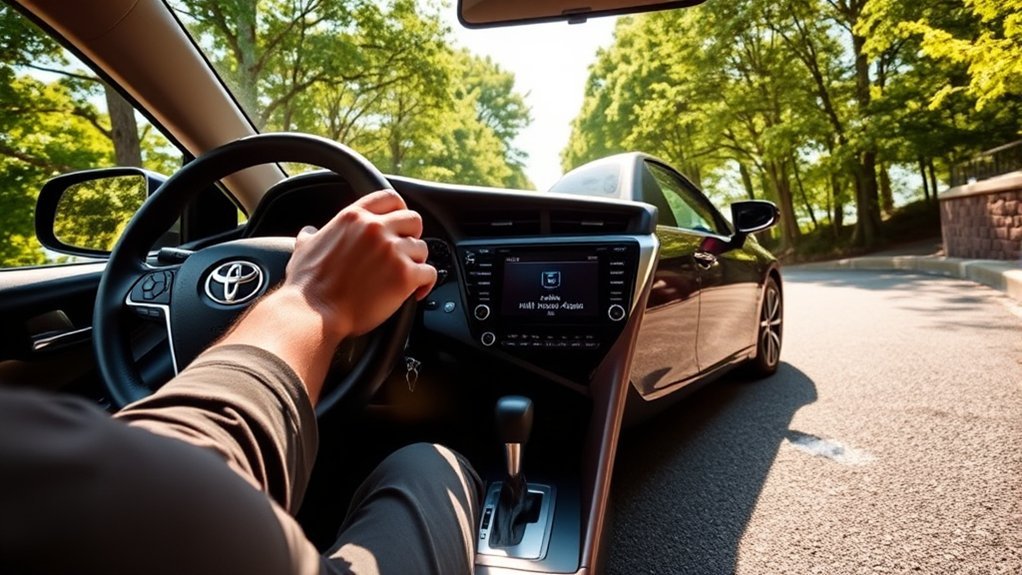
Once you have confirmed how HAC operates on your model year, the normal hill-start sequence is simple:
- Stop completely. Hold the Camry in place with the brake pedal rather than balancing the vehicle with the accelerator.
- Keep the correct drive range selected. For a normal forward uphill start, this will usually be Drive or another forward drive range permitted by your manual.
- Activate HAC if your model requires it. Some older Camry Hybrid models require an additional firm brake press. Newer systems generally operate automatically when their conditions are satisfied.
- Release the brake and move promptly to the accelerator. On recent U.S. Camry manuals, HAC assistance ends after a maximum of about two seconds following brake release, or sooner when a cancellation condition occurs.
- Apply the accelerator smoothly. Do not wait for the car to roll before adding normal drive force.
- Reapply the brake if the vehicle does not respond as expected. Do not add excessive accelerator input or assume the system will continue holding the car.
HAC gives you a brief transition window; it does not lock the vehicle in place.
How to Activate HAC in Your Toyota Camry
How Does Automatic HAC Work on Newer Camrys?
On newer Camrys, including the 2025 U.S. Camry, HAC is integrated into the vehicle’s brake and stability-control systems. There is no separate HAC button in the center console.
For the 2025 U.S. Camry, Toyota lists the following operating conditions: the vehicle is stopped; the shift position is other than P or N when starting forward or backward on an upward incline; the accelerator is not depressed; the parking brake is not engaged; and the power switch is ON.
- Stop fully on the incline with the brake pedal depressed.
- Keep the appropriate drive range selected and the parking brake released when you are ready to leave.
- Keep the accelerator pedal released until you are ready to start moving.
- Release the brake pedal.
- Press the accelerator smoothly and without unnecessary delay.
The system can retain braking force briefly while drive force develops. The 2025 U.S. Camry manual specifies a maximum of about two seconds after brake-pedal release. You may notice a small change in brake feel or an operating sound, but you should not wait for a universal HAC beep or dedicated HAC lamp unless your owner’s manual specifically describes one.
Some Older Camry Hybrid Models
The 2013 Camry Hybrid owner’s manual documents a different activation procedure:
- Bring the vehicle to a complete stop.
- Further depress the brake pedal to activate HAC.
- Listen for one buzzer sound and look for the slip indicator to flash.
- Release the brake and begin accelerating within approximately two seconds.
On that documented system, HAC cancels if the driver does not attempt to move within about two seconds, shifts to Park, applies the parking brake, or depresses the brake pedal again. Do not automatically apply this older firm-brake procedure to another Camry model year.
Pro Tip: Practice only on a gentle, quiet incline with a clear area behind the vehicle. Have your foot ready to return to the brake immediately. Never perform a deliberate HAC test in traffic, on ice, or close to another vehicle.
What Problems Might You Face When Activating HAC?
| Symptom | Possible reason | What to do |
|---|---|---|
| No beep or dedicated HAC light | Your Camry may use automatic HAC and may not provide the older activation feedback. | Do not keep pressing harder just to trigger a beep. Check the exact model-year manual; recent Camry systems can operate automatically without the older activation confirmation. |
| Vehicle begins rolling | The slope may be outside the system’s effective range, assistance may have timed out, or an operating condition may not be satisfied. | Reapply the brake immediately and restart the hill-start procedure. |
| HAC does not seem to engage | The vehicle may not be fully stopped, the parking brake may be applied, the accelerator may already be depressed, or the wrong drive range may be selected. | Stop fully, hold the brake, confirm the gear selection, keep off the accelerator, and follow the exact manual procedure. |
| ABS, VSC, TRAC, slip, or brake warning remains on | A related brake or stability-control system may have a fault. | Do not rely on HAC. Follow the displayed warning and arrange inspection by a qualified Toyota technician. |
| Unsure whether HAC works in Reverse | Operation depends on the model year, slope direction, transmission range, and other operating conditions. | Newer U.S. Camry manuals describe operation when starting forward or backward on an upward incline. Verify the exact manual before relying on that behavior in another generation. |
If the brake pedal feels abnormal, braking performance is reduced, warning messages remain displayed, or the vehicle rolls more than expected, use the service brake and have the system inspected. HAC has no separate maintenance procedure, but it depends on properly operating brake, ABS, stability-control, and traction-control components. For warning-light context, see the Toyota Camry brake system warning-light guide.
HAC vs. Brake Hold vs. the Parking Brake
These three systems can all prevent or reduce vehicle movement, but they are designed for different situations.
| System | Main purpose | Typical use |
|---|---|---|
| Hill Start Assist Control | Briefly reduces rollback during the transition from brake to accelerator. | Starting from a complete stop on an incline. |
| Brake Hold | Keeps the service brakes applied after a complete stop while the system is enabled. | Traffic lights, queues, and stop-and-go driving. Confirm the operating indicator before removing your foot from the brake. |
| Parking brake | Secures the parked vehicle and can provide controlled holding support when required by the owner’s manual. | Parking or holding the vehicle for longer than a brief start. |
The 2025 Camry Quick Reference Guide describes a separate Brake Hold switch and operating indicator. Do not mistake that feature for HAC. For the full switch procedure, see how to use Brake Hold on a Toyota Camry. For longer-term vehicle securing, see how to use the Camry electric parking brake.
Key Benefits of HAC for Hill Starts

When its operating conditions are satisfied, HAC can:
- Reduce backward movement while the driver transfers from the brake to the accelerator.
- Make a normal uphill start smoother and more controlled.
- Reduce the need to rush between pedals.
- Assist on an incline without requiring the driver to balance the car using excessive accelerator input.
HAC does not increase tire grip, guarantee that the car will remain stationary, or control the vehicle indefinitely. Its value comes from providing brief assistance while the driver performs an otherwise normal hill start.
Does a Toyota Camry Have Downhill Assist Control (DAC)?
Hill Start Assist Control and Downhill Assist Control solve different problems. However, you should not assume that a Toyota Camry has DAC simply because it has HAC. The 2025 Camry guidance instead describes selectable shift ranges and S mode for controlling engine-braking force on descents.
| Feature | HAC | DAC |
|---|---|---|
| Purpose | Reduces rollback while starting on an incline. | Controls an equipped vehicle’s speed during a steep, low-speed descent. |
| When it works | From a complete stop during a hill start. | While descending, within the equipped model’s operating range. |
| Activation | Automatic on newer systems; an extra brake press is required on some older systems. | Normally uses a dedicated control on Toyota vehicles equipped with DAC. |
| Camry availability | Available on many Camry configurations, subject to model-year confirmation. | Do not assume it is installed. The 2025 Camry guide does not list a DAC switch. |
Toyota describes DAC as controlling braking to maintain a low descent speed on equipped vehicles. That is different from selecting a lower transmission range or using S mode for additional engine braking.
When Should You Use HAC Instead of DAC?
Ideal Usage Scenarios
Use HAC when the Camry is stopped on an incline and you are ready to drive away. It is designed for the brief transition in which the vehicle could otherwise move backward while your foot travels from the brake to the accelerator.
Use DAC only if the vehicle is actually equipped with it and the owner’s manual documents its controls and operating conditions. Do not treat a Camry without documented DAC equipment as though it has the system.
For downhill driving in a 2025 Camry, Toyota explains that selecting lower ranges in S mode can increase engine-braking force. Choose the range gradually, avoid abrupt shifting on slippery surfaces, and continue to use the service brake as conditions require.
Key Functional Differences
- HAC starts from a stop. It provides a brief brake-force transition while you begin moving.
- DAC manages a descent. On equipped vehicles, it actively controls low-speed downhill travel.
- S or B mode is not DAC. Transmission selections can increase engine or regenerative braking but do not create a DAC system.
- Neither system replaces the driver. Road grip, speed, vehicle loading, weather, and slope still determine how much control is available.
Frequently Asked Questions
How do I use Hill Start Assist in a Toyota Camry?
Stop completely on the incline and keep the brake firmly depressed. On a newer Camry, confirm that the required operating conditions are met, release the brake, and apply the accelerator smoothly. On some older Camry Hybrid models, you must first press the brake farther until a buzzer sounds and the slip indicator flashes.
How do I activate Hill Hold Assist?
Activation depends on the model year. Newer Camry HAC systems normally operate automatically when the vehicle is stopped, the proper drive range is selected, the accelerator is not pressed, the parking brake is released, and the other manual conditions are met. Some older Camry Hybrid systems require an additional firm brake press.
How does Hill Start Assist Control work?
HAC temporarily retains braking force after the driver releases the brake pedal. This gives the driver a brief opportunity to apply the accelerator and develop enough drive force to move uphill with less rollback.
How long does Toyota Camry Hill Start Assist hold the brakes?
Recent U.S. Camry manuals specify a maximum of about two seconds after the brake pedal is released. Older procedures and other markets can differ, so use the owner’s manual for your exact Camry rather than treating two seconds as a worldwide specification.
How do I know whether Hill Start Assist is operating?
Feedback varies. Some older Camry Hybrid systems sound one buzzer and flash the slip indicator when activated. Newer systems may operate without a dedicated HAC confirmation. Use the procedure in your owner’s manual rather than relying on a universal light or sound.
Is Brake Hold the same as Hill Start Assist?
No. HAC briefly reduces rollback while you start on a hill. Brake Hold is a separate driver-selected system that can keep the service brakes applied after a complete stop until you press the accelerator or the system otherwise cancels.
Does Hill Start Assist work in Reverse?
Newer U.S. Camry manuals describe HAC operation when starting forward or backward on an upward incline as long as the other operating conditions are satisfied. That wording should not be assumed to apply to every older Camry generation, so check the exact model-year manual before relying on reverse assistance.
Conclusion
Hill Start Assist can make a Toyota Camry easier to start on an incline, but the correct procedure depends on the vehicle. Recent Camrys generally provide assistance automatically when their operating conditions are satisfied, while some older Camry Hybrid models require an extra firm brake press. Treat HAC as brief support only: move smoothly from the brake to the accelerator, reapply the brake if the vehicle behaves unexpectedly, and use Brake Hold or the parking brake for their intended purposes.
Sources
- Toyota 2025 Camry Interactive Owner’s Manual — Driving Assist Systems — current HAC purpose, operating conditions, cancellation timing, warnings, and limitations.
- Toyota 2013 Camry Hybrid Owner’s Manual — older firm-brake activation, buzzer, slip-indicator, cancellation, and safety instructions.
- Toyota 2025 Camry Quick Reference Guide — Brake Hold operation and S-mode/downhill driving guidance.
- Toyota USA Newsroom — Anti Lock Braking — general Toyota explanations of HAC and DAC brake-control operation.
